We Help International Investors and Project Owners Deliver Major CEE Projects Without Expensive Surprises
Independent project intelligence and advisory across energy, transport, real estate and industrial construction.
Webuild Is Buying Its Own Foundation Crew. Why a 44.99% Trevi Stake Changes Tunnel Bidding
Webuild now holds 44.99% of Trevi, the Italian ground engineering specialist, and its cash offer for the rest closes on 20 November. Owning the crew that digs the shafts and station boxes moves margin, capacity and delay risk inside one group, and changes the field for every rival bidder on underground work.
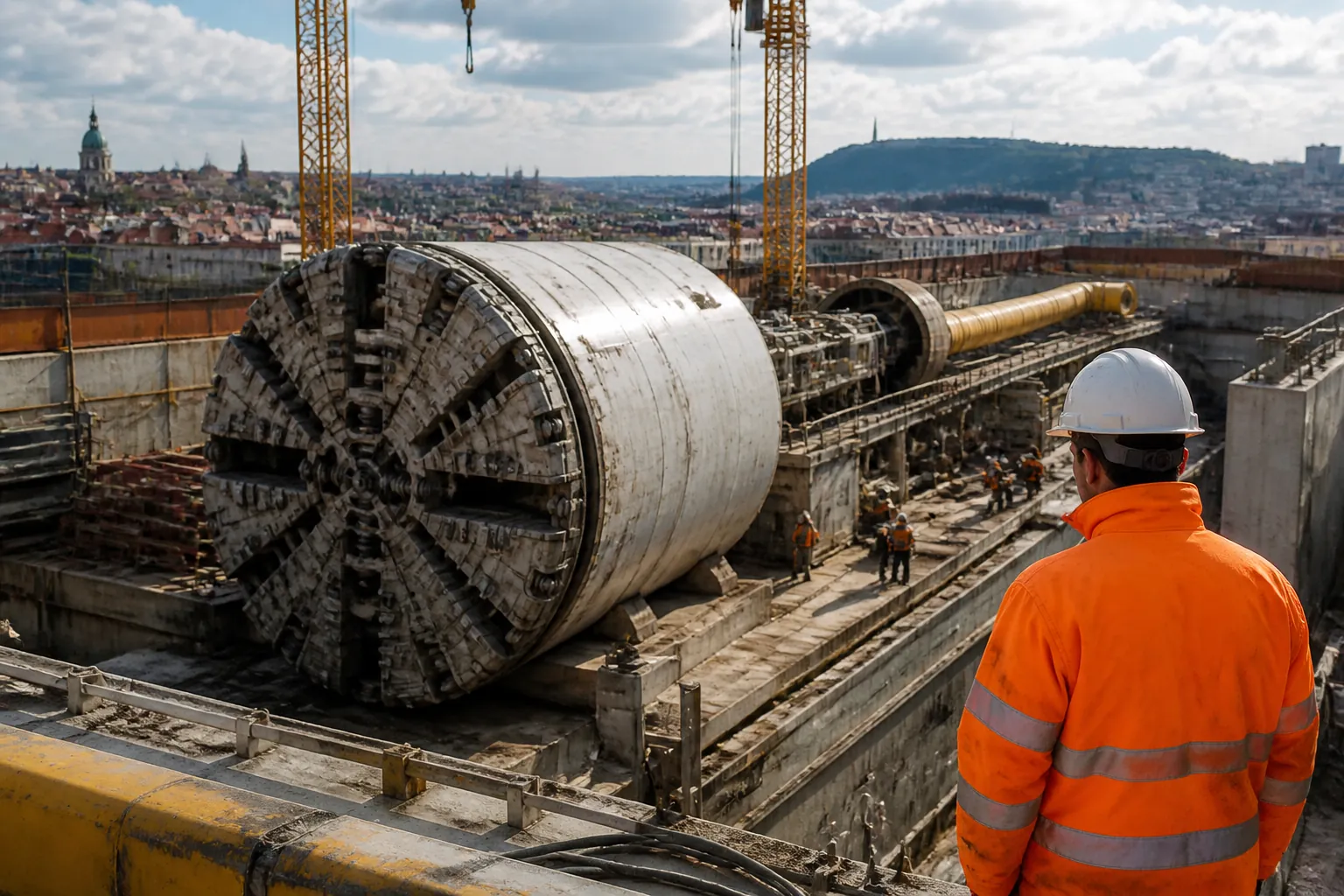
If I ran a European tunnel programme, I would add one line to every bid review. Who owns the foundation crew? On large underground jobs, that answer now decides more than the headline price.
On 13 November, Webuild raised its holding in Trevi to 44.99%, according to Teleborsa. Its cash tender offer for the remaining shares closes on 20 November. Italy's largest general contractor is about to control one of Europe's best-known foundation specialists.
The price shows how much Webuild wanted it. The original offer was 4.50 euros a share. Webuild raised it to 5.165 euros in October. That followed a competing share-exchange bid from Icop, a rival builder (MF Milano Finanza). Icop has since stepped back, leaving Webuild as the only buyer in the race.
What Webuild is actually buying
Trevi does the work that has to happen before a tunnel or a viaduct can start. It drills piles, builds diaphragm walls and treats unstable ground. Its Soilmec division makes the heavy drilling rigs that do this work. Trevi's order backlog reached 854 million euros at the end of September (Il Resto del Carlino, 14 November). That is 26% higher than a year earlier.
That matters because specialist ground capacity is scarce. A general contractor can hire labour and lease cranes within weeks. It cannot quickly hire a crew that has built deep diaphragm walls beneath a working city centre. Those crews take years to form, and the rigs are built to order.
Webuild is buying capacity and know-how that the open market cannot supply at short notice. The share price is the cheapest part of that purchase. The expensive part would be trying to build the same team from scratch.
Why ground work sits on the critical path
Ground work comes first on almost every underground job. Shafts, station boxes and portals must be dug and supported before a tunnel boring machine can launch. Any delay there pushes back every activity behind it.
Here is why that changes the economics. Under a design-build contract, the main contractor usually carries most ground risk once the baseline report is agreed. If the specialist subcontractor runs late, the main contractor pays the client's delay damages. The subcontractor's own liability is usually capped well below that exposure.
Owning the specialist closes the gap between the party that causes a delay and the party that pays for it. The group can move crews and rigs between its own sites by priority. It no longer has to negotiate for them against other main contractors.
Where the margin goes
Webuild has said what it expects to gain. It puts run-rate synergies at 80 to 90 million euros of EBITDA a year (Forbes Italia). EBITDA is earnings before interest, tax, depreciation and amortisation. Its stated logic is that high-value work now outsourced will come in-house.
The reason is simple. On a large tunnel, a main contractor pays its foundation subcontractor a full price. That price includes the specialist's profit and its own risk contingency. Inside one group, the contingency can be held once, and the profit stays in the group.
The deal is small against the platform it serves. The maximum cash outlay for the offer was about 275 million euros, per MF Milano Finanza. In its nine-month update on 12 November, Webuild reported 11.1 billion euros of new orders. Its short-term commercial pipeline stands at 99.3 billion euros.
A foundation business that is small in group terms can set the pace on a large share of that pipeline. Webuild says about three quarters of this year's orders came from what it calls low-risk geographies. Its named awards sit mainly in Italy, North America and Australia.
What changes for rival contractors and clients
Trevi has long worked as an independent specialist. An independent specialist sells to every main contractor bidding a job. A captive one answers first to its parent.
That matters because large tunnel tenders often draw the same few bidders. If one bidder owns scarce ground capacity, its rivals must source it elsewhere. That usually means a higher price, a later start or a less experienced crew.
The mechanism is quiet. Nobody is refused outright. The captive crew is simply booked on its parent's jobs first, and outside quotes arrive later and dearer.
Clients face a matching risk. A procurement authority that wants several real bids may need to check subcontractor commitments at prequalification. Otherwise the field can look wide on paper and narrow in practice.
Cassa Depositi e Prestiti, the Italian state investment bank, holds 21.3% of Trevi (Il Resto del Carlino). Its choice on the offer will shape whether Webuild ends up with full control or a shared one. The independent model is now off the table. Icop had pitched a combined foundations group with a backlog above 2.2 billion euros (Forbes Italia). That group would have stayed open to all bidders.
My read: European contractors will start buying their bottlenecks
I expect at least one more large European contractor to buy or tie up a ground engineering specialist before the end of 2027. That happens because capacity is the binding constraint in this cycle. When the scarce input is a crew, the contractor who owns it wins the schedule argument at tender.
The figure that would change my call is Trevi's third-party order intake once it sits inside Webuild. If outside orders hold at today's pace, the specialist stays open to the market and rivals lose little. If they fall sharply over the next year, the captive model has won, and others will copy it.
For clients and rival bidders, the foundation crew has become part of the competition. Bid teams should now price it as such.
Share it with your peers
Help your network stay ahead of CEE capital projects.
Strategic Insights
📊 Analytics & Strategic Insight
The scarce input on underground work is the crew, and Webuild is buying it
The decision most in this industry are avoiding:
👉 Subcontract liability caps are the real gap in most ground risk registers. Main contractors book ground risk as their own, then rely on specialists whose exposure is capped far lower. Integration exposes how much of that risk was never truly passed down.
👉 The drilling rig maker matters as much as the crews. A contractor that owns rig production can see which rivals are ordering equipment and when. That is market intelligence a buyer of rigs never gets.
👉 Clients may end up paying for integration twice. They gain one accountable party on ground work. They can also lose a bidder, because rivals without their own crews may decline to bid at all.
Here's the full context:
→ July 2026: Webuild launches a cash tender offer for Trevi at 4.50 euros a share (Adnkronos).
→ September 2026: Icop raises its competing share-exchange offer for Trevi (Forbes Italia, 30 September 2026).
→ October 2026: Webuild lifts its offer to 5.165 euros and buys 13.9% of Trevi from funds (MF Milano Finanza).
→ 12 November 2026: Webuild confirms 2026 guidance. It excludes the Trevi offer and already absorbs the end of its NEOM work (Webuild).
→ Most recent: On 13 November 2026, Webuild reaches 44.99% of Trevi, with the offer closing on 20 November (Teleborsa).
What this means for infrastructure operators, contractors and investors:
✅ Rival bid teams need a second source for ground engineering now. Framework terms agreed before the next large tunnel tender are cheaper than spot quotes during it. Lock in a specialist partner while capacity is still being shared.
✅ Procurement authorities should ask for named ground subcontractors at prequalification. A firm commitment shows whether each bidder can actually start the shafts on time. It also keeps the competition real.
✅ Equity investors should track external revenue at the acquired specialist. Synergies come from in-house work, yet outside clients may drift away. The net result decides whether the deal adds value or simply moves it.
3 moves you can make this week:
1️⃣ List the ground engineering firms on your live bids. Mark which ones are independent and which belong to a rival group. Gaps on that list are your schedule risk.
2️⃣ Read the liability cap in your foundation subcontracts. Compare it with the delay damages you owe the client. The difference is risk you are carrying without pricing it.
3️⃣ Ask your rig suppliers about delivery slots. Find out how far ahead large piling and diaphragm wall rigs are booked. Reserve equipment for next year if a programme depends on it.
The analyst's read:
This proves that Webuild values owned ground engineering capacity above buying it job by job. It does not prove that integration lowers the final cost of a tunnel for the client. The figure that settles it is Trevi's order intake from outside clients in its first full year inside the group.
Related analyses
- Transport & Infrastructure
Budapest Swaps Its Unpaid Rákosrendező Land Bill for State Equity. The 800 Million Euro Rail Package Now Sets the Clock
Budapest and the Hungarian government have agreed to turn the unpaid balance on the Rákosrendező rail yard into a state stake in a joint project company. The deal fixes the city's balance sheet, but the railway works the state must fund now decide when the first homes can start.
Read analysis → - Transport & Infrastructure
Romania's A7 Bacău-Pașcani Opens Only 30 km This Year as Grant Money Stops Before the Build Ends
Romania's transport ministry now expects only 30 km of the A7 Bacău-Pașcani motorway to open this year, out of 77 km once planned. Recovery funding stopped paying for the works on 31 August, so the remaining lots wait on the state budget and on where the single contractor group puts its crews.
Read analysis → - Transport & Infrastructure
Port Polska's EUR 1.5 Billion EIB Appraisal Puts the Terminal Contract on Trial
The European Investment Bank has admitted Poland's new airport to appraisal for up to EUR 1.5 billion, just as CPK concedes its EU grant assumption looks too optimistic. The terminal tender now has to produce a contract that lenders will accept.
Read analysis →
Get a second opinion before it gets expensive.
Contractor selection, tender strategy, a project drifting off track — send us the situation and we'll come back with a clear plan.