We Help International Investors and Project Owners Deliver Major CEE Projects Without Expensive Surprises
Independent project intelligence and advisory across energy, transport, real estate and industrial construction.
Romania's A7 Bacău-Pașcani Opens Only 30 km This Year as Grant Money Stops Before the Build Ends
Romania's transport ministry now expects only 30 km of the A7 Bacău-Pașcani motorway to open this year, out of 77 km once planned. Recovery funding stopped paying for the works on 31 August, so the remaining lots wait on the state budget and on where the single contractor group puts its crews.
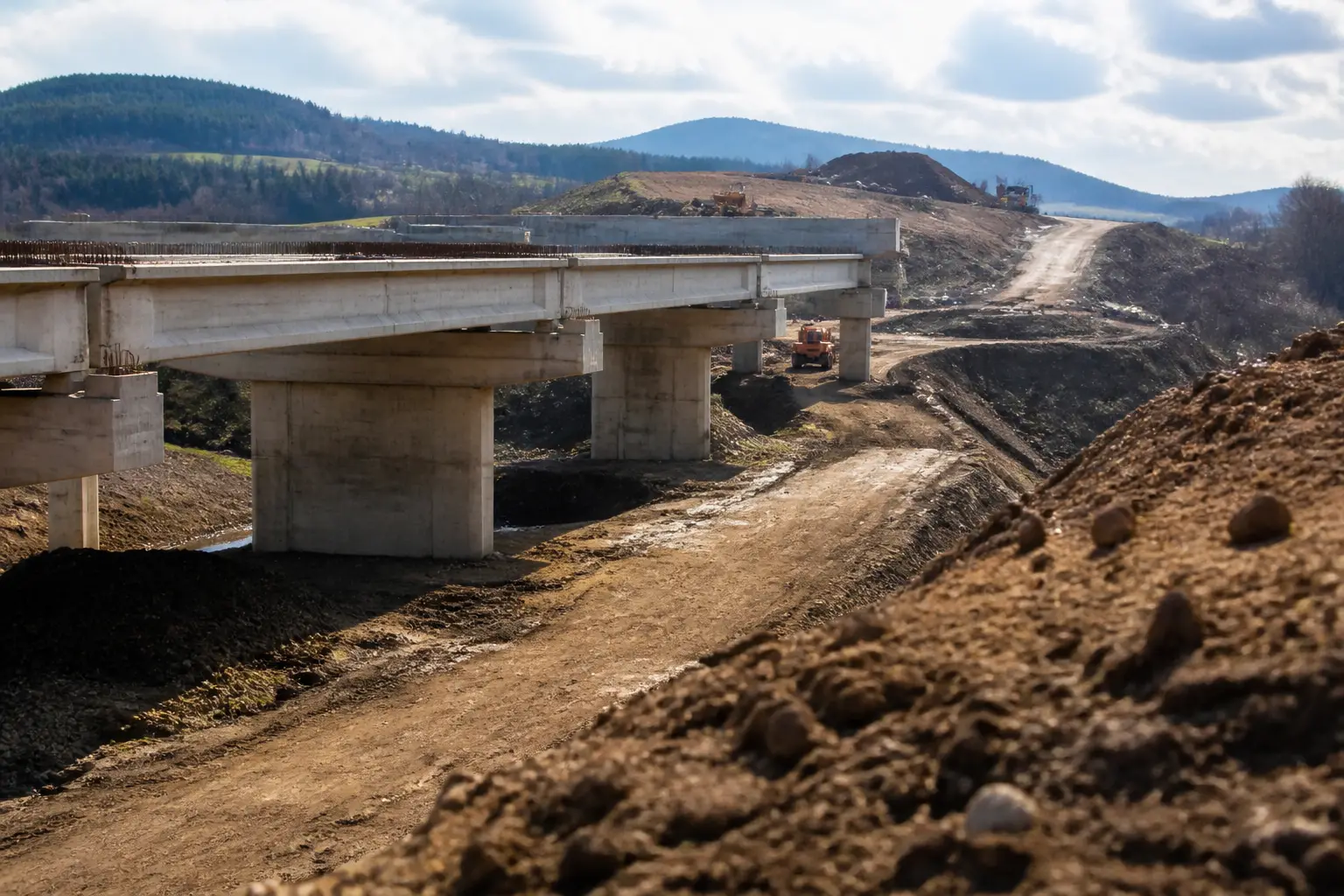
I keep seeing the same ending when a grant deadline passes in the middle of a build. The works carry on. The payer changes, and the opening date starts to follow the new payer. On 24 November Romania's transport minister said only 30 km of the Bacău-Pașcani A7 opens this year.
Minister Ștefan Ovidiu Popa gave the new calendar on a site visit, the business daily Puterea reported. The first stretch runs from Bacău to Roman Sud. The next 19 km, to Mircești, should follow in early 2027. The full 77 km section reaches Pașcani after mid-2027. Earlier this year the target for 2026 was the whole section. The road authority CNAIR has said the same thing in its own words. Its director general wrote that the calendar depends on two things, the weather and the money.
Three lots that were due in November 2025
The A7 is the Moldova motorway, the main north-south route through Romania's north-east. The Bacău-Pașcani section was split into three lots. All three were signed in early 2023 with a 30-month build term. Every lot was due in November 2025, a year before the date now promised for the first one.
CNAIR's director general, Cristian Pistol, put progress this week at 83% for lot 1. Lot 2 stood at 70% and lot 3 at 62%. These are physical progress figures, measured on site. That matters because physical progress is what opens a road. A lot at 83% can be finished in a few weeks of dry weather. A lot at 62% still needs a full construction season, with bridges and interchanges still open.
The payer changed on 31 August
The money behind the timetable changed this autumn. The Recovery and Resilience Facility (RRF) is the EU recovery fund, run in Romania as the PNRR. It paid for work on these lots only up to 31 August 2026. Work done after that date needs money from the state budget. CNAIR told the news site Economedia in October that it had asked the government for the sums. It has not published the amount.
Adrian Covăsnianu leads the civic group Moldova Vrea Infrastructură. He told Ziare that CNAIR needs more than 187 million euro (1 billion lei) for the three lots. Conversions use the latest European Central Bank reference rate, about 5.35 lei per euro. A grant pays against a fixed deadline, while a budget pays against a yearly appropriation. That is the mechanism. Once the deadline passes, every invoice needs a budget line that someone has approved. A contractor then paces its crews to the cash it can see. Lots 1 and 2 were also moved twice between the grant and loan parts of Romania's plan, Economedia reported. Each move changed which pot paid which invoice.
One contractor group holds all three lots
All three lots sit with the UMB group of Bacău. It works through Spedition UMB and its sister firms SA&PE Construct and Tehnostrade. Together the contracts are worth about 874 million euro (4.68 billion lei) before VAT.
That concentration explains the 30 km. A single builder on three lots can move crews to the lot nearest completion, and lot 1 is that lot. Here is why it does so. A finished lot opens to traffic and closes most of its risk. Three lots that are nearly finished open nothing at all. The minister counted more than 1,200 workers across the first two lots, HotNews reported.
The same logic shapes what the client can do. With one builder on the whole section, CNAIR has no second contractor to compare pace against. It also has no one else to call if the group slows the lot it values least.
Who carries the delay under the contract
The cause of each delay now decides who pays for it. CNAIR's motorway contracts are based on FIDIC conditions. Under those terms, a delay caused by the client can earn the contractor more time and sometimes costs. A delay caused by slow mobilisation earns delay damages instead. That matters because the money follows the label on each delay.
Covăsnianu named both kinds. He listed slow mobilisation at some stages and complex structures. He also listed funding uncertainty after the recovery money ended. The funding gap can only explain delay after 31 August, because the lots were already late before it opened. That is our reading of the timeline, and it matters at the final account. The months between the contract deadline and the end of the recovery money sit outside the funding argument.
The group itself can carry a short gap. The reason is simple. The financial daily ZF reported combined 2024 revenue of about 2.67 billion euro (14.3 billion lei) for the three firms. On that scale the gap Covăsnianu cites is less than a month of billing. The pressure sits lower down, with subcontractors and suppliers paid from the same cash.
The analyst's read: Roman Sud within weeks, Pașcani late
My call is that the stretch to Roman Sud opens around the turn of the year. A few weeks of weather either way is normal. Mircești slips from early 2027 into spring. Pașcani lands in the second half of 2027. That happens because of the funding sequence. Romania's 2027 budget will be set before lot 3's main summer season. If the budget line covers the gap, crews stay. If it falls short, the group finishes lot 2 first and slows lot 3.
The figure that settles it is the sum CNAIR receives for the A7 in the 2027 budget. A line at or above the gap Covăsnianu cites keeps Pașcani in 2027. Anything well below it pushes the last lot toward 2028.
Which Romanian contractors can carry a gap like this for a season, and which need every invoice paid on time? Spare cash, order books and payment exposure decide who keeps crews on site when the payer changes. Our CEE Contractor League Table and Financial Health Monitor is being built to answer that, contractor by contractor. It is in preparation, and you can join the waitlist to hear when it is published.
Share it with your peers
Help your network stay ahead of CEE capital projects.
Strategic Insights
📊 Analytics & Strategic Insight
The grant deadline set the price of delay. The state budget now sets the opening date.
The decision most in this industry are avoiding:
👉 The opening date has become a budget document. Engineers can say when a lot is buildable. Only the finance ministry can say when it is paid for, and the second answer now governs the first.
👉 The funding gap is a convenient story for both sides. It lets the client explain a missed calendar and lets the builder reframe earlier slippage. The final account will separate the two, and that is where the money moves.
👉 A headline opening can hide a slower whole programme. Moving crews to the lot nearest completion produces a ribbon-cutting. It can also leave the hardest structures on the last lot for the season when money is least certain.
Here's the full context:
→ 2023: CNAIR signs all three Bacău-Pașcani lots with the UMB group, each with a 30-month build term.
→ November 2025: The contractual deadline for all three lots passes with the road unfinished.
→ 31 August 2026: PNRR recovery financing for work on the lots ends; later work needs state budget money.
→ October 2026: CNAIR asks the government for budget funding and says lot 1 depends on money and weather.
→ Most recent: On 24 November 2026 the minister says 30 km to Roman Sud opens this year and Pașcani after mid-2027.
What this means for infrastructure operators, contractors and investors:
✅ Project boards on other recovery-funded roads should list every invoice dated after the cut-off. Those invoices now compete for the national budget, and the board needs the total before the budget is drafted.
✅ Subcontractors to a single prime contractor should check their payment terms now. When the prime stretches its cash, the delay usually lands one tier down first.
✅ Lenders' technical advisers should split delay by cause. Delay before the funding cut-off and delay after it carry different claim value, and the split decides who carries the cost.
3 moves you can make this week:
1⃣ Pull the physical progress figure for each lot on any programme you track. Rank the lots by how close they are to opening, because that is where crews will go.
2⃣ Ask the client which budget line pays after the grant deadline. If no one can name it, add a funding slip to your own schedule.
3⃣ Read the delay notices in your own contracts. Make sure each one names its cause, because the cause decides time, cost and damages.
The analyst's read:
This calendar proves that the end of recovery money has slowed the last part of the A7. It does not prove that funding caused the whole delay, because the lots were late long before the money stopped. What settles it is the size of next year's budget line for the road, and whether lot two is finished before the summer season.
CEE Capital Projects reports
📋 Coming next
CEE Contractor League Table and Financial Health Monitor, now in preparation. Awards, order books and financial health across CEE contractors. Join the waitlist to hear when it is published.
→ Join the waitlist
⚡ CEE Grid Procurement Pipeline 2027-2030
Contract opportunities, suppliers and bid risk in electricity transmission and distribution across 19 markets. PDF report plus interactive Excel database, with awards since 2020 and named packages to 2030.
→ See the report and free sample
🚆 CEE Rail Build-Out 2027-2030
Rail tender pipeline to 2030, awards since 2020, contractor capacity and bid risk across 17 markets. PDF report plus interactive Excel database, one row per tender lot.
→ See the report and free sample
Related analyses
- Transport & Infrastructure
Budapest Swaps Its Unpaid Rákosrendező Land Bill for State Equity. The 800 Million Euro Rail Package Now Sets the Clock
Budapest and the Hungarian government have agreed to turn the unpaid balance on the Rákosrendező rail yard into a state stake in a joint project company. The deal fixes the city's balance sheet, but the railway works the state must fund now decide when the first homes can start.
Read analysis → - Transport & Infrastructure
Port Polska's EUR 1.5 Billion EIB Appraisal Puts the Terminal Contract on Trial
The European Investment Bank has admitted Poland's new airport to appraisal for up to EUR 1.5 billion, just as CPK concedes its EU grant assumption looks too optimistic. The terminal tender now has to produce a contract that lenders will accept.
Read analysis → - Transport & Infrastructure
Czech Road Bids at 76% of Estimate: Why Indexation and Land Send the Discount Back to ŘSD
Czech road tenders keep landing a fifth or more below estimate, with even a sole bidder on the D6 at 80%. Indexation clauses, local asphalt plants and unfinished land purchases mean part of that discount returns to the client at the final account.
Read analysis →
Is your project leaking money through its subcontractors?
Most owners lose 3–8% in vendor packages without noticing. Tell us about your project — we'll tell you where we'd look first.