We Help International Investors and Project Owners Deliver Major CEE Projects Without Expensive Surprises
Independent project intelligence and advisory across energy, transport, real estate and industrial construction.
Czech Road Bids at 76% of Estimate: Why Indexation and Land Send the Discount Back to ŘSD
Czech road tenders keep landing a fifth or more below estimate, with even a sole bidder on the D6 at 80%. Indexation clauses, local asphalt plants and unfinished land purchases mean part of that discount returns to the client at the final account.
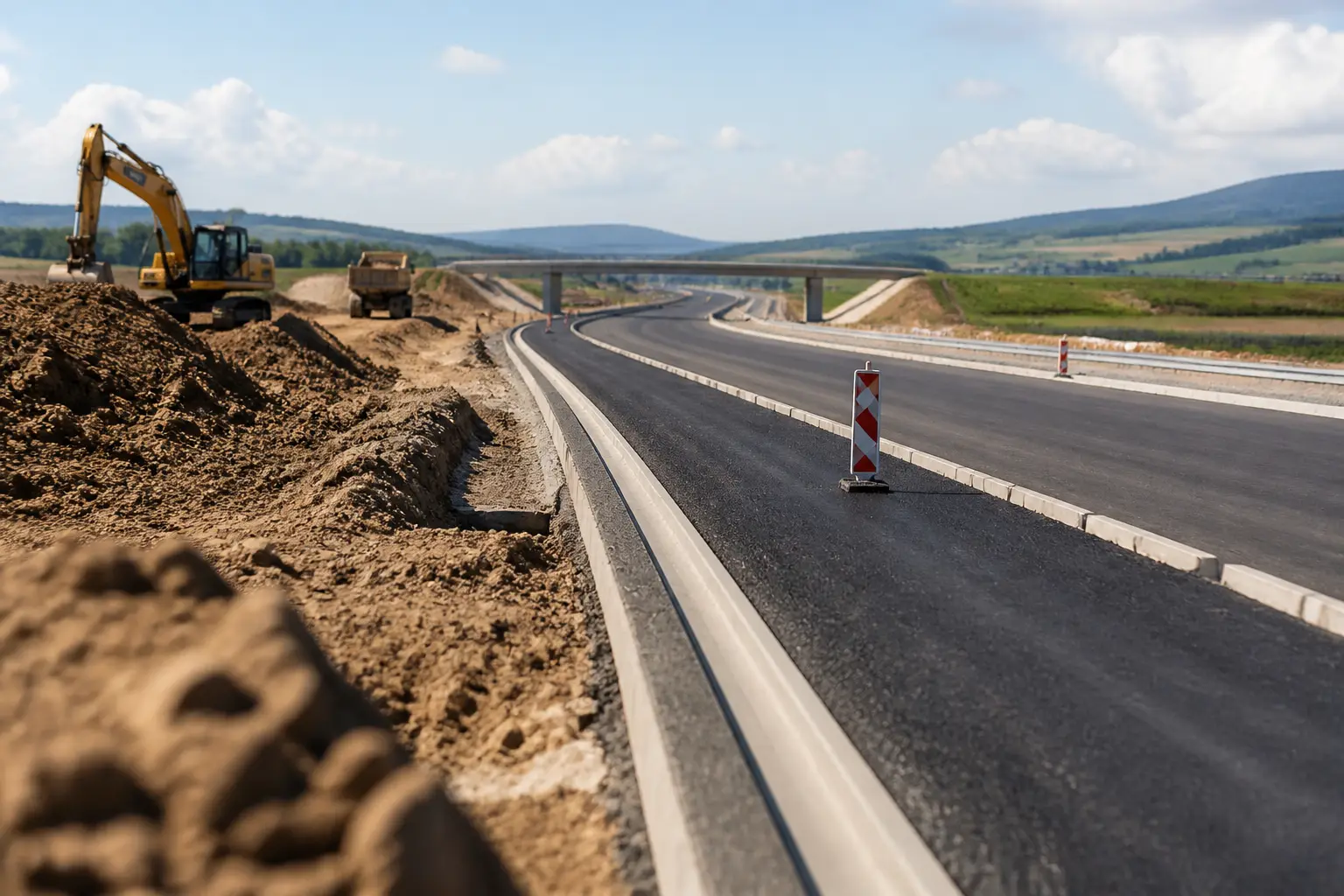
If I ran the Czech road programme, I would audit the estimates before I banked the savings. A discount of a quarter is good news only if the estimate was right. This month the road authority ŘSD signed a 7.3 km stretch of the D6 at 76% of its estimate.
The winner is a consortium of Eurovia CZ, Stavby mostů, MI Roads and Berger Bohemia. Five groups bid, the transport news site Zdopravy reported on 12 November. The price is about 95 million euro (2.31 billion koruna) before VAT. Conversions use the latest European Central Bank reference rate, about 24.4 koruna per euro. A day earlier ŘSD and the city of Pardubice signed a bypass at 79.2% of estimate. These results are now the normal run of Czech road tenders.
A year of bids well below the estimate
The pattern has held all year. In July the ŘSD director general, Radek Mátl, gave examples on a Zdopravy podcast. The Úlibice bypass on the D35 came in at 75% of estimate. A repair of the D11 between Poděbrady and Sadská came in at 56%. He said the savings would let ŘSD deliver about 16 extra projects this year.
That matters because ŘSD spends against a fixed yearly budget. Every koruna saved on one lot funds the next lot on its reserve list. ŘSD tenders that reserve list in parallel, so the extra work is already moving. The savings have already been spent, on more projects.
Why the builders can price this low
Mátl gave his reasons in the same interview. ŘSD builds its estimates from a standard price list for road works. The State Fund for Transport Infrastructure (SFDI) issues it. Bids then reflect each firm's spare capacity, its material purchasing, its subcontracts and how close it has an asphalt plant. He said a low price in no way means the winner has underpriced the work.
His third reason carries the most weight. Czech road contracts include an indexation clause. It adjusts the price for movements in input costs after signing. Here is why that changes the bid. A fixed-price bidder must add a premium for inflation it cannot see. With indexation, the client pays that inflation later, through the formula.
The risk premium has moved out of the bid and into ŘSD's future budget. On our reading, part of the discount comes from that move. The estimate still prices a risk that the contract no longer leaves with the builder.
One bidder, and still a fifth below
The most telling result came in April. It was on the neighbouring D6 section from Karlovy Vary to Olšová Vrata. The same consortium was the only bidder. It still bid about 141 million euro (3.44 billion koruna). That was 80% of an estimate of about 176 million euro (4.3 billion koruna), Zdopravy reported.
A sole bidder has no rival to undercut. Mátl said the result could reflect the location and the firms' local base. The mechanism is the asphalt plant. Hot asphalt must be laid within hours of mixing. A firm with a plant nearby has a cost advantage. A distant rival cannot close it by bidding harder.
A sole bid a fifth below estimate says the estimate has room in it. It also says the local plant decides who competes. Czech road lots behave like regional markets. The winners are often the groups already established in that region.
The land is the risk ŘSD still carries
The low price is only half the contract. The other half is the site. On the Žalmanov section, completion has already moved from 2028 to 2029. In September ŘSD had settled about 80% of the permanent land it needs, Zdopravy reported. Part of the rest is going through expropriation. Two opponents have also sued at the regional court in Ostrava over the permit.
That matters because handing over the site is the client's duty under FIDIC-style road contracts. If land is not ready, the builder claims extra time and cost. The indexation clause then adds a second effect. Work built later is paid at later prices, through the same formula. Each month of land delay can add a claim and a later index date to a cheap contract.
None of this means the winning bids are wrong. It means the price signed today is a starting point. The outturn depends on how fast ŘSD clears the land.
A record budget will test the discount
The money is rising. In September the government approved a record SFDI budget for 2027 of about 7.5 billion euro (183.1 billion koruna). ŘSD's share rises about 7%, to about 3.6 billion euro (87 billion koruna). EU money supplies roughly a ninth of the fund. It comes mainly through the national transport programme, the Connecting Europe Facility and the Modernisation Fund.
The reason this matters is capacity. Discounts follow spare capacity. When firms have idle crews and plant, they bid close to the cost of keeping them busy. A larger budget fills that spare capacity. New D52 sections, part of the D55 and the Krnov and Opava bypasses are all due next year.
My read: the discount narrows in 2027
I expect winning bids to move closer to the estimate during 2027. That happens because the budget grows faster than builders can add crews, plants and bonding room. Bidders will then price the extra demand. The regional pattern will stay, because local plants still decide who can compete.
I also expect the cheapest contracts already signed to cost more at outturn than at signing. Land delay and indexation both push the final account up. Neither is a sign of bad bidding. Both are risks the contract leaves with ŘSD.
The figure that settles it is the bid-to-estimate ratio on the first D52 and D55 tenders of 2027. If winners land above about 85% of estimate, the discount is closing and capacity has become the constraint.
For anyone pricing Czech work, these awards show where the market sits today. Winning prices, bidder counts and regional strongholds decide which contractors grow. They also decide who carries thin margins into a busier year. Our CEE Contractor League Table and Financial Health Monitor is being built to track exactly that, contractor by contractor. It is in preparation, and you can join the waitlist to hear when it is published.
Share it with your peers
Help your network stay ahead of CEE capital projects.
Strategic Insights
📊 Analytics & Strategic Insight
The discount is signed at award. The cost of land and indexation arrives at the final account.
The decision most in this industry are avoiding:
👉 A bid far below estimate is often a verdict on the estimate. When a sole bidder still undercuts the client's own figure, competition did not create the gap. The estimate carried risks that the contract had already moved back to the client.
👉 Indexation makes cheap bids look cheaper than they are. The award price excludes the inflation the formula will pay later. Comparing award prices across countries with and without indexation compares different products.
👉 Regional strongholds are a market structure, and procurement rarely names them. Where one group owns the nearby asphalt plant, open tendering cannot create a real contest. The client should design lots and timing with that in mind.
Here's the full context:
→ April 2026: A single consortium bids for the D6 Karlovy Vary to Olšová Vrata section, at 80% of the estimate.
→ July 2026: The ŘSD director general says tender savings will fund about 16 extra projects this year.
→ September 2026: The government approves a record SFDI budget for 2027 of 183.1 billion koruna.
→ October 2026: The same consortium wins the five-bid D6 Žalmanov tender at 76% of the estimate.
→ Most recent: ŘSD signs the D6 Žalmanov and Pardubice bypass contracts in November, both well below estimate.
What this means for infrastructure operators, contractors and investors:
✅ Lenders and sureties should judge contractors on final accounts as well as awards. A record of cheap awards says little until the final accounts show what indexation and claims added back.
✅ Bid teams outside their home region should price the plant gap first. A firm without a nearby asphalt plant should know its haul cost before deciding whether a lot is worth the bid cost.
✅ ŘSD's budget planners should hold a reserve for index payments and land claims. Spending every saving on new lots leaves nothing for the cost that the contracts send back later.
3 moves you can make this week:
1⃣ Pull the bid-to-estimate ratios for your own region's recent road awards. Note the bidder count beside each one, so sole-bid discounts stand out.
2⃣ Map asphalt plants within an hour of each upcoming lot. The owner of the nearest plant is usually the favourite before the tender opens.
3⃣ Check land status before you price a programme date. Ask how many plots still need expropriation, and build the slip into your cash plan.
The analyst's read:
These awards prove that Czech road bids are running well below estimate across many lots. They do not prove that builders are underpricing, because indexation and local plants explain much of the gap. The figure that settles it is the ratio of winning bid to estimate on the first large tenders funded by next year's budget.
CEE Capital Projects reports
📋 Coming next
CEE Contractor League Table and Financial Health Monitor, now in preparation. Awards, order books and financial health across CEE contractors. Join the waitlist to hear when it is published.
→ Join the waitlist
⚡ CEE Grid Procurement Pipeline 2027-2030
Contract opportunities, suppliers and bid risk in electricity transmission and distribution across 19 markets. PDF report plus interactive Excel database, with awards since 2020 and named packages to 2030.
→ See the report and free sample
🚆 CEE Rail Build-Out 2027-2030
Rail tender pipeline to 2030, awards since 2020, contractor capacity and bid risk across 17 markets. PDF report plus interactive Excel database, one row per tender lot.
→ See the report and free sample
Related analyses
- Transport & Infrastructure
Budapest Swaps Its Unpaid Rákosrendező Land Bill for State Equity. The 800 Million Euro Rail Package Now Sets the Clock
Budapest and the Hungarian government have agreed to turn the unpaid balance on the Rákosrendező rail yard into a state stake in a joint project company. The deal fixes the city's balance sheet, but the railway works the state must fund now decide when the first homes can start.
Read analysis → - Transport & Infrastructure
Romania's A7 Bacău-Pașcani Opens Only 30 km This Year as Grant Money Stops Before the Build Ends
Romania's transport ministry now expects only 30 km of the A7 Bacău-Pașcani motorway to open this year, out of 77 km once planned. Recovery funding stopped paying for the works on 31 August, so the remaining lots wait on the state budget and on where the single contractor group puts its crews.
Read analysis → - Transport & Infrastructure
Port Polska's EUR 1.5 Billion EIB Appraisal Puts the Terminal Contract on Trial
The European Investment Bank has admitted Poland's new airport to appraisal for up to EUR 1.5 billion, just as CPK concedes its EU grant assumption looks too optimistic. The terminal tender now has to produce a contract that lenders will accept.
Read analysis →
Get a second opinion before it gets expensive.
Contractor selection, tender strategy, a project drifting off track — send us the situation and we'll come back with a clear plan.