We Help International Investors and Project Owners Deliver Major CEE Projects Without Expensive Surprises
Independent project intelligence and advisory across energy, transport, real estate and industrial construction.
Portugal Oiã-Soure High-Speed PPP: Sacyr's 262 Million Euro Lead Rests on Bridge Design Loads
Portugal's jury has asked the Sacyr-led group bidding for the Oiã-Soure high-speed PPP which design loads its bridges carry. The answer decides whether a 262 million euro bid gap reflects efficiency or a lighter design basis.
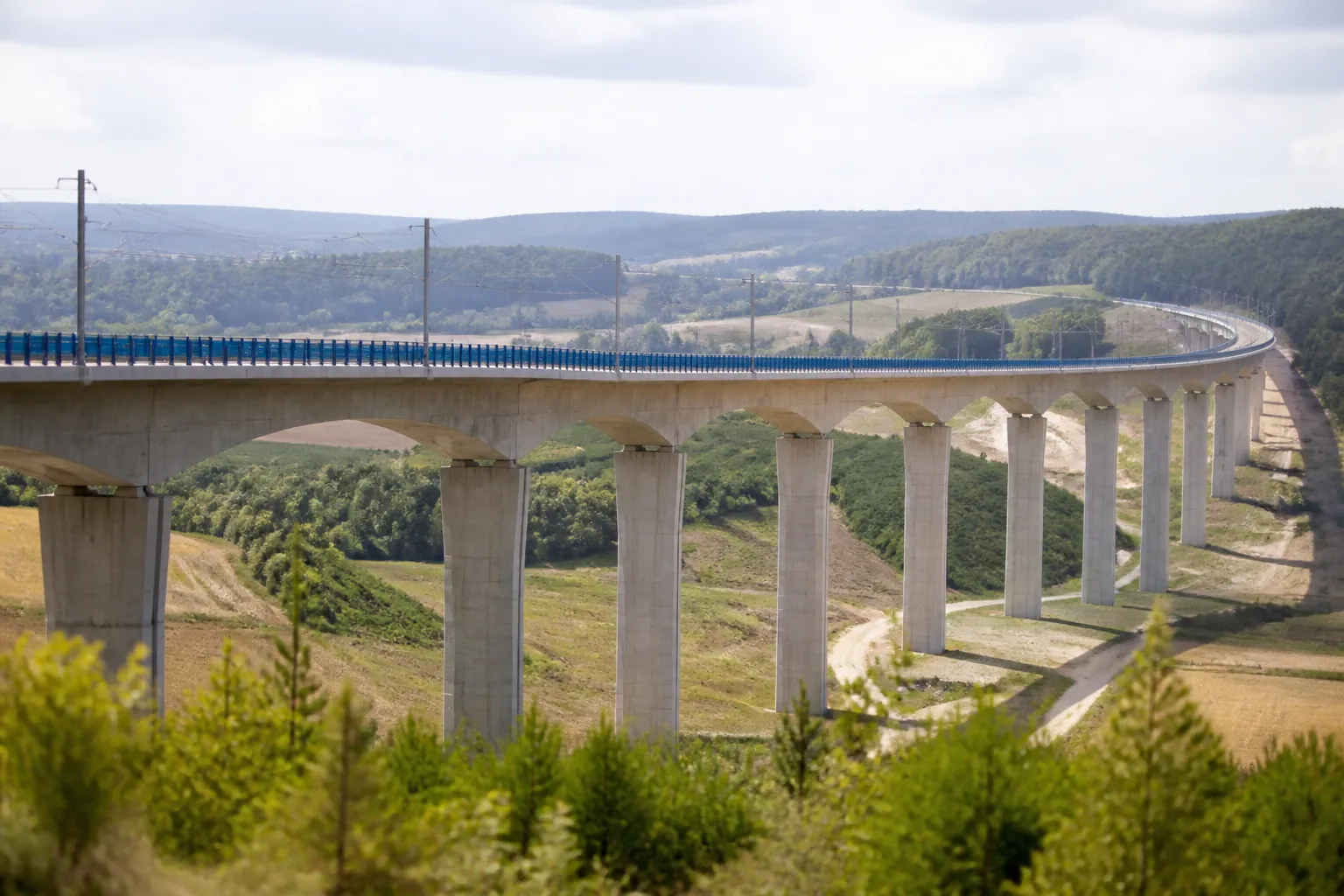
A second concession, decided on paper
When two bids for the same railway sit 262 million euros apart, I ask one question first. Which train did each team design its bridges for? On Portugal's next high-speed section, the jury is now asking the same thing.
The section runs from Oiã to Soure, in the middle of the Porto-Lisbon line. It is the second public-private partnership (PPP) on the route. Two groups bid in July. A Sacyr-led consortium with DST and Alberto Couto Alves (ACA) offered 2.04 billion euros. The Mota-Engil-led Lusolav group offered about 2.3 billion euros. ECO reported both prices in mid-July.
That matters because the tender is scored 80% on price. In late August the jury's preliminary report proposed the award to the Sacyr group. It also proposed excluding Lusolav, whose bid departed from the client's reference solution. The client is Infraestruturas de Portugal (IP), the state rail and road manager. Lusolav contested the report.
On 1 November, the jury sent the Sacyr group two technical questions about its bridges. Jornal de Negócios and ECO reported them the following day.
Two questions that go straight to the price
The first question asks which load classification factor the group used for its bridges and viaducts. The second asks about crack opening and decompression in its concrete design. The group had five business days to answer.
Both are design-basis choices. The load classification factor scales the standard train load in the Eurocode for rail bridges. A higher factor means heavier design loads. Every span then needs more concrete, more reinforcement and more prestressing steel. Decompression is a limit state for prestressed concrete. It keeps a section in compression under frequent loads. That protects the steel tendons from cracking and corrosion.
That matters because both parameters move quantities, and quantities move price. On a line with long viaduct runs, a small change compounds across kilometres of deck. The jury is asking, in effect, whether part of the gap is a design gap.
The questions came days after a fatal high-speed collision in Spain on 28 October. No link between that accident and bridge design has been reported. It has still sharpened scrutiny of every safety margin in Iberian rail.
Why a price-heavy tender invites the question
Price carries 80% of the score and quality 20%. Quality is judged mainly on the design of the Coimbra station. On that formula, the cheaper compliant bid wins. Here is why that shapes bidder behaviour. Where parameters are left open, the cheapest bid often uses the lightest assumption that still complies.
A reference solution exists to close that door. IP fixed the alignment and the main technical requirements. Bidders then price construction, finance and maintenance against them. In theory, the spread between bids should come from productivity, purchasing and the cost of capital.
A 262 million euro spread is wide for two bids priced against one reference design. It is roughly an eighth of the lower price. That does not prove a design difference. It is the reason the jury wants the parameters in writing before it signs.
The scope was already cut once to get competition. The 60 km section is 11 km shorter than in the first tender. That tender closed with a single bid, which was excluded as non-compliant. IP trimmed the job and relaunched in January. Two bidders came back.
The concession ends long before the bridge does
The contract is a 30-year concession. Roughly the first five years cover design, finance and construction. The rest is an availability period. IP pays for a line that is open and maintained, with deductions when it is not. Jornal Económico put lifetime payments at 4.2 to 4.8 billion euros at current prices.
Availability payments make a concessionaire live with its own design, but only until handback. A lighter structure that needs more maintenance shows up as cost and deductions inside the concession. The concessionaire prices that risk. A rail bridge, however, is designed for a 100-year working life under the Eurocodes.
That happens because risk transfer stops at handback. Most of a viaduct's life sits with the public owner after the concession ends. No bidder prices those decades. The public sponsor is the only party with a reason to insist on the heavier assumption. The jury's question is that sponsor acting on it.
The calendar now carries the grant
IP plans 600 million euros of its own funds alongside the PPP. The section also has 365.8 million euros allocated from the Connecting Europe Facility (CEF), the EU transport grant programme. CEF grants carry end dates. Eligible works must be done and paid inside them.
Every month the award slips is a month taken out of the grant window. The mechanism is simple. Construction is planned from 2027, and signature is expected that year. A court challenge to the final award could push it later. Under Portuguese procedure, challenging an award can suspend signature while the case runs.
The first section shows what that costs. Its concession was signed in July 2025. Works began only this October. The second section starts further back, with no signed contract at all.
My read: the award holds, and the design basis gets written down
I expect the jury to confirm the Sacyr group. The reason is simple. A clarification cannot change a price under Portuguese procurement rules. If the answers show compliant parameters, the 2.04 billion euro bid stands. If they show a lighter basis than specified, the bid falls. IP would then face one excluded and one contested bidder.
The likelier outcome is an award with the design basis fixed in the contract. That protects IP for the decades after handback. It also sets the benchmark for the sections between Soure and Lisbon. Bidders there will price the heavier assumption from the first day, and spreads should narrow.
The figure that settles it is the price in the final report. An unchanged 2.04 billion euros with an award means the gap was efficiency. An exclusion means the gap was design. Either way, that answer will price every structure on the rest of the line.
Share it with your peers
Help your network stay ahead of CEE capital projects.
Strategic Insights
📊 Analytics & Strategic Insight
On a price-weighted PPP, the bid gap is born in the design basis
The decision most in this industry are avoiding:
👉 The cheapest bid is a design hypothesis until its parameters are signed. Juries test compliance against tender documents. They rarely test the assumptions behind the quantities. A load factor left implicit can win a tender and return as a variation fight once construction starts.
👉 A reference solution fixes the route and the interfaces, and leaves the spans to the bidder. The structural basis inside each deck stays a bidder choice. On a viaduct-heavy line, that is where most of the construction cost of an availability PPP sits.
👉 Whatever this jury accepts becomes the benchmark for the next lots. The clarification answers will travel. Bidders on the Soure-Lisbon sections will read them and price their own structures to the standard set here.
Here's the full context:
→ July 2025: The first concession on the Porto-Lisbon line, Porto-Oiã, is signed, and its works begin only in October 2026.
→ January 2026: IP relaunches the Oiã-Soure tender with a 60 km scope, after the first procedure closed with a single non-compliant bid.
→ 6 July 2026: Two bids arrive: Sacyr, DST and ACA at 2.04 billion euros, and the Mota-Engil-led Lusolav at about 2.3 billion euros.
→ 26 August 2026: The jury's preliminary report proposes the award to the Sacyr group and the exclusion of Lusolav, which contests it.
→ Most recent: On 1 November 2026 the jury asks the Sacyr group to clarify its load classification factor and its crack and decompression design.
What this means for infrastructure operators, contractors and investors:
✅ Bid teams on Iberian rail PPPs should state the design basis on the face of the offer. A load factor and a decompression criterion written into the bid remove the jury's easiest question. They also protect the price from a later argument that the specification was ambiguous.
✅ Procurement authorities should treat the years after handback as their own risk book. The public owner alone carries a viaduct's later decades. It can price that through durability points in the quality score, or a minimum structural basis in the specification.
✅ Lenders' technical advisers should test structural assumptions before credit approval. Availability PPP debt is sized on construction cost. If the design basis is challenged after financial close, cost rises while the payment stream stays fixed, and the coverage ratios absorb the difference.
3 moves you can make this week:
1️⃣ Pull the design-basis report for every live bridge-heavy bid. Check the load classification factor and the serviceability criteria against the employer's specification, line by line.
2️⃣ Split every price gap into quantities and rates. For any tender you won or lost on price, separate the design effect from the efficiency effect. If quantities drive the gap, expect the jury to ask.
3️⃣ Map grant end dates against award timelines. For each CEF-funded section still in procurement, set the latest signature date that lets eligible works finish inside the grant window.
The analyst's read:
This clarification proves the jury will not sign a price gap without knowing where it comes from. It does not prove the Sacyr design is lighter than the specification. The settling item is the final report: an unchanged award at the July price means the gap was efficiency, and an exclusion means it was design.
Related analyses
- Transport & Infrastructure
Budapest Swaps Its Unpaid Rákosrendező Land Bill for State Equity. The 800 Million Euro Rail Package Now Sets the Clock
Budapest and the Hungarian government have agreed to turn the unpaid balance on the Rákosrendező rail yard into a state stake in a joint project company. The deal fixes the city's balance sheet, but the railway works the state must fund now decide when the first homes can start.
Read analysis → - Transport & Infrastructure
Romania's A7 Bacău-Pașcani Opens Only 30 km This Year as Grant Money Stops Before the Build Ends
Romania's transport ministry now expects only 30 km of the A7 Bacău-Pașcani motorway to open this year, out of 77 km once planned. Recovery funding stopped paying for the works on 31 August, so the remaining lots wait on the state budget and on where the single contractor group puts its crews.
Read analysis → - Transport & Infrastructure
Port Polska's EUR 1.5 Billion EIB Appraisal Puts the Terminal Contract on Trial
The European Investment Bank has admitted Poland's new airport to appraisal for up to EUR 1.5 billion, just as CPK concedes its EU grant assumption looks too optimistic. The terminal tender now has to produce a contract that lenders will accept.
Read analysis →
Building in Central Europe?
Tell us what you're building. We'll tell you what can go wrong — and how to prevent it.