We Help International Investors and Project Owners Deliver Major CEE Projects Without Expensive Surprises
Independent project intelligence and advisory across energy, transport, real estate and industrial construction.
Hungary's EUR 2.7 Billion Rail Tender Wave Meets Empty Order Books: Why the Cheapest Bid Is the Risk
Hungary plans more than HUF 1,000 billion of rail construction tenders in the coming months, aimed at a contracting market that has shed staff and is bidding below cost. A faster procurement machine helps, but the first wave will be priced by balance sheets, and the cheapest bid is the one to audit.
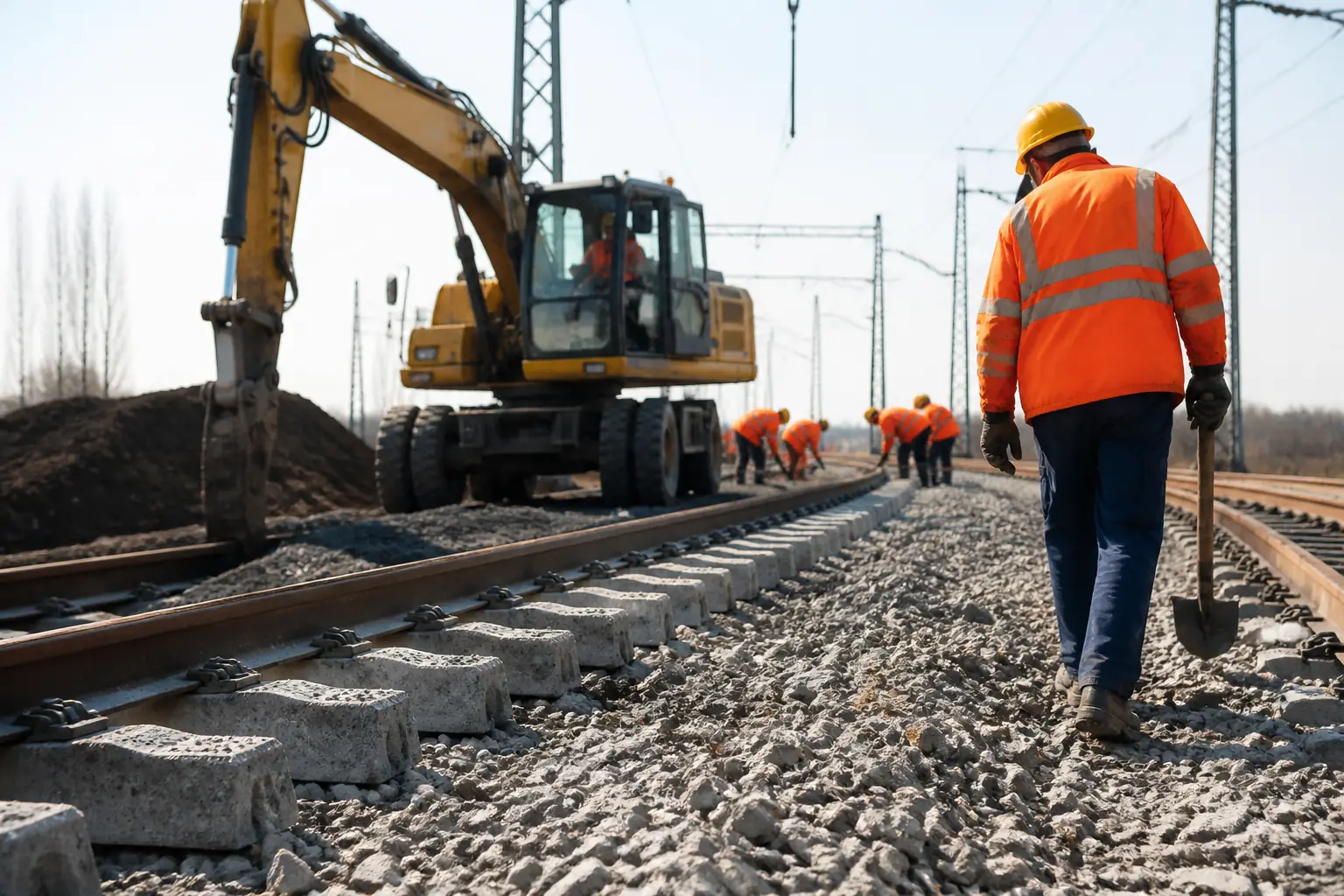
I had read Hungary's rail restart as a funding story. One number changed that read: 40 to 70 days. That is how long a contract signature could take after the evaluation committee had picked a winner. Transport and Investment Minister Dávid Vitézy gave the figure at Portfolio's Future of Construction conference on 12 November.
The state is now cutting that delay just as its largest rail tender wave in years reaches the market. How the wave prices depends on the contractors left to bid for it. That is where the risk sits.
A tender wave into a thinner market
Vitézy said more than EUR 2.7 billion of rail construction tenders (HUF 1,000 billion) could launch in the coming months. Several procedures are already running. Converted at the central bank rate of about 365 forints per euro on 11 November.
The lines named include a speed upgrade on the Budapest to Vienna main line and double-tracking between Szeged and Kiskunfélegyháza. Full renovations of Debrecen to Nyíregyháza and Hatvan to Füzesabony are on the list too. Most of the money is EU funding under the Baross Gábor rail plan. That matters because EU money carries a spending deadline. A deadline compresses tendering into a short window, so many lots reach the same pool of bidders at once.
That pool has shrunk. Construction employment is down by 50,000 from its peak. That is the estimate of ÉVOSZ, the contractors' federation, as reported by Világgazdaság on 1 November. Rail is the thinnest corner of the market. Track, catenary and signalling crews take years to train and cannot be hired back in a quarter.
Why a signature delay is a price
A bid is a price struck on one day. Steel, labour and finance costs keep moving after it. Every day between evaluation and signature is exposure the bidder carries without a contract.
That matters because a bidder cannot order rail, book plant or draw a bank facility until the contract exists. So the wait is priced in advance. It shows up as a contingency line or a fatter margin. The client pays it whether or not the delay actually happens.
Vitézy said the old process ran to 160 steps, with documents carried on paper between ministry offices. MÁV, the state railway, has since built its own investment organisation. It has more than 100 staff and its own procurement powers. The mechanism is simple. Fewer hand-offs shorten the gap between price and contract. A shorter gap means a thinner cushion in the next bid.
Faster procurement is therefore a pricing reform as much as an administrative one. The saving should show up in bid prices before it shows up in the calendar.
Empty order books make cheap bids
The danger in the first wave runs the other way. ÉVOSZ surveyed 400 firms for its first-half sentiment report, published by Index on 10 November. Lack of orders was the biggest problem for 80 percent of them. Its president, László Koji, expects most firms to earn between zero and 3 percent on revenue this year.
Here is why that pushes prices down. A contractor with an empty book still carries its overhead: yards, plant and salaried engineers. Any contract that covers part of that overhead beats no contract at all. So the bid is priced to keep the firm alive. The cost of the job itself becomes secondary.
Sándor Bujdosó of VIV told the Kecskemét conference that some firms are already bidding below their material cost. He put chain debt across the sector at about EUR 820 million (HUF 300 billion). Chain debt is money owed down the supply chain and not yet paid.
A price below material cost in a fixed-price contract is a deferred claim. The gap does not disappear. It returns later as variation requests, disputed measurement or a contractor that cannot finish.
Who carries the materials
The second constraint is working capital. Szabolcs Vingelmann runs Swietelsky Vasúttechnika, a rail specialist. He said the firm must pre-finance about EUR 14 million of materials (HUF 5 billion) before March starts. That happens because rail, sleepers and switches are ordered months before the track possession. The contractor pays its suppliers long before the client pays the contractor.
On a margin of a few percent, that cash cycle decides who can bid. A firm can rehire crews within a year. It cannot rebuild a bank line or a bonding facility as fast. The size of the field will be set by balance sheets, and the crew count comes second.
Vingelmann also asked for multi-year investment schedules and less price risk for contractors. A ministry panel at the 12 November conference argued for lifecycle value over lowest-price selection. Both point to the same tool. That tool is a price-adjustment clause tied to a published cost index.
The read: cheap first lots carry the risk
The likely outcome is that the first large rail lots draw adequate fields and clear at or below their estimates. Empty books and a deadline-driven wave both push that way. Sponsors will read the result as procurement success.
That reading is too generous. Koji does not expect a significant rise in public orders before mid-2027. ÉVOSZ sees a strong rebound only from 2028. The reason is simple. The first lots will be priced at the bottom of the cycle and built in the recovery. Costs rise in a recovery, and a contractor that bid to survive carries that gap.
The call is that low first-wave prices become the programme's claim book once the recovery starts. One figure would change it. Suppose a large lot clears more than 10 percent below its estimate. Without index-linked price adjustment, treat that saving as a future claim. If the tender documents carry that clause, the low price is far safer to bank.
Share it with your peers
Help your network stay ahead of CEE capital projects.
Strategic Insights
📊 Analytics & Strategic Insight
Hungary's rail restart will be priced by balance sheets, and the cheapest bid is the one to audit
The decision most in this industry are avoiding:
👉 Treat procurement speed as a cost line. Sponsors book a faster signature as an administrative win. Bidders book it as contingency they no longer need. If the client never asks for that cushion back, the contractor keeps it.
👉 A survival bid is a balance-sheet signal. Evaluation committees read a low price as healthy competition. Often it is a firm buying turnover to cover overhead. A committee that scores the bidder's cash position alongside its price learns far more.
👉 The binding input is working capital. Crews come back when work comes back. Bank lines and surety capacity, once cut, return slowly and on worse terms. Lenders will draw the field for the first lots before the tender rules do.
Here's the full context:
→ 2022: Hungary postpones about HUF 5,000 billion of state investment, and public orders fall to roughly a third of their earlier level (ÉVOSZ, via Index).
→ Early 2025: Swietelsky Vasúttechnika has cut its workforce from more than 440 to about 200 (Világgazdaság, 1 November 2026).
→ First half of 2026: 43.3 percent of firms in the ÉVOSZ survey report lower revenue than a year earlier (Index, 10 November 2026).
→ 1 November 2026: At the ÉVOSZ Kecskemét conference, contractors report bids below material cost and chain debt of about HUF 300 billion (Világgazdaság).
→ Most recent: On 12 November, Dávid Vitézy announces more than HUF 1,000 billion of rail tenders in the coming months and says signatures had taken 40 to 70 days after evaluation (Portfolio).
What this means for infrastructure operators, contractors and investors:
✅ Bid teams should price the signature gap in the open. Show the client a contingency tied to bid validity and signature date. A shorter process then earns a visible price cut, which strengthens the case for the reform.
✅ MÁV's new investment unit should publish price adjustment in the first lots. An index-linked clause lets bidders drop their inflation cushion. It also stops a survival price from turning into a claim when costs rise in the recovery.
✅ Lenders and sureties hold the real capacity. Bonding lines decide how many lots each firm can carry at once. Underwriters should test cash conversion and receivables age, since chain debt eats the liquidity that pays for materials.
3 moves you can make this week:
1️⃣ Map the announced rail lots against your bonding headroom. List each line named so far, estimate the security each will need, and mark which ones your facilities can carry at the same time.
2️⃣ Run your bid model twice. Price one lot with an index-linked adjustment and once without it. The difference is the claim exposure you would accept on a fixed price.
3️⃣ Ask your key subcontractors for their aged receivables. A supplier carrying overdue invoices from other jobs is a delivery risk on yours. Find out now, before materials have to be ordered.
The analyst's read:
The restart proves the state is fixing the machine that turns budgets into signed contracts. It does not prove the market can deliver the wave at a sustainable price. The settling evidence is the first large rail award measured against its published estimate, and whether that contract carries an index-linked price adjustment.
Related analyses
- Transport & Infrastructure
Budapest Swaps Its Unpaid Rákosrendező Land Bill for State Equity. The 800 Million Euro Rail Package Now Sets the Clock
Budapest and the Hungarian government have agreed to turn the unpaid balance on the Rákosrendező rail yard into a state stake in a joint project company. The deal fixes the city's balance sheet, but the railway works the state must fund now decide when the first homes can start.
Read analysis → - Transport & Infrastructure
Romania's A7 Bacău-Pașcani Opens Only 30 km This Year as Grant Money Stops Before the Build Ends
Romania's transport ministry now expects only 30 km of the A7 Bacău-Pașcani motorway to open this year, out of 77 km once planned. Recovery funding stopped paying for the works on 31 August, so the remaining lots wait on the state budget and on where the single contractor group puts its crews.
Read analysis → - Transport & Infrastructure
Port Polska's EUR 1.5 Billion EIB Appraisal Puts the Terminal Contract on Trial
The European Investment Bank has admitted Poland's new airport to appraisal for up to EUR 1.5 billion, just as CPK concedes its EU grant assumption looks too optimistic. The terminal tender now has to produce a contract that lenders will accept.
Read analysis →
Get a second opinion before it gets expensive.
Contractor selection, tender strategy, a project drifting off track — send us the situation and we'll come back with a clear plan.