We Help International Investors and Project Owners Deliver Major CEE Projects Without Expensive Surprises
Independent project intelligence and advisory across energy, transport, real estate and industrial construction.
Fehmarnbelt gasket damage leaves 85 tunnel elements to immerse and puts the build rate on trial
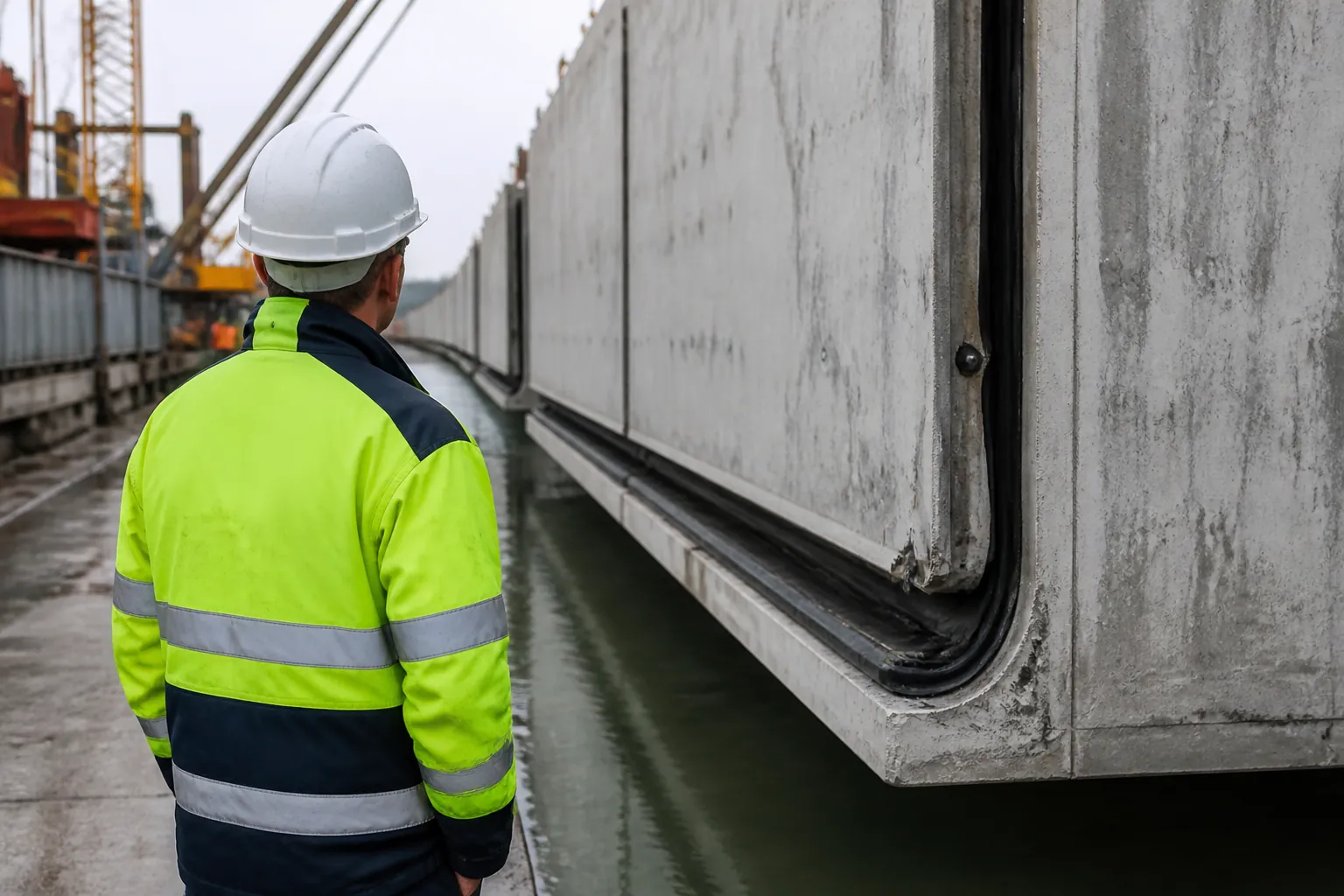
Damage to a GINA rubber seal has stopped immersion of the first special element of the Fehmarnbelt tunnel between Denmark and Germany. The repair is a matter of weeks, while the immersion pace so far and the disputed trench behind the damage now decide the opening date.
The coverage reads the Fehmarnbelt news as a damaged rubber seal. I read it as a rate problem. A tunnel built one element at a time moves only as fast as its slowest joint.
Femern A/S said on 13 November 2026 that its contractor had postponed immersion of the tunnel's first special element. The contractor is Femern Link Contractors (FLC), a joint venture led by VINCI. The damage sits on the GINA gasket of the element already on the seabed. GINA is the rubber seal that makes a joint watertight when two elements are pressed together. It must be repaired before the next element can dock.
What the inspection found
Femern A/S gave no repair duration and no revised schedule. It said the damage may have come from cleaning and preparing the tunnel trench. That cause is not confirmed. German news agency dpa reported on 18 November that divers found the damage during a routine inspection.
That matters because an immersed tunnel is a chain. Each element docks against the seal of the one before it. A damaged joint on the fourth element therefore blocks the fifth. The fifth then blocks every element behind it. There is no second front on the seabed to move the crews to. Above water, the casting yard can keep producing elements. It cannot place them.
The rate behind the repair
The first element was placed on 7 May. The fourth was down by 28 September. That is three intervals in 144 days. On our count, it averages about 48 days per element. The finished tunnel has 89 elements, so 85 remain.
Here is why the average matters more than the gasket. At that pace, the remaining elements would take more than a decade. Finishing inside three years needs one element roughly every fortnight. That is close to four times the summer rate.
The special elements make the next step harder. They are shorter and carry the tunnel's technical installations, so the crews and the vessel face a new set-up. Learning from the first four standard elements does not carry over in full. The start itself came about two years late. Sund & Bælt blamed problems completing and approving the immersion vessel, IVY, and said that time cannot be recovered.
Why the trench keeps coming back
The suggested cause points at the most contested part of the job. A separate consortium, Fehmarn Belt Contractors, dredged the trench. It paid Femern A/S compensation for digging too deep. FLC then refused to accept the trench. In May, Sund & Bælt agreed to pay FLC on time and materials to prepare the first stretch. That arrangement has since been extended. The fix kept the works moving. It also changed who pays for the way the trench is handled.
That is what the payment route does to this repair. If trench cleaning damaged the seal, the owner was paying for that cleaning at cost. Under a cost-reimbursed arrangement, the risk of side effects usually follows the payer. Nobody has said who will carry this repair. The terms of the trench deal will decide it.
The repair also lands beside an open claim. FemernBusiness reported in October 2025 that FLC sought about 1.95 billion euro (DKK 14.5 billion) for delay. No settlement has been published. Krone figures here convert at the fixed central rate of 7.46 per euro.
What a slow rate costs a user-paid tunnel
The tunnel has no availability payment. Denmark finances it alone through loans with a state guarantee. Tolls and rail charges repay them. The official construction budget is about 7.1 billion euro (DKK 52.6 billion in 2015 prices). That includes a reserve of about 1 billion euro (DKK 7.3 billion).
The mechanism is simple: every month without tolls adds interest to the debt. The planned payback period of 28 years absorbs that by stretching. Sund & Bælt said in June that repayment still fits the period the Construction Act assumes. It gave no new cost figure. That silence is normal while a plan is being rebuilt. It also keeps the interest cost of each lost month out of public view.
The German half of the timetable
Deutsche Bahn told the federal ministry that the rail hinterland link will open after 2029, with no date. The new Fehmarnsund tunnel is planned by 2035, at an estimated 2.3 billion euro. Femern A/S has already said the link will open in two stages, road first.
That matters because the rail revenue depends on a line Denmark does not control. A road-first opening brings toll income earlier. It also means the rail share of the business case arrives on Germany's timetable. If the German line is the later of the two, a Danish slip may cost the rail revenue nothing. It still costs the road tolls in full.
Our read: the next interval sets the date
Our read is that the gasket costs weeks and the cadence costs years. Divers can inspect and repair a seal on the seabed. That is a known task. The cause weighs more. It points at a step that repeats. That happens because the trench is cleaned again before each element goes down. Each pass now needs more care, and care takes days. That is why the next immersion matters more than the repair report.
We expect the owner's new overall plan to confirm a road opening no earlier than 2032. Chief executive Mikkel Hemmingsen gave that date to Børsen in May. Rail will follow later. The figure that settles it is the gap between the fifth and sixth elements. Under 30 days says the rate is recovering. 50 days or more puts 2032 at risk too.
The open question for every FLC partner is how a long, cost-reimbursed seabed programme will read in its own accounts. Several of these builders also bid across Central and Eastern Europe. We are building the CEE Contractor League Table and Financial Health Monitor to compare backlog quality and cash across the region's builders. Join the waitlist to hear when it is published.
Share it with your peers
Help your network stay ahead of CEE capital projects.
Strategic Insights
📊 Analytics & Strategic Insight
A serial build has no float, so the slowest joint sets the opening
The decision most in this industry are avoiding:
👉 The trench is a recurring operation. Coverage treats trench preparation as a dispute that was parked by paying at cost. Each element needs its own cleaning pass, so the disputed step and its risk come back with every immersion.
👉 The cost-reimbursed fix moved repair risk back to the owner. Paying the contractor at cost unblocked the works. It also means the side effects of that work can land with the payer, unless the arrangement says otherwise.
👉 The special elements start a second learning curve. Crews have learned the standard sequence. The first special element resets that curve at the moment a joint failed, so the next intervals may lengthen before they shorten.
Here's the full context:
→ 2016: FLC signs three conditional design-and-build contracts with Femern A/S, worth 3.4 billion euro combined.
→ 2025: FLC's delay claim of about 1.95 billion euro is reported, and Fehmarn Belt Contractors pays compensation for over-deep trench dredging.
→ May 2026: The first element is placed on 7 May. Femern A/S announces a two-stage opening, road first, and Sund & Bælt starts paying FLC at cost for trench preparation.
→ September and October 2026: The fourth element goes down by 28 September. In October a cyber attack on FLC stops vessels and site work before a staged restart.
→ Most recent: On 13 November 2026, immersion of the first special element is postponed after damage to the GINA gasket on the preceding element.
What this means for infrastructure operators, contractors and investors:
✅ Owner project boards should write the cadence into the plan. A plan built on an opening year hides its main assumption. A plan built on days per element exposes it, so the board sees drift within one interval.
✅ Bid teams on immersed and segmental works should price the interface step on its own. Where one party prepares the bed and another places the unit, damage at the joint needs a named owner in the contract. Without one, it turns into a cost-reimbursed dispute.
✅ Lenders and guarantors to user-paid links should test the payback against the build rate. A slower build stretches repayment before it raises the headline cost. The warning therefore shows up in the debt model first.
3 moves you can make this week:
1⃣ Track the gap between the fifth and sixth elements. Diary the next immersion notice from Femern A/S and compare it with the summer average. It is the cleanest live signal on the opening date.
2⃣ Read your own interface clauses. On any job where one contractor prepares a surface that another depends on, check who pays when the preparation damages installed work.
3⃣ Re-run any serial schedule at half speed. For a project built as a chain of identical units, model the finish at half the planned rate. See what breaks first: financing, permits or crews.
The analyst's read:
This proves that the hand-off between trench preparation and element placement is the project's weak point. It does not yet prove a later opening year. The interval to the sixth element settles it, and the owner's new overall plan will show whether that interval has been priced in.
CEE Capital Projects reports
📋 Coming next
CEE Contractor League Table and Financial Health Monitor, now in preparation. Join the waitlist to hear when it is published.
→ Join the waitlist
🚆 CEE Rail Build-Out 2027-2030
Rail tender pipeline to 2030, awards since 2020, contractor capacity and bid risk across 17 markets. PDF report plus interactive Excel database, one row per tender lot.
→ See the report and free sample
⚡ CEE Grid Procurement Pipeline 2027-2030
Contract opportunities, suppliers and bid risk in electricity transmission and distribution across 19 markets. PDF report plus interactive Excel database, with awards since 2020 and named packages to 2030.
→ See the report and free sample
Related analyses
- Transport & Infrastructure
Budapest Swaps Its Unpaid Rákosrendező Land Bill for State Equity. The 800 Million Euro Rail Package Now Sets the Clock
Budapest and the Hungarian government have agreed to turn the unpaid balance on the Rákosrendező rail yard into a state stake in a joint project company. The deal fixes the city's balance sheet, but the railway works the state must fund now decide when the first homes can start.
Read analysis → - Transport & Infrastructure
Romania's A7 Bacău-Pașcani Opens Only 30 km This Year as Grant Money Stops Before the Build Ends
Romania's transport ministry now expects only 30 km of the A7 Bacău-Pașcani motorway to open this year, out of 77 km once planned. Recovery funding stopped paying for the works on 31 August, so the remaining lots wait on the state budget and on where the single contractor group puts its crews.
Read analysis → - Transport & Infrastructure
Port Polska's EUR 1.5 Billion EIB Appraisal Puts the Terminal Contract on Trial
The European Investment Bank has admitted Poland's new airport to appraisal for up to EUR 1.5 billion, just as CPK concedes its EU grant assumption looks too optimistic. The terminal tender now has to produce a contract that lenders will accept.
Read analysis →
Building in Central Europe?
Tell us what you're building. We'll tell you what can go wrong — and how to prevent it.