We Help International Investors and Project Owners Deliver Major CEE Projects Without Expensive Surprises
Independent project intelligence and advisory across energy, transport, real estate and industrial construction.
CCECC wins 16.1 million euro Montenegro rail rehabilitation as EU-funded lots go to the lowest delivered price
China's CCECC has won the EIB and WBIF-funded rehabilitation of the Lutovo to Bioče railway in Montenegro, about 7% above the tender estimate. The award shows how lot size and open lender rules decide who bids, and sets the test for the larger Golubovci to Bar contract.
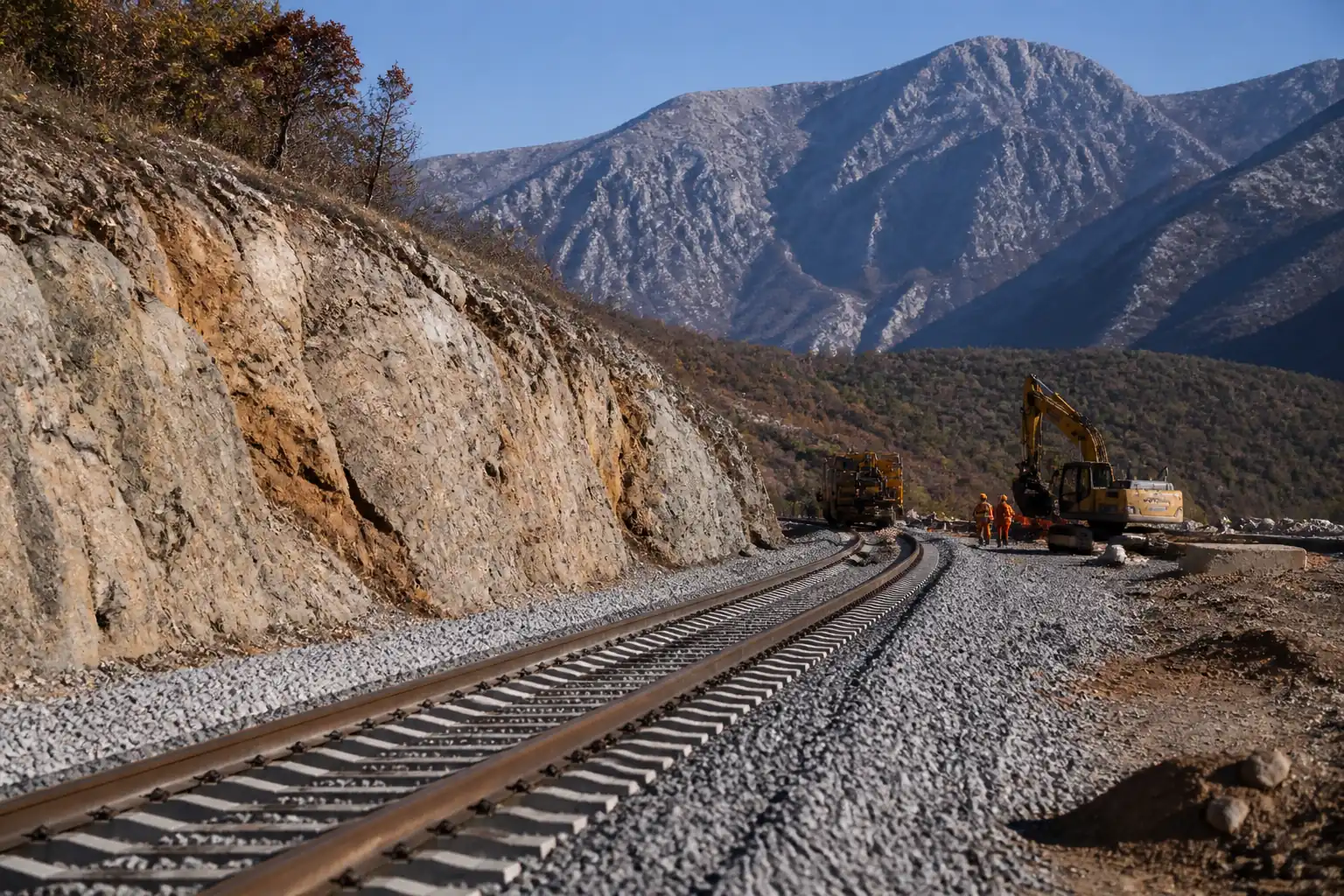
I keep seeing the same ending on EU-funded rail work in the Western Balkans. Europe lends and grants the money. A Chinese state contractor then signs the works contract. Montenegro has just written that ending again.
China Civil Engineering Construction Corporation (CCECC) has won a 16.1 million euro rail contract in Montenegro. The job is the rehabilitation of the Lutovo to Bioče line. Railway Gazette reported the award on 12 November 2026. The value excludes VAT. The client is the national infrastructure manager, Željeznička infrastruktura Crne Gore (ŽICG). The money comes from a European Investment Bank (EIB) loan and a Western Balkans Investment Framework (WBIF) grant.
What Montenegro is buying
The section runs for about 20 kilometres north of Podgorica. It sits on the main line from the port of Bar to Serbia, the country's main international link. The works renew the track and rebuild the main-line tracks at Bratonožići and Bioče stations. The contract runs for 36 months.
The tender estimate was 15 million euros, excluding VAT, according to Biznis.rs in August 2025. The award therefore landed about 7% above the estimate. That matters because the estimate was set before the bids, in the prices of that year. The contractor now carries steel, ballast and labour prices across three years of work. Work on an operating line also runs in possession windows. Short windows mean idle plant and night shifts, and both cost money.
So an award above estimate is no proof of a padded bid. It is more often a sign that the client's estimate was light. The lesson for the next lot is simple. The estimate is a planning number, and the market reprices it the day the bids open.
Why the door is open to everyone
The tender was open to bidders from any country. Biznis.rs reported that eligibility turned only on conflict of interest and on not being declared ineligible by the bank. That is the normal position for a lender-funded tender outside the EU. The reason is simple. The lender wants the borrower to get the lowest compliant price, and global competition is its tool for that.
The EU has built new defences at home. The Foreign Subsidies Regulation makes bidders declare state support in large EU public tenders. Its notification duty starts at contracts of 250 million euros, and it applies inside the EU. Montenegro is a candidate country, and this lot is a fraction of that size. No subsidy screen reaches a small rail lot in a candidate country.
That leaves the lender's own rulebook to decide the market. Inside an open rulebook, the cheapest delivered price wins. A state-owned group with low-cost capital can price thinner margins and carry slower payment. Railway Gazette notes that CCECC already has an established presence in the Western Balkans.
Why the lot size picks the bidder
A 16 million euro track renewal is a small job for a European major. Here is why that matters. Mobilising a foreign site team, plant and supply chain costs about the same for any lot size. Spread over a small contract, that fixed cost eats most of the margin.
A contractor already working in the region pays the mobilisation once. It then spreads that cost over several jobs in the same corridor. The lot size therefore picks the bidder before the price does. European groups usually answer this through a joint venture with a local partner, which shares the site overhead.
Each small win also builds a platform. The winner adds crews, machines and local suppliers to its regional base. It then bids the next, larger lot with part of its mobilisation already paid.
The precedent is in Croatia
The Pelješac Bridge in Croatia showed the same price gap at scale. China Road and Bridge Corporation won it with a bid of 278 million euros, EU Perspectives reported in October 2025. An Austrian consortium bid 351 million euros. An Italian-Turkish offer came in at 341 million euros. EU cohesion funds paid for most of the bridge.
That happens because a lowest-price award gives little credit for anything else. The second-lowest bid sat more than a fifth above the winner. A gap that wide reflects cost of capital and supply chains as much as engineering. European bidders priced their normal risk and finance costs. The winner priced a different balance sheet.
The real test is Golubovci to Bar
The bigger contract on this line is still to come. The 39 kilometre Golubovci to Bar section has a 230.8 million euro funding package. The EU grants 112.6 million euros through WBIF. The EIB lends 63 million euros, and the EBRD lends 50 million euros. Railway Gazette reports that the works contract has not yet been awarded.
This lot is large enough to justify a fresh mobilisation by any bidder. The reason is simple. A large lot spreads the fixed set-up cost over enough work to absorb it. That removes the small-lot advantage. It puts the weight back on price, capability and how the client scores them.
What changes when the scope gets technical
The Golubovci to Bar scope includes 11 bridges and three stations. It also covers new signalling, telecoms and power supply. That matters because signalling and bridges reward proven systems and design capability. A bidder can buy cheap track labour, but it cannot quickly buy a signalling track record.
The scoring rule decides how much that capability counts. A separate World Bank-financed level crossing tender in Montenegro scores price at 70% and non-price criteria at 30%. If the Golubovci to Bar tender scores capability that way, European signalling firms gain ground. If it awards on price after a pass or fail check, the Lutovo to Bioče pattern repeats.
My read: price will lead, and the gap will tell us why
I expect Golubovci to Bar to draw at least one Chinese bid close to its estimate. European groups will bid through joint ventures with local partners, or chase the signalling scope as subcontractors. The mechanism is the lenders' mandate. They answer for the borrower's price, so they will keep the rulebook open.
The figure that settles it is the gap between the lowest and second-lowest compliant bids. A gap like Pelješac's means capital cost is deciding the award. A gap under one tenth means engineering is competitive again. The bid opening will tell us which, and contractors should plan for the first case.
This award is one small lot in a much larger Western Balkan rail programme. Our CEE Rail Build-Out 2027-2030 report tracks that programme lot by lot, with contractor capacity and bid behaviour. It covers 17 markets, including Montenegro. See the report and download the free sample edition.
Share it with your peers
Help your network stay ahead of CEE capital projects.
Strategic Insights
📊 Analytics & Strategic Insight
Western Balkan rail: the lender opens the door, and the cheapest balance sheet walks through it
The decision most in this industry are avoiding:
👉 The estimate is the client's price signal, and it is often stale. Bidders read a published estimate as the ceiling. An award above it on a small lot says the work costs more than the client planned, whoever wins.
👉 Small lots are how a regional platform gets built. Each small win adds plant, crews and suppliers. The winner then bids the next large lot with mobilisation already paid, and rivals price theirs from scratch.
👉 The subsidy screens stop at the EU border. Candidate-country rail lots sit outside them. In that market the lenders, and not the regulators, decide who can bid.
Here's the full context:
→ 2019 onward: Chinese firms win over 1 billion euros of EIB-funded contracts outside the EU, about 13.1% of that value (EU Perspectives).
→ 2022: Pelješac Bridge in Croatia opens after a winning Chinese bid of 278 million euros.
→ 2025: ŽICG tenders Lutovo to Bioče at an estimated 15 million euros; the bid deadline moves to 15 September.
→ October 2026: The EBRD lends 50 million euros for the Golubovci to Bar section.
→ Most recent: CCECC wins Lutovo to Bioče at 16.1 million euros, reported on 12 November 2026.
What this means for infrastructure operators, contractors and investors:
✅ Bid teams need a regional cost base before the large lot. Bidding a big lot from a standing start loads all mobilisation onto one price. A contractor with nearby work spreads it.
✅ Project boards should test the lowest price in writing. Ask for the price build-up before award. A price that cannot be explained usually returns as claims and delay.
✅ The lender's technical adviser carries the delivery check. An open rulebook moves the burden to evaluation. Firm capability tests on signalling and bridges protect the borrower more than price weight does.
3 moves you can make this week:
1⃣ Map the plant you already have in the region. List track renewal machines and crews within reach of Montenegro and Serbia, and their release dates.
2⃣ Open talks with a local partner now. A joint venture formed after the notice publishes is formed too late to price well.
3⃣ Read the evaluation criteria the day they publish. The split between price and quality decides whether a European bid can win at all.
The analyst's read:
This award proves that EU-funded rail in Montenegro goes to the lowest delivered price, with no subsidy screen in the way. It does not yet prove that European contractors are priced out of the larger, technical lots. The figure that settles it is the spread between the two lowest Golubovci to Bar bids, on the day they are opened.
CEE Capital Projects reports
🚆 CEE Rail Build-Out 2027-2030
Rail tender pipeline to 2030, awards since 2020, contractor capacity, bid behaviour and risk across 17 markets in Central Europe, the Baltic states, Greece, Bulgaria, Croatia and the Western Balkans. PDF report plus interactive Excel database, one row per tender lot.
→ See the report and free sample
📋 Coming next
CEE Contractor League Table and Financial Health Monitor, and CEE Grid and Energy Construction Pipeline. Join a waitlist and vote on which we publish first.
→ Join the waitlist
Related analyses
- Transport & Infrastructure
Budapest Swaps Its Unpaid Rákosrendező Land Bill for State Equity. The 800 Million Euro Rail Package Now Sets the Clock
Budapest and the Hungarian government have agreed to turn the unpaid balance on the Rákosrendező rail yard into a state stake in a joint project company. The deal fixes the city's balance sheet, but the railway works the state must fund now decide when the first homes can start.
Read analysis → - Transport & Infrastructure
Romania's A7 Bacău-Pașcani Opens Only 30 km This Year as Grant Money Stops Before the Build Ends
Romania's transport ministry now expects only 30 km of the A7 Bacău-Pașcani motorway to open this year, out of 77 km once planned. Recovery funding stopped paying for the works on 31 August, so the remaining lots wait on the state budget and on where the single contractor group puts its crews.
Read analysis → - Transport & Infrastructure
Port Polska's EUR 1.5 Billion EIB Appraisal Puts the Terminal Contract on Trial
The European Investment Bank has admitted Poland's new airport to appraisal for up to EUR 1.5 billion, just as CPK concedes its EU grant assumption looks too optimistic. The terminal tender now has to produce a contract that lenders will accept.
Read analysis →
Facing a decision on a CEE capital project?
Describe the situation in a few sentences. Within 72 hours you get an experienced read: the risks we see, what we'd check, and whether we can help — no calls, no obligation.