We Help International Investors and Project Owners Deliver Major CEE Projects Without Expensive Surprises
Independent project intelligence and advisory across energy, transport, real estate and industrial construction.
Budimex Strategy Sets a 6% Margin Floor as Poland's Largest Contractor Leaves the Motorway Era
Budimex's strategy to 2030 targets an average EBIT margin above 6 per cent, below every year it has posted since 2021. The lower bar prices a shift from repeat road work into rail, grids, nuclear and concession equity.
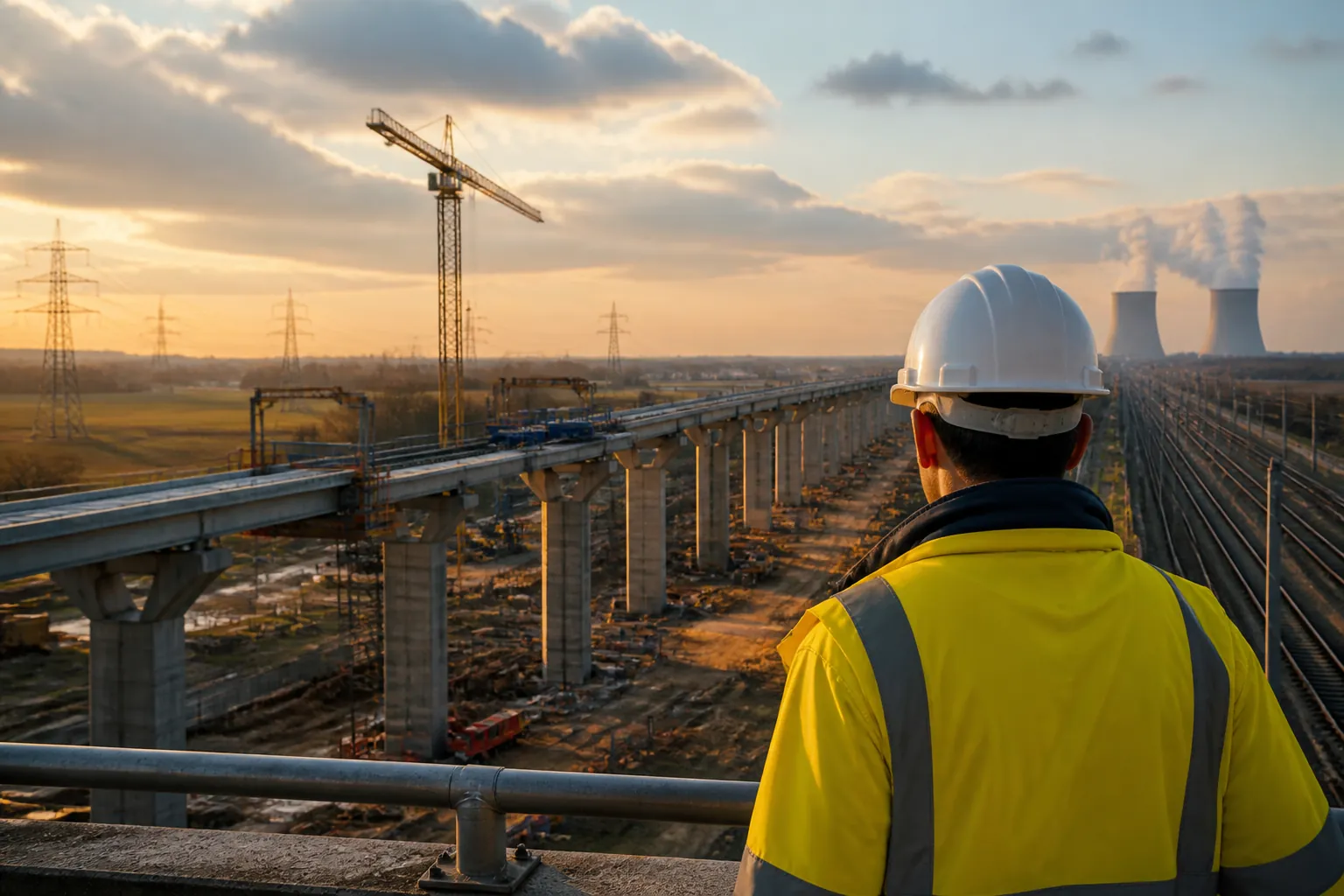
Most of the market heard caution in Budimex's new margin target. I hear a contractor pricing the risk of the work it is about to win. The road book that paid for the last decade is nearly built.
Poland's largest listed contractor presented its strategy to 2030 last week. It targets average revenue growth above 8 per cent a year. It also targets an average EBIT margin above 6 per cent, below every year Budimex has posted since 2021. EBIT is earnings before interest and tax. Strefa Inwestorów set out that comparison on 30 October. The shares fell on the day.
The road book is nearly built
Motorways carried Budimex for fifteen years. Chief executive Artur Popko put the end point plainly. Polish motorways are 93 per cent complete. Expressways are 62 per cent complete. The remaining work is smaller and more scattered.
Roads still make up about 2.3 billion euros (10 billion zloty) of the order book. Conversions here use the late-October rate. The strategy now calls roads stable, so growth has to come from somewhere else.
That matters because a road programme is a repeat product. The client, the contract template and the asphalt supply chain recur for years. Each repeat lowers the cost of bidding and the cost of mistakes. That learning curve is where the high margins came from. A contractor that leaves it gives up its cheapest source of profit. Rivals with the same road-heavy books face the same cliff.
Rail, grids and nuclear carry different risk
Budimex names rail, power grids, nuclear and defence as its growth drivers. In the 2025 order book, rail and grid networks made up 24 per cent. Nuclear and industrial work was a sliver. By the end of the plan, rail and grids are meant to be the largest segment.
Here is why the margin falls as the mix shifts. Rail work on a live network runs inside possessions, the hours a line can be closed. Track, signalling and power sit with different suppliers. Every interface between them is a place where delay turns into a claim. Claims take years to settle, and the contractor finances the gap.
Nuclear works the same way, one level down. Budimex has started preparatory works under Bechtel, the general contractor for Poland's first plant. A second-tier contractor inherits the prime's schedule and quality rules without controlling either. Its margin is capped by what the prime is willing to pass down.
A lower target is a different risk book
The target reads as caution only if the work stays the same. It will not. Six per cent on a rail package is harder to earn than six per cent on a repeat road.
The record shows what the bad years look like. Over the past decade Budimex averaged 6.7 per cent. The margin fell to 3 per cent in 2019. It reached 9.5 per cent in 2025. The mechanism is simple. A fixed-price bid carries the cost index until the indexation clause catches up. When materials and labour move faster, the margin absorbs the gap.
So the new floor sits near the long-run average rather than the peak. It assumes some years like 2019 will come back. On rail and grid work, where the interfaces multiply, that is a sensible assumption. A board that promised the peak would be promising the road programme back.
The concession moves where the profit shows up
The second shift is quieter. Budimex holds 10 per cent of the consortium chosen for the Czech D35 motorway PPP. PPP means public-private partnership. Popko said the group now takes part in the financing as well as the building.
That matters because concession equity earns through dividends over decades. It never passes through construction EBIT. A contractor that moves into concessions can report a lower build margin and still earn more over the asset's life.
It also needs cash to do it. Net cash fell to about 410 million euros (1.8 billion zloty) at end-September. That is down by almost a third since the end of last year. The dividend policy still allows Budimex to pay out its entire net profit. Equity calls and dividends will compete for the same balance. That tension sits at the centre of the plan.
Abroad, the backlog is already there
Foreign markets make up 8.5 per cent of revenue. The target is 10 to 15 per cent by the end of the plan. Budimex counted about 1.07 billion euros (4.7 billion zloty) of Baltic backlog at end-September. That includes Rail Baltica work. Germany is the long option, with thousands of bridges needing reconstruction.
Here is why the foreign target is modest. Abroad, a contractor bids without its home plant and its home supply chain. It buys subcontractors at local market rates. The first contracts in a new market are priced to win entry, and entry is expensive. Margin comes later, once the local supply chain is in place. Each new market therefore starts below the home margin.
The read: the floor is the signal
The likelier reading is that 6 per cent is a floor Budimex expects to clear in most years. Popko said the targets were presented somewhat conservatively. The reason is simple. A listed contractor that misses a margin target is punished harder than one that beats a low one.
The test is order intake over the next year. Contracts signed in the first nine months rose by almost two-thirds, XYZ reported. If the rail and grid share of intake stays flat next year, the plan has stalled. If it rises, the market will have priced the caution and missed the change. The next full-year report will show which way it is going.
Share it with your peers
Help your network stay ahead of CEE capital projects.
Strategic Insights
📊 Analytics & Strategic Insight
Budimex Has Priced the End of the Repeat Road Contract. Its Rivals Have Not.
The decision most in this industry are avoiding:
👉 The dividend is the real constraint on the plan. A full-payout policy and concession equity draw on the same cash. The first year with two equity calls will force the board to choose. That choice will say more than the margin target.
👉 The road slowdown hits the supply chain before it hits the contractor. Asphalt plants, quarries and plant fleets were sized for a motorway programme. Their utilisation falls first, and whoever owns them carries the fixed cost.
👉 The nuclear role is a qualification asset more than a revenue line. Early works under a US prime build the quality record the next plant's tender will demand. Valuing it on today's revenue misses where the value sits.
Here's the full context:
→ 2011: Motorways and expressways become the main driver of Budimex results for fifteen years.
→ 2019: The EBIT margin drops to 3 per cent as costs outrun fixed-price work.
→ 2025: Revenue reaches about 2.1 billion euros (9.4 billion zloty) at a 9.5 per cent EBIT margin.
→ October 2026: A consortium including Budimex wins selection for the Czech D35 motorway PPP.
→ Most recent: Budimex adopts its strategy to 2030, with an average EBIT margin target above 6 per cent.
What this means for infrastructure operators, contractors and investors:
✅ Rival bid teams should expect harder pricing in Polish rail. A contractor of this size moving its order book toward rail adds a disciplined bidder to every large package. Prices in that segment will be set by the bidder with the deepest balance sheet.
✅ Procurement authorities gain bidders but need tighter interface rules. More contractors chasing rail and grid work helps price tension. It also brings in firms new to possessions and signalling, so the contract must say who carries each interface.
✅ Equity sponsors in CEE concessions have a new kind of partner. A builder that also wants to hold equity changes the consortium negotiation. Sponsors should test how much equity it can commit alongside its dividend policy.
3 moves you can make this week:
1️⃣ Re-run your rail margin assumptions against your claims history. Take your last three rail packages and price the interface delays that became claims. Use that result as your planning base in place of the bid margin.
2️⃣ Map who is bidding transformer-station work. Pull the recent grid operator tenders and list every bidder. A new name from the road sector is an early signal of where pricing goes next.
3️⃣ Ask contractor partners for an equity commitment in writing. On any PPP in preparation, request a board-approved equity letter before the bid stage. A builder with a full-payout dividend may have less spare cash than its balance sheet suggests.
The analyst's read:
This proves Budimex accepts that its best margins were a dividend from a repeat road programme. It does not prove the group can earn its target on rail, grids and nuclear. The figure that settles it is the rail and grid share of order intake in the next full-year report.
Related analyses
- Transport & Infrastructure
Budapest Swaps Its Unpaid Rákosrendező Land Bill for State Equity. The 800 Million Euro Rail Package Now Sets the Clock
Budapest and the Hungarian government have agreed to turn the unpaid balance on the Rákosrendező rail yard into a state stake in a joint project company. The deal fixes the city's balance sheet, but the railway works the state must fund now decide when the first homes can start.
Read analysis → - Transport & Infrastructure
Romania's A7 Bacău-Pașcani Opens Only 30 km This Year as Grant Money Stops Before the Build Ends
Romania's transport ministry now expects only 30 km of the A7 Bacău-Pașcani motorway to open this year, out of 77 km once planned. Recovery funding stopped paying for the works on 31 August, so the remaining lots wait on the state budget and on where the single contractor group puts its crews.
Read analysis → - Transport & Infrastructure
Port Polska's EUR 1.5 Billion EIB Appraisal Puts the Terminal Contract on Trial
The European Investment Bank has admitted Poland's new airport to appraisal for up to EUR 1.5 billion, just as CPK concedes its EU grant assumption looks too optimistic. The terminal tender now has to produce a contract that lenders will accept.
Read analysis →
Building in Central Europe?
Tell us what you're building. We'll tell you what can go wrong — and how to prevent it.