We Help International Investors and Project Owners Deliver Major CEE Projects Without Expensive Surprises
Independent project intelligence and advisory across energy, transport, real estate and industrial construction.
Webuild Begins Melito Tunnel Drive on Italy's Naples-Bari High-Speed Railway as Advance Rates Decide the 2030 Date
Webuild has launched the Aurora tunnel boring machine on the 4,413 metre Melito Tunnel, the second longest on the Apice to Hirpinia section of Italy's Naples to Bari high-speed railway. The number that governs the handover is the one the last machine on this section recorded, an average of 16 metres a day.
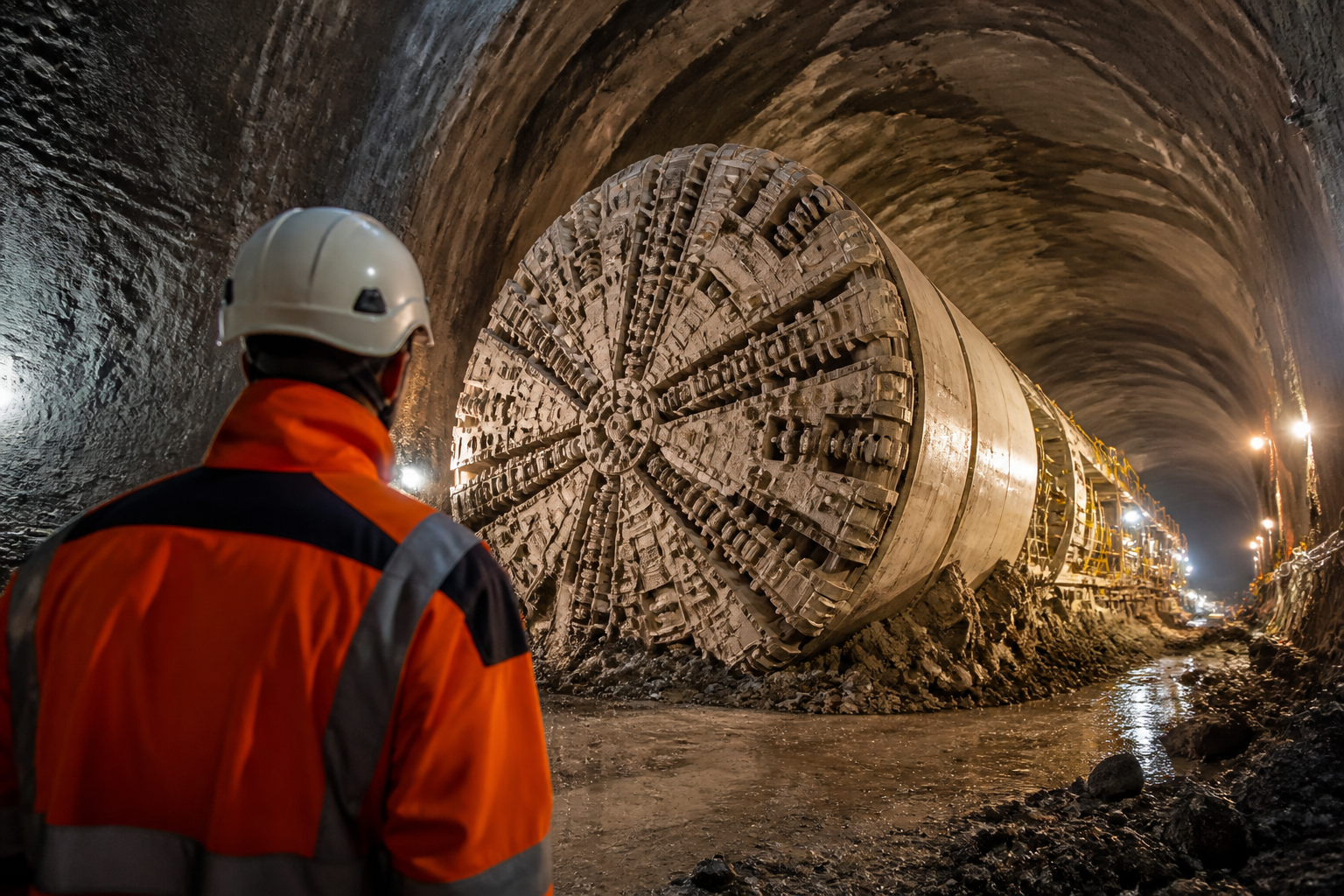
If this were my programme, I would stop reading the order backlog and start logging metres per day. Webuild put a 12.5 metre boring machine into the ground beneath the Southern Apennines on 30 September 2026. The last machine on this same section averaged 16 metres a day.
The new machine is called Aurora. It is excavating the 4,413 metre Melito Tunnel on the Apice to Hirpinia section of the Naples to Bari high-speed and high-capacity line, Railway PRO reported on 30 September 2026. The client is Rete Ferroviaria Italiana, part of the FS Italiane group.
Aurora runs about 100 metres long and weighs around 1,600 tonnes. Eighteen motors give it a combined 6.3 MW. It will install more than 22,200 precast concrete segments and work at a maximum depth of about 130 metres. More than 140 specialised operators and technicians run it around the clock.
One number governs the handover date
Webuild said on 5 May 2026 that it had completed excavation of the 6,455 metre Rocchetta Tunnel on this section. The machine used there, Futura, advanced at an average of 16 metres a day, with peaks above 29 metres. That is the only productivity figure on the section with a completed tunnel behind it.
Apply it to Melito. At 16 metres a day the 4,413 metre drive takes about 276 days of continuous advance, a little over nine months. At 10 metres a day it takes about 441 days. A swing of six metres a day moves the breakthrough by roughly five months.
Nothing downstream recovers that. Track, systems and testing all queue behind the last concrete ring. Advance rate is therefore the programme, and every other date on the section is a derived number.
Seventy per cent of this section is underground
The Apice to Hirpinia section runs 18.7 km, of which about 13 km sits in tunnel. It carries three double-track bores: Grottaminarda at about 1,965 metres, Melito at 4,413 metres and Rocchetta at 6,455 metres. Four viaducts cross the Ufita river, the longest of them 705 metres.
The neighbouring lot is more extreme. Webuild won the Hirpinia to Orsara section in June 2021 for EUR 1.075 billion, with Pizzarotti holding 30 per cent, Railway News reported on 23 June 2021. That section covers about 28 km with roughly 27 km in tunnel.
Lots built this way are priced by geology, segment supply and spoil logistics. Trackwork is the cheap, predictable part. An employer who benchmarks these packages against surface railway rates will misread both the cost and the risk.
The order book is not the binding constraint
Webuild reported results for the six months to 30 June 2026 on 29 July 2026. Total order backlog reached EUR 53.7 billion and construction backlog EUR 46.6 billion. Revenue came in at EUR 6.7 billion with EBITDA of EUR 673 million, a margin of 10.1 per cent. New orders for the year to date stood at EUR 7.7 billion and the net financial position was positive at EUR 110 million.
Set that against the delivery base. In Southern Italy the group listed 21 projects worth over EUR 16 billion staffed by 10,200 people on 5 May 2026. Melito alone absorbs more than 140 of them on a single face.
So the scarce resource is a crewed, equipped tunnel face, and there are only so many of those. Order intake of EUR 7.7 billion in six months does not create one. That gap between orders won and faces working is where schedule risk now lives for every large tunnelling contractor in Europe.
The sponsor has already banked the money
FS Italiane puts the Naples to Bari line at EUR 6.327 billion across 145 km, with phased activation between 2025 and 2030. Journey time between Naples and Bari falls from four hours to about two, and Rome to Bari saves about an hour and a half. The sponsor describes the line as fully funded, including through Italy's national recovery plan.
Funding is therefore settled and the timetable is not. When a programme is fully funded, the political cost of delay lands on the delivery date rather than on the budget line. That changes which number a board should be reporting.
What to watch from here
Public sponsors should derive milestone dates from measured advance rates rather than from a works programme submitted at tender. Where a section is 70 per cent underground, a monthly metres-per-day return is a better progress report than a percentage complete. Asking for it costs nothing and removes the most common source of late surprise.
Contractors bidding tunnel-heavy lots should price segment supply and spoil haulage as critical path items, not as support trades. A segment plant that cannot keep ahead of a 16 metre day will stop the machine as surely as bad ground. Investors have a narrower test. Watch whether Webuild's Italian margin holds while over 60 per cent of revenue comes from outside Italy, because the domestic high-speed lots are where its tunnelling capacity is committed through the end of this decade.
📊 Analytics & Strategic Insight
In tunnel-heavy rail programmes the advance rate has quietly become the only date that matters
The decision most in this industry are avoiding:
👉 Report metres a day, not percentage complete. A percentage figure can be met by moving spend between activities. A metres-per-day return on the critical bore cannot be dressed up, which is exactly why most reporting packs leave it out.
👉 Treat the segment plant as critical path. Melito needs more than 22,200 precast rings. A plant sized for an average day stops the machine on a good one, so the supply line deserves the same scrutiny as the ground investigation.
👉 Admit that orders won do not add capacity. Webuild booked EUR 7.7 billion of new orders in six months and still has a finite number of crewed faces. Growth in backlog without growth in faces lengthens delivery, and someone has to own that arithmetic.
Here's the full context:
→ 2021: Webuild won the Hirpinia to Orsara section of the Naples to Bari line for EUR 1.075 billion with Pizzarotti on 30 per cent, covering about 28 km of which roughly 27 km is tunnel (Railway News, 23 June 2021).
→ May 2026: The group completed the 6,455 metre Rocchetta Tunnel on the Apice to Hirpinia section. Its TBM Futura averaged 16 metres a day with peaks above 29 metres (Webuild, 5 May 2026).
→ May 2026: The same release put Webuild at 21 projects worth over EUR 16 billion in Southern Italy, staffed by 10,200 people.
→ July 2026: Half-year results showed total backlog of EUR 53.7 billion, revenue of EUR 6.7 billion and EBITDA of EUR 673 million at a 10.1 per cent margin, with over 60 per cent of revenue earned outside Italy (Webuild, 29 July 2026).
→ Most recent: On 30 September 2026 the Aurora TBM began excavating the 4,413 metre Melito Tunnel for RFI, with a 12.5 metre cutterhead, 6.3 MW of installed power and more than 140 operators working around the clock.
What this means for infrastructure operators, contractors and investors:
✅ A funded programme shifts the risk to the calendar. The Naples to Bari line is described as fully funded at EUR 6.327 billion, so there is no budget argument left to have. Every remaining dispute will be about time, and time claims are won on records kept from day one.
✅ Tunnel share should drive the contract strategy. At about 70 per cent underground on this section and roughly 96 per cent on the next, these are tunnelling contracts wearing a railway name. Risk allocation, insurance and claims regimes should be written for ground conditions.
✅ Delivery capacity is now a valuation input. With a backlog near EUR 53.7 billion, the question for an equity holder is how fast it converts. Faces working, machines in the ground and crews certified to run them explain conversion better than order intake does.
3 moves you can make this week:
1️⃣ Add an advance-rate line to your board pack. For every active bore, record metres achieved per day this month against the rate assumed at tender. Put the gap in days on the handover date beside it.
2️⃣ Stress the schedule at two advance rates. Run your critical tunnel at the tender rate and at two thirds of it. If the second case breaks a contractual milestone, you have a claim to prepare rather than a surprise to absorb.
3️⃣ Audit your segment and spoil chain. Check that precast output and haulage capacity exceed a peak day, not an average one. Where they do not, fix the supply side before you argue about the machine.
Share it with your peers
Help your network stay ahead of CEE capital projects.
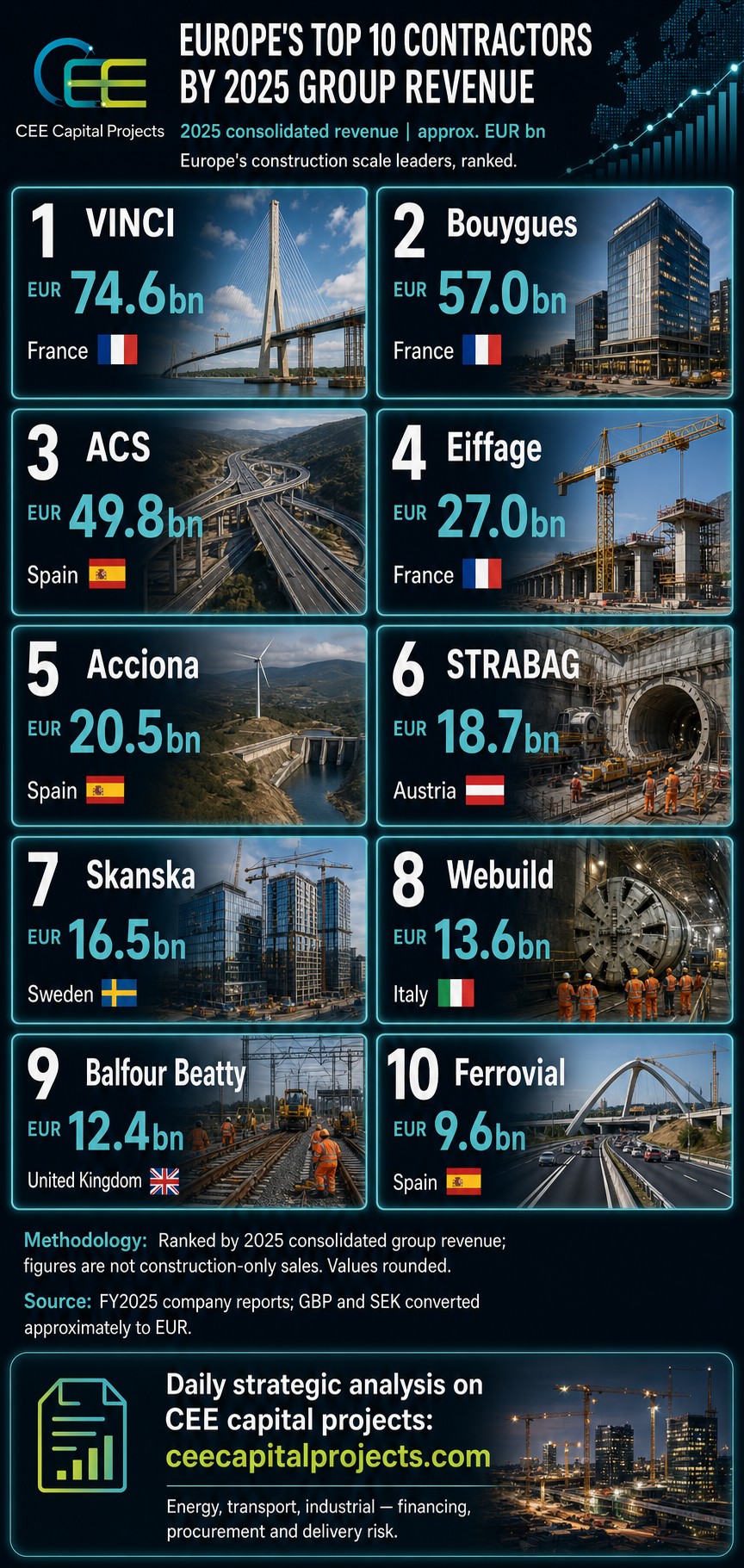
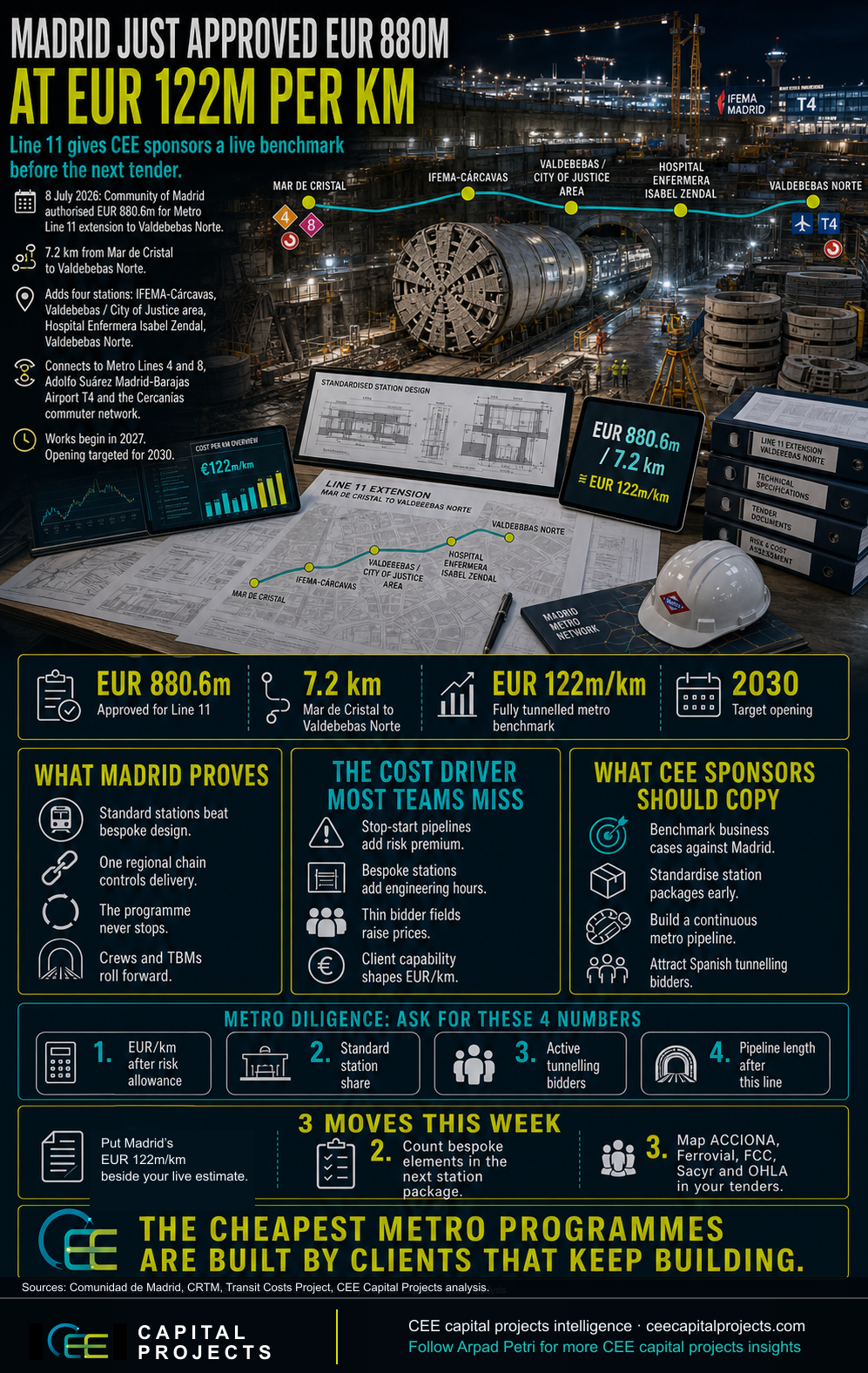
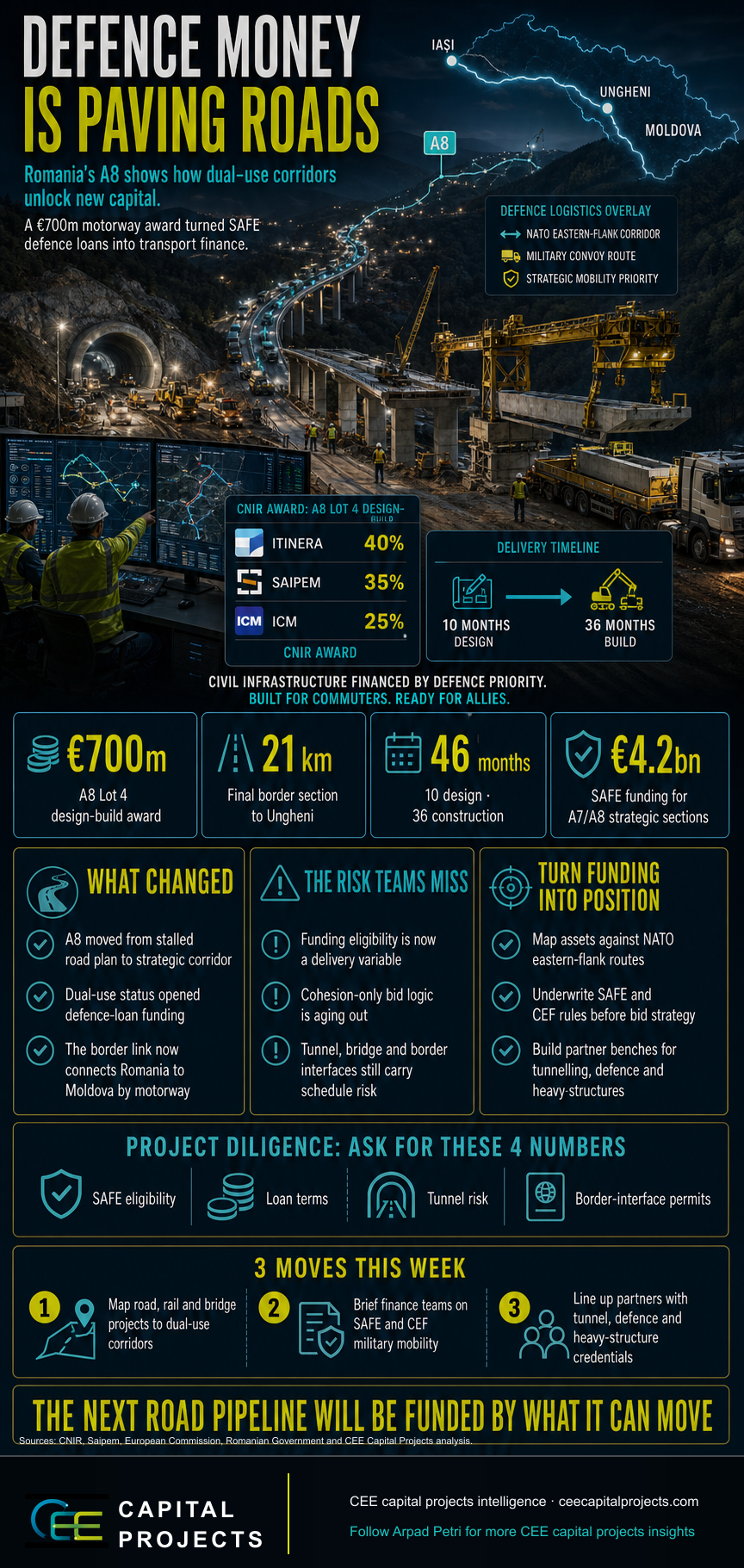
Explore our infograph library — strategic visuals for CEE capital projects leaders.
Project benchmarks, financing structures, tender dynamics and delivery risk — at a glance. Free access for investors, owners, contractors and strategy teams tracking CEE capital projects.
Browse the libraryRelated analyses
- Transport & Infrastructure
ViAlliance35 Wins the Czech D35 Motorway Concession, and the 2.9 Billion Euro Headline Is a Payment Stream
The Czech government has approved the ViAlliance35 concession contract for 35.4 km of the D35 motorway between Opatovec and Mohelnice. The headline of about 2.9 billion euro is the discounted value of 22 years of availability payments, which is a different product from a construction budget.
Read analysis → - Transport & Infrastructure
Poland's PLN 1.3bn A2 Widening: 89 km of Third Lane, and the Pre-2012 Design That Made It Cheap
GDDKiA has signed the fourth and final contract to widen 92 km of the A2 between Łódź and Warsaw, closing a programme worth about PLN 1.3bn. The cost is low because land and structures were sized for a third lane before the motorway opened in June 2012.
Read analysis → - Transport & Infrastructure
CTP Signs Pepco to a 55,619 Sqm Direct Lease at CTPark Bucharest West, and the Space Was Already Occupied
CTP has signed Pepco to a direct long term lease on 55,619 sqm at CTPark Bucharest West, replacing an arrangement the retailer held through a logistics provider. The deal adds no occupied space and changes who stands behind the rent.
Read analysis →
Get a second opinion before it gets expensive.
Contractor selection, tender strategy, a project drifting off track — send us the situation and we'll come back with a clear plan.