We Help International Investors and Project Owners Deliver Major CEE Projects Without Expensive Surprises
Independent project intelligence and advisory across energy, transport, real estate and industrial construction.
ViAlliance35 Wins the Czech D35 Motorway Concession, and the 2.9 Billion Euro Headline Is a Payment Stream
The Czech government has approved the ViAlliance35 concession contract for 35.4 km of the D35 motorway between Opatovec and Mohelnice. The headline of about 2.9 billion euro is the discounted value of 22 years of availability payments, which is a different product from a construction budget.

I had the Czech D35 down as a 2.9 billion euro road. One line in the government's own paperwork changed how I read it. That figure measures future payments rather than construction.
On 26 October 2026 the Czech government approved the winning bid for the D35 completion. It also approved the draft concession contract. Zdopravy.cz reported it the same day, citing the Ministry of Transport. The winner is the ViAlliance35 consortium. Its members are Cintra Global, the highways arm of Spain's Ferrovial, and Austria's STRABAG Motorway. Poland's Budimex and the Dutch infrastructure investor Invesis complete the group. The net present value, or NPV, of its availability payments is about 2.9 billion euro (71.3 billion koruna). Converted at the rate Ferrovial used in its own October release.
What the headline number actually contains
The scope is 35.4 km of new motorway in two sections. They run Opatovec to Staré Město and Staré Město to Mohelnice. The figure is the discounted value of every payment the state will make over the deal's life. That matters because an availability payment buys four things at once. It buys the construction, the debt and equity that fund it, the operation, and 22 years of maintenance. A conventional construction budget contains none of the financing and none of the upkeep. So setting this number against the Road and Motorway Directorate's own build costs compares two different products. The discounting does the rest of the work. A payment due in the late 2040s is worth a fraction of the same payment today. So the headline looks small beside the cash the state will actually hand over. It looks large beside a build-only estimate.
The gap between the three bids is a financing gap
Three consortia filed final bids in July 2026. LitMo brings together FCC, Meridiam and Metrostav Concessions. It bid about 3.1 billion euro (76.2 billion koruna). ViaCM brings together Vinci Highways, Abrdn and John Laing. It bid about 3.5 billion euro (86 billion koruna). The spread between the cheapest and the dearest bid is about 607 million euro. The ministry fixed the scope, the output specification and the deduction regime. The reason that spread opens is simple. With the engineering held constant, the remaining variable is the price of money. Gearing, debt tenor and the equity return each move the discount applied to a two-decade payment stream. Shift that discount and the headline moves by hundreds of millions of euro on identical drawings. So roughly a fifth of the winning bid was decided by balance sheets rather than by civils rates.
Nothing is paid until everything opens
The state starts paying only once all the new sections carry traffic. Construction must finish within 70 months of financial close. Financial close is expected in the first quarter of 2027. So the consortium funds roughly six years of works before the first payment arrives. On a derived basis that puts the opening around late 2032. Here is why that decides who can bid at all. Interest during construction accrues on drawn debt with no revenue against it. The equity carries completion risk, and the deduction regime only starts at availability. Payments are cut if the road or the service falls short of the agreed standards. That is the mechanism that turned this into an investor-led field. Cintra and Invesis bring the capital and hold the long drawdown. STRABAG and Budimex bring the plant and the crews.
The operator inherits 17 km it did not build
The concessionaire also takes over the adjacent Litomyšl to Opatovec section. That stretch runs 17 km and the Road and Motorway Directorate is building it now. The handover happens once the new sections open. That brings about 52 km under one operator for 22 years. Maintaining an asset you did not build is a different risk from maintaining your own. The mechanism is the handover condition survey. Pavement and structures are priced against a baseline recorded at transfer. If that baseline is thin, latent defects in another builder's workmanship arrive as the operator's deductions. Lenders read that schedule closely. Availability deductions hit the same payment that services their debt.
The vote that comes before financial close
Government approval is not a signature. The financial commitments now go to the Chamber of Deputies. They pass through committees and then the floor. Only after that can the contract be signed. That vote is the real condition precedent. The reason is simple. Lenders cannot commit against a state payment obligation that parliament has not yet authorised. Interest and currency hedges are signed at financial close, so every month before it is an open position. One thing works in the programme's favour here. The statutory objection window closed with no challenge from either losing bidder. František Jemelka, the Ministry of Transport's spokesperson, confirmed that to Zdopravy.cz. An appeal is the usual reason an award-to-close gap stretches, and this one has none. Unlike the earlier D4 concession, this contract also lets preparatory works start as soon as it is signed. Those works are planned before the end of 2026.
Where I think this lands
I think this signs and closes inside the first quarter of 2027, close to the published plan. Two things support that. The appeal window has passed. The preparatory-works clause gives the consortium useful work before close. The figure that would change my call is the 70-month construction programme. The reason is simple. Almost 4 km of it is the Dětřichov tunnel, which will be the longest motorway tunnel in the country. The Maletín tunnel adds another 1.3 km. Tunnel excavation rates set the critical path on a job shaped like this. If the drive slips, availability slips with it. Then interest during construction grows, the first payment date moves, and the equity carries both. For the state the structure holds a quiet advantage. It pays nothing for a road it cannot yet drive on. For contractors the lesson is narrower and harder. On this kind of road the civils price is the entry ticket, and the capital stack is the bid.
Share it with your peers
Help your network stay ahead of CEE capital projects.
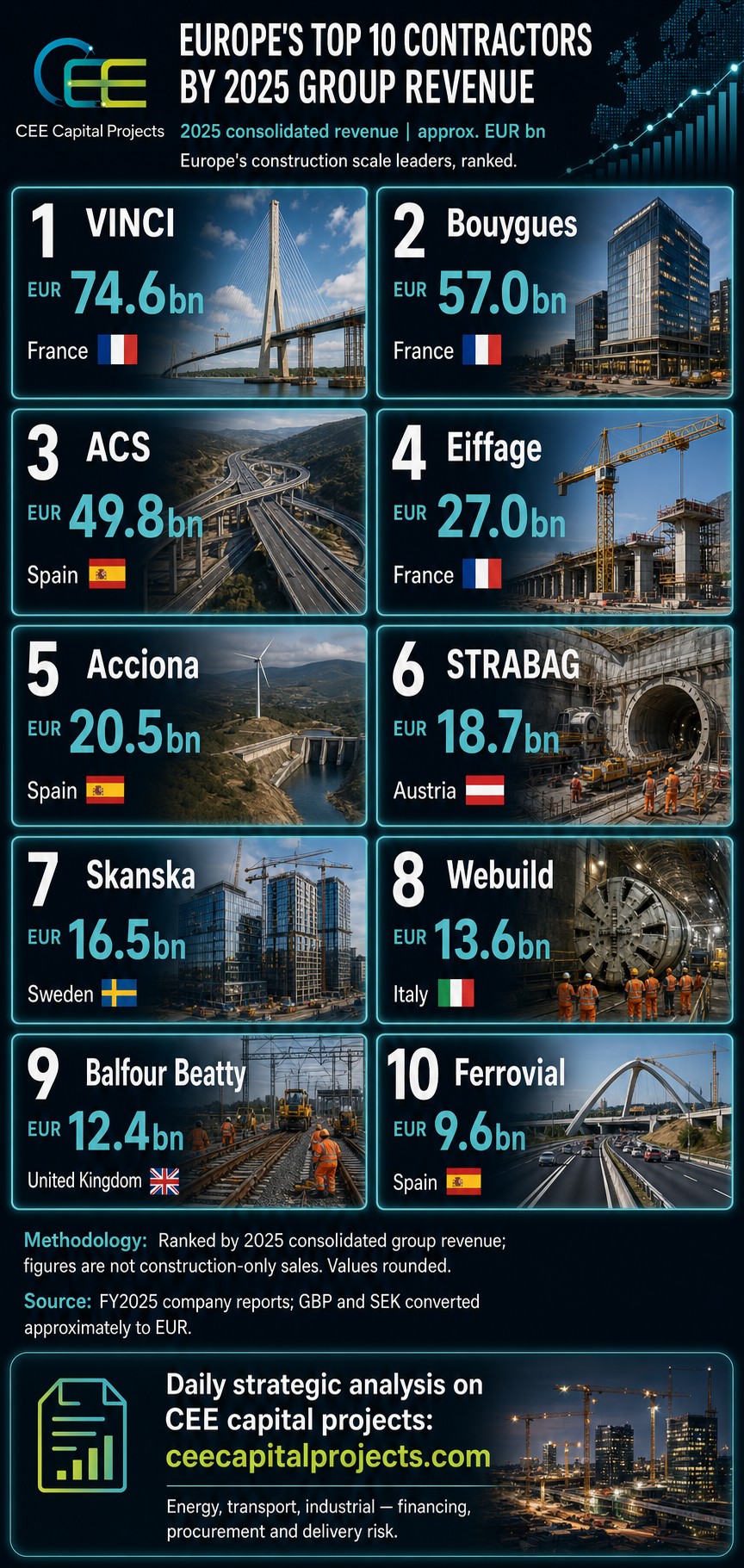
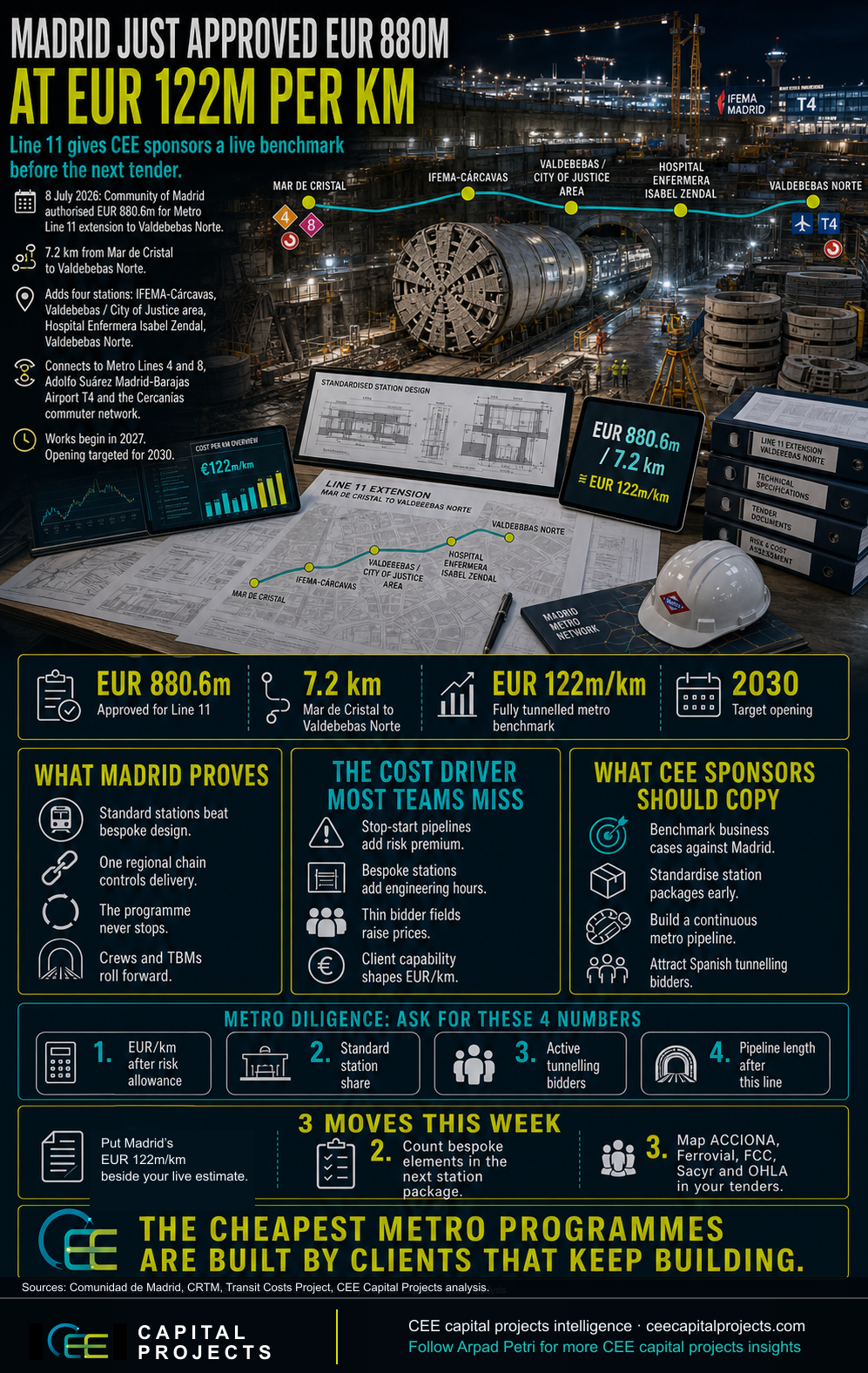
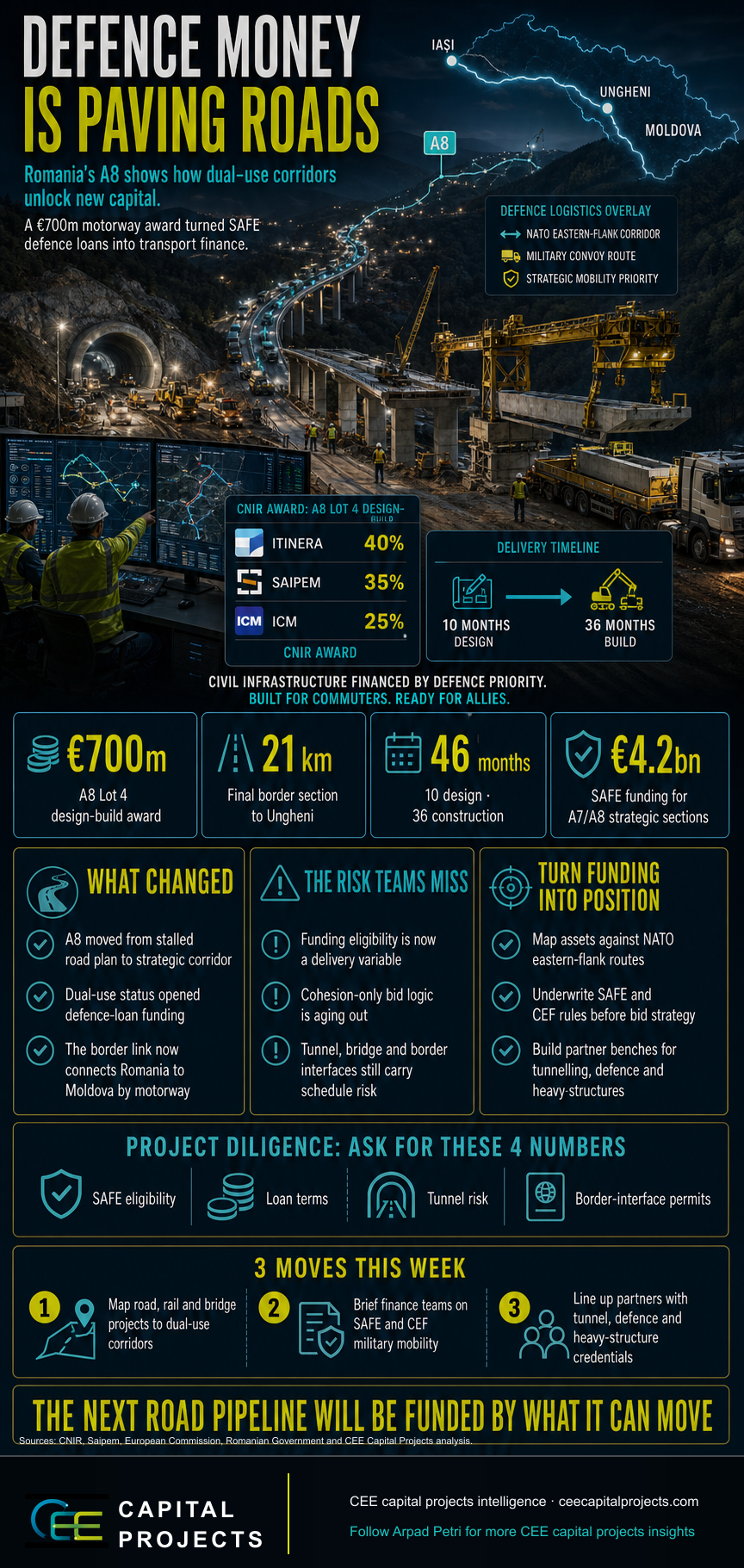
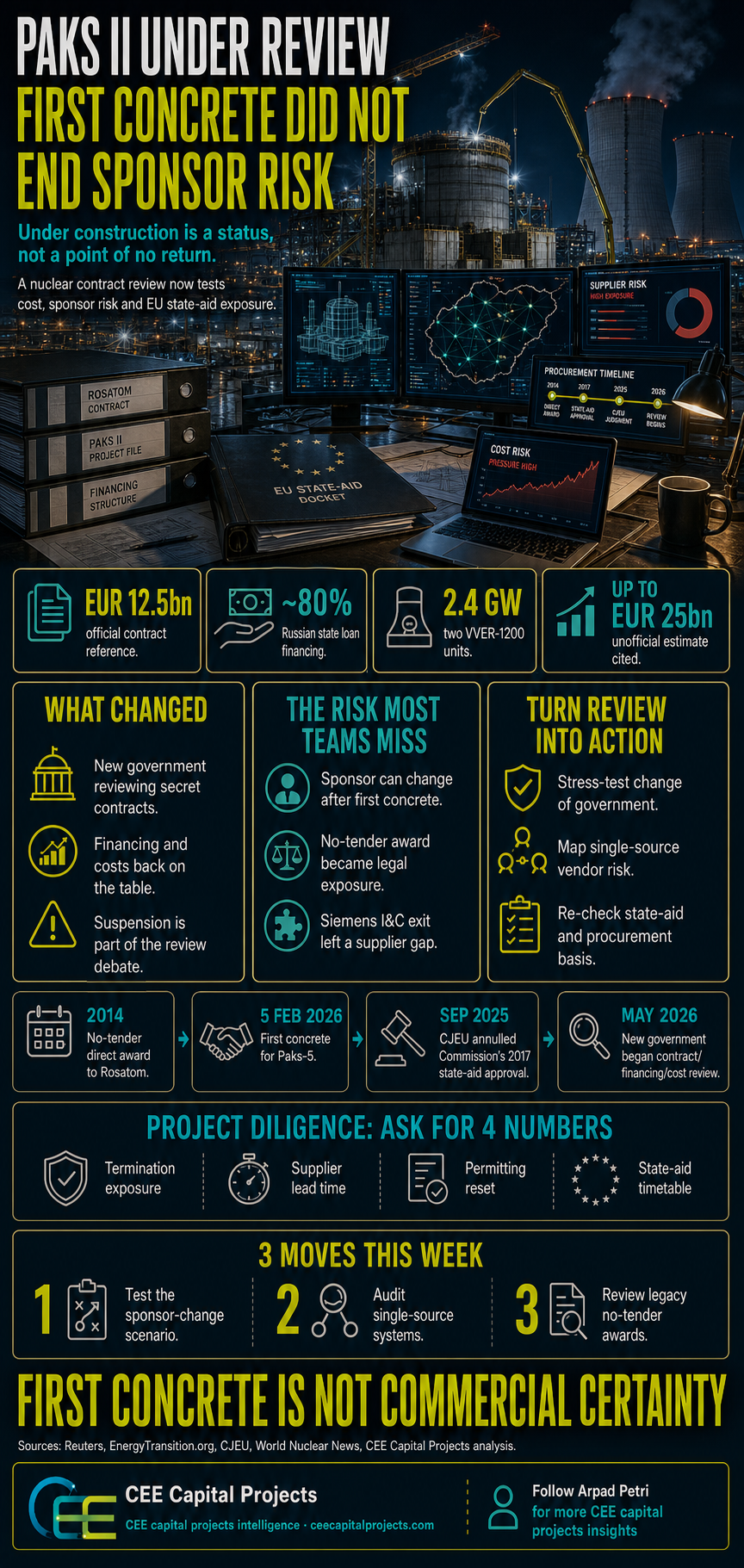
Explore our infograph library — strategic visuals for CEE capital projects leaders.
Project benchmarks, financing structures, tender dynamics and delivery risk — at a glance. Free access for investors, owners, contractors and strategy teams tracking CEE capital projects.
Browse the libraryStrategic Insights
📊 Analytics & Strategic Insight
A concession price is a financing decision wearing a construction costume
The decision most in this industry are avoiding:
👉 Stop benchmarking availability-payment NPVs against construction budgets. Public debate sets the two side by side every time a road PPP is awarded. It produces the wrong verdict in both directions. The honest comparison is whole-life public cost against whole-life public cost. That means the concession set against a state-built and state-maintained road, including the state's own borrowing. Almost nobody publishes that second number.
👉 This competition was fought in treasury departments. Contractors still describe awards like this as construction wins. On fixed scope and a fixed output specification, the differentiator is the capital stack. A builder with no equity partner is out before the drawings are opened.
👉 Taking over somebody else's asset into your own deduction regime is underpriced across the market. Operators treat an inherited section as incremental revenue. It is closer to an open-ended warranty on work they never supervised. The baseline condition survey is the only real protection, and it is usually signed in a hurry.
Here's the full context:
→ Competitive dialogue: The Czech Ministry of Transport ran a competitive dialogue for the D35 completion and admitted four groups.
→ July 2026: Three consortia filed final bids: ViAlliance35, LitMo and ViaCM.
→ 6 October 2026: The ministry named ViAlliance35 as preferred bidder, and Ferrovial confirmed the selection the same day.
→ October 2026: The statutory objection period closed with no challenge from either losing bidder.
→ Most recent: On 26 October 2026 the government approved the bid and the draft concession contract. The financial commitments went to the Chamber of Deputies, with financial close expected in the first quarter of 2027.
What this means for infrastructure operators, contractors and investors:
✅ For the bid team, the qualifying document is the term sheet. On an availability-payment road the engineering submission wins nothing if the funding competition is lost. Pair early with an equity sponsor that can hold a long construction drawdown.
✅ For the lender's technical adviser, the handover condition schedule is now a credit document. An inherited section's baseline drives deductions. Deductions hit the cash that services the debt. Treat the survey as diligence rather than a formality.
✅ For the project board, the parliamentary authorisation is a dated risk. Manage it like one. Put the committee stage on the critical path. Hold the hedging strategy ready for the week of signature.
3 moves you can make this week:
1️⃣ Rebuild one of your own PPP bids as a payment stream. Strip out the construction cost and see what financing and the maintenance tail contribute to the headline. If you cannot produce that split in a day, your bid model is a cost estimate with a wrapper.
2️⃣ Pull the handover condition schedule for every asset you maintain but did not build. Check whether a baseline survey exists and whether latent defects are carved out. Where it is missing, raise it before the next deduction cycle.
3️⃣ Run a discount-rate sensitivity on your longest concession. Write down what a modest rate move does to the bid price. Take that single page to your next bid-no-bid meeting. It will change which jobs you chase.
The analyst's read:
This proves that a Czech availability-payment road can be competed to a decided winner and an unchallenged award. The D4 experience had left that open. It does not prove the model is cheaper than conventional delivery. The comparison the state has not published is the whole-life public cost of building and maintaining the same road itself. The figure that settles it is the financing cost locked at financial close.
Related analyses
- Transport & Infrastructure
Poland's PLN 1.3bn A2 Widening: 89 km of Third Lane, and the Pre-2012 Design That Made It Cheap
GDDKiA has signed the fourth and final contract to widen 92 km of the A2 between Łódź and Warsaw, closing a programme worth about PLN 1.3bn. The cost is low because land and structures were sized for a third lane before the motorway opened in June 2012.
Read analysis → - Transport & Infrastructure
CTP Signs Pepco to a 55,619 Sqm Direct Lease at CTPark Bucharest West, and the Space Was Already Occupied
CTP has signed Pepco to a direct long term lease on 55,619 sqm at CTPark Bucharest West, replacing an arrangement the retailer held through a logistics provider. The deal adds no occupied space and changes who stands behind the rent.
Read analysis → - Transport & Infrastructure
Slovakia Reopens the EUR 1.57bn D1 Turany-Hubova Tender With Its EUR 870m Tunnel Line Still Unverified
Slovakia's procurement regulator cleared the D1 Turany-Hubova tender to continue on 21 October 2026 and the participation deadline moved to 19 November. The state's own value-for-money unit had already put the mined tunnel works near EUR 870m and said it could not verify them.
Read analysis →
Facing a decision on a CEE capital project?
Describe the situation in a few sentences. Within 72 hours you get an experienced read: the risks we see, what we'd check, and whether we can help — no calls, no obligation.