We Help International Investors and Project Owners Deliver Major CEE Projects Without Expensive Surprises
Independent project intelligence and advisory across energy, transport, real estate and industrial construction.
Poland's PLN 1.3bn A2 Widening: 89 km of Third Lane, and the Pre-2012 Design That Made It Cheap
GDDKiA has signed the fourth and final contract to widen 92 km of the A2 between Łódź and Warsaw, closing a programme worth about PLN 1.3bn. The cost is low because land and structures were sized for a third lane before the motorway opened in June 2012.
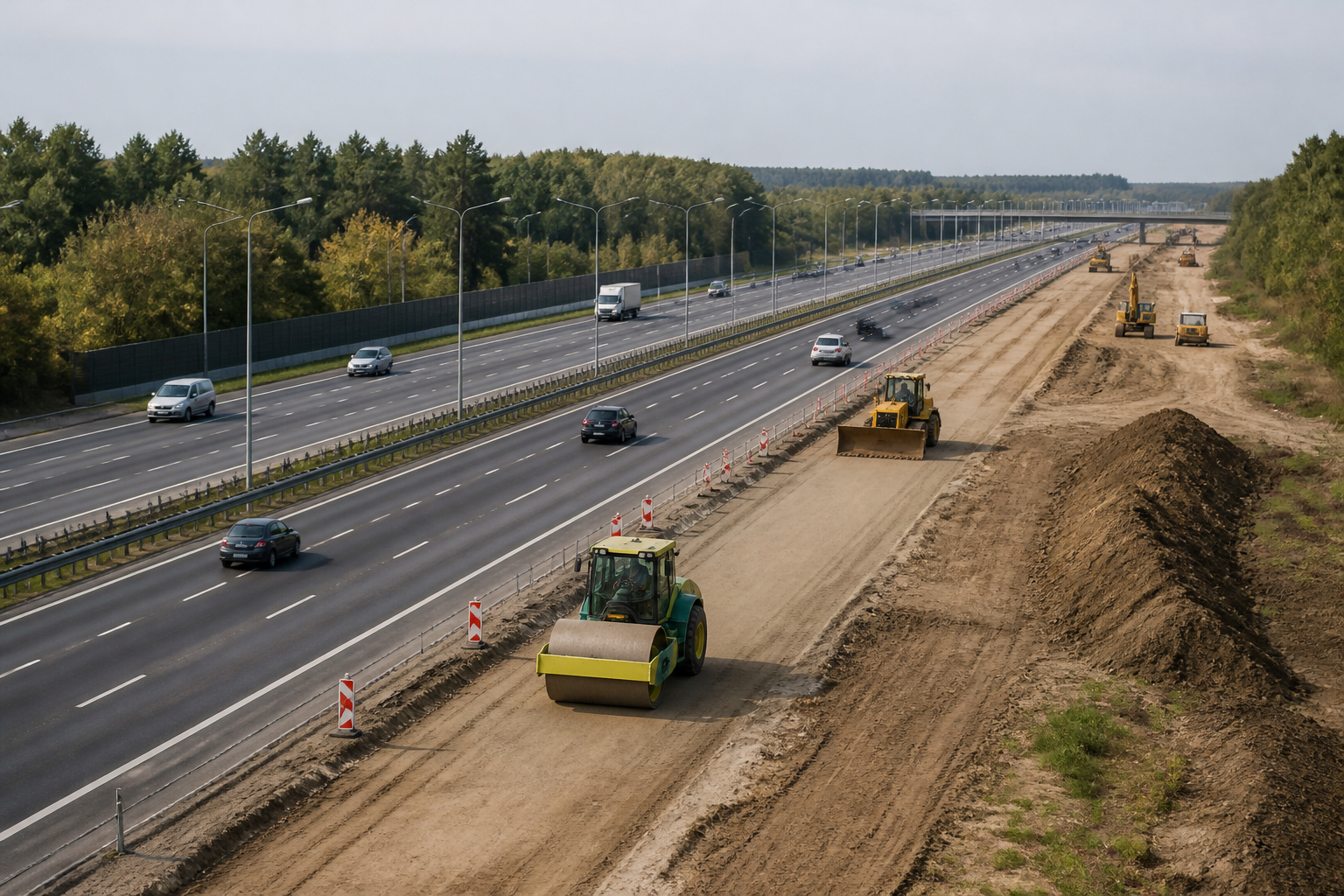
The coverage reads this as a roadworks story. I read it as a verdict on a set of drawings signed off before 2012. GDDKiA has now signed all four contracts to widen the A2 between Łódź and Warsaw.
Rynek Infrastruktury reported on 26 October 2026, citing GDDKiA, that the final package went to Budimex for over PLN 453m. It covers 28 km between the Łódź Północ and Łowicz junctions. Three earlier sections went to STRABAG: PLN 231m signed on 24 June, just over PLN 295m on 21 August, and nearly PLN 345m on 11 September. The four contracts total about PLN 1.3bn. The programme covers 92 km. Of that, 89 km gains a lane in each direction. The remaining 3 km is resurfacing and lighting work at Łódź Północ, where the A1 crosses.
The headroom was bought in the design office
GDDKiA's own account carries the detail that matters most. When the motorway was first designed, the agency reserved land for extra lanes. It also built the structures spanning the motorway wide enough to clear a broader carriageway later.
That decision is why a third lane now costs what it costs. Divide PLN 1.3bn by 89 km of widened route and the figure is roughly PLN 14.6m per kilometre. New two-lane motorway in Poland does not get built at that number. At Łódź Północ no widening is needed at all, because each carriageway there already carries three lanes.
Nothing here required a fresh land-acquisition round. No viaduct deck has to come down to make room. The expensive parts of a capacity upgrade were paid for once, at design stage, when they were cheap.
Fourteen years from opening to near-capacity
The A2 on this alignment opened in June 2012. GDDKiA now describes its capacity as close to exhausted. The latest General Traffic Measurement puts daily traffic at nearly 60,000 vehicles near Łódź and almost 100,000 near Warsaw.
That is fourteen years from ribbon to rebuild. It sits inside the design life of the pavement and well inside the life of the structures. Any sponsor sizing a carriageway on a thirty-year traffic forecast should sit with that number.
Four contracts and a staggered finish
The sections do not finish in the order they were signed. Two complete by the end of 2027. A third runs to January 2028. The Budimex section, signed last, runs to April 2028.
That last contract was also the slowest to reach signature. A rival bidder took the award to the Warsaw Regional Court. The court upheld the National Appeals Chamber's choice of the winning bid. Main carriageway works are due to begin in November.
Two lanes in each direction stay open throughout. The works zone carries a 70 km/h limit with average-speed enforcement. That constraint sets the productivity a contractor can plan for, more tightly than the asphalt does.
Brownfield widening is a different trade
Greenfield motorway rewards earthworks scale, long open fronts and bulk haulage. Widening under live traffic rewards none of those things.
The work happens in a narrow corridor beside moving vehicles. Plant is smaller. Shifts are shorter or nocturnal. Barrier, signage and traffic-management costs become a real line rather than a preliminary. Safety management absorbs supervision time that a greenfield site spends on production. A contractor whose cost base assumes volume will price this work badly or deliver it slowly.
Poland is not alone in facing the question. The Czech D1 and Hungary's M1 are both being taken to three lanes in each direction. The first generation of CEE motorway is reaching the traffic levels it was sized for. Much of it was built with cohesion money between 2005 and 2015.
What sponsors should take from this
The useful lesson sits with sponsors who are still drawing. A reserved median and oversized overbridges add a small percentage to a first build. They remove a land-acquisition programme and a structures replacement programme from a widening fifteen years later.
Contractors should read the A2 as a signal about where the Polish roads market goes next. Public clients should put one question to their designers on every new alignment: what does the third lane cost if we want it in 2041? Investors holding toll or availability-based road assets should ask the same question about what they already own. Headroom is value, and its absence is a capital call waiting for a date.
📊 Analytics & Strategic Insight
Capacity headroom is an option, and most CEE motorways were sold without one
The decision most in this industry are avoiding:
👉 Design headroom never makes the value-engineering list, and it should. Reserving a median and oversizing overbridges is the first item cut when a first-build budget tightens. The saving shows up this year. The cost lands on a different team fifteen years later.
👉 A thirty-year traffic forecast is a commercial document before it is a technical one. The A2 reached near-capacity in fourteen years. A sponsor who sizes a carriageway on the central case is buying a widening nobody has budgeted.
👉 Brownfield widening needs a different contractor, and the market has not sorted itself yet. Firms priced for earthworks volume are bidding work that pays for traffic management and night shifts. Some will take it at greenfield margins and learn the difference on site.
Here's the full context:
→ 2012: The A2 between Łódź and Warsaw opens in June with two lanes each way. Land is reserved and structures are sized for a later third lane.
→ 2012 to 2026: Traffic builds to nearly 60,000 vehicles a day near Łódź. The latest General Traffic Measurement puts it close to 100,000 near Warsaw.
→ June to September 2026: GDDKiA signs three widening contracts with STRABAG, worth PLN 231m, just over PLN 295m and nearly PLN 345m.
→ October 2026: A losing bidder challenges the fourth award. The Warsaw Regional Court upholds the National Appeals Chamber decision on the winning bid.
→ Most recent: On 26 October 2026 GDDKiA signs the final package with Budimex for over PLN 453m. That completes a PLN 1.3bn programme across 92 km.
What this means for infrastructure operators, contractors and investors:
✅ The Polish roads pipeline is shifting from new alignment to upgrade. Volume keeps coming. It arrives in packages that look more like renewal than like construction.
✅ Traffic management is becoming a priced capability. A client awarding widening under live traffic is buying a logistics service with asphalt attached.
✅ A road asset without headroom carries a hidden liability. A concession or availability asset that cannot be widened cheaply will need a capital event. The alternative is to throttle its own revenue.
3 moves you can make this week:
1️⃣ Pull the design files on every road asset you hold or operate. Check whether the median is reserved and whether the overbridges span a wider deck. Write the answer down per asset.
2️⃣ Reprice one live widening bid against a traffic-management cost base. Strip out the earthworks learning curve and the long-front productivity assumption. Then look again at the margin.
3️⃣ Add one question to your design review gate. Ask what a third lane costs in 2041 on this alignment. Record that number beside the capital saving from leaving it out.
Share it with your peers
Help your network stay ahead of CEE capital projects.
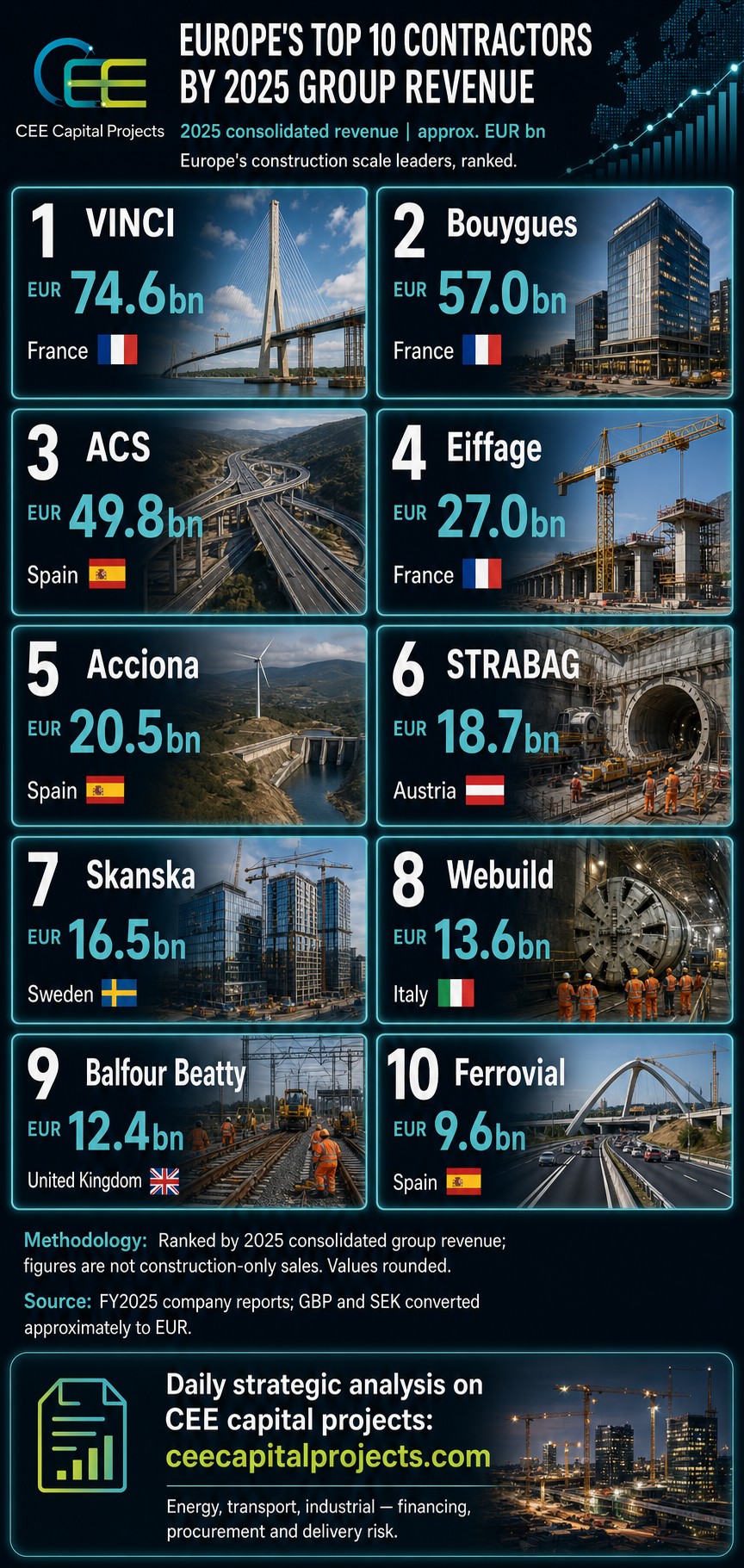
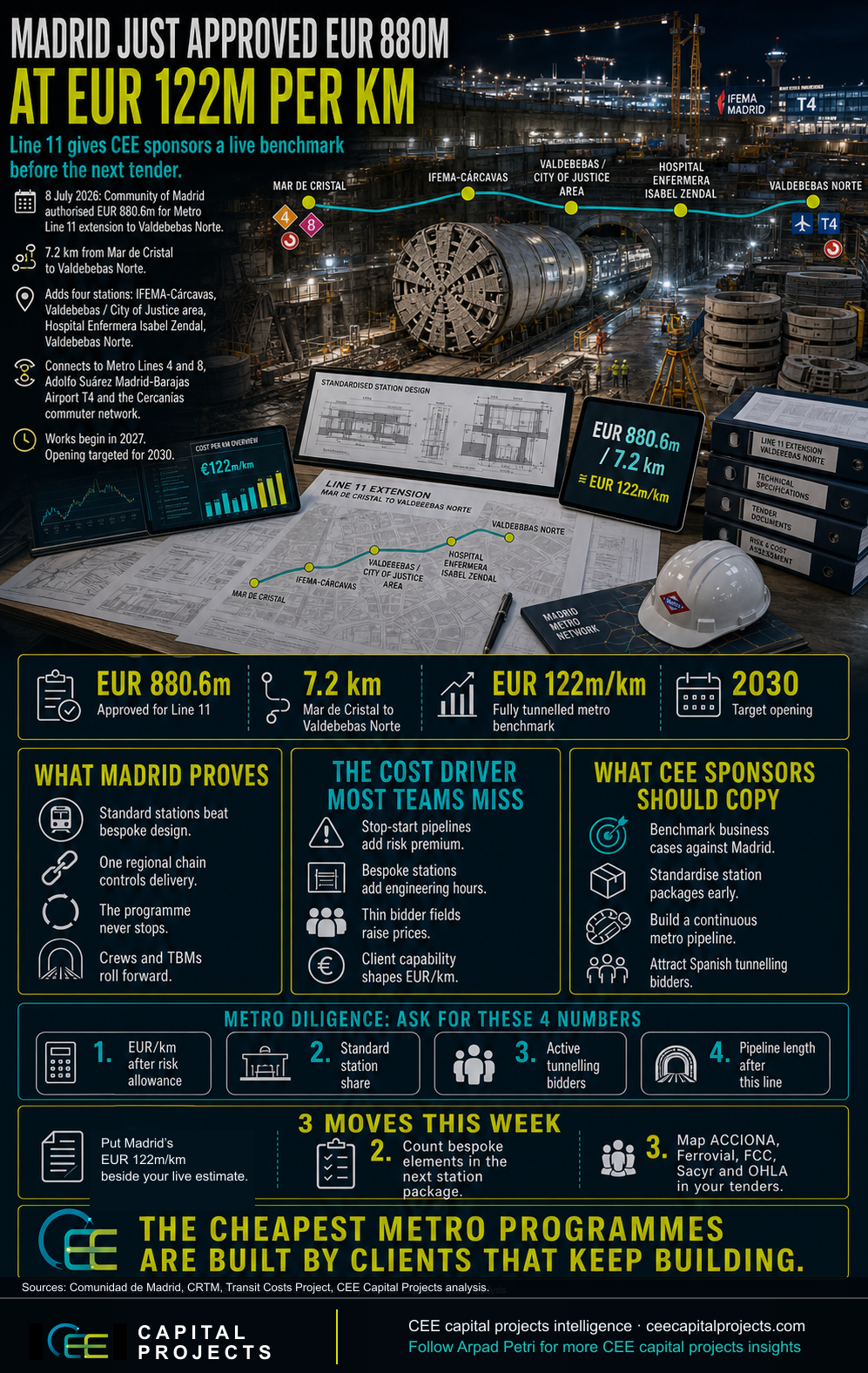
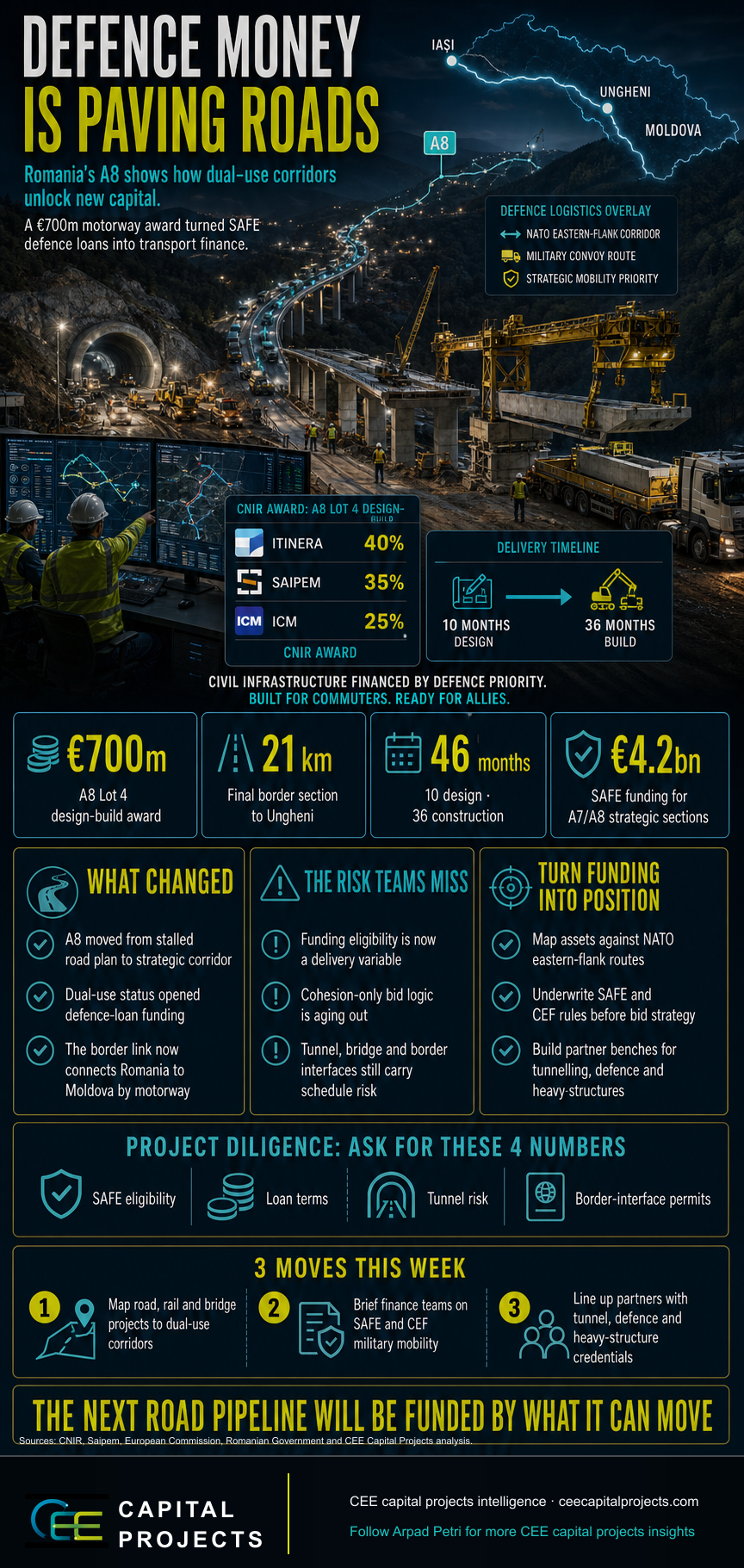
Explore our infograph library — strategic visuals for CEE capital projects leaders.
Project benchmarks, financing structures, tender dynamics and delivery risk — at a glance. Free access for investors, owners, contractors and strategy teams tracking CEE capital projects.
Browse the libraryRelated analyses
- Transport & Infrastructure
ViAlliance35 Wins the Czech D35 Motorway Concession, and the 2.9 Billion Euro Headline Is a Payment Stream
The Czech government has approved the ViAlliance35 concession contract for 35.4 km of the D35 motorway between Opatovec and Mohelnice. The headline of about 2.9 billion euro is the discounted value of 22 years of availability payments, which is a different product from a construction budget.
Read analysis → - Transport & Infrastructure
CTP Signs Pepco to a 55,619 Sqm Direct Lease at CTPark Bucharest West, and the Space Was Already Occupied
CTP has signed Pepco to a direct long term lease on 55,619 sqm at CTPark Bucharest West, replacing an arrangement the retailer held through a logistics provider. The deal adds no occupied space and changes who stands behind the rent.
Read analysis → - Transport & Infrastructure
Slovakia Reopens the EUR 1.57bn D1 Turany-Hubova Tender With Its EUR 870m Tunnel Line Still Unverified
Slovakia's procurement regulator cleared the D1 Turany-Hubova tender to continue on 21 October 2026 and the participation deadline moved to 19 November. The state's own value-for-money unit had already put the mined tunnel works near EUR 870m and said it could not verify them.
Read analysis →
Facing a decision on a CEE capital project?
Describe the situation in a few sentences. Within 72 hours you get an experienced read: the risks we see, what we'd check, and whether we can help — no calls, no obligation.