We Help International Investors and Project Owners Deliver Major CEE Projects Without Expensive Surprises
Independent project intelligence and advisory across energy, transport, real estate and industrial construction.
VINCI's Fehmarnbelt Consortium Just Placed Tunnel Element 3 of 89. It Is Also Billing Denmark EUR 1.95bn for the Trench It Sits In
Femern Link Contractors immersed the third of 89 elements on 2 August 2026, three in 88 days, with 86 still to go. The same VINCI-led joint venture is claiming DKK 14.5bn from the Danish client over a seabed trench dug by somebody else.
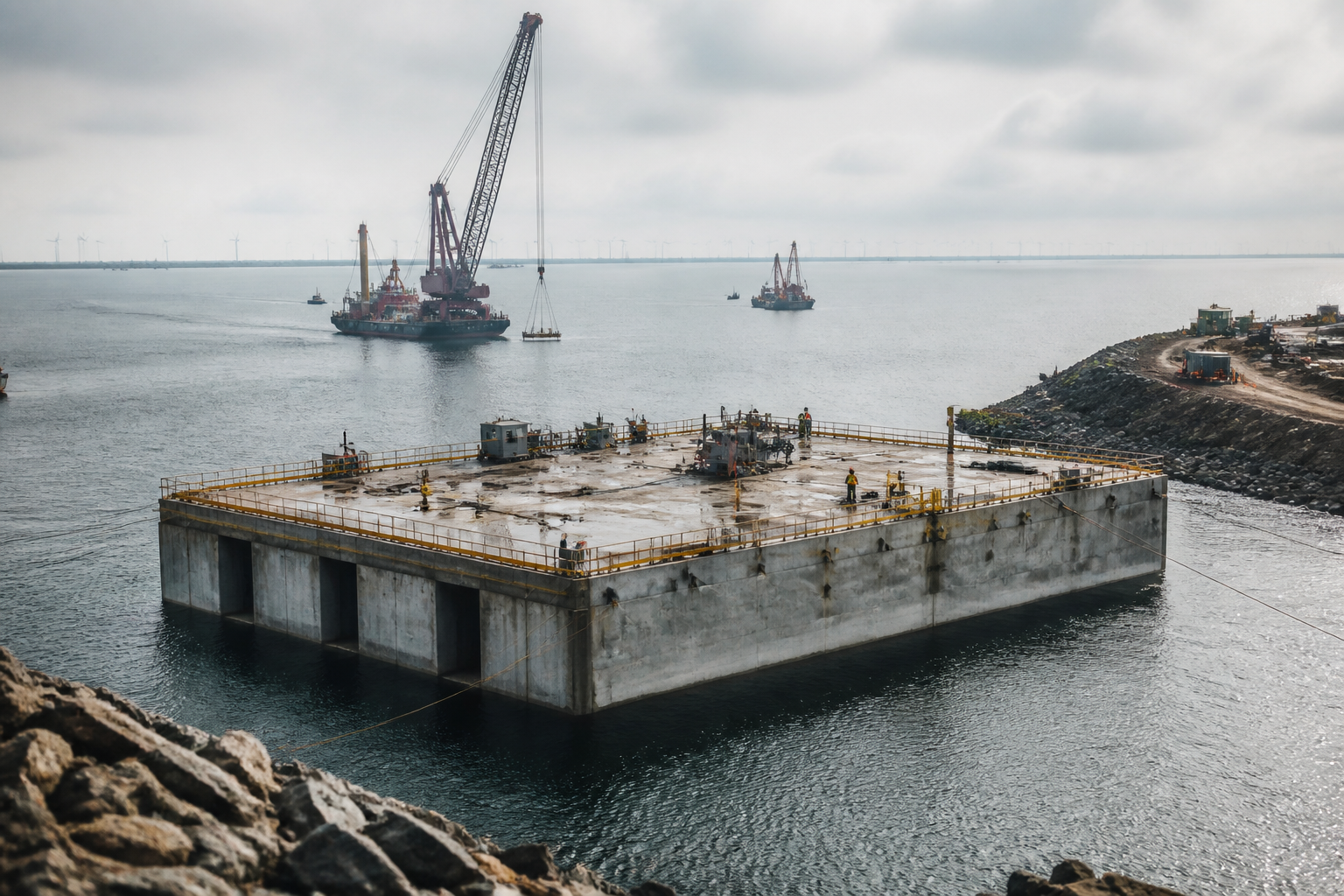
On 2 August, five tugboats towed a 217-metre concrete box weighing more than 73,500 tonnes about 500 metres off the coast of Lolland and lowered it onto the seabed. It was the third of 89 elements that will make up the Fehmarnbelt tunnel between Denmark and Germany. The first was immersed on 6 May, the second on 29 June. Three elements in 88 days. Eighty-six to go.
Femern A/S, the Danish state-owned client, described the operation as a demanding precision task and said its contractor gains useful experience with each immersion. Both statements are accurate. Neither addresses the arithmetic.
Three down, 86 to go: the run rate is the schedule
Take the observed cadence at face value and roughly one element goes in every 29 days. Hold that flat and the remaining 86 take just under seven years, putting the last one on the seabed around 2033. Nobody expects the rate to stay there. Immersion campaigns are seasonal, crews climb a learning curve, and Sund & Bælt has said it will publish a revised schedule once the first elements are in and it has seen how the standard and special elements behave in practice.
That is the honest position: the programme does not yet have a defensible completion date, and the next four immersions will produce one. For anyone underwriting the corridor, the metric to track from here is days between immersions, not tonnes placed. Femern already concedes that work on the Danish side is running about two years late because of problems with the specialised vessel used to sink the elements.
The EUR 1.95bn argument is about a hole in the seabed
Running alongside the marine campaign is a commercial dispute large enough to be a project in its own right. Femern Link Contractors, the joint venture led by VINCI Construction Grands Projets, has lodged a claim of DKK 14.5bn against Femern A/S — roughly EUR 1.95bn, or a quarter of the project's approximately EUR 7.4bn capital cost. A separate international arbitration over Covid-era delay is running at around DKK 570m.
The subject of the big claim is the trench. The 18-kilometre channel on the seabed was dredged between 2020 and 2024 by a different consortium, Fehmarn Belt Contractors, led by Royal Boskalis Westminster and Van Oord. Femern A/S accepted that work from the dredging contractor. FLC, which has to place 89 elements into it, has declined to take it over. Sund & Bælt has since paid extra to have the first 650 metres of trench prepared to FLC's satisfaction; the remaining seventeen-plus kilometres sit in negotiation.
Strip away the specifics and this is the oldest failure mode in split-package delivery. Two contracts, one physical boundary, and a client standing between them holding an interface it never priced. Whoever signs off package A's work owns the argument with package B. On a project where the boundary is a dredged trench under forty metres of water, that argument costs EUR 1.95bn to have.
Germany's clock runs on permits, not concrete
The Danish end is not the only constraint. In July 2025 Germany's federal transport ministry confirmed that the rail land facilities on the German side would not be operational in 2029 as planned, citing approval and permit procedures. The German plan approval also sets hard limits on underwater noise and on when and where marine work can take place in German waters, which removes most of the flexibility a delayed marine programme would normally use to claw time back.
On 17 May 2026 Sund & Bælt drew the obvious conclusion and split the opening in two. Road first, rail whenever the German land facilities are ready. Chief executive Mikkel Hemmingsen called the rail lag unfortunate for the green transition and for rail passengers, and framed the split as a way to get the asset earning sooner while simplifying the endgame.
What a phased opening buys, and what it costs
The commercial logic is sound. Fehmarnbelt is user-financed, so opening the four road lanes brings toll revenue forward against a debt stack that accrues interest either way. It also decouples two commissioning programmes that would otherwise have to succeed at the same moment.
The cost sits in the case that justified the tunnel. The EU has committed roughly EUR 1.3bn of Connecting Europe Facility money to the construction phase, and the rail link is the reason: a seven-minute crossing that halves the Hamburg to Copenhagen rail journey and closes the Scandinavian gap in the TEN-T network. A road-only Fehmarnbelt is a faster ferry. The corridor benefit arrives with the trains.
For contractors and sponsors elsewhere in Europe, the transferable lesson has nothing to do with immersed tunnels. It is that on any programme split into separately procured packages, the handover between them is a priced risk somebody has to carry, and the party holding it is rarely the party best placed to manage it. Rail Baltica, CPK, the German Generalsanierung and every Baltic grid build-out have the same seam running through them. Denmark is currently paying to find out what that seam is worth.
Share it with your peers
Help your network stay ahead of CEE capital projects.
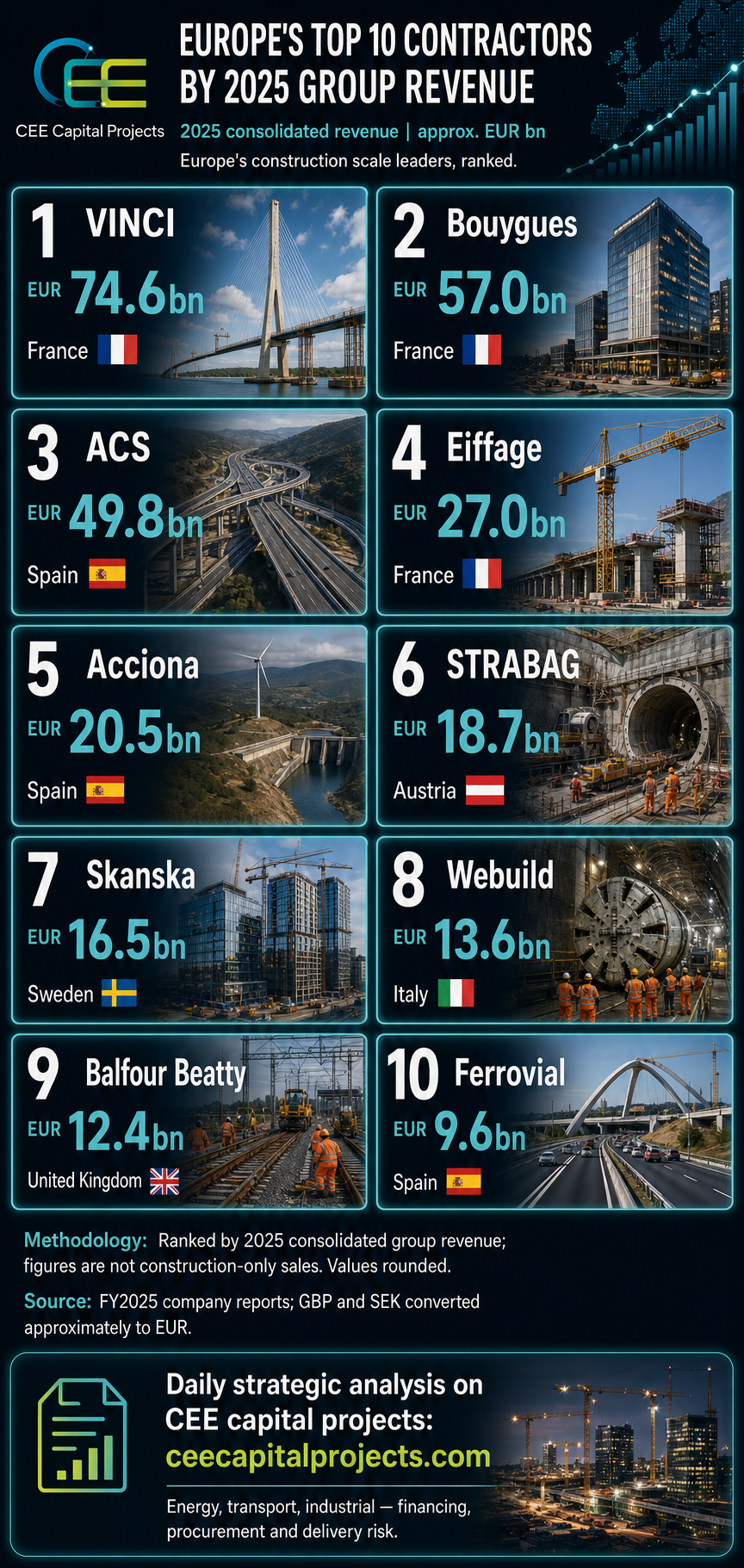
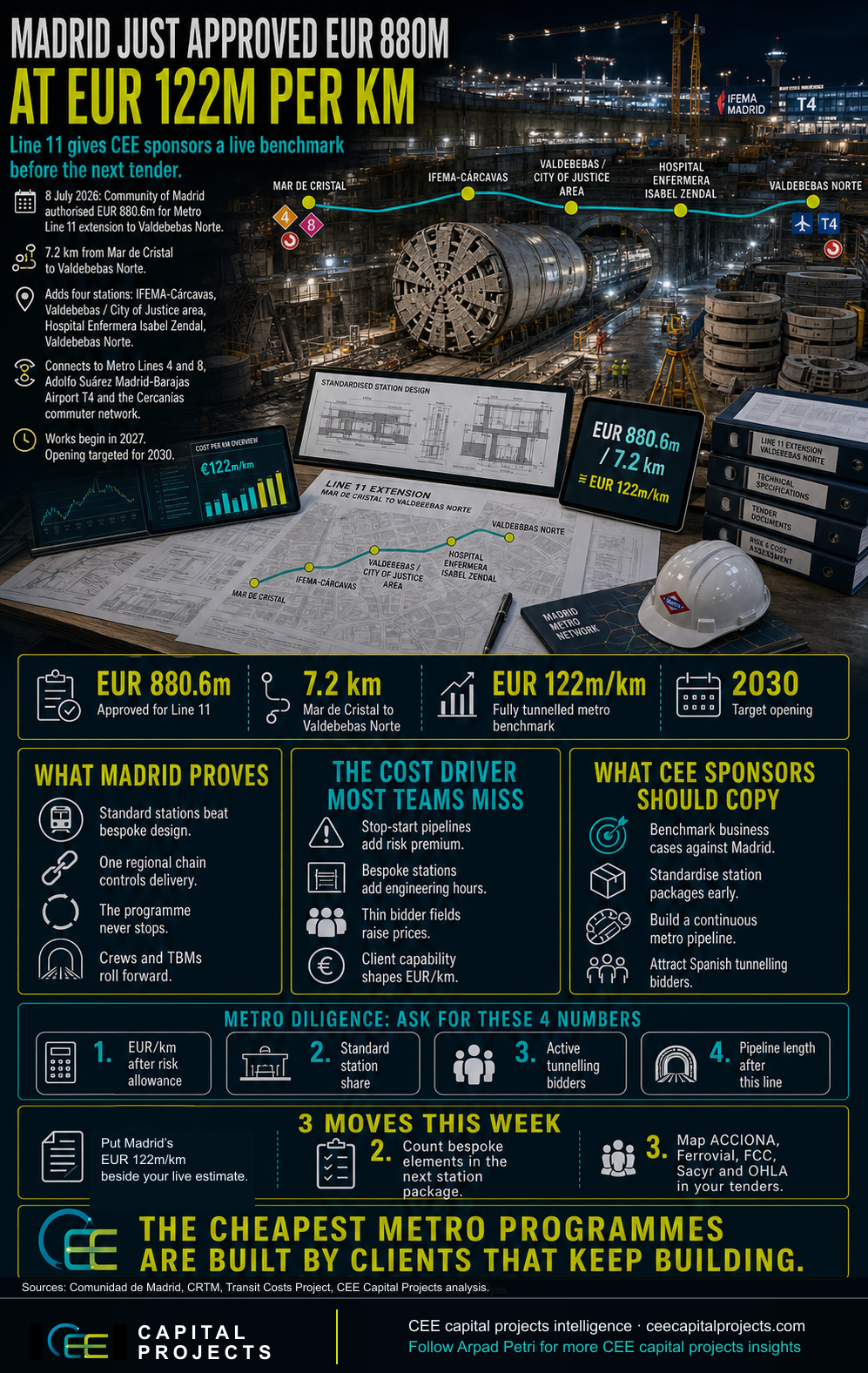
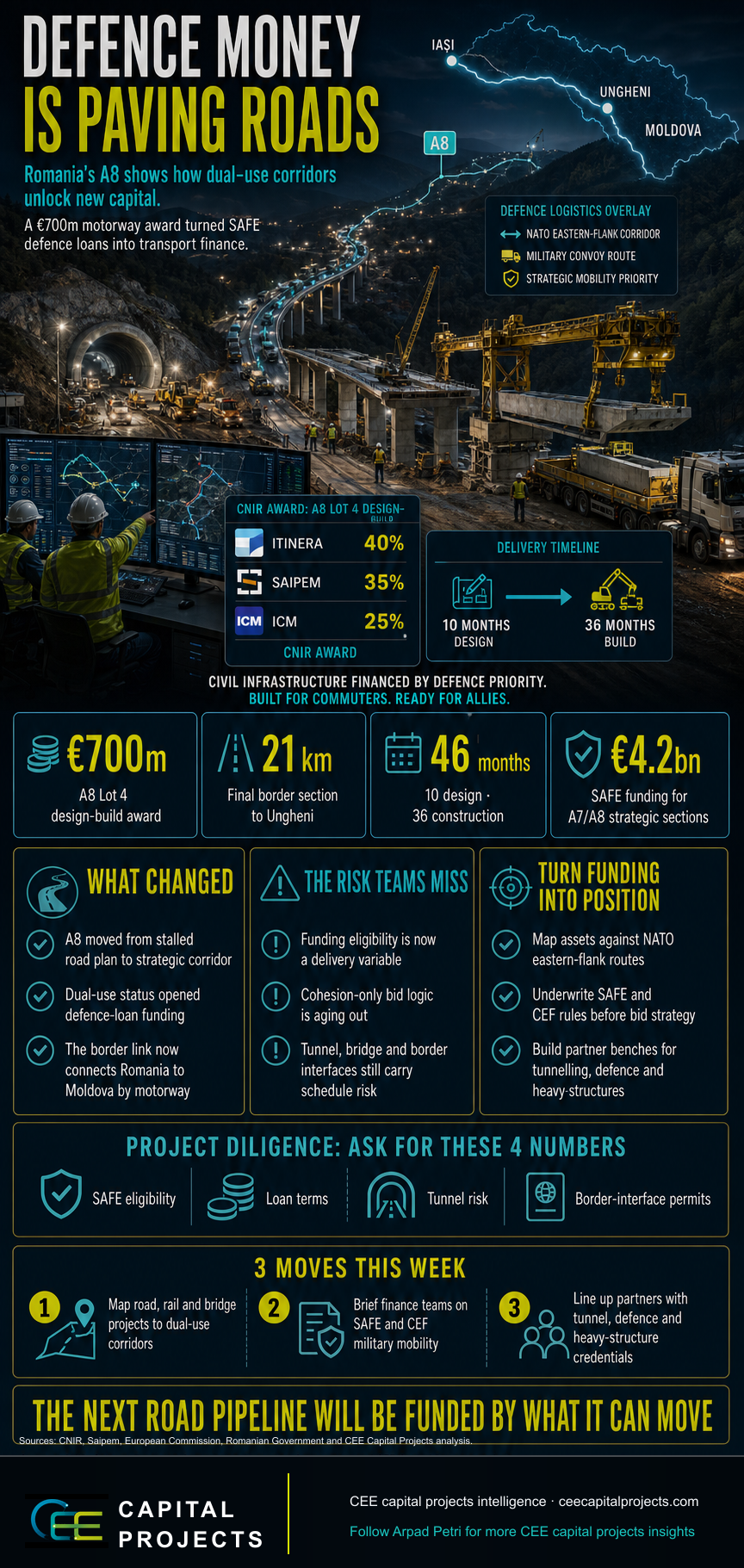
Explore our infograph library — strategic visuals for CEE capital projects leaders.
Project benchmarks, financing structures, tender dynamics and delivery risk — at a glance. Free access for investors, owners, contractors and strategy teams tracking CEE capital projects.
Browse the libraryStrategic Insights
📊 Analytics & Strategic Insight
The gap between two contracts is where big projects go wrong
The decision most in this industry are avoiding:
👉 Nobody owns the seam. One firm digs the trench. A second firm has to fill it. The client sits in the middle. When the second firm says the trench is not good enough, no contract says who pays. That gap is worth EUR 1.95bn here.
👉 Splitting a job into packages moves risk. It does not delete it. Clients split work to get better prices on each piece. The risk lands on the handover between the pieces. It never shows up in the tender price.
👉 Watch the pace, not the photo. A 73,500-tonne box being lowered into the sea makes a great picture. Three boxes in three months tells you when the road opens. Most boards look at the picture.
Here's the full context:
→ 2020 to 2024: A Dutch team, Boskalis and Van Oord, dug the 18 km trench on the seabed. The client accepted the work as finished.
→ July 2025: Germany said the rail works on its side will not be ready in 2029. Permits take too long.
→ 6 May and 29 June 2026: The first and second tunnel pieces went onto the seabed.
→ 17 May 2026: Sund & Bælt split the opening in two. Cars first. Trains later.
→ Most recent: On 2 August 2026 the third piece went down. 86 are left. The main contractor is claiming DKK 14.5bn from the client over the trench it will not accept.
What this means for infrastructure operators, contractors and investors:
✅ Price the handover before you sign. If your work starts where someone else stopped, put the acceptance test in writing. Name who inspects, what counts as a pass, and who pays if it fails.
✅ Use the first few cycles as the real forecast. The first three repeats of any task tell you more than the plan does. Rebuild the end date from them and share it early.
✅ A staged opening can be a smart move. Cars pay tolls while the trains wait. But the money case was built on the trains, so be clear about what the delay costs as well.
3 moves you can make this week:
1️⃣ List your handovers. Take your biggest job. Write down every point where one firm hands work to another. Mark who signs each one off.
2️⃣ Check one acceptance clause. Pick the handover with the most money behind it. Read what the contract says a pass looks like. If it is vague, fix it now.
3️⃣ Start a cycle log. Record the days between each repeat task on site. Show that trend at the next board meeting instead of a percentage complete.
Related analyses
- Transport & Infrastructure
V-Híd Just Lost Hungary's HUF 338 Billion Déli Körvasút at 42 Per Cent Complete. The Grant Clock Is the Real Story
Hungary halted construction of the Budapest Southern Circle Railway on 9 October 2026 and barred V-Híd from every ongoing rail investment. The HUF 367 billion of EU money behind the job survives only if a lawful re-tender lands inside two years.
Read analysis → - Transport & Infrastructure
Afcons Wins Croatia's EUR 899m Dugo Selo-Novska Rail Contract: Four Bids, No European Prime
Croatia signed its largest ever railway contract on 1 October 2026, handing 83 km of double-tracking to India's Afcons Infrastructure at EUR 677.06m excluding VAT. Four bids were priced for the work and not one of them came from a European prime contractor.
Read analysis → - Transport & Infrastructure
STRABAG Closes BAWI Construction Buy in Romania as Rail Qualification Becomes the Scarce Asset
STRABAG has closed its purchase of BAWI Construction, a Bucharest rail specialist with 240 employees and about EUR 60 million of 2025 output. The number that matters is the qualification it buys, as Romania opens a EUR 5.99 billion rail programme with the EU recovery window shut.
Read analysis →
Get a second opinion before it gets expensive.
Contractor selection, tender strategy, a project drifting off track — send us the situation and we'll come back with a clear plan.