We Help International Investors and Project Owners Deliver Major CEE Projects Without Expensive Surprises
Independent project intelligence and advisory across energy, transport, real estate and industrial construction.
V-Híd Just Lost Hungary's HUF 338 Billion Déli Körvasút at 42 Per Cent Complete. The Grant Clock Is the Real Story
Hungary halted construction of the Budapest Southern Circle Railway on 9 October 2026 and barred V-Híd from every ongoing rail investment. The HUF 367 billion of EU money behind the job survives only if a lawful re-tender lands inside two years.
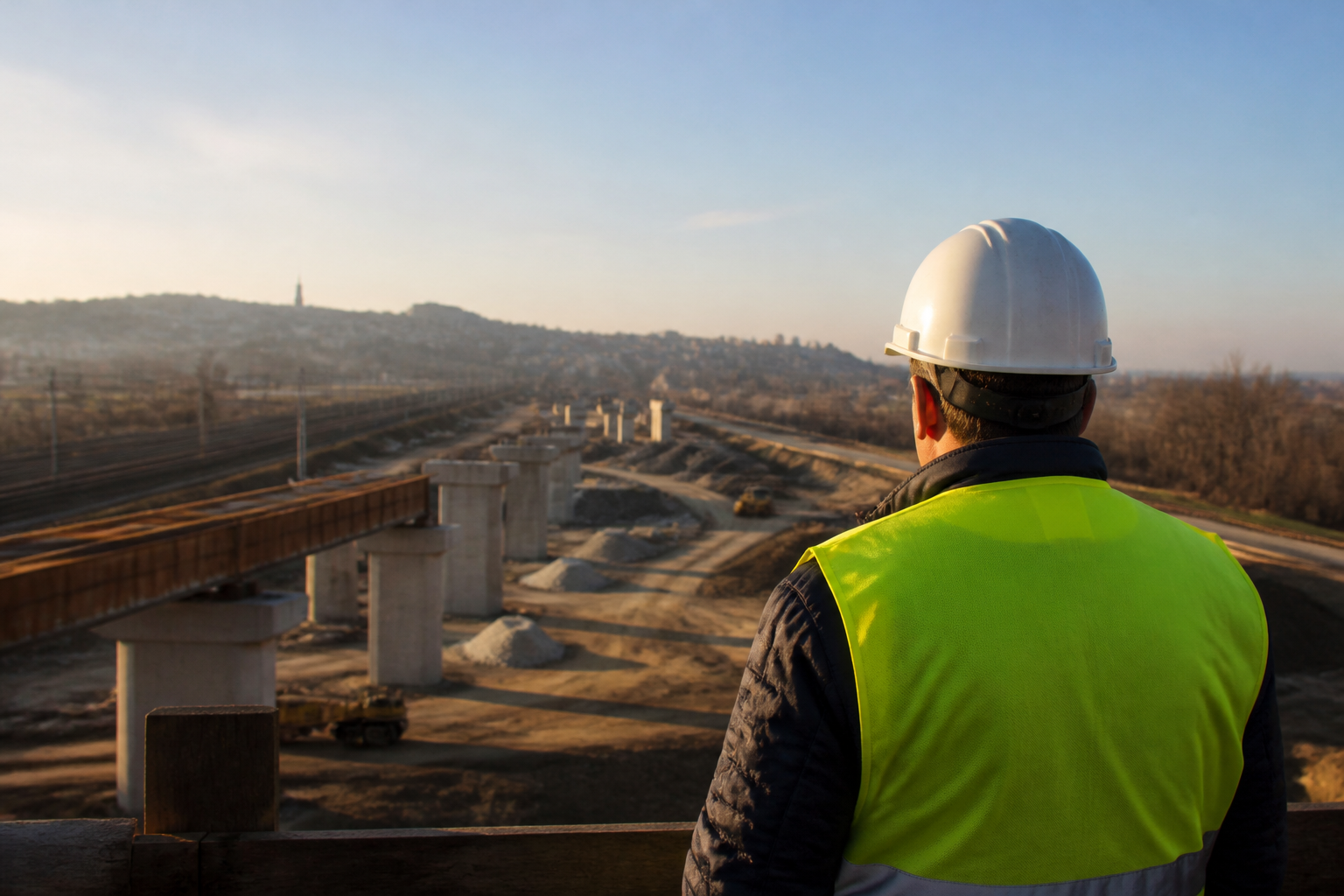
If I were handed this half-built railway on Monday, my first purchase would be a condition survey. The rest of the file argues over money that is already spent.
On 9 October 2026 Hungary's transport ministry halted construction of the Déli körvasút, the Southern Circle Railway in Budapest. Technical completion stands at 42 per cent (Infostart, 9 October 2026). The same decision barred V-Híd Építő Zrt. from every ongoing Hungarian rail investment.
What the resolution actually orders
The government resolution was published in Magyar Közlöny the same day. It instructs the minister to suspend performance where that is justified. It then sets a route to settlement and to termination of the works contract. If negotiations fail, the state will terminate the contract unilaterally.
V-Híd has been told the works are closed. It must vacate the site in good order. It must also account for the advance it still holds. The company said it is reviewing the decision and the statements made at the briefing. It declined to comment until that review ends (Világgazdaság, 9 October 2026).
The grant is the asset at risk
The European Commission withdrew from the grant agreement in September 2026. The sum involved is HUF 367bn. Of that, HUF 210bn came from the IKOP Plus operational programme. A further HUF 157bn came from the Connecting Europe Facility, the EU's transport fund (Origo, 9 October 2026).
The eligibility window runs to the end of 2030. The tender notice set contractual completion at 31 December 2027. The ministry's working view is that the grant survives if re-tendering adds no more than two years. That is the binding date on this programme now.
Two years has to cover a great deal. Settlement, condition survey, design refresh, Commission consent, a fresh open tender and mobilisation all sit inside it. Anyone who has run out a terminated contract knows how fast that window closes.
The advance is the live exposure
NIF, the state infrastructure developer, paid V-Híd an advance of HUF 101.4bn. By 31 August 2026 the company had accounted for HUF 44.3bn of it. HUF 57.1bn remains outstanding (Infostart, 9 October 2026).
The advance repayment guarantee now sits with MFB, the Hungarian development bank. It was issued earlier by MKB, now MBH. The ministry put the likely loss to the state at HUF 50bn to HUF 100bn. A guarantee written by a state-owned bank keeps that loss inside the public perimeter.
Why the designer sits at the centre of it
Kontúr Csoport prepared the itemised cost estimate for NIF, at a net value of HUF 306.2bn. V-Híd later bought Kontúr, which then worked on the job as a design subcontractor. The ministry says 59 per cent of roughly 400 bid line items used the same multipliers as V-Híd's bid. It says no other bidder showed any such match.
The Commission pointed to the 14 days between the award and the acquisition. These remain allegations by the ministry and the Commission. Nothing has been established in court. A competition authority case and a criminal complaint are both to follow. The exclusion bites hardest where Kontúr held design roles, including the Szeged to Kiskunfélegyháza upgrade.
What a re-tender has to price
The scope is about 6 km between Kelenföld and Ferencváros. It adds a third track and in part a fourth. Six road bridges are replaced with new steel structures. Two step-free stops are built at Nádorkert and Közvágóhíd, with 45,000 sqm of noise barriers. The winning bid worked out at HUF 56.3bn per kilometre. The runner-up consortium led by Dömper bid HUF 345bn (Economx, 24 September 2021).
A new bidder has to price three things. Remaining works are the easy part. The condition and compliance of the completed 42 per cent are harder. The inherited design is hardest of all, because the party holding it is the excluded one. MÁV Pályaműködtetési Zrt. will run the new procurement in place of NIF.
The read for sponsors, contractors and lenders
Exclusion is a procurement remedy with a delivery bill attached. Hungary has removed a large rail builder from a thin market while a grant clock runs. Bidders will read the HUF 56.3bn per kilometre figure and the state's loss estimate together. Expect a wider spread of prices, and tighter demands on survey data and design warranties. Sponsors elsewhere should check one thing this month: who owns the firm that priced your job.
📊 Analytics & Strategic Insight
A stopped railway is a handover problem before it is a money problem
The decision most in this industry are avoiding:
👉 Check who owns your designer. Most clients read the builder's accounts. Few ask who bought the firm that drew and priced the work. That ownership chain can cancel a grant.
👉 An advance is a loan with a bank behind it. Ask who wrote the guarantee. If a state bank wrote it, the public purse carries the risk and no private lender does.
👉 Half-built work is worth less than it looks. The value of finished work rests on records. With no records there is no payment and no clean handover.
Here's the full context:
→ 2021: NIF put the Kelenföld to Ferencváros works out to tender. A consortium led by V-Híd won it at about HUF 338 billion.
→ 2021: The itemised cost estimate behind that tender was drawn up by the design firm Kontúr, at HUF 306.2 billion net.
→ 2024: The guarantee covering the advance passed to MFB, the state development bank.
→ September 2026: The European Commission pulled out of the grant deal and took HUF 367 billion of EU money with it.
→ Most recent: On 9 October 2026 the government stopped the work at 42 per cent built. It also barred the builder from other rail jobs.
What this means for infrastructure operators, contractors and investors:
✅ Grant money has a last date. The EU money on this job can be spent until the end of 2030. Every step from here has to fit inside that.
✅ Fewer bidders means higher prices. Hungary has taken a big rail builder out of a small market. The next tender starts with a shorter list.
✅ Your paperwork is your payment. Site records, test results and as-built drawings decide what a stopped job is worth.
3 moves you can make this week:
1️⃣ Map the ownership behind your advisers. List every designer, cost consultant and surveyor on your job. Check who owns each one today.
2️⃣ Read your advance clause out loud. Find the sum still unspent, the guarantee behind it, and the bank that issued it. Put that number in front of your board.
3️⃣ Order a condition survey now. Do not wait for a dispute. A survey taken while the crew is still on site costs little and settles a lot.
Share it with your peers
Help your network stay ahead of CEE capital projects.




Explore our infograph library — strategic visuals for CEE capital projects leaders.
Project benchmarks, financing structures, tender dynamics and delivery risk — at a glance. Free access for investors, owners, contractors and strategy teams tracking CEE capital projects.
Browse the libraryRelated analyses
- Transport & Infrastructure
Afcons Wins Croatia's EUR 899m Dugo Selo-Novska Rail Contract: Four Bids, No European Prime
Croatia signed its largest ever railway contract on 1 October 2026, handing 83 km of double-tracking to India's Afcons Infrastructure at EUR 677.06m excluding VAT. Four bids were priced for the work and not one of them came from a European prime contractor.
Read analysis → - Transport & Infrastructure
STRABAG Closes BAWI Construction Buy in Romania as Rail Qualification Becomes the Scarce Asset
STRABAG has closed its purchase of BAWI Construction, a Bucharest rail specialist with 240 employees and about EUR 60 million of 2025 output. The number that matters is the qualification it buys, as Romania opens a EUR 5.99 billion rail programme with the EU recovery window shut.
Read analysis → - Transport & Infrastructure
FS International Says Europe Can Find the EUR 345bn for High-Speed Rail. A EUR 10m Certification Bill in Every Country Is What Stops It
At InnoTrans 2026 the chief executive of FS International told the industry that money is not the constraint on Europe's high-speed network. The constraint is a technical specification that keeps moving, and it prices into every concession, lease and availability payment.
Read analysis →
Facing a decision on a CEE capital project?
Describe the situation in a few sentences. Within 72 hours you get an experienced read: the risks we see, what we'd check, and whether we can help — no calls, no obligation.