We Help International Investors and Project Owners Deliver Major CEE Projects Without Expensive Surprises
Independent project intelligence and advisory across energy, transport, real estate and industrial construction.
STRABAG Closes BAWI Construction Buy in Romania as Rail Qualification Becomes the Scarce Asset
STRABAG has closed its purchase of BAWI Construction, a Bucharest rail specialist with 240 employees and about EUR 60 million of 2025 output. The number that matters is the qualification it buys, as Romania opens a EUR 5.99 billion rail programme with the EU recovery window shut.
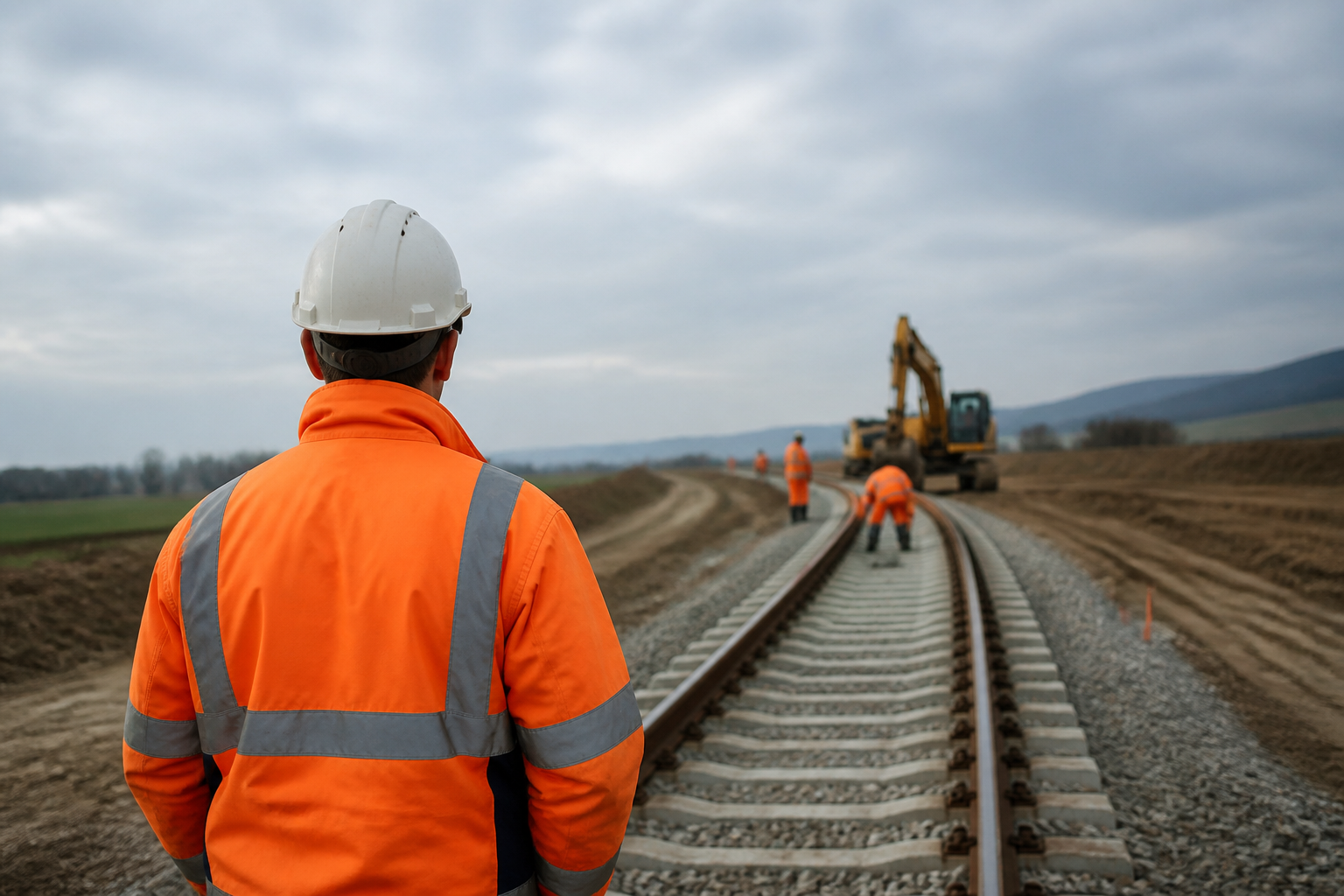
I think this is a prequalification document dressed as an acquisition. STRABAG has bought a Romanian rail contractor whose 2025 output was about EUR 60 million. The group's own order backlog stands at EUR 35,985.22 million.
STRABAG SE confirmed on 1 October 2026 that it had closed its purchase of BAWI Construction SRL. The deal covers 100 per cent of the Bucharest rail infrastructure specialist. The release puts BAWI at 240 employees and about EUR 60 million of output volume in 2025.
Péter Glöckler, the management board member for the South and East segment, welcomed the BAWI team. He pointed to its proven expertise and strong market position. The company first announced the planned takeover in June 2026, and regulatory clearance followed.
The arithmetic rules out a volume play
Put the numbers side by side. STRABAG's half-year report of 28 August 2026 showed group order backlog of EUR 35,985.22 million, up 27 per cent. The South and East segment, which contains Romania, held EUR 8,671.74 million of that, up 2 per cent.
Segment output reached EUR 3,367.08 million in six months, up 6 per cent. Segment earnings stayed negative. So BAWI's annual output equals under 2 per cent of what that segment turns over in half a year.
Nobody spends three months on regulatory clearance for a rounding error in revenue. The asset here is the 240 people, the plant and the component production. Those are the things a Romanian rail tender actually tests.
What a rail tender scores before it looks at price
Rail work is awarded on qualification first. A bidder needs references on comparable track, certified welders, authorised supervisory staff and competence in signalling and overhead lines. It needs tamping and laying machines with crews who can run them.
Machines can be leased. Certified crews and completed references take years to build. Neither can be assembled inside a tender period. Qualification therefore behaves like a scarce asset in a funded market.
A contractor facing a visible pipeline has two routes. It can grow the capability slowly and miss the early rounds. Or it can buy a firm that already holds the certificates and the track record.
The spending window sets the price
Romania approved a railway infrastructure strategy for 2026 to 2030 worth EUR 5.99 billion, SteelOrbis reported on 26 August 2026. The split is EUR 2.66 billion for line renewal and critical works and EUR 3.33 billion for TEN-T projects.
That report also puts about 9,700 km of line, or 73 per cent of the network, in need of renewal. The funding mix behind the programme has changed. The EU Recovery and Resilience Facility closed on 31 August 2026. The PNRR phase of Romanian rail procurement is therefore finished.
Cohesion money, the Connecting Europe Facility and the national budget now carry the pipeline. Those sources move on slower and more conditional timetables. A seller of qualified rail capability is scarcest in the months before a large programme reaches the market.
That is when the multiple peaks. Any buyer should test the price against slippage. Would the number still work if the programme arrived two years late?
Four specialist purchases in one year
BAWI is at least the fourth capability deal STRABAG has announced during 2026. Construction Briefing reported on 11 June 2026 that the group had agreed to buy Van Elle for GBP 59 million. Van Elle is a UK piling specialist, and Crofton Engineering, bought earlier the same year, does steelwork.
STRABAG then signed for KEE Surfacing in Australia on 22 September 2026. Half-year guidance caps net investments at EUR 1.5 billion for the year. Read together, these look like supply-chain purchases rather than growth deals.
Each one moves a specialist trade inside the group. Each one also removes an independent supplier from a rival's subcontract market.
What to watch from here
Employers in South East Europe should expect fewer independent specialist bidders on rail packages. Procurement teams that assume a deep subcontract market should count who is still free to bid. Where the count is thin, qualification criteria need rewriting before the tender goes out, so competition survives.
Contractors without in-country rail qualification have a narrow window. A partner or a target must be in place before the first design-and-build packages are advertised. Investors have a cleaner test: whether the South and East segment's earnings turn as the Romanian programme loads.
Public sponsors carry the last piece. A programme that is announced faster than it is tendered pushes contractors to buy scarcity instead of competing for it. Publishing a credible tender calendar is the cheapest way to keep more bidders in the room.
📊 Analytics & Strategic Insight
Qualification has become the binding constraint in EU-funded rail
The decision most in this industry are avoiding:
👉 Treat the acquisition as a bid cost. A purchase that buys certificates, crews and references is tender spend. Price it against the packages it opens, with a named owner inside the bid team.
👉 Admit that plant is the easier half. Tampers and laying trains can be leased within months. Authorised supervisors, certified welders and completed references cannot, so the people are the scarce line in the model.
👉 Spend first on the weakest segment. STRABAG's South and East earnings stayed negative at the half year while group backlog rose 27 per cent. The money went where the capability gap was widest.
Here's the full context:
→ 2022: Romania contracted the PNRR-funded Caransebes to Arad line upgrade over 162 km. The price was RON 8.77 billion, about EUR 1.8 billion (Romania Insider).
→ 2025: BAWI Construction recorded about EUR 60 million of output volume with 240 employees (STRABAG, 1 October 2026).
→ June 2026: STRABAG announced the planned BAWI takeover. It had already agreed to buy UK piling firm Van Elle for GBP 59 million (Construction Briefing, 11 June 2026).
→ August 2026: Romania approved a EUR 5.99 billion rail strategy for 2026 to 2030 (SteelOrbis, 26 August 2026). The EU Recovery and Resilience Facility then closed on 31 August 2026.
→ Most recent: On 1 October 2026 STRABAG confirmed closing of its purchase of 100 per cent of BAWI Construction after regulatory approvals.
What this means for infrastructure operators, contractors and investors:
✅ The subcontract market is thinning. Four specialist purchases in a year by one group changes who is available to everyone else. Map your critical trades and count the independent suppliers left.
✅ Qualification criteria now decide competition. An employer who copies last cycle's criteria will receive two bids. Set criteria that test real capability and still leave room for a credible newcomer with a partner.
✅ Segment earnings are the scoreboard. STRABAG's South and East result is the number that shows whether CEE rail volume turns into margin. Watch it ahead of any backlog headline.
3 moves you can make this week:
1️⃣ Write your qualification gap list. Take the next three rail packages you want and list every certificate, reference and machine you lack. Put a lead time against each line.
2️⃣ Price your targets against slippage. Run every acquisition case on a two-year programme delay. If the deal only works on time, it is a bet on someone else's calendar.
3️⃣ Count your independent specialists. For welding, piling, overhead line and signalling, name the firms still outside a competitor's group. Lock in framework terms with the ones that remain.
Share it with your peers
Help your network stay ahead of CEE capital projects.




Explore our infograph library — strategic visuals for CEE capital projects leaders.
Project benchmarks, financing structures, tender dynamics and delivery risk — at a glance. Free access for investors, owners, contractors and strategy teams tracking CEE capital projects.
Browse the libraryRelated analyses
- Transport & Infrastructure
V-Híd Just Lost Hungary's HUF 338 Billion Déli Körvasút at 42 Per Cent Complete. The Grant Clock Is the Real Story
Hungary halted construction of the Budapest Southern Circle Railway on 9 October 2026 and barred V-Híd from every ongoing rail investment. The HUF 367 billion of EU money behind the job survives only if a lawful re-tender lands inside two years.
Read analysis → - Transport & Infrastructure
Afcons Wins Croatia's EUR 899m Dugo Selo-Novska Rail Contract: Four Bids, No European Prime
Croatia signed its largest ever railway contract on 1 October 2026, handing 83 km of double-tracking to India's Afcons Infrastructure at EUR 677.06m excluding VAT. Four bids were priced for the work and not one of them came from a European prime contractor.
Read analysis → - Transport & Infrastructure
FS International Says Europe Can Find the EUR 345bn for High-Speed Rail. A EUR 10m Certification Bill in Every Country Is What Stops It
At InnoTrans 2026 the chief executive of FS International told the industry that money is not the constraint on Europe's high-speed network. The constraint is a technical specification that keeps moving, and it prices into every concession, lease and availability payment.
Read analysis →
Get a second opinion before it gets expensive.
Contractor selection, tender strategy, a project drifting off track — send us the situation and we'll come back with a clear plan.