We Help International Investors and Project Owners Deliver Major CEE Projects Without Expensive Surprises
Independent project intelligence and advisory across energy, transport, real estate and industrial construction.
V-Híd Just Won Hungary's First State Rail Contract of the New Era. Nobody Else Bid, and That Is the Real Risk to the €9.8 Billion Baross Plan
V-Híd Vagyonkezelő Kft. won a HUF 300 million GYSEV rail-welding framework on 6 August 2026 as the only bidder, its first state contract since Hungary's change of government. Hungary has just committed HUF 3,550 billion to rail through 2035 and cannot field two qualified welding contractors for a HUF 300 million framework.
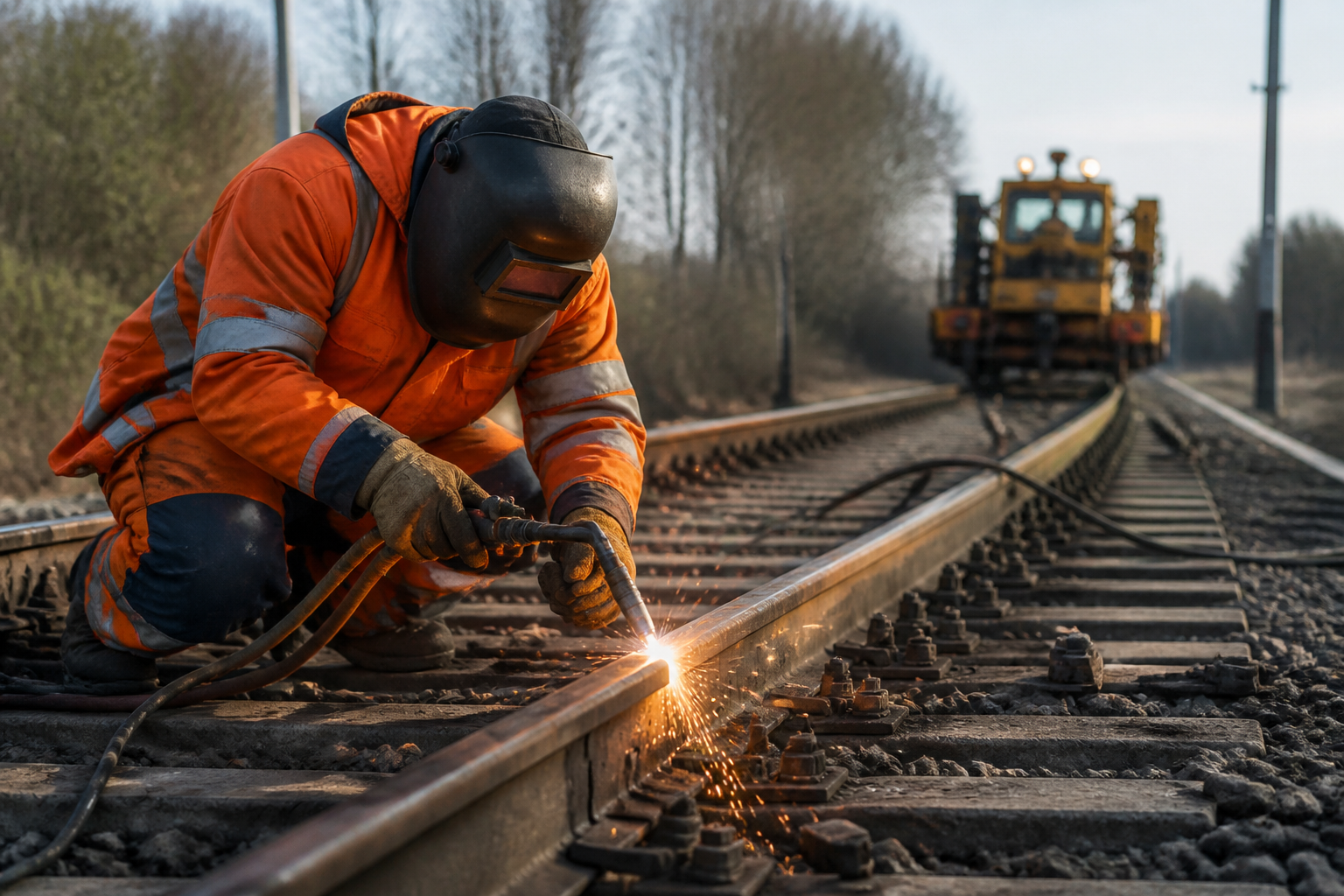
On 6 August 2026 a Hungarian state railway awarded a rail-welding framework worth HUF 300 million, roughly EUR 830,000 at current rates. One company bid. That company was V-Híd Vagyonkezelő Kft., part of Lőrinc Mészáros's construction group, and the award is its first state contract since Hungary's change of government. Two weeks earlier, the same government had committed HUF 3,550 billion to rail. The distance between those two numbers is the story.
A field of one, decided before bidding opened
GYSEV, through MÁV Szolgáltató Központ Zrt., opened the procedure in early April 2026 in two lots: HUF 175 million net for aluminothermic rail welding across the GYSEV network, carrying a committed call-off of HUF 135 million; and HUF 125 million net for build-up arc welding of rails and turnouts, with a committed call-off of HUF 97 million.
Prequalification required at least 100 aluminothermic welds completed in the past six years, at least 40 turnout build-up welds, at least 18 glued-insulated joints, and valid MSZ EN ISO 9001:2015 and MSZ EN ISO 3834-2:2021 certification. None of that is unreasonable for safety-critical work on running track under traffic. It is also, on the Hungarian market, a very short list of qualifying firms. Átlátszó reported the award on 6 August 2026, citing TED notice 547024-2026: V-Híd Vagyonkezelő was the sole bidder.
This is the mechanism procurement teams keep underestimating. Prequalification thresholds get written from operational reality, and operational reality is the incumbent. Every threshold that describes what safe delivery looks like also describes who is already delivering it.
The market consultation nobody used
GYSEV ran a preliminary market consultation before publishing the tender. Two economic operators took part. Neither submitted a single comment on the draft documents. Then neither bid.
Read that sequence carefully, because it inverts the usual interpretation. This was not a market that objected to onerous terms and walked away. It was a market that examined the terms, found nothing worth arguing about, and still did not turn up. For a client that is the worse outcome. An objection tells you which clause to fix. Silence followed by absence tells you the capacity does not exist at that price and that scale, whatever the clauses say.
HUF 3,550 billion meets a HUF 300 million problem
On 22 July 2026, Prime Minister Péter Magyar and Transport and Investment Minister Dávid Vitézy presented the Baross Gábor rail development plan at Rákospalota-Újpest station: HUF 3,550 billion, about EUR 9.8 billion, running to 2035. At least 35 InterCity trainsets and 42 HÉV units, line and station renewals, reopened regional routes, tram-train extensions, an M3 metro extension and preparatory work on high-speed links towards Vienna and Warsaw. Budapest describes it as the first Hungarian rail plan designed to outlive a single parliamentary term.
Every kilometre of it lands on continuous welded rail. Aluminothermic welding, turnout build-up welding and glued-insulated joints are the operations that convert delivered components into a railway that can carry traffic. A decade-long capital plan is, in supply terms, a decade-long demand curve for exactly this crew type. Thursday's award is the supply-side reading of that curve, and it returned one.
What a change of government changes, and what it does not
The political layer here is real but secondary. Mészáros exited V-Híd Vagyonkezelő in March 2026; its sole owner is now V-Híd Építő Zrt., which he also owns. In February the company took a HUF 5 billion MÁV contract on another single-bid procedure. In March, MÁV cancelled a rail tender precisely because V-Híd was the only bidder. In November 2025, Homlok's companies won a HUF 6.6 billion MÁV award after V-Híd priced too high.
The pattern across the change of government is that awards get slower, more contested and more publicly scrutinised, while the roster of firms physically able to deliver stays the same. Political will can redirect a contract. It cannot certify a welding crew.
The macro picture matches. Hungary ran 34% of its public procurement procedures with a single bidder in 2024, against an EU average of 28%, according to the European Commission's Single Market Scoreboard. On EU-funded procedures Hungary has driven the figure down to 9.5%, inside its sub-15% commitment, though that is more than double the 4.2% recorded in 2024.
What sponsors, contractors and investors should do with this
For public sponsors, the binding constraint on Baross Gábor is neither the budget line nor the politics. It is the certified specialist base, and supplier development is now programme work rather than policy work: break frameworks into lots a mid-sized firm can staff, accept cross-border references from Austrian, Slovak, Czech and Romanian welding contractors, and part-fund certification for firms that want in. Swietelsky Vasúttechnika, STRABAG Vasútépítő and Homlok already operate at scale on Hungarian track; the live question is who else can be brought to the qualifying line inside 18 months.
For contractors, this is an entry window with a visible price. Qualification is the moat, and the moat is buildable: ISO 3834-2 welding approval, a documented reference trail and a trained crew cost far less than the frameworks they unlock. For investors pricing Hungarian rail exposure, the number that matters is not HUF 3,550 billion. It is the average bid count on maintenance and renewal frameworks over the next four quarters. Right now it is one.
Share it with your peers
Help your network stay ahead of CEE capital projects.
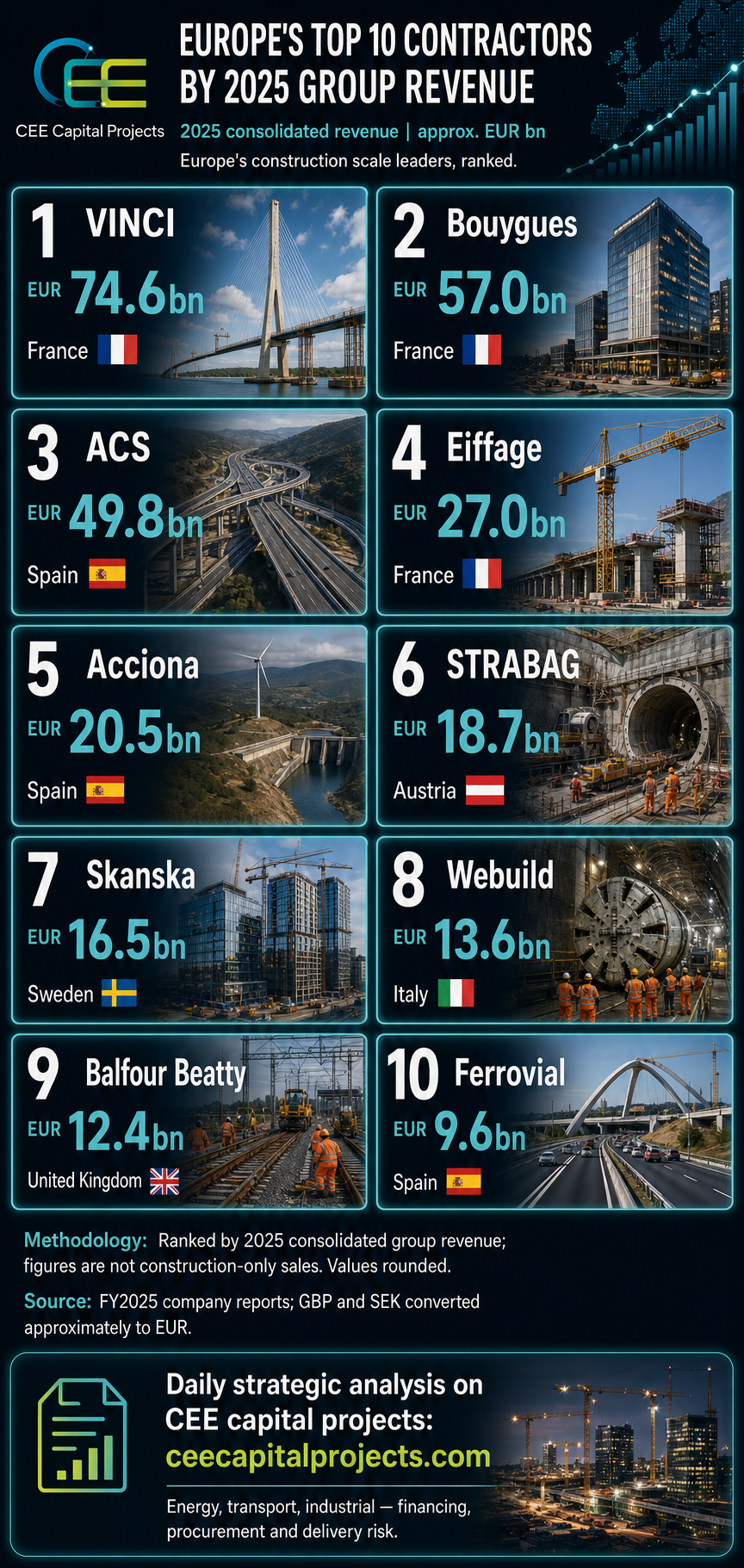
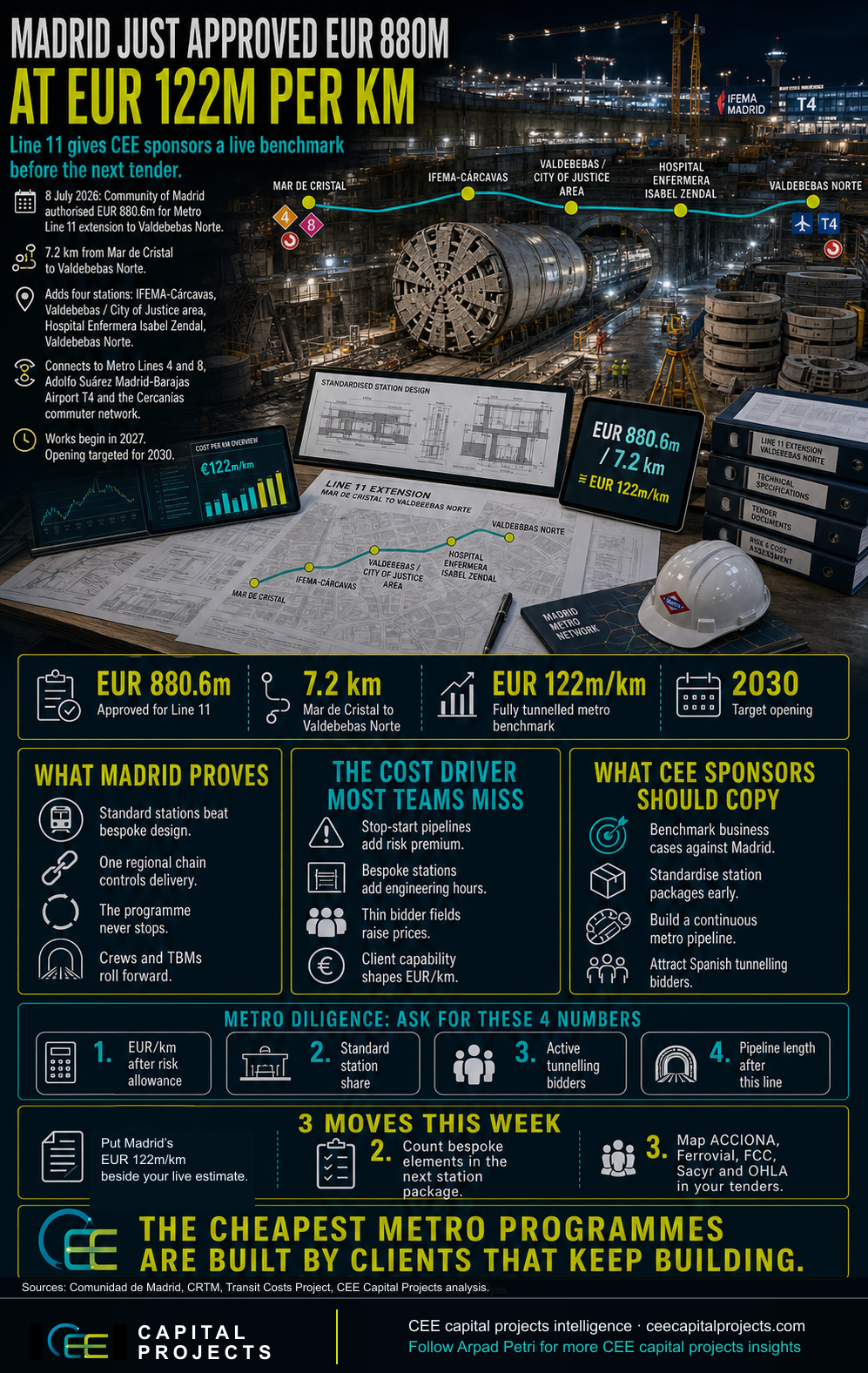
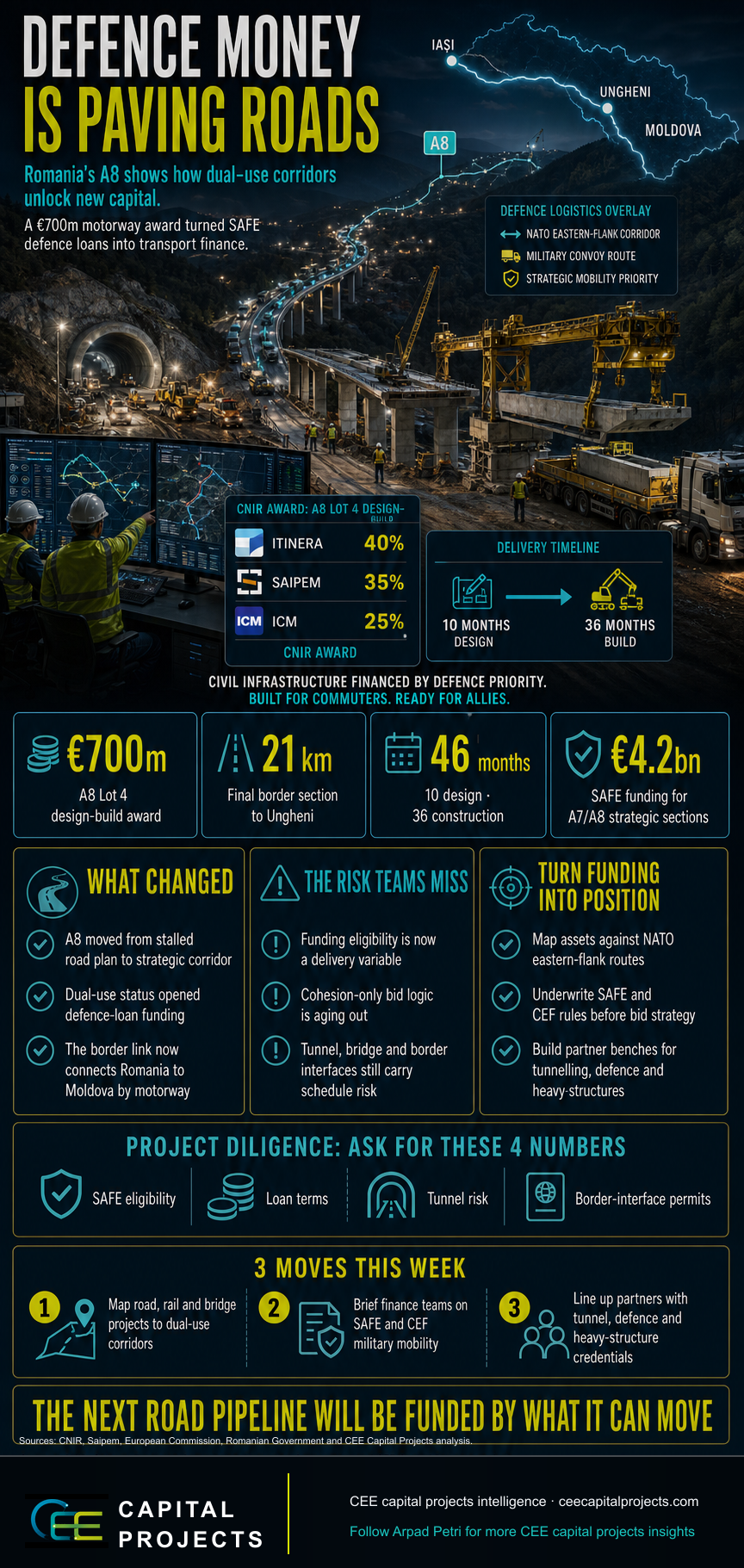
Explore our infograph library — strategic visuals for CEE capital projects leaders.
Project benchmarks, financing structures, tender dynamics and delivery risk — at a glance. Free access for investors, owners, contractors and strategy teams tracking CEE capital projects.
Browse the libraryStrategic Insights
📊 Analytics & Strategic Insight
Money was never the hard part. Finding people who can weld rail is.
The decision most in this industry are avoiding:
👉 Nobody counts the crews before signing the plan. Hungary agreed HUF 3,550 billion of rail work over ten years. No one asked how many certified welding teams the country has. The money was voted. The people were assumed.
👉 The rules that keep track safe also keep new bidders out. Asking for 100 past welds and two certificates is fair. It also means only firms already doing the work can bid. Safety rules and competition rules pull against each other, and almost nobody says so out loud.
👉 A quiet market is worse news than an angry one. Two firms read the tender papers and said nothing. Then they did not bid. A complaint would have told the client what to fix. Silence told them nothing until the bid box was empty.
Here's the full context:
→ 2024: Hungary ran 34% of its public tenders with only one bidder. The EU average was 28% (European Commission, Single Market Scoreboard).
→ November 2025 to February 2026: MÁV gave a HUF 6.6bn track job to Homlok's firms because V-Híd asked too much. Three months later V-Híd won a HUF 5bn MÁV job as the only bidder.
→ March 2026: MÁV threw out a rail tender because V-Híd was the only firm that bid. The same month, Lőrinc Mészáros stepped out of V-Híd Vagyonkezelő. Its only owner is now V-Híd Építő Zrt., which he also owns.
→ 22 July 2026: The government launched the Baross Gábor rail plan. HUF 3,550bn, about EUR 9.8bn, running to 2035.
→ Most recent: On 6 August 2026 V-Híd won a HUF 300m rail welding job from GYSEV. It was the only bidder. This is its first state job under the new government.
What this means for infrastructure operators, contractors and investors:
✅ Big plans do not create crews. Check the workforce before you trust the timeline. Ask how many certified teams exist in the country, and how much work they have already booked.
✅ Certificates are the real gate. A mid-sized firm that pays for ISO 3834-2 welding approval and builds a reference record can walk into a market with one seller. The cost of entry is training and paperwork, not heavy plant.
✅ One bid is a price problem, not only a fairness problem. When one firm turns up, the client has no way to test the price. Over ten years of call-offs, that gap adds up to real money.
3 moves you can make this week:
1️⃣ Count the crews on your biggest programme. Pick the trade that is hardest to replace. Write down how many firms can legally do it in your country. If the answer is one or two, your plan has a date problem.
2️⃣ Read your own prequalification list as an outsider would. Every number in it cuts the field. Mark which lines protect the public and which only protect the firm already doing the job.
3️⃣ Find who joined your last market consultation and said nothing. Call them. A firm that reads your papers and stays quiet is usually short of people, not short of interest. That call tells you more than the tender result did.
Related analyses
- Transport & Infrastructure
V-Híd Just Lost Hungary's HUF 338 Billion Déli Körvasút at 42 Per Cent Complete. The Grant Clock Is the Real Story
Hungary halted construction of the Budapest Southern Circle Railway on 9 October 2026 and barred V-Híd from every ongoing rail investment. The HUF 367 billion of EU money behind the job survives only if a lawful re-tender lands inside two years.
Read analysis → - Transport & Infrastructure
Afcons Wins Croatia's EUR 899m Dugo Selo-Novska Rail Contract: Four Bids, No European Prime
Croatia signed its largest ever railway contract on 1 October 2026, handing 83 km of double-tracking to India's Afcons Infrastructure at EUR 677.06m excluding VAT. Four bids were priced for the work and not one of them came from a European prime contractor.
Read analysis → - Transport & Infrastructure
STRABAG Closes BAWI Construction Buy in Romania as Rail Qualification Becomes the Scarce Asset
STRABAG has closed its purchase of BAWI Construction, a Bucharest rail specialist with 240 employees and about EUR 60 million of 2025 output. The number that matters is the qualification it buys, as Romania opens a EUR 5.99 billion rail programme with the EU recovery window shut.
Read analysis →
Building in Central Europe?
Tell us what you're building. We'll tell you what can go wrong — and how to prevent it.