Uniper's 1.7 GW Bid Into Germany's First Capacity Auction: Why the Brownfield Site Decides the StromVKG Result
The European Commission cleared Germany's capacity mechanism on 2 September 2026, six days before the first StromVKG tender closes on 8 September. Uniper is bidding around 1.7 GW and RWE more than 3 GW into a 4,500 MW round where a cleared brownfield site outweighs the price.
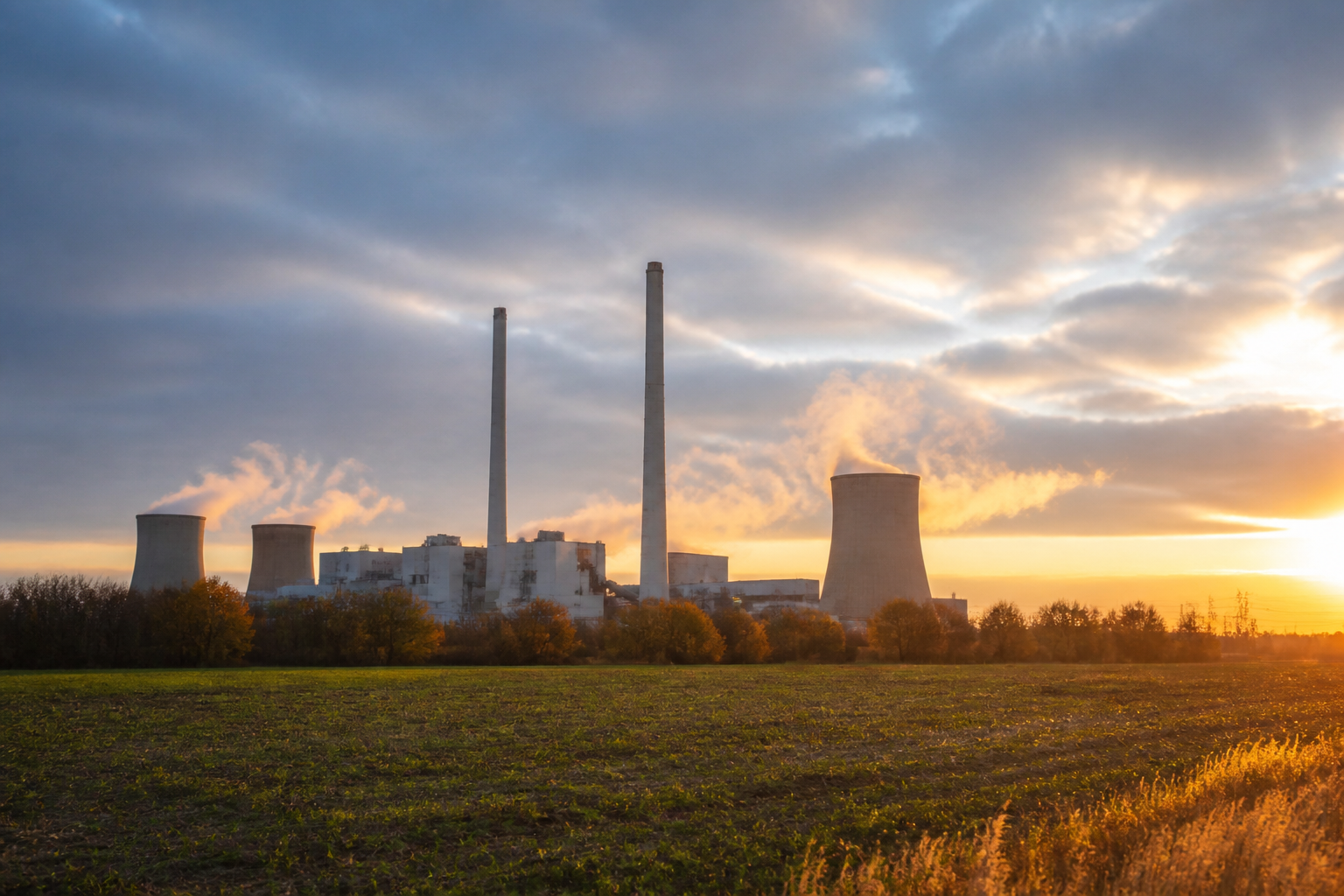
The question I keep putting to anyone bidding into a capacity auction is short. What did you already own before the rules were written? Germany answers that question this week.
On 2 September 2026 the European Commission approved Germany's capacity mechanism under EU state aid rules. Bids for the first tender under the Electricity Supply Security and Capacity Act, the StromVKG, close on 8 September. That leaves six days between the legal clearance and the deadline, as Energy-Storage.News reported on 3 September 2026. The Bundesnetzagentur opened the round in July. It seeks 4,500 MW of reduced capacity and pays winners for 15 years. Bids are capped at EUR 244,000 per MW a year (Enerdata, 23 July 2026).
The volume is spoken for before the round opens
Uniper says it will bid two hydrogen-ready projects into the German rounds. They sit at Gelsenkirchen-Scholven and Staudinger and total around 1.7 GW. The company set this out on 17 July 2026. Its EUR 5bn plan to 2030 puts about half the money in Germany. RWE has more than 3 GW of new gas capacity ready for the same auctions.
Those two declarations alone come to roughly 4.7 GW. The auction buys reduced capacity rather than nameplate output, so the figures do not net out cleanly. The direction is still obvious. Round one is a contest between a handful of incumbent thermal operators, and the December round will look similar.
Reduced capacity is a different number from nameplate
The Bundesnetzagentur buys availability, then discounts it by statutory reduction factors. A combined-cycle gas plant carries a factor of 0.85. A ten-hour battery carries 0.58, and only a twenty-hour battery reaches the gas factor. Batteries must also show 100 per cent technical availability against 85 per cent for a CCGT. They need a round-trip efficiency of at least 92 per cent. Cells and inverters must come from the EU or from a free trade partner.
Layered together, these rules do the sorting before any price is submitted. Long-term capacity requires ten consecutive hours of output. In 2026 that means gas, and the market knows it.
Location carries a price of its own
The design also steers awards geographically. At least one third of the volume goes first to projects in the grid-technical north. Southern bids are then assessed after a deduction of EUR 16,000 per MW from the bid price. A southern site can therefore bid higher and still rank level with a northern one. Grid congestion has been turned into a number on the bid sheet.
The site is the entry ticket
Here is the part the coverage keeps missing. Uniper demolished cooling towers D and E at Scholven in May 2026. The federal cabinet approved the StromVKG draft on 13 May 2026. Site clearance and lawmaking therefore ran in parallel.
Prequalification runs through the transmission system operators. A bidder needs a grid connection confirmation. It must also prove it is not double funded under the renewables or CHP regimes. Registration and authentication on the regulator's closed platform had to be complete by 1 September 2026. Miss that date and the bid never exists, however sharp the price.
No newcomer assembles a cleared site, a gas connection and a grid confirmation inside a tender window. That work takes years. The auction rewards whoever did it early.
What the decision means beyond Germany
The scale is large. ClientEarth puts the mechanism at between EUR 15.6bn and EUR 35.2bn. The first auction alone costs EUR 1bn to EUR 3bn. The charity and the campaign group Beyond Fossil Fuels both argue the design shuts out storage. The think tank Epico has said 5 GW would be enough through 2035. Germany has reserved 9 GW this year for long-term capacity.
Several member states are drafting their own capacity mechanisms. They now have a cleared template that pays brownfield thermal sites for 15 years. Poland has run a capacity market for years. Polish and Czech utilities hold the same kind of site bank. PGE alone is targeting 7.8 GW of gas capacity by 2030.
What to watch next
Awards from this round set the German EPC pipeline for hydrogen-ready gas plants from 2027. Contracted capacity must be available from 2031, and every winner has to be climate neutral by 2045. A second long-term round follows in December 2026, with a further date in May 2027 if volume goes unsold. Batteries get their first real opening in the duration-neutral round next year.
For sponsors and investors the practical lesson lands now. Audit the site bank before the next auction is designed. The qualifying work has to be finished before the rules are published. For contractors, the German thermal order book is about to be set for a decade by decisions taken this month.
Share it with your peers
Help your network stay ahead of CEE capital projects.
Explore our infograph library — strategic visuals for CEE capital projects leaders.
Project benchmarks, financing structures, tender dynamics and delivery risk — at a glance. Free access for investors, owners, contractors and strategy teams tracking CEE capital projects.
Browse the libraryStrategic Insights
📊 Analytics & Strategic Insight
Germany just priced fifteen years of gas availability, and the site bank decided who could compete
The decision most in this industry are avoiding:
👉 Eligibility rules allocate the money, and price only settles the change. The ten-hour rule, the availability test and the component sourcing test removed most bidders before a single euro was quoted.
👉 A cleared brownfield site has become a financial asset in its own right. Cooling water, a gas connection and a live grid confirmation cannot be bought inside a tender window.
👉 Waiting for legal certainty is itself a bidding strategy, and it usually loses. Brussels cleared the scheme six days before bids closed. Every serious bidder had already spent money on an unapproved framework.
Here's the full context:
→ 2024: Germany's Power Plant Security Act was drafted and its auctions planned. The scheme never entered into force after the governing coalition collapsed.
→ November 2025: the economy ministry cut the programme back from an initial 20 GW ambition. ClientEarth filed a state aid complaint against the auction design.
→ January 2026: Berlin and the Commission agreed a scheme covering 12 GW, with first plants targeted for 2031. RWE publicly pressed for speed.
→ July 2026: the StromVKG was adopted and the Bundesnetzagentur opened round one for 4,500 MW. The deadline was set at 8 September.
→ Most recent: on 2 September 2026 the European Commission cleared the mechanism under state aid rules. The first bids were due six days later.
What this means for infrastructure operators, contractors and investors:
✅ Owners of retired thermal sites hold a repriced asset. Fifteen years of contracted availability payments attach to land that carried a decommissioning liability three years ago.
✅ The German EPC market for hydrogen-ready gas plants is about to be fixed for a decade. Turbine slots, civil packages and grid connection works will be committed off this round and the December one.
✅ Storage investors should model the 2027 rounds rather than this one. Duration-neutral volume arrives next year, and derating factors will decide whether longer batteries clear.
3 moves you can make this week:
1️⃣ Inventory every site you control that already has a grid or gas connection. Record connection capacity, cooling, land status and any live consents, then rank them by how fast they could qualify.
2️⃣ Read the eligibility annex of any scheme you plan to bid into before the price annex. Technical thresholds and sourcing rules decide the field, and they are usually settled long before the deadline.
3️⃣ Put every registration and prequalification gate in your own scheme calendar with an owner against it. Administrative deadlines knock out competitive bidders every year, and they are the cheapest risk to remove.
Related analyses
- Energy & Power
Hungary's Construction Starts Fell to HUF 470 Billion. E.ON, MVM and MAVIR Are the Clients With Signed Money
Hungarian contractors started barely HUF 470bn of new work in the second quarter of 2026, the third weakest quarter since 2021, and civil engineering accounted for just over HUF 120bn of it. Almost all of that value was energy work, while MAVIR, E.ON and MVM signed close to HUF 500bn of EU grant agreements in August.
Read analysis → - Energy & Power
ČEZ Is Testing a 1:13 Model Before It Builds Orlík's CZK 8bn Pumped Storage. On a World-First Turbine, the Laboratory Sets the Programme
ČEZ has begun 1:13 scale model tests on a reversible Francis turbine for the CZK 8 billion Orlík pumped storage conversion in Czechia. On a world-first machine, a laboratory in Blansko sets the date every other package waits for.
Read analysis → - Energy & Power
Nuclearelectrica's CEO Exit Leaves Cernavodă's EUR 800 Million EIB Loan Between Approval and Signature
Cosmin Ghiță asked to end his mandate as Nuclearelectrica's chief executive on 25 August 2026, six weeks after the European Investment Bank board approved an EUR 800 million loan for the Cernavodă Unit 1 refurbishment that the company has still to contract. With both reactors offline on low Danube levels and a three-year outage due to start in 2027, the risk in this story is continuity at the sponsor rather than a change of name at the top.
Read analysis →
Facing a decision on a CEE capital project?
Describe the situation in a few sentences. Within 72 hours you get an experienced read: the risks we see, what we'd check, and whether we can help — no calls, no obligation.