ČEZ Is Testing a 1:13 Model Before It Builds Orlík's CZK 8bn Pumped Storage. On a World-First Turbine, the Laboratory Sets the Programme
ČEZ has begun 1:13 scale model tests on a reversible Francis turbine for the CZK 8 billion Orlík pumped storage conversion in Czechia. On a world-first machine, a laboratory in Blansko sets the date every other package waits for.
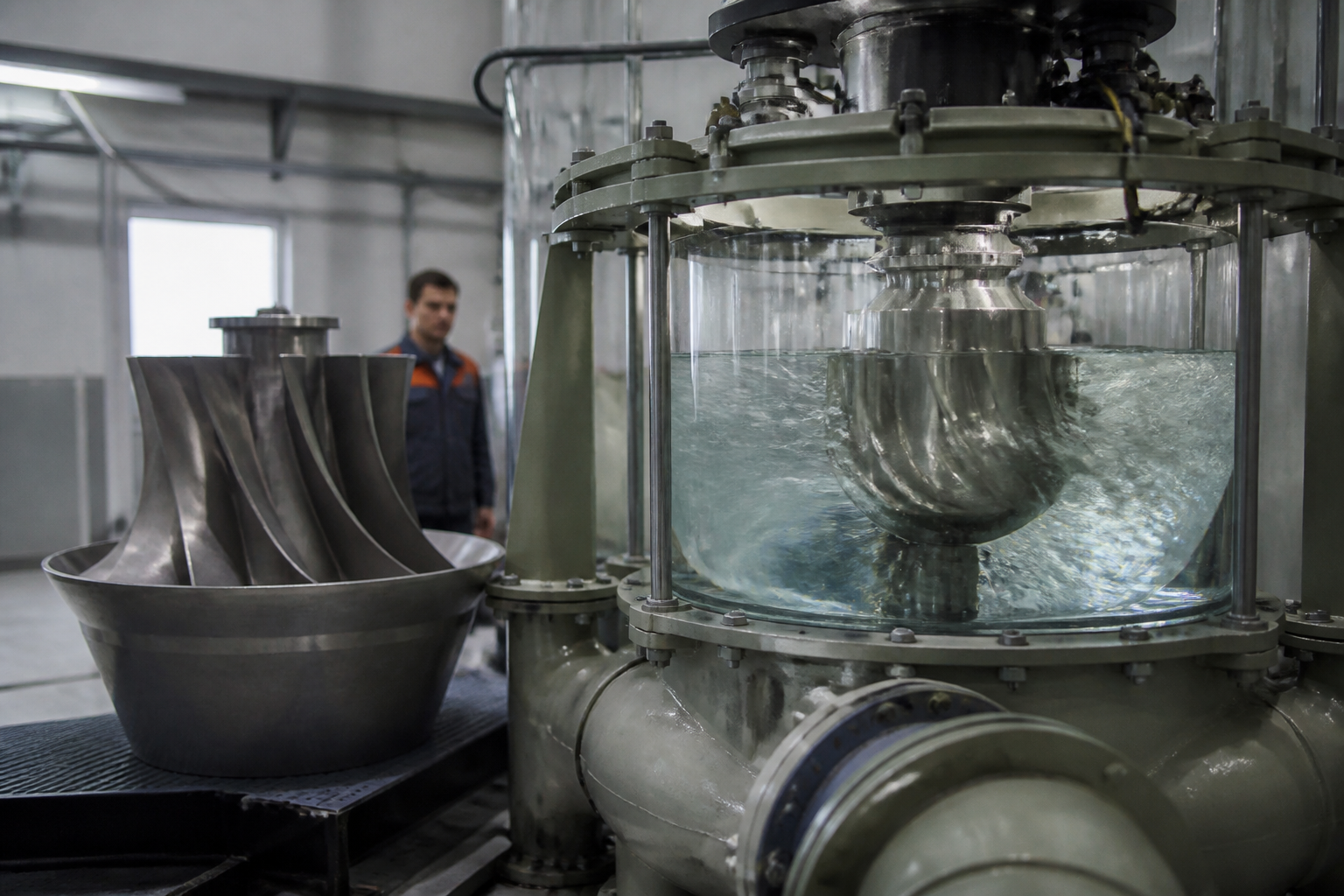
I will say this plainly. The riskiest item on this project is a machine that does not exist yet. It has to pass a water tank in Blansko before anything is built on the Vltava.
On 1 September 2026 ČEZ began model tests on a reversible Francis turbine for the Orlík hydropower plant. Its contractor is Litostroj Engineering. Engineers are running a 1:13 scale model of the five-metre machine at Blansko. They are checking hydraulic performance, efficiency and operating stability before production starts. The conversion behind that test is worth CZK 8 billion, about EUR 330 million. ČEZ calls it the largest Czech hydropower project in three decades.
What ČEZ is actually building at Orlík
All four generating units at Orlík will be rebuilt. Total installed capacity stays at 364 MW. Two units keep conventional one-way operation at 95 MW each, or 190 MW combined. The other two become fully reversible at 87 MW each, or 174 MW of pumped storage.
The reversible pair will pump water from the lower Kamýk reservoir back into Orlík when the grid has surplus power. One full cycle stores up to 750 MWh. ČEZ puts that at the daily consumption of about 80,000 Czech households. The head between the two reservoirs is 70 metres.
Main works start in 2027 and the pumped storage plant is due in service in 2033. It becomes the country's fourth large pumped storage facility, after Dlouhé stráně, Dalešice and Štěchovice. The last one was built in the mid-1990s. ČEZ says Orlík lifts national pumped storage capacity by more than 12%. The conversion is staged so at least two of the four units run throughout.
Why a scale model sets the whole programme
ČEZ describes the conversion as a world first. An operating run-of-river station is being turned into a pumped storage plant while it keeps generating. Two Kaplan turbines are being replaced by reversible Francis units inside a concrete envelope finished more than sixty years ago. The fourth and final unit at Orlík entered service 63 years ago.
That combination removes the usual comfort of a reference machine. There is no fleet of identical units to price a performance guarantee against. Efficiency, cavitation behaviour and stability across both the pumping and generating range have to be proven before metal is cut. The 1:13 model in Blansko is where that proof happens.
Only a handful of hydraulic laboratories in the world can qualify a reversible pump-turbine. Blansko holds one of them. Wikov agreed to acquire the Litostroj group in 2024, which brought that laboratory inside the supplier. So the release date for manufacturing is set indoors, in a test rig. Every civil and electrical package sits downstream of it.
The price of four hours
Take the published numbers at face value. 174 MW against 750 MWh gives a duration of roughly 4.3 hours. On my own arithmetic, EUR 330 million across 750 MWh works out near EUR 440 per kWh of cycle energy.
Treat that as an upper bound. The same spend renews all four units, holds 364 MW of capacity and adds decades of life to the whole plant. Storage is one product of the investment among several. It arrives on a site where the reservoirs, the head and the grid connection already exist.
Lithium projects clear that headline number per kWh today. Their design life is measured in fifteen to twenty years, and the largest Czech battery systems are still counted in tens of megawatts. Orlík is a duration asset with a design life measured in decades. Duration is where European systems are getting short as solar output grows.
The consents that never had to be reopened
The reservoir belongs to the Vltava River Basin Authority. Its chief executive, Petr Kubala, said the conversion needs no major structural work on the dam. Operating water levels set in the plant's operating rules stay unchanged. No land has to be acquired, and recreation, navigation and fishing are unaffected.
That is the quiet reason the turbine dominates the schedule. On a greenfield pumped storage scheme, consent and land would run for years and would swallow the critical path. Here they were settled decades ago by the people who built the dam.
What to watch next
Three things decide whether 2033 holds. The first is the model result and the date manufacturing is released. The second is whether the staged outage plan really keeps two units earning through six years of work. The third is laboratory and workshop capacity across Europe, because every operator now studying a reversible retrofit will queue at the same few doors.
For contractors and suppliers, the qualification gate deserves as much attention as the tender itself. For sponsors and investors, the lesson is about sequencing. When the novel item is a single machine, the programme is only as firm as the test that proves it. No amount of progress on site can pull that date forward.
Share it with your peers
Help your network stay ahead of CEE capital projects.
Explore our infograph library — strategic visuals for CEE capital projects leaders.
Project benchmarks, financing structures, tender dynamics and delivery risk — at a glance. Free access for investors, owners, contractors and strategy teams tracking CEE capital projects.
Browse the libraryStrategic Insights
📊 Analytics & Strategic Insight
When one machine has never been built, the test rig owns your schedule
The decision most in this industry are avoiding:
👉 The critical path has moved indoors. Teams track site milestones every week. Almost nobody tracks the date a prototype passes its test. On a first-of-a-kind machine, that quiet date controls everything behind it.
👉 A performance guarantee on a world first is only an opinion. There is no fleet of identical units behind it. The number in the contract rests on a calculation. The test tank turns it into evidence.
👉 Test capacity is scarcer than build capacity. Many firms in Europe can build a powerhouse. Very few labs can qualify a reversible pump-turbine. That shortage shows up in no order book.
Here's the full context:
→ 1963: The last of Orlík's four units started up on the Vltava Cascade, sixty-three years ago.
→ Mid-1990s: Dlouhé stráně came on line. It was the last pumped storage plant built in Czechia.
→ 2024: Wikov agreed to buy the Litostroj group. The Blansko test lab moved inside the turbine supplier.
→ 12 June 2026: ČEZ announced the Orlík conversion. CZK 8 billion, 750 MWh per cycle, in service 2033.
→ Most recent: On 1 September 2026 ČEZ and Litostroj began 1:13 scale model tests at Blansko.
What this means for infrastructure operators, contractors and investors:
✅ Duration is cheaper to buy than to build. Orlík gives about 4.3 hours of storage. The reservoirs, the head and the grid link were paid for in the 1960s.
✅ Staged conversion changes the revenue case. Two of four units keep running for six years. The plant earns while it is rebuilt, so the outage costs less.
✅ Supplier queues will grow before prices move. Every operator studying a retrofit needs the same design and test slots. Booking early beats tendering early.
3 moves you can make this week:
1️⃣ Name the one thing on your job that has never been built. Give it a date, an owner and a test location. Then list the work waiting behind that date.
2️⃣ Ask your main supplier where their test capacity is booked. Get the next twenty-four months in writing. Include the rig and the weeks already sold.
3️⃣ Price storage by years of service rather than nameplate. Run the same duty cycle over sixty years and over fifteen. See which answer changes your decision.
Related analyses
- Energy & Power
Uniper's 1.7 GW Bid Into Germany's First Capacity Auction: Why the Brownfield Site Decides the StromVKG Result
The European Commission cleared Germany's capacity mechanism on 2 September 2026, six days before the first StromVKG tender closes on 8 September. Uniper is bidding around 1.7 GW and RWE more than 3 GW into a 4,500 MW round where a cleared brownfield site outweighs the price.
Read analysis → - Energy & Power
Hungary's Construction Starts Fell to HUF 470 Billion. E.ON, MVM and MAVIR Are the Clients With Signed Money
Hungarian contractors started barely HUF 470bn of new work in the second quarter of 2026, the third weakest quarter since 2021, and civil engineering accounted for just over HUF 120bn of it. Almost all of that value was energy work, while MAVIR, E.ON and MVM signed close to HUF 500bn of EU grant agreements in August.
Read analysis → - Energy & Power
Nuclearelectrica's CEO Exit Leaves Cernavodă's EUR 800 Million EIB Loan Between Approval and Signature
Cosmin Ghiță asked to end his mandate as Nuclearelectrica's chief executive on 25 August 2026, six weeks after the European Investment Bank board approved an EUR 800 million loan for the Cernavodă Unit 1 refurbishment that the company has still to contract. With both reactors offline on low Danube levels and a three-year outage due to start in 2027, the risk in this story is continuity at the sponsor rather than a change of name at the top.
Read analysis →
Facing a decision on a CEE capital project?
Describe the situation in a few sentences. Within 72 hours you get an experienced read: the risks we see, what we'd check, and whether we can help — no calls, no obligation.