Hungary's Construction Starts Fell to HUF 470 Billion. E.ON, MVM and MAVIR Are the Clients With Signed Money
Hungarian contractors started barely HUF 470bn of new work in the second quarter of 2026, the third weakest quarter since 2021, and civil engineering accounted for just over HUF 120bn of it. Almost all of that value was energy work, while MAVIR, E.ON and MVM signed close to HUF 500bn of EU grant agreements in August.
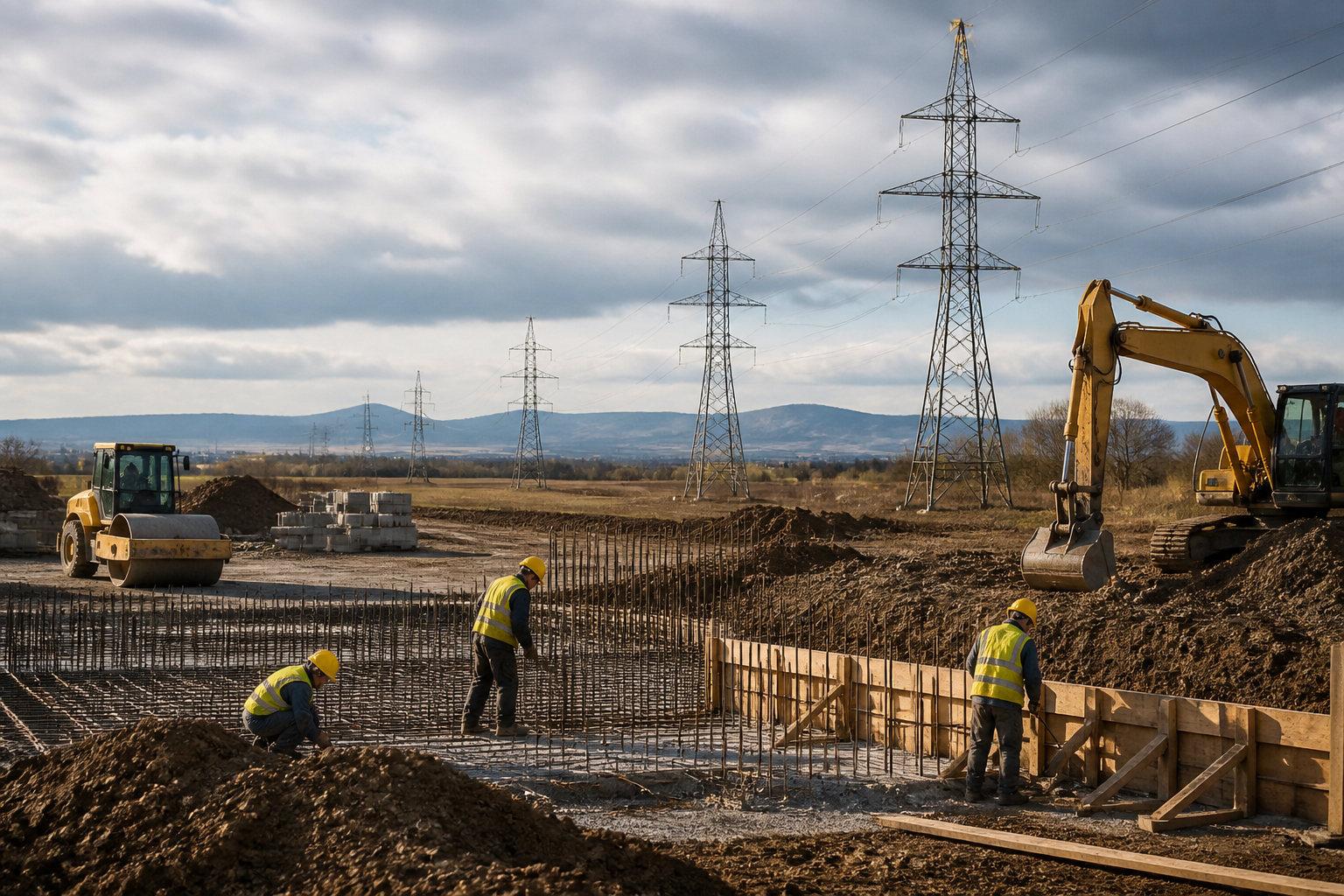
The coverage reads this as a construction slowdown. I read it as a change of client. Hungarian contractors started barely HUF 470bn of new work between April and June.
That is the third weakest quarter since 2021. The number comes from the second-quarter EBI Construction Activity Report, produced by Eltinga, iBuild and Buildecon. Portfolio.hu published it on 3 September 2026. The same report shows where the little that started actually went.
Civil engineering started HUF 120bn in three months
Building work fell hardest. Projects entering the construction phase did not reach HUF 350bn. The half-year figure for non-residential building is an eight-year low. Offices, logistics sheds and education buildings held up better than housing.
Civil engineering was thinner still. First-quarter numbers had been lifted by Paks II. Between April and June, new civil projects only just passed HUF 120bn. Most of that value was energy work. The report names the Visonta gas turbine scheme and the Zsana geothermal plant. Road building was represented almost entirely by one job, the Baja southern bypass.
The map moved as well. Over the last twelve months Közép-Dunántúl took 26 per cent of national starts. It passed Budapest, which sits at 25 per cent. The M1 widening begun last autumn explains most of the shift.
Finishing the book without refilling it
One pair of numbers matters more than the rest. New condominium starts were barely above HUF 100bn, the weakest in two years. Completions in the same quarter reached HUF 180bn, an eleven-year high.
Contractors are converting an old order book into revenue at speed. They are replacing it slowly. Revenue looks healthy this year for exactly that reason. The gap arrives twelve to eighteen months later, when the finished work runs out.
The clients with signed money
Against that background one group of Hungarian clients has cash already committed. On 22 August 2026 the Hungarian Development Bank signed all five grant agreements. They sit inside the country's Recovery and Resilience Facility grid programme. The counterparties are MAVIR, E.ON and MVM. Economy and Energy Minister István Kapitány said the government had already transferred the full envelope to the bank. It is close to HUF 500bn, about €1.38bn. The larger scheme, worth HUF 486bn, targets a grid that can absorb weather-dependent generation.
E.ON Hungária is the private operator in that set. It runs its RRF network development work as a named project. For suppliers this is the most bankable Hungarian pipeline on the table. It covers cable, substations, metering and the civils that go with them. It also runs to a grant deadline.
Eligibility is now a pipeline risk
The same programme shows the other side. MFB told OPUS TITÁSZ on 6 August that its applications had succeeded. On 10 August the bank's board excluded the company from both schemes on statutory transparency grounds. OPUS TITÁSZ calls the decision unfounded and is pursuing legal remedies, as Portfolio.hu reported on 12 August 2026.
Four distribution areas now have funded network programmes. One does not. No contractor caused that outcome and no bid price protects against it. Client eligibility now sits above procurement risk in EU-funded work, and it moves faster than any tender.
The rail money runs on a different clock
Rail is where the announcements are. On 1 September 2026 the Ministry of Construction and Transport published notice 599931-2026 in the EU procurement journal. It covers signalling, telecoms and ETCS Level 2 between Debrecen and Nyíregyháza. The section is about 47 route kilometres and 94 track kilometres. The estimated value is more than HUF 60.552bn, funded from EU sources.
Three conditions decide how this gets priced. The procurement is conditional, because the funding is not yet available. Delivery runs 48 months from the day the contract takes effect, and trains must keep running throughout. The winner also produces the permit designs and obtains the certificates needed to place the system in service.
What to watch next
The Recovery and Resilience Facility calendar now does the sorting. Milestones had to be met by 31 August 2026. Final payment requests are due by 30 September. Money already sitting with MFB is the money most likely to reach a site inside eighteen months.
Contractors should read their own mix against that calendar. Grid and generation clients hold signed grants. Road and rail clients hold plans, notices and conditions. Investors in Hungarian builders should track starts, because starts pay wages in 2028. Public sponsors should price what a conditional tender costs them. Uncertainty handed to bidders comes back as money.
Share it with your peers
Help your network stay ahead of CEE capital projects.
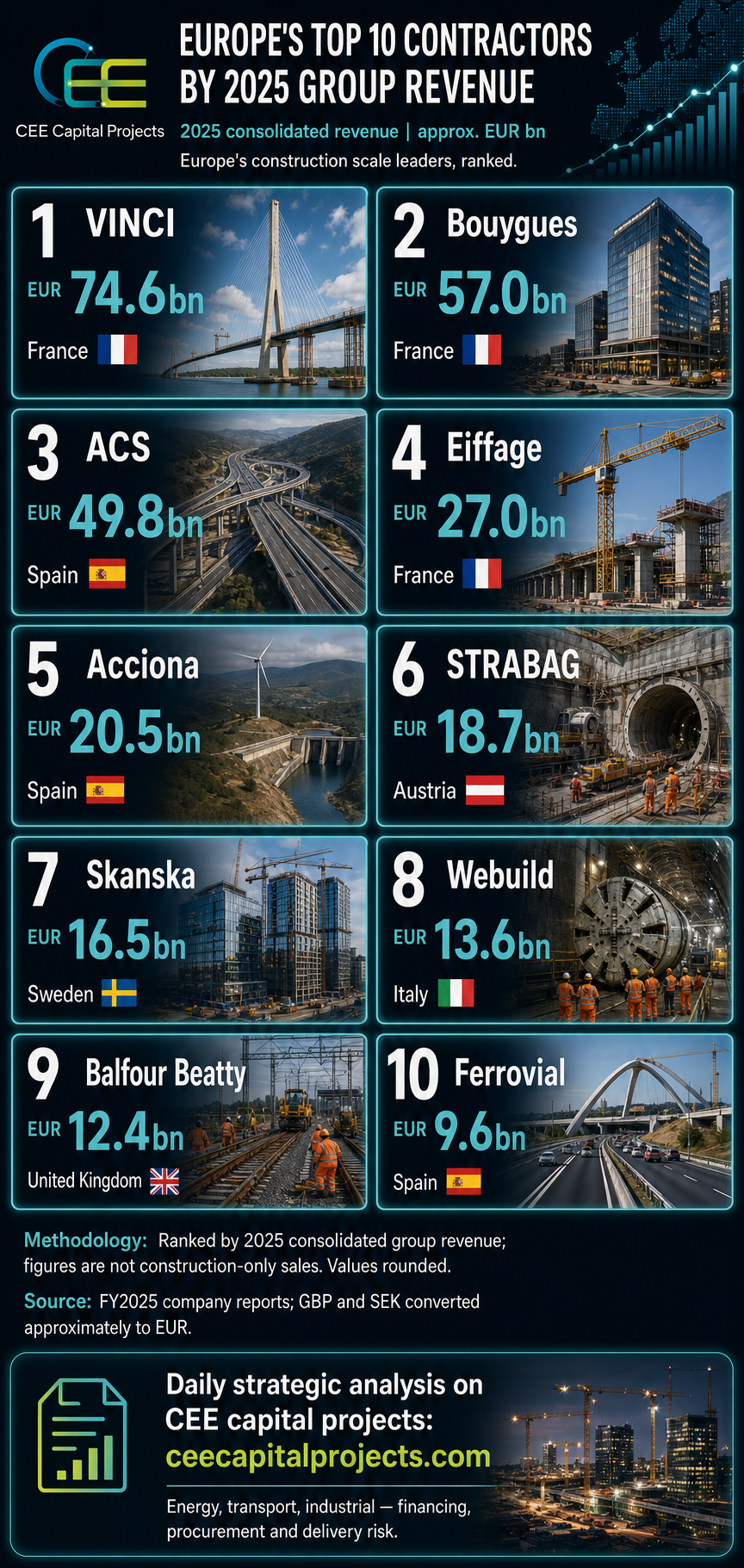
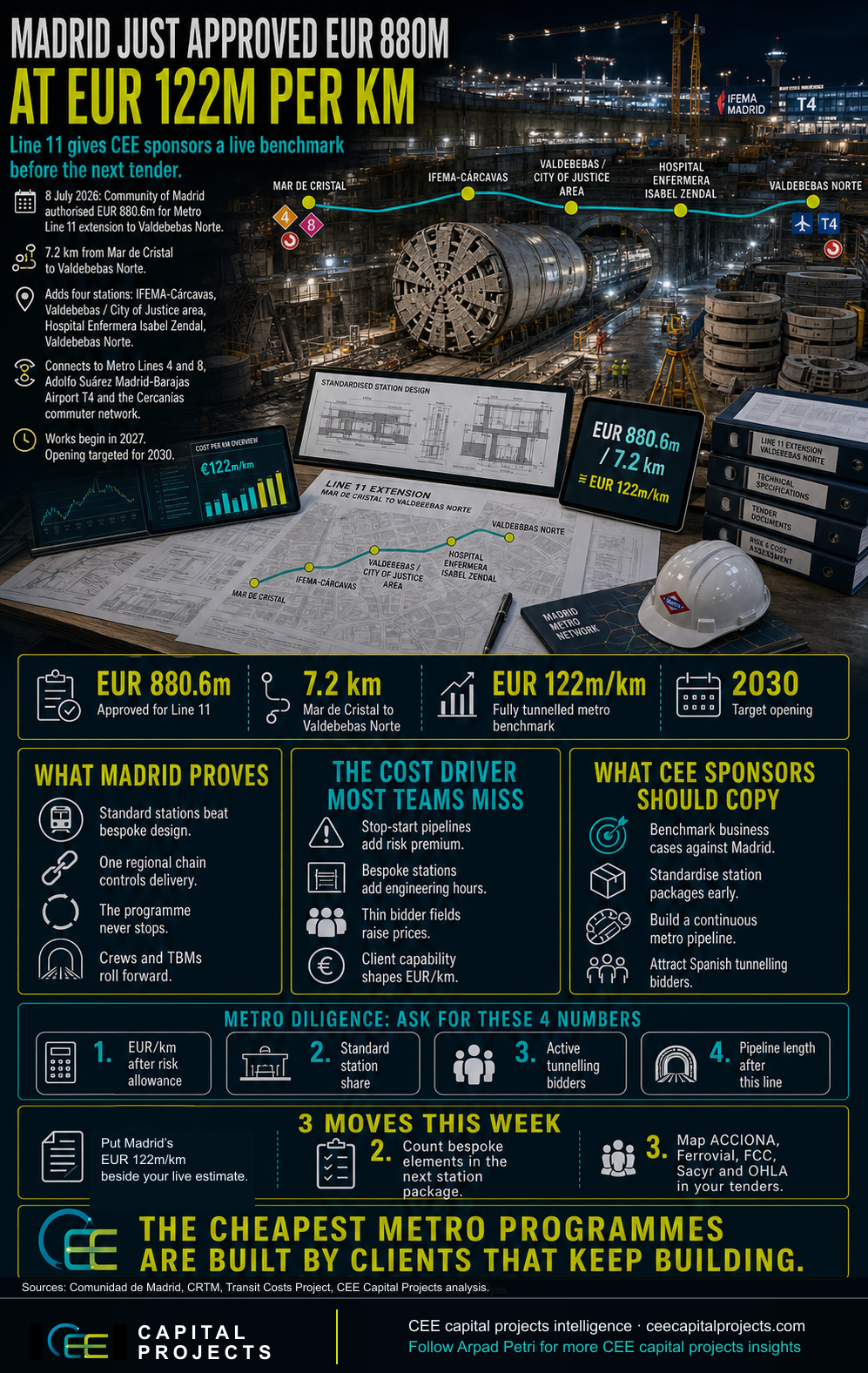
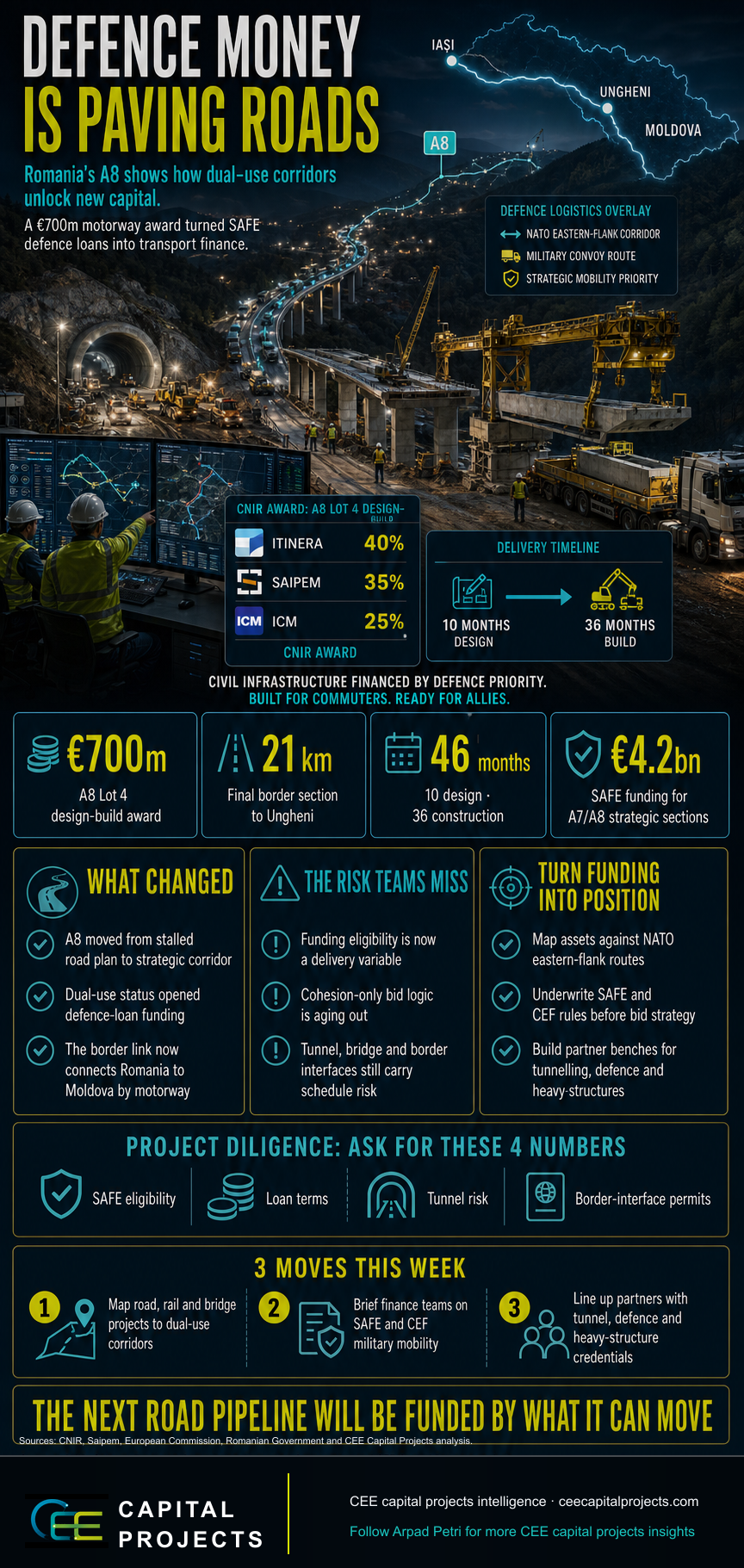
Explore our infograph library — strategic visuals for CEE capital projects leaders.
Project benchmarks, financing structures, tender dynamics and delivery risk — at a glance. Free access for investors, owners, contractors and strategy teams tracking CEE capital projects.
Browse the libraryStrategic Insights
📊 Analytics & Strategic Insight
Hungary is still building. The client list changed, and the calendar changed with it.
The decision most in this industry are avoiding:
👉 Reading output when you should be reading starts. Output tells you what you are finishing. Starts tell you what you will bill in two years. HUF 470bn of starts is the number that sets 2028 revenue.
👉 Treating client eligibility as somebody else's problem. A distribution company lost two grant schemes four days after being told it had won them. No bid price protects a supply chain against that.
👉 Bidding conditional tenders at unconditional prices. The Debrecen to Nyíregyháza notice states that the funding is not yet available. That risk sits somewhere, and silence puts it on the contractor.
Here's the full context:
→ 2021: Hungarian construction starts run at levels that make the second quarter of 2026 the third weakest quarter since.
→ 22 July 2026: the government presents the Baross Gábor rail plan, worth about HUF 3,550bn of investment to 2035.
→ 6 to 10 August 2026: MFB tells OPUS TITÁSZ its RRF applications succeeded, then excludes it on statutory transparency grounds.
→ 22 August 2026: MFB signs all five RRF grid grant agreements with MAVIR, E.ON and MVM, and close to HUF 500bn moves to the bank.
→ Most recent: on 3 September 2026 the EBI report puts second-quarter civil engineering starts just above HUF 120bn, most of it energy work.
What this means for infrastructure operators, contractors and investors:
✅ Grid work is the most bankable Hungarian pipeline right now. The grant is signed, the money is at the bank and the deadline is fixed. Cable, substation, metering and civils packages follow that money.
✅ The completion peak is a warning rather than a result. HUF 180bn completed against HUF 100bn started in housing is a revenue cliff dated twelve to eighteen months out.
✅ Conditional tenders get priced. A sponsor who withholds funding certainty should expect fewer bidders, longer standby claims and a higher award.
3 moves you can make this week:
1️⃣ Split your order book by client funding type. Signed grant, annual budget line, or conditional notice. Put the expiry date of each funding source next to it.
2️⃣ Check the eligibility status of your top five clients. Transparency declarations, ownership disclosure and grant conditions. Ask for the answer in writing before you mobilise.
3️⃣ Put a number on the conditional clause. Cost the standby period between award and funding, then carry that number into the bid instead of the claim.
Related analyses
- Energy & Power
Uniper's 1.7 GW Bid Into Germany's First Capacity Auction: Why the Brownfield Site Decides the StromVKG Result
The European Commission cleared Germany's capacity mechanism on 2 September 2026, six days before the first StromVKG tender closes on 8 September. Uniper is bidding around 1.7 GW and RWE more than 3 GW into a 4,500 MW round where a cleared brownfield site outweighs the price.
Read analysis → - Energy & Power
ČEZ Is Testing a 1:13 Model Before It Builds Orlík's CZK 8bn Pumped Storage. On a World-First Turbine, the Laboratory Sets the Programme
ČEZ has begun 1:13 scale model tests on a reversible Francis turbine for the CZK 8 billion Orlík pumped storage conversion in Czechia. On a world-first machine, a laboratory in Blansko sets the date every other package waits for.
Read analysis → - Energy & Power
Nuclearelectrica's CEO Exit Leaves Cernavodă's EUR 800 Million EIB Loan Between Approval and Signature
Cosmin Ghiță asked to end his mandate as Nuclearelectrica's chief executive on 25 August 2026, six weeks after the European Investment Bank board approved an EUR 800 million loan for the Cernavodă Unit 1 refurbishment that the company has still to contract. With both reactors offline on low Danube levels and a three-year outage due to start in 2027, the risk in this story is continuity at the sponsor rather than a change of name at the top.
Read analysis →
Get a second opinion before it gets expensive.
Contractor selection, tender strategy, a project drifting off track — send us the situation and we'll come back with a clear plan.