Nuclearelectrica's CEO Exit Leaves Cernavodă's EUR 800 Million EIB Loan Between Approval and Signature
Cosmin Ghiță asked to end his mandate as Nuclearelectrica's chief executive on 25 August 2026, six weeks after the European Investment Bank board approved an EUR 800 million loan for the Cernavodă Unit 1 refurbishment that the company has still to contract. With both reactors offline on low Danube levels and a three-year outage due to start in 2027, the risk in this story is continuity at the sponsor rather than a change of name at the top.
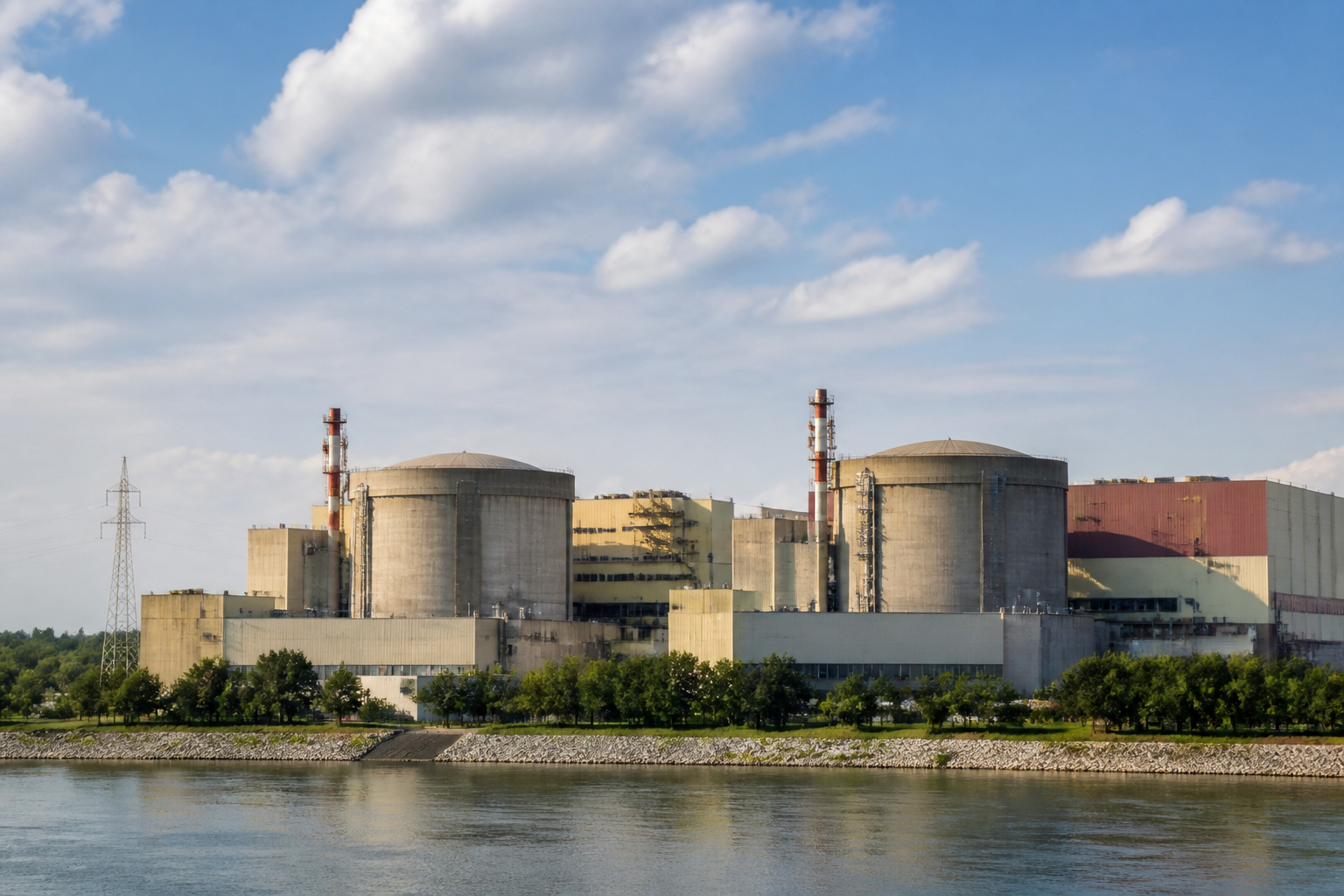
The coverage reads this as a personnel story. I read it as a financing one. Cosmin Ghiță told Nuclearelectrica on 25 August 2026 that he was giving up a mandate running to February 2027.
Six weeks before that letter, on 15 July 2026, the board of the European Investment Bank approved an EUR 800 million loan for the refurbishment of Cernavodă Unit 1. Nuclearelectrica said the borrowing still has to go to a general shareholders’ meeting before the company can contract it. Romania’s largest nuclear financing therefore sits between an approval and a signature, and the chief executive who took it that far is working a notice period.
What the company told the market
Nuclearelectrica notified the Bucharest Stock Exchange on 25 August 2026 that Ghiță had requested termination of his mandate. The Energy Ministry, majority shareholder and supervising authority, said the decision follows a new professional opportunity and that it respects a unilateral act. It added that the company and the Cernavodă plant continue to operate under normal conditions.
Ghiță has run Nuclearelectrica since September 2017, when he was first appointed on a provisional four-month term. His current mandate started on 12 February 2023 and was due to expire in February 2027, according to Agerpres. The notice period will be set under the mandate contract and by a board decision, so the handover date is still open.
The financing stack he leaves behind
Unit 1 is the largest live nuclear project in Romania. The refurbishment is costed at around EUR 1.9 billion and is meant to extend the reactor’s operating life by 30 years. Once back in service, the unit is expected to supply roughly 9 per cent of Romanian electricity between 2030 and 2060.
The funding has been assembled in layers. A EUR 540 million facility for the preliminary phase was signed in September 2025 with a banking syndicate led by JP Morgan SE. The EUR 800 million EIB approval followed on 15 July 2026. The programme then runs into a major outage from 2027 to 2030, with the unit returning to service in 2030.
Read those dates together and the position is tight. The outage that takes a 700 MW reactor off the system for three years begins inside the next eighteen months. The single largest tranche of debt behind it is approved and unsigned.
Two reactors offline at once
The resignation lands in the hardest operational period the plant has had. Unit 1 was disconnected from the grid in a controlled shutdown on 28 July 2026 because of low Danube levels. Unit 2 entered a controlled shutdown on 13 August 2026 for the same reason.
It is the first time both reactors have been taken offline simultaneously for hydrological reasons. The two units are rated at about 700 MW each, roughly 1,400 MW in total, and normally provide around 20 per cent of Romania’s electricity production. Nuclearelectrica says both are held in a safe shutdown state and that reconnection depends on the flow and level of the river.
Key-man risk sits on the wrong side of the table
Lenders price key-man risk with care. Fund documents carry key-man clauses. EPC contracts name the project director, the construction manager and the quality lead, and give the client rights if those people leave. Almost none of that discipline runs in the other direction.
The sponsor is where continuity actually lives on a nuclear programme. One organisation holds the regulator relationship, the shareholder mandate, the lender relationships and the institutional memory of every commitment made on the way to financial close. Inside a state-owned sponsor that memory usually sits with a very small number of people, and no contract obliges them to stay.
The exposure is the gap that follows. A new chief executive at a state company arrives through a nomination process, then has to be accepted by the board, the ministry, the regulator and the lenders. That is measured in months. The outage window is not moving.
What to watch next
Three things decide whether this becomes an operational story. First, the date of the general shareholders’ meeting that authorises the EUR 800 million EIB borrowing. Second, whether an interim chief executive is named quickly or the seat stays empty into the autumn. Third, whether the 2027 outage start survives the transition without a formal restatement.
For contractors and suppliers holding Unit 1 packages, the immediate task is to establish who now signs variations and approves milestone payments. For investors in SNN, the question is whether an approved loan converts into a contracted one on the original timetable. For every other European sponsor running a multi-billion euro programme through a state-owned company, this is a cheap lesson to learn at somebody else’s expense. Diligence the counterparty’s bench as carefully as its balance sheet.
📊 Analytics & Strategic Insight
The riskiest window in a nuclear financing is the one between board approval and signature
The decision most in this industry are avoiding:
👉 You diligence the contractor’s team and never the client’s. Every EPC contract names the individuals who must stay on the job. Sponsor-side capability is assessed as an institution, which is a polite way of saying it is not assessed at all.
👉 An approved loan gets treated as money in the bank. A credit approval is a conditional promise with a list attached. On this project the list includes a shareholder authorisation that has not yet been given, and the person who built the lender case is leaving.
👉 State-owned sponsors are assumed to be institutions when they are actually rosters. Nine years of regulator, ministry and syndicate relationships do not transfer with a handover note. Nobody budgets for the months it takes to rebuild them.
Here’s the full context:
→ 1996 and 2007: Cernavodă Units 1 and 2 entered service, giving Romania two CANDU reactors of about 700 MW each.
→ September 2017: Cosmin Ghiță was appointed chief executive of Nuclearelectrica, initially on a provisional four-month term, and stayed for nine years.
→ September 2025: A EUR 540 million facility covering the preliminary phase of the Unit 1 refurbishment was signed with a banking syndicate led by JP Morgan SE.
→ 15 July 2026: The EIB board approved a EUR 800 million loan for the refurbishment, which Nuclearelectrica must still put to a general shareholders’ meeting before contracting.
→ Most recent: Unit 1 went offline on 28 July and Unit 2 on 13 August 2026 on low Danube levels, and on 25 August Ghiță asked to end a mandate that ran to February 2027.
What this means for infrastructure operators, contractors and investors:
✅ Approval-to-signature is a schedule item rather than a formality. Any condition precedent that depends on a corporate body meeting is exposed to a leadership change, because a new chief executive will want to read the file before signing.
✅ A three-year outage is a commercial event before it is a technical one. The 2027 to 2030 window sets procurement, mobilisation and long-lead ordering dates that are already inside contractors’ planning horizons.
✅ River risk is now a permanent line in Danube-basin generation economics. Two reactors offline together for hydrological reasons is a first, and first events reprice availability assumptions across the region.
3 moves you can make this week:
1️⃣ List your conditions precedent with a name against each one. Take every open item between credit approval and first drawdown, put the responsible person and the governing body next to it, and load the dates into the master schedule.
2️⃣ Write down the five people whose departure would cost you three months. Include the client and lender sides. For each, note what they know that exists nowhere in writing, then fix the worst gap.
3️⃣ Ask your counterparty who signs while a seat is vacant. Get the delegated authority levels for variations, milestone certificates and drawdown requests in writing before you need them.
Share it with your peers
Help your network stay ahead of CEE capital projects.
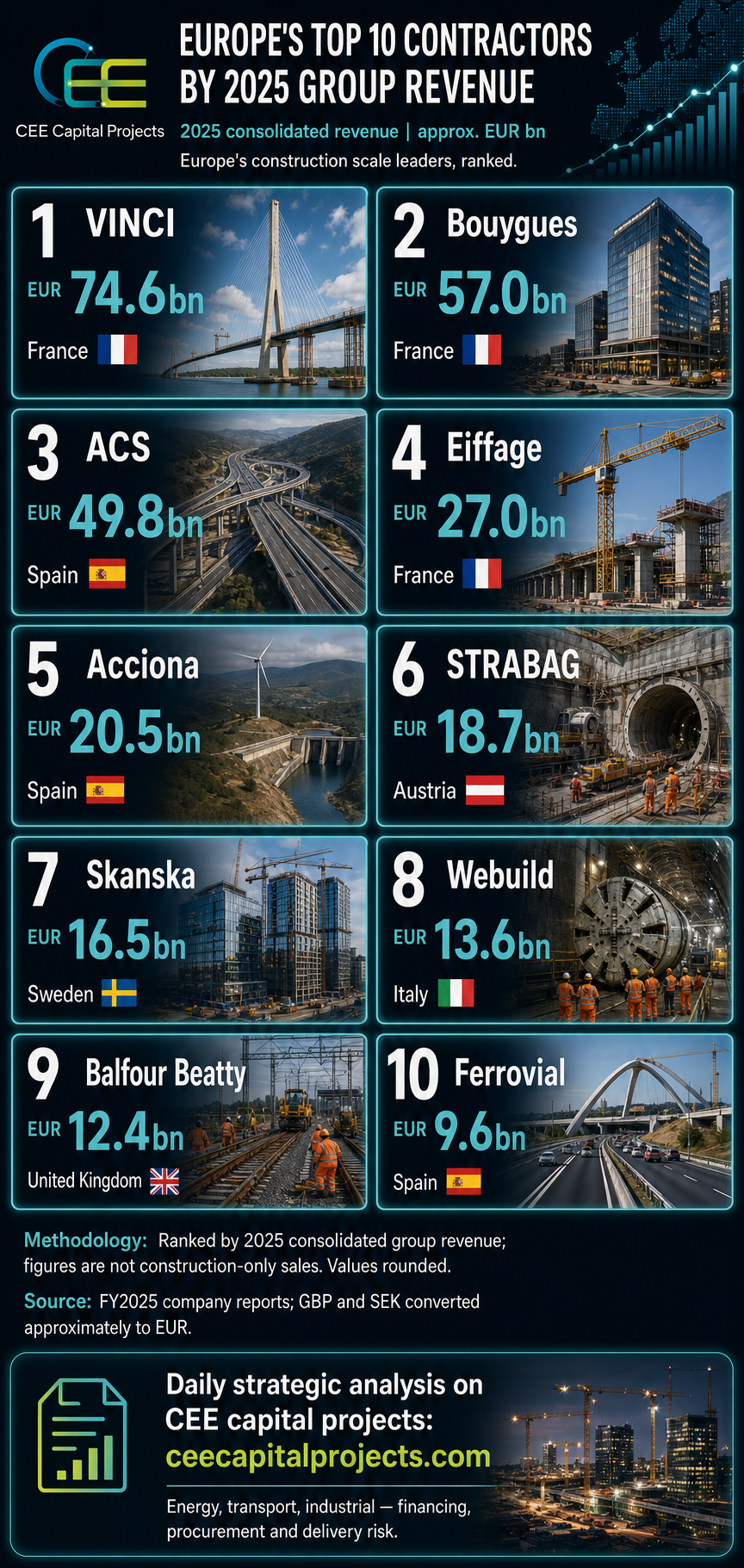
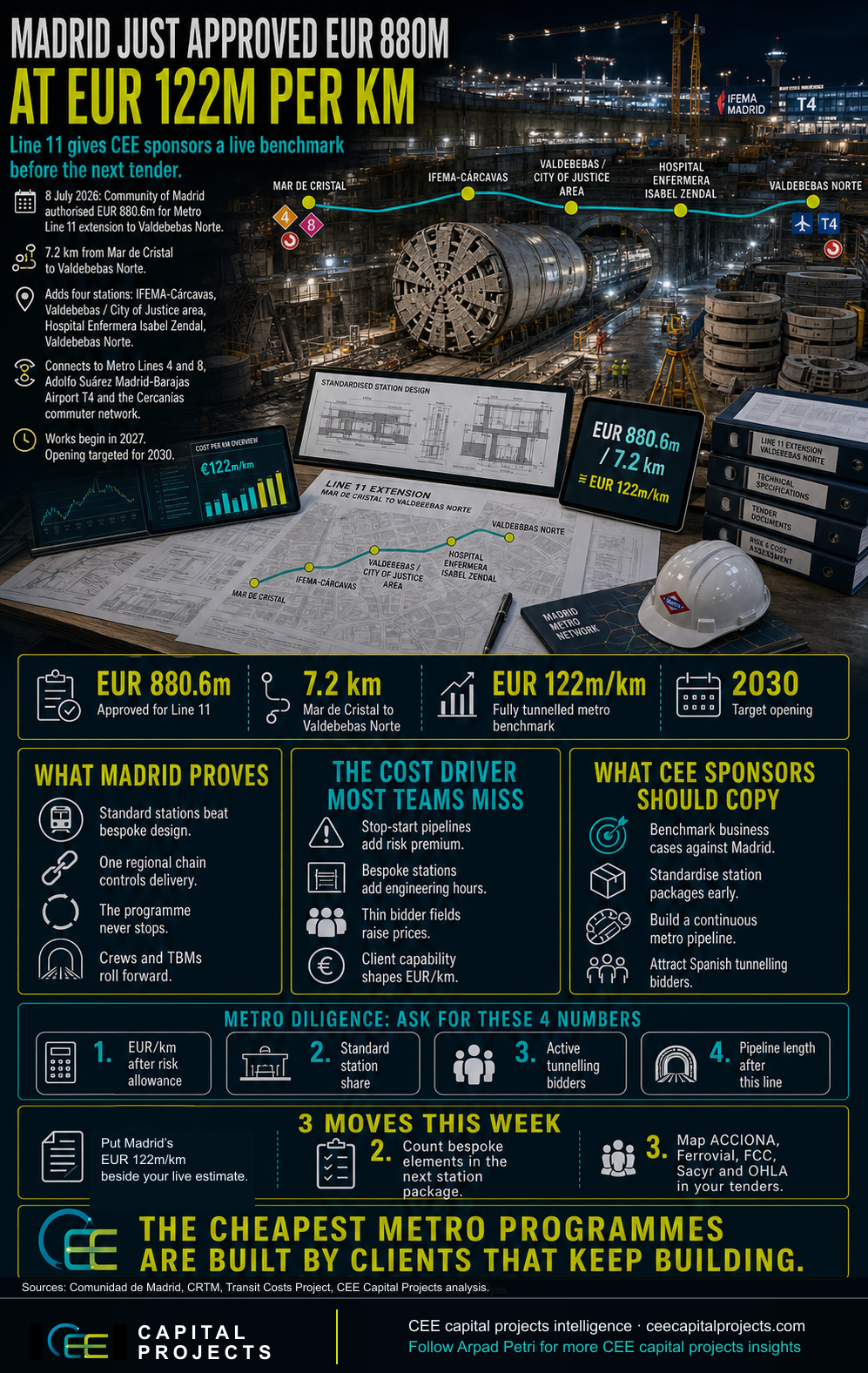
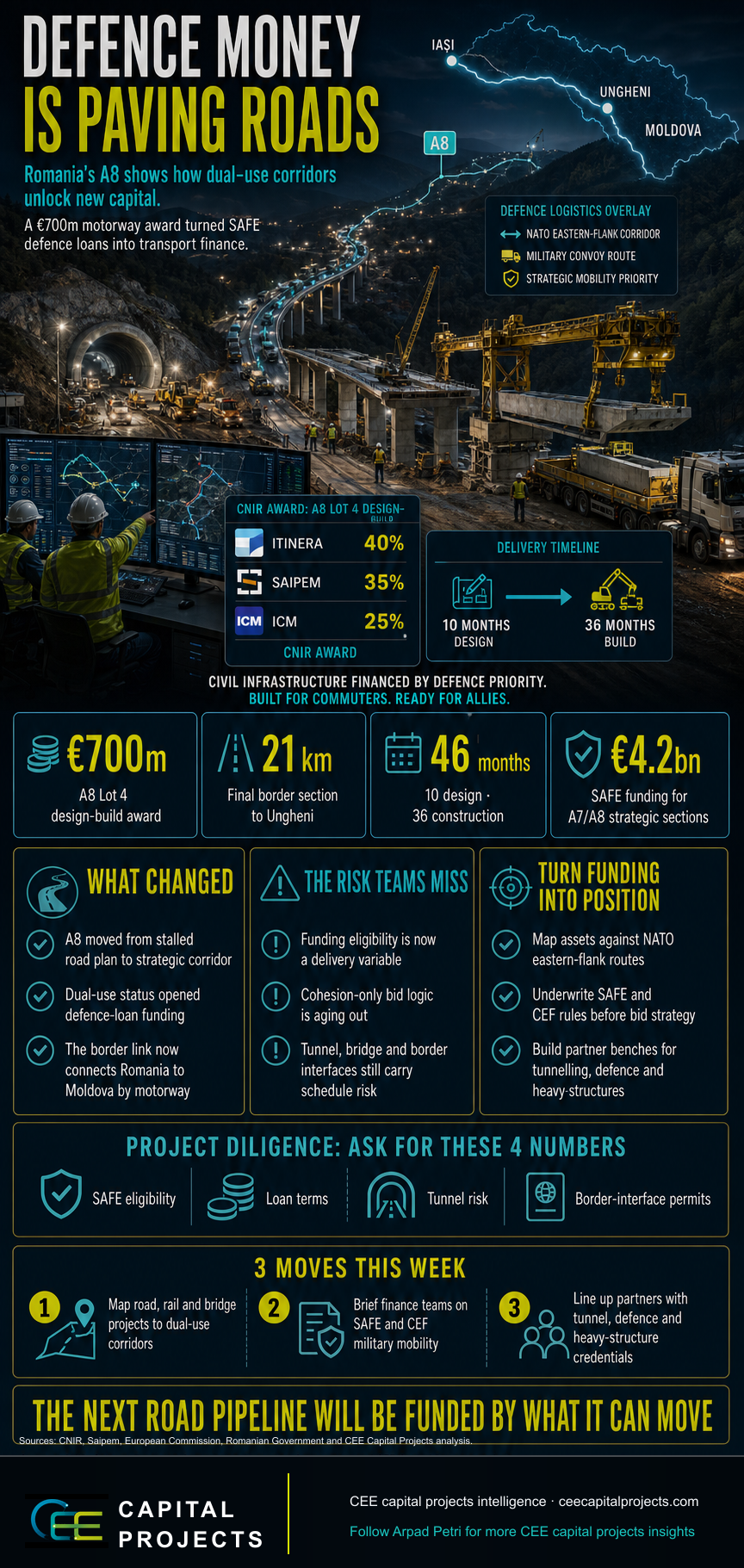
Explore our infograph library — strategic visuals for CEE capital projects leaders.
Project benchmarks, financing structures, tender dynamics and delivery risk — at a glance. Free access for investors, owners, contractors and strategy teams tracking CEE capital projects.
Browse the libraryRelated analyses
- Energy & Power
Uniper's 1.7 GW Bid Into Germany's First Capacity Auction: Why the Brownfield Site Decides the StromVKG Result
The European Commission cleared Germany's capacity mechanism on 2 September 2026, six days before the first StromVKG tender closes on 8 September. Uniper is bidding around 1.7 GW and RWE more than 3 GW into a 4,500 MW round where a cleared brownfield site outweighs the price.
Read analysis → - Energy & Power
Hungary's Construction Starts Fell to HUF 470 Billion. E.ON, MVM and MAVIR Are the Clients With Signed Money
Hungarian contractors started barely HUF 470bn of new work in the second quarter of 2026, the third weakest quarter since 2021, and civil engineering accounted for just over HUF 120bn of it. Almost all of that value was energy work, while MAVIR, E.ON and MVM signed close to HUF 500bn of EU grant agreements in August.
Read analysis → - Energy & Power
ČEZ Is Testing a 1:13 Model Before It Builds Orlík's CZK 8bn Pumped Storage. On a World-First Turbine, the Laboratory Sets the Programme
ČEZ has begun 1:13 scale model tests on a reversible Francis turbine for the CZK 8 billion Orlík pumped storage conversion in Czechia. On a world-first machine, a laboratory in Blansko sets the date every other package waits for.
Read analysis →
Facing a decision on a CEE capital project?
Describe the situation in a few sentences. Within 72 hours you get an experienced read: the risks we see, what we'd check, and whether we can help — no calls, no obligation.