We Help International Investors and Project Owners Deliver Major CEE Projects Without Expensive Surprises
Independent project intelligence and advisory across energy, transport, real estate and industrial construction.
Spie batignolles Is Building Dunkirk's 1,150-Metre Quay for €132m. The Other €171m Is Where European Port Expansions Actually Fail
Dunkerque-Port has started work on a €303m second container terminal, but the quay civils contract accounts for only €132m of it. Across Europe, from Dunkirk to Antwerp to Immingham, the berth is the fastest and cheapest part of a port expansion, and the marshalling yards, power connections and consents behind it are where the programme risk sits.
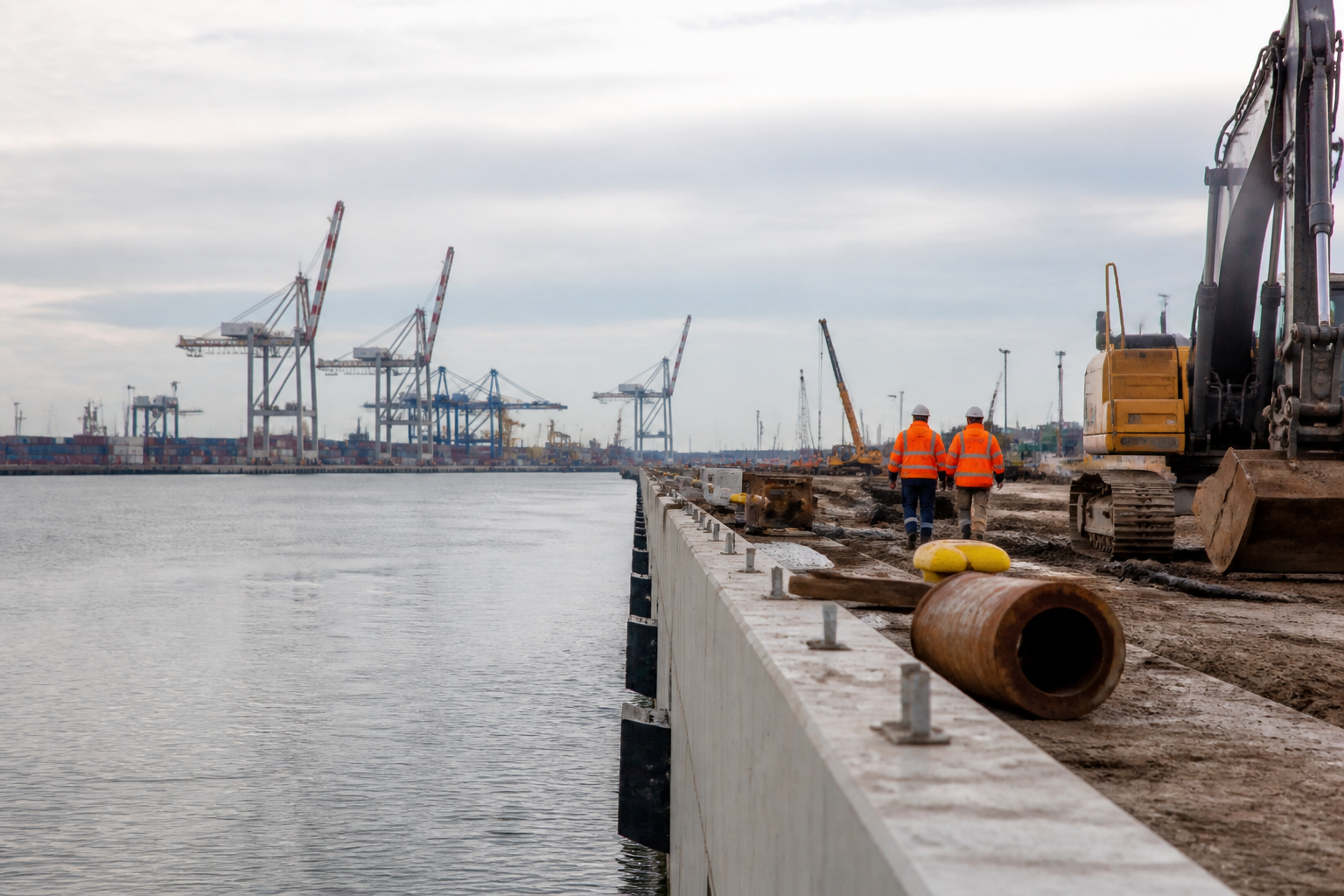
A container quay is the most visible thing a port authority ever builds, and the least likely thing to go wrong. At Dunkirk, the concrete accounts for €132 million of a €303 million project. The other €171 million — dredging, terminal works, power supply, rail, land — is where European port expansions actually come unstuck.
That ratio is worth sitting with, because port capacity is being announced across Europe in TEU headlines while the works that determine whether the TEU ever arrives sit on a completely different programme.
What Dunkirk actually bought
Spie batignolles confirmed on 24 June 2026 that works had started on the quay of the second container terminal at Dunkerque-Port. The scope is a 1,150-metre deepwater quay in the extension of the Bassin de l'Atlantique, dredged to 17.5 metres, capable of taking two additional ultra-large container ships simultaneously. The contract is worth €132 million excluding tax and was awarded to a construction grouping made up of Spie batignolles fondations as lead, alongside Spie batignolles nord, ETPO, Spie batignolles travaux publics and other partners. Works run to 2029.
The quay is the centrepiece of Dunkirk's CAP 2020 scheme, which lifts container capacity from the 850,000 TEU currently available at Terminal des Flandres toward roughly 2 million TEU. The financing is almost entirely public: the European Commission approved €127 million of French state aid in December 2024, and the €303 million package combines a loan from Caisse des Dépôts et Consignations, an €87 million non-repayable state subsidy and €8 million of equity from the port authority.
So a public balance sheet is funding the fixed asset, and private terminal operators will carry the throughput risk on top of it. That structure is now standard across Northern Europe, and it explains why sponsors move fast on quay walls and slowly on everything else.
The berth is the fast part
Marine civils is unglamorous and unusually well behaved as a work package. Sheet piles, anchors, capping beam, dredging, fenders and bollards. The design is mature, the quantities are measurable and the programme is three or four years. Once the piling rig is on site the job is largely a question of weather windows and steel supply.
What does not run on that clock is everything that turns a berth into a working terminal. The high-voltage supply for ship-to-shore cranes and shore power. The rail sidings and the marshalling capacity to move boxes inland. The road connection. The land itself, and the environmental consents attached to it.
Antwerp shows the real bill
The clearest illustration is on the Scheldt. On 29 May 2026 the Flemish Government approved the draft project decision for the Container Cluster Linkerscheldeoever, an expansion sized at an additional 7 million TEU for Port of Antwerp-Bruges. Read the works list rather than the headline. It covers infilling the Northern Cut Dock, building a marshalling yard for container freight trains, relocating high-voltage power lines, developing the De Bieshoek industrial and logistics zone, and creating two new nature areas at Doelpolder South and Prosperpolder South.
The container terminal is one line in that list, and not the hardest one. The scheme goes to public consultation from 12 June to 10 August 2026, then to an opinion from the Council of State, and only then to a final decision by the Flemish Government. Meanwhile Antwerp-Bruges opened the second phase of its automated Deurganck Dock terminal on 22 April 2026, adding 2 million TEU, and DP World completed a €230 million expansion of its Antwerp Gateway.
Demand is not the issue. Rotterdam handled 4.1 million TEU in the first quarter of 2026, up 7% year on year. The issue is sequencing: a berth delivered ahead of its rail yard is a very expensive place to stack containers.
A thin bidder pool, and a contracting question
Marine civils is also a specialist market with a short list of credible bidders, which matters for anyone modelling competitive tension. Dragados, part of the ACS group alongside HOCHTIEF, holds the Stage Two contract from Associated British Ports for the Immingham Eastern Ro-Ro Terminal, a joint ABP and Stena Line investment of more than £200 million due to open in 2028. Marine works there began this month, with the first pile marked in a ministerial visit on 17 July 2026, and Dutch specialist Ravestein carrying marine infrastructure through to July 2027.
Note the contract form. Immingham runs on an NEC4 ECC Option C design and build contract, a target-cost arrangement with pain and gain share, rather than the fixed-price model still standard on continental quay works. Driving piles into an estuary is exactly the situation where ground risk and target cost belong in the same conversation.
What follows
For contractors, the specialist marine entities are the binding constraint, not group balance sheets, and capacity in piling and dredging plant will price ahead of general civils through this cycle. For terminal operators and their investors, the asset to diligence is the hinterland connection, because a berth without rail capacity earns a fraction of its design case. For public sponsors, the discipline is simple and rarely applied: publish the marshalling yard and grid connection dates alongside the quay completion date, and be judged on the later of the two.
Share it with your peers
Help your network stay ahead of CEE capital projects.
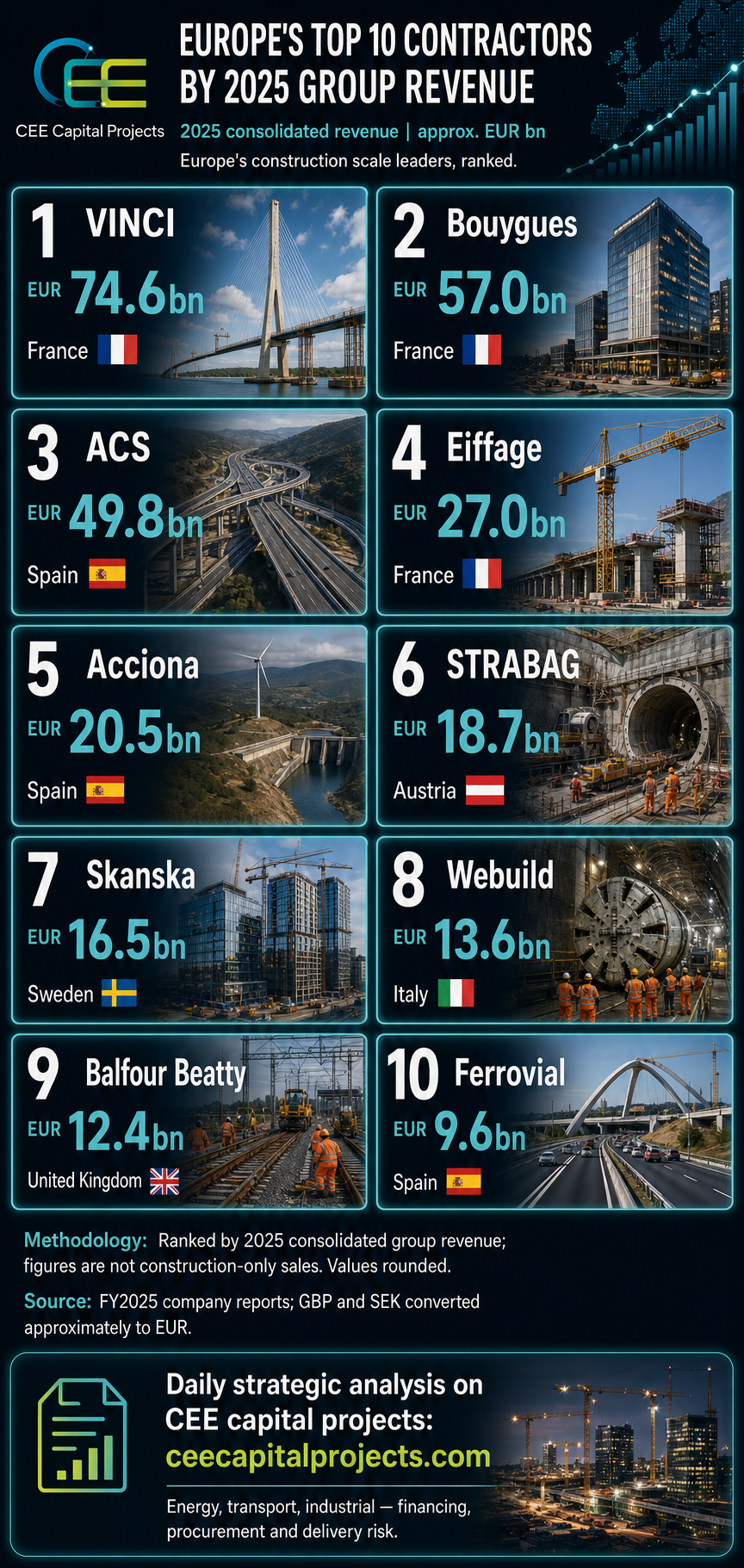
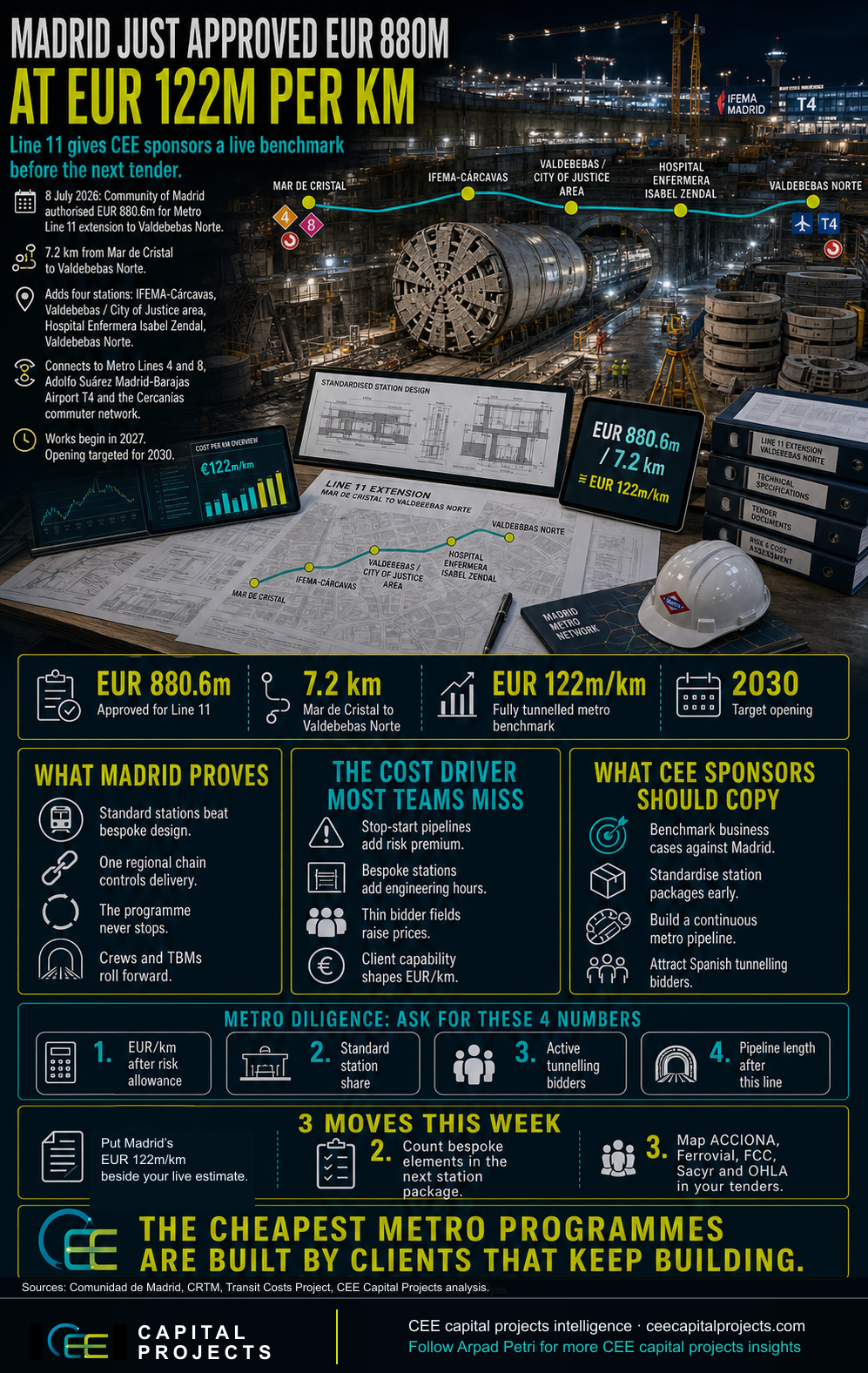
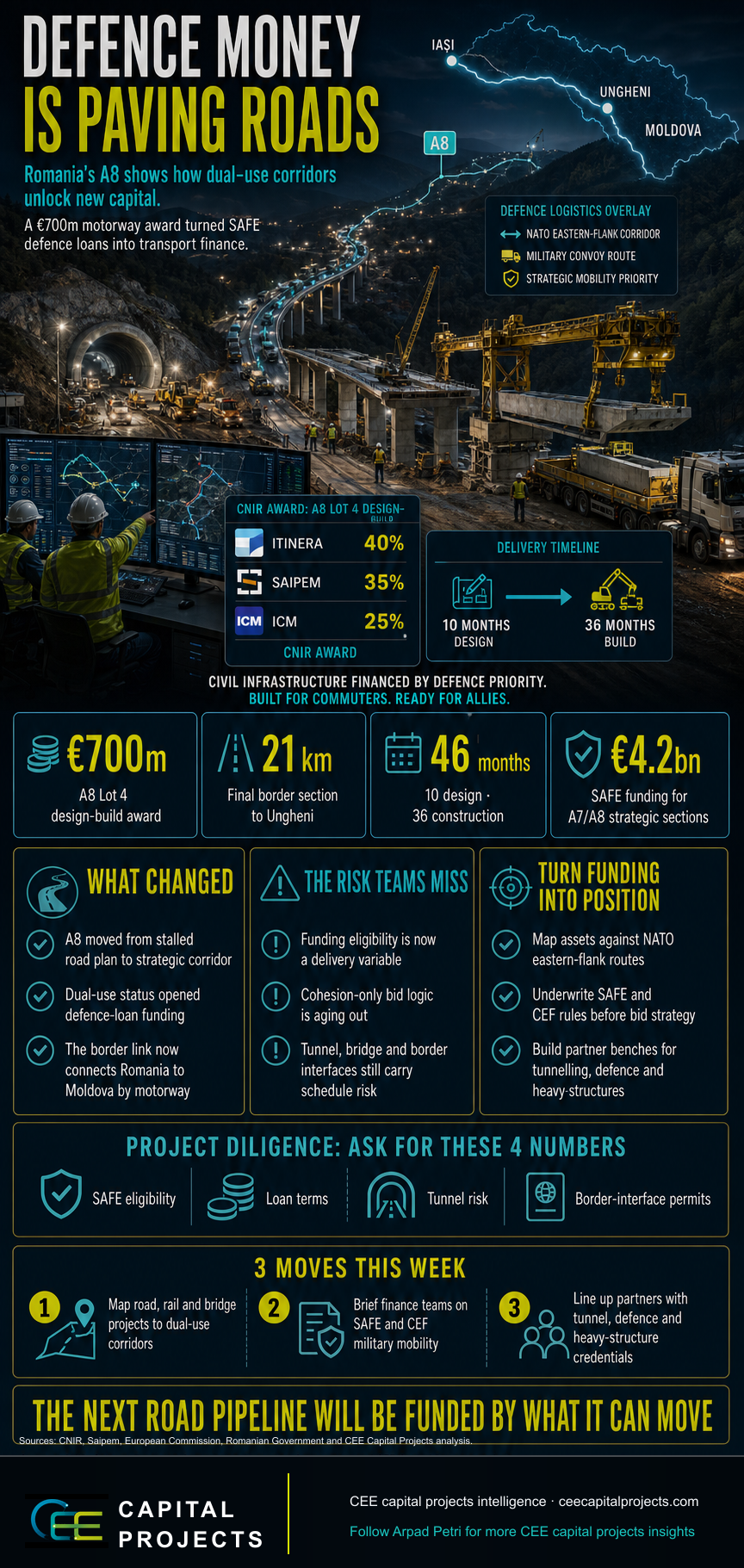
Explore our infograph library — strategic visuals for CEE capital projects leaders.
Project benchmarks, financing structures, tender dynamics and delivery risk — at a glance. Free access for investors, owners, contractors and strategy teams tracking CEE capital projects.
Browse the libraryStrategic Insights
📊 Analytics & Strategic Insight
European port expansions are decided by the land behind the quay, not the quay wall
The decision most in this industry are avoiding:
👉 The quay wall is the lowest-risk element and still takes the most executive attention. Marine civils is mature, measurable and programmable. It is the high-voltage connection, the marshalling capacity and the environmental consents that can push revenue start out by years, and they rarely sit on the same project control surface.
👉 Capacity announced in TEU is a misleading metric for an investment decision. Antwerp's 7 million TEU headline is, in substance, dock infilling, power line relocation, a logistics zone and two nature areas. Model from the headline and you are pricing the wrong asset.
👉 Splitting a publicly funded fixed asset from private throughput risk distorts the incentives. The port authority gets aid for the quay; the operator carries the missing hinterland link. That structure explains why the concrete goes up quickly and everything else does not.
Here's the full context:
→ December 2024: The European Commission approves €127 million of French state aid for Dunkirk's CAP 2020 project.
→ April 2026: Port of Antwerp-Bruges opens the second phase of its automated Deurganck Dock terminal, adding 2 million TEU; DP World completes a €230 million expansion at Antwerp Gateway.
→ 29 May 2026: The Flemish Government approves the draft project decision for the Container Cluster Linkerscheldeoever, sized at an additional 7 million TEU, with a marshalling yard and high-voltage line relocation in scope.
→ Q1 2026: Rotterdam handles 4.1 million TEU, up 7% year on year, so the demand side is not the constraint.
→ Most recent: On 24 June 2026 Spie batignolles announces the start of works on Dunkirk's 1,150-metre deepwater quay under a €132 million net contract inside a €303 million programme; on 17 July 2026 a ministerial visit marks the first pile at the Immingham Eastern Ro-Ro Terminal, where Dragados is main contractor.
What this means for infrastructure operators, contractors and investors:
✅ Specialist marine capacity will price ahead of general civils. Few firms carry the piling and dredging fleet plus the track record, and a group balance sheet does not substitute for the specialist entity.
✅ The hinterland connection is the real diligence item in a terminal acquisition or concession. Without marshalling capacity and a grid connection, a berth earns a fraction of its design case.
✅ Target-cost contract forms will spread into marine works. The NEC4 ECC Option C arrangement at Immingham signals that shared ground risk is becoming the norm where fixed price used to be the default.
3 moves you can make this week:
1️⃣ Ask for the hinterland programme on every port project in your portfolio. Marshalling yard, grid connection, road link, each with a date, on the same sheet as the quay completion date.
2️⃣ Review your marine civils bidder list. If there are fewer than three credible bidders, the competitive tension assumed in your pricing model is too optimistic.
3️⃣ Test the contract form on your next marine package. Put fixed price next to a target-cost arrangement and quantify what you are paying today to transfer ground risk.
Related analyses
- Transport & Infrastructure
V-Híd Just Lost Hungary's HUF 338 Billion Déli Körvasút at 42 Per Cent Complete. The Grant Clock Is the Real Story
Hungary halted construction of the Budapest Southern Circle Railway on 9 October 2026 and barred V-Híd from every ongoing rail investment. The HUF 367 billion of EU money behind the job survives only if a lawful re-tender lands inside two years.
Read analysis → - Transport & Infrastructure
Afcons Wins Croatia's EUR 899m Dugo Selo-Novska Rail Contract: Four Bids, No European Prime
Croatia signed its largest ever railway contract on 1 October 2026, handing 83 km of double-tracking to India's Afcons Infrastructure at EUR 677.06m excluding VAT. Four bids were priced for the work and not one of them came from a European prime contractor.
Read analysis → - Transport & Infrastructure
STRABAG Closes BAWI Construction Buy in Romania as Rail Qualification Becomes the Scarce Asset
STRABAG has closed its purchase of BAWI Construction, a Bucharest rail specialist with 240 employees and about EUR 60 million of 2025 output. The number that matters is the qualification it buys, as Romania opens a EUR 5.99 billion rail programme with the EU recovery window shut.
Read analysis →
Get a second opinion before it gets expensive.
Contractor selection, tender strategy, a project drifting off track — send us the situation and we'll come back with a clear plan.