We Help International Investors and Project Owners Deliver Major CEE Projects Without Expensive Surprises
Independent project intelligence and advisory across energy, transport, real estate and industrial construction.
Skanska Booked SEK 4.7 Billion of Building Work in Ten Working Days. Not One Krona Went to a Road
Skanska signed five contracts worth about SEK 4.7 billion between 2 and 15 July 2026: a university campus, a data centre, nuclear-waste caverns, an aluminium plant and a rail bridge. The run maps where construction demand now sits, and why repeat private clients are outbuilding public roads programmes.

Skanska signed five construction contracts in ten working days at the start of July, worth roughly SEK 4.7 billion (about EUR 420 million) combined. A university campus in Sweden. A data centre in Virginia. Rock caverns for Sweden's nuclear-waste repository. An aluminium plant in Norway. A rail bridge in New Jersey. Not one krona of it went to a road. For an industry that still equates order-book growth with motorway megaprojects, the Swedish group's July run is a map of where construction demand actually sits in 2026: buildings for the electrified, reindustrialised economy, ordered mostly by private and repeat clients, in packages small enough to price with discipline.
Five contracts, two continents, one pattern
The sequence started on 2 July with a USD 87 million (SEK 810 million) contract from Amtrak to rehabilitate Dock Bridge in Newark, New Jersey. On 3 July came a NOK 1.1 billion (SEK 1.0 billion) order from aluminium producer Hydro for a new wire rod facility in Karmøy, Norway. On 6 July, Svensk Kärnbränslehantering (SKB) commissioned about SEK 1 billion of new rock caverns at the Forsmark repository for short-lived radioactive waste. On 7 July, an existing data-centre client signed an additional USD 94 million (SEK 870 million) contract in Virginia. And on 15 July, Skanska announced a roughly SEK 1 billion commission from Boulevardfastigheter to build the new city campus of Kristianstad University.
The campus contract, announced in Skanska's press release of 15 July 2026, is the clearest signal in the set: about 25,000 square metres of floor space for 13,000 students and 550 staff, construction starting in early August 2026, completion in June 2029, booked into Swedish order intake for the third quarter. It is urban-regeneration money, a developer betting that a downtown campus lifts a mid-size city's economy.
The Virginia deal tells the second story. It is an "additional contract" with an unnamed existing client: a single-storey, 17,700 square metre data centre with four colocation halls and a designed capacity of 38.4 MW, built between October 2026 and the second quarter of 2028. This is repeat AI-infrastructure work, negotiated rather than tendered.
The Karmøy plant tells the third. Hydro's new line will produce about 110,000 tonnes of aluminium wire rod a year, the feedstock for the conductors and cables that Europe's grid build-out consumes. The building contractor now sits one step upstream in the energy transition's supply chain. Completion is scheduled for March 2028.
The order book of 2026 is buildings for the electric economy
Put together, the five clients are a university developer, a data-centre operator, a state nuclear-waste agency, an aluminium producer and a national railway. Education, compute, energy back-end, transition manufacturing, rail. The absent categories are equally telling: no motorway, no open-tender public office block, no speculative commercial development.
That mix mirrors what building construction is becoming across Europe. VINCI Construction took a EUR 157 million share of the EUR 210 million second building of the New Reims Hospital on 25 June, a 58,000 square metre, 498-bed block. Mota-Engil signed the EUR 207.3 million first phase of CALB's battery gigafactory in Sines, Portugal, on 26 May, roughly 62,000 square metres of manufacturing shell on a 22-month schedule. Hospitals, factories, campuses and data halls are carrying the order books that roads and rail once filled, while several flagship civil programmes fight budget stress, tender appeals and political review.
There is also a commercial logic in the size of the tickets. Five contracts averaging under EUR 100 million spread execution risk in a way one EUR 500 million motorway cannot. Small packages get priced at current input costs, start within months and turn cash quickly. And repeat-client building work is largely negotiated: the margin discussion happens with a counterparty that has already watched the contractor deliver.
What this means east of Vienna
For CEE the relevance is direct. The region's building-construction pipeline is following the same demand map: battery and EV plant shells, data-centre campuses moving toward power-rich Polish sites, hospital programmes, university and urban-regeneration blocks. The buyers are increasingly corporate rather than public, which changes how work is won. Prequalification, framework relationships and delivered references count for more than the lowest open-tender bid. Contractors used to the rhythm of EU-funded road cycles will find the growth in rooms, halls and shells, and in the clients who order them twice.
The forward question is whether this demand mix holds once rate cuts revive commercial development and the EU's next budget cycle restarts the big civil programmes. Until then, the evidence favours builders that can price a factory hall, a data hall and a campus off the same industrial playbook. Order books are being built client by client, building by building. Skanska just showed how fast that can compound.
Share it with your peers
Help your network stay ahead of CEE capital projects.
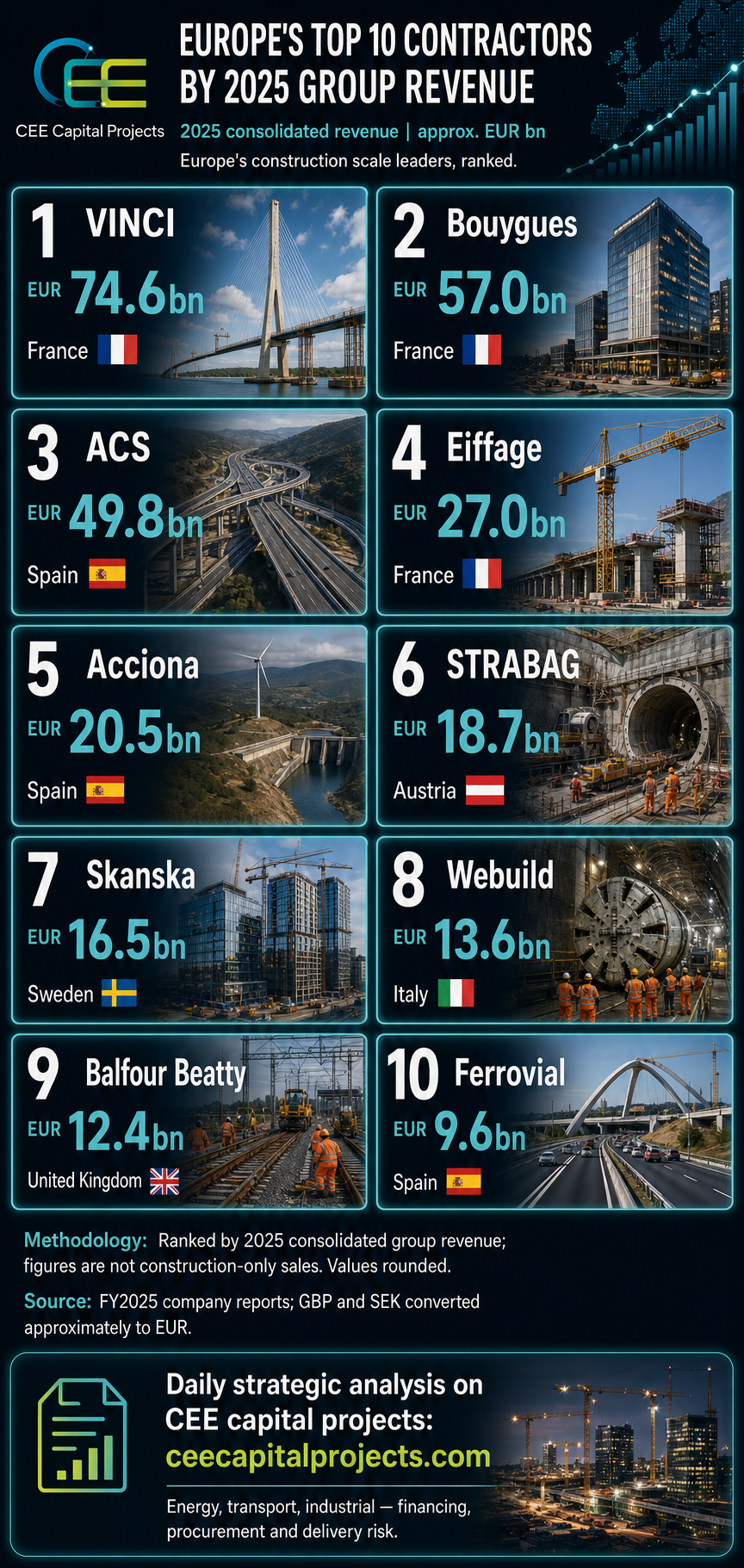
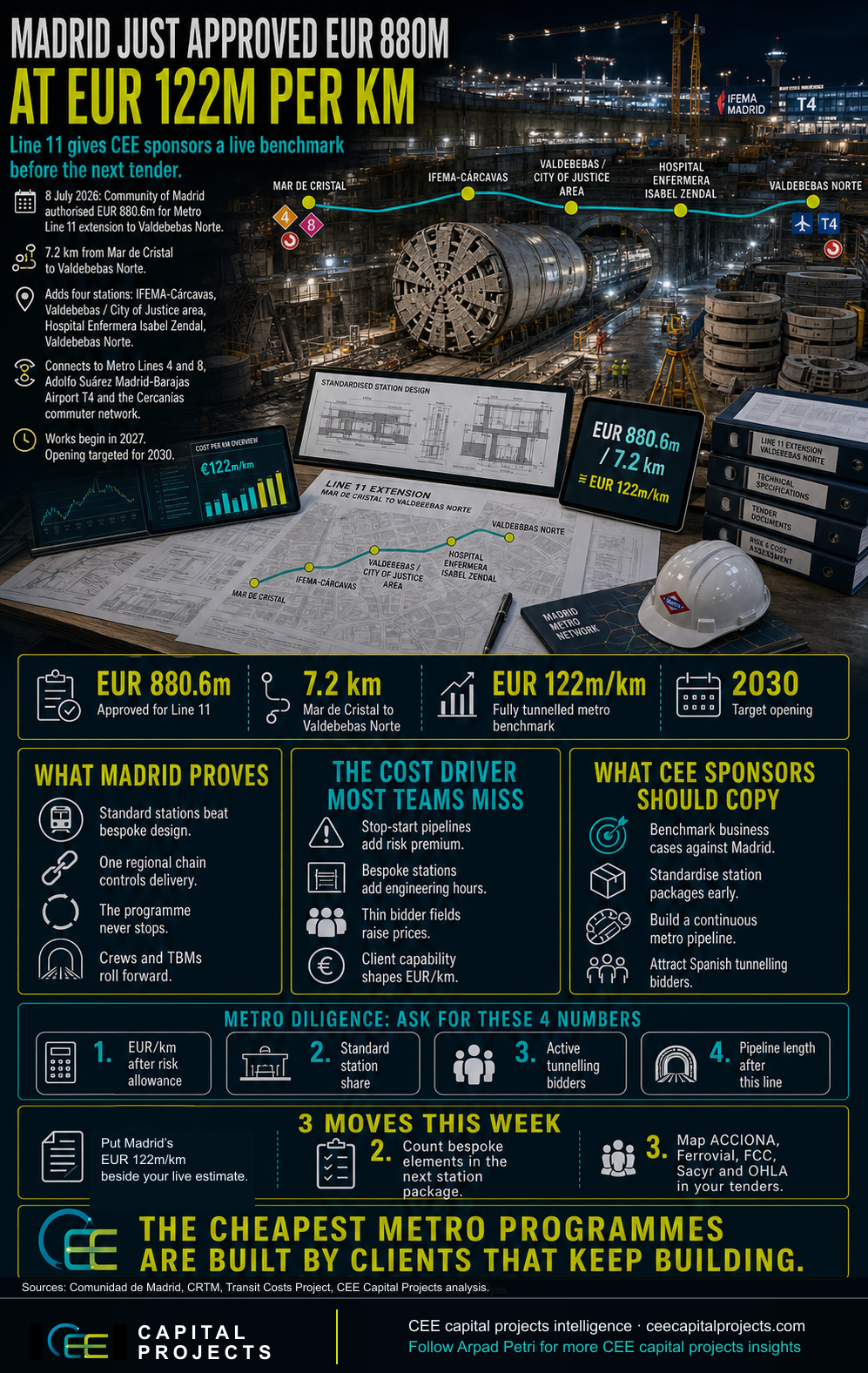
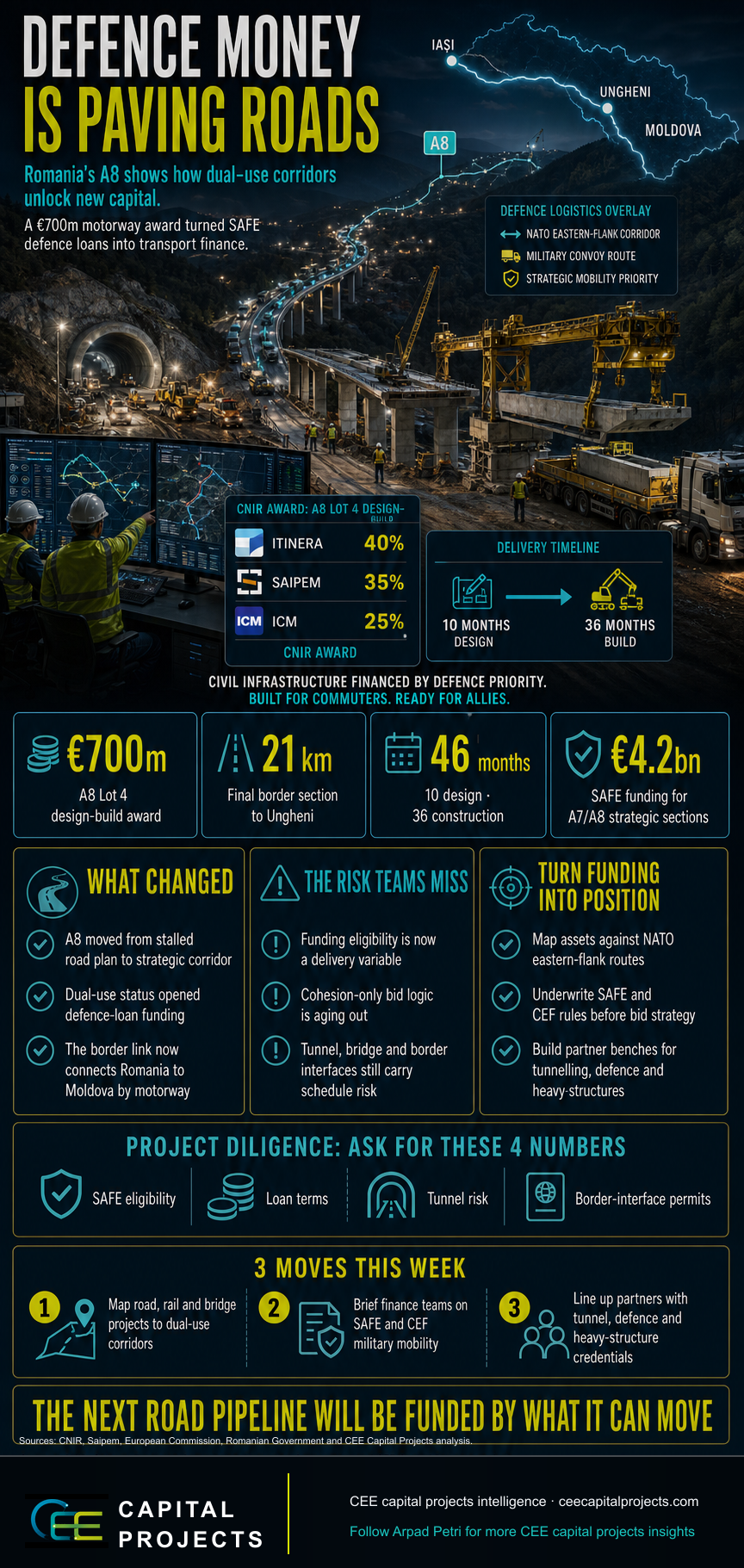
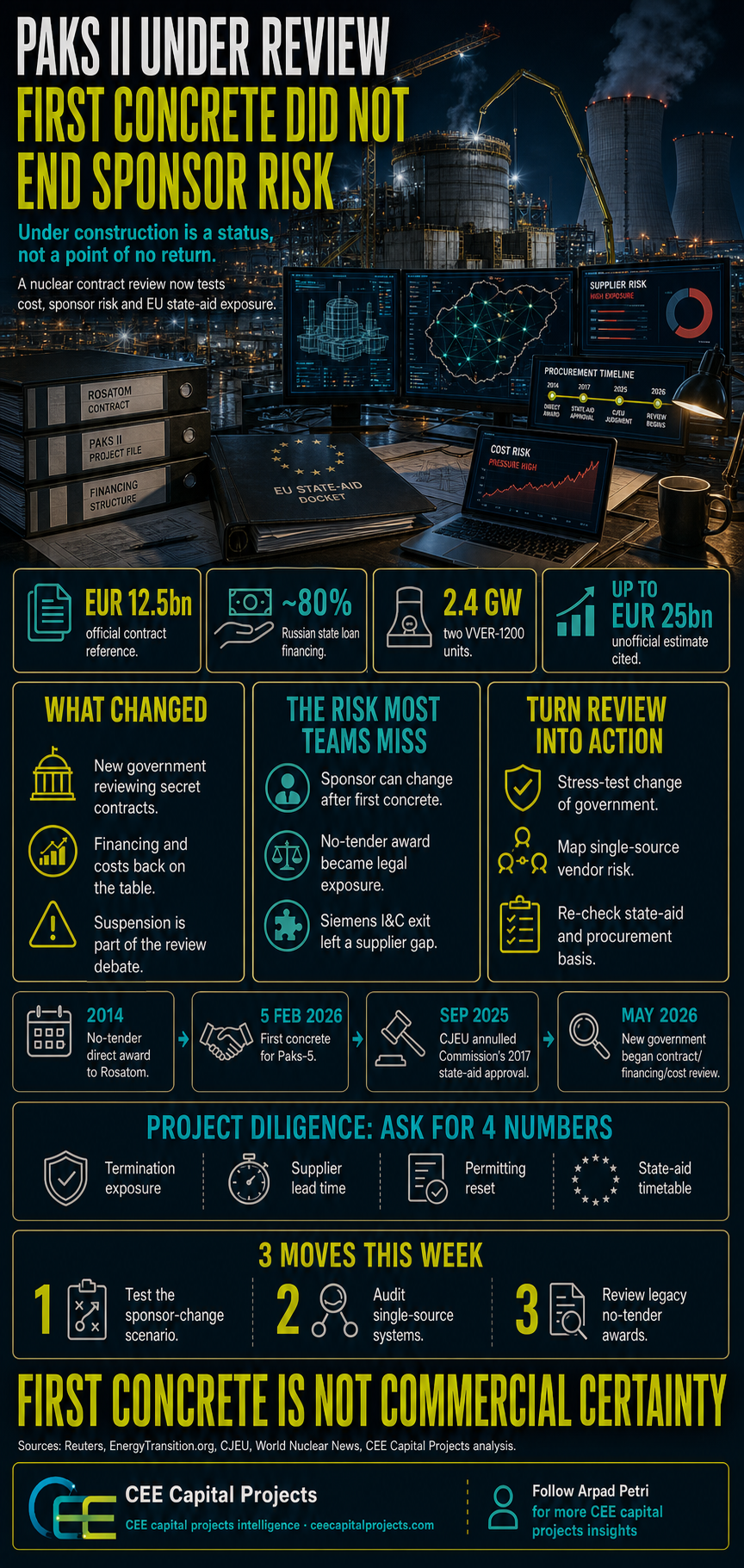
Explore our infograph library — strategic visuals for CEE capital projects leaders.
Project benchmarks, financing structures, tender dynamics and delivery risk — at a glance. Free access for investors, owners, contractors and strategy teams tracking CEE capital projects.
Browse the libraryStrategic Insights
📊 Analytics & Strategic Insight
Repeat private clients are outbuilding public programmes: the mid-ticket building boom
The decision most in this industry are avoiding:
👉 Many mid-size buildings beat one megaproject. Five contracts averaging under EUR 100 million diversify client, geography and input-cost risk that a single motorway concentrates, yet most contractors still chase the big civil ticket for prestige and league-table optics.
👉 "Additional contract with existing client" is the most under-priced phrase in the sector. Repeat data-centre and industrial work is negotiated, closes faster and carries structurally better margin than open tenders, yet order-book commentary almost never separates it from tendered intake.
👉 A factory shell is an energy-transition asset. The Karmøy line exists to feed conductors into Europe's grid build-out. Builders who master industrial process buildings sit upstream of electrification demand instead of downstream of public budgets.
Here's the full context:
→ 2024: ACER puts EU grid-congestion costs at EUR 4.3 billion for the year, hardening the case for a decade of grid, storage and grid-supply manufacturing investment.
→ June 2025: Ember reports new data centres wait 7-10 years for grid connections in Europe's main hubs; compute construction starts following available power, including toward the Nordics and CEE.
→ 26 May 2026: Mota-Engil signs the EUR 207.3 million first phase of CALB's battery gigafactory in Sines, Portugal: about 62,000 square metres of manufacturing shell on a 22-month schedule.
→ 25 June 2026: VINCI Construction takes EUR 157 million of the EUR 210 million second building of the New Reims Hospital, a 58,000 square metre, 498-bed block on a 45-month programme.
→ Most recent: Between 2 and 15 July 2026 Skanska signs five contracts worth about SEK 4.7 billion: Dock Bridge for Amtrak, the Karmøy plant for Hydro, Forsmark rock caverns for SKB, a Virginia data centre for a repeat client, and the SEK 1 billion Kristianstad city campus announced on 15 July.
What this means for infrastructure operators, contractors and investors:
✅ Re-weight business development toward repeat corporate clients. One delivered data hall or plant shell is worth more than ten open-tender bids, because it puts you in the room when the client's next capex tranche is approved. Structure teams around key accounts, not pursuit lists.
✅ Build industrial-buildings capability now. Process buildings for metals, batteries, pharma and compute demand a schedule discipline and MEP density that road-focused contractors often lack. Partnering or hiring for it opens the fastest-growing ticket class in Europe.
✅ Investors: read order-book quality, not just size. A book of mid-ticket, negotiated, private building work carries different and often better margin and litigation risk than one headline megaproject. Ask management for the split between tendered and negotiated intake.
3 moves you can make this week:
1️⃣ Split your pipeline by client type. Tag every pursuit as open tender, framework or repeat client, and put a cost of sale on each category. The result usually argues for reallocating bid budget within a week.
2️⃣ Call your last three private clients. Ask what they plan to build in the next 24 months. "Additional contracts" go to whoever is already trusted when the investment decision lands.
3️⃣ Screen one industrial vertical. Pick batteries, data halls or grid-supply manufacturing, map the announced European projects that lack a named builder, and shortlist where your delivery record travels.
Related analyses
- Transport & Infrastructure
V-Híd Just Lost Hungary's HUF 338 Billion Déli Körvasút at 42 Per Cent Complete. The Grant Clock Is the Real Story
Hungary halted construction of the Budapest Southern Circle Railway on 9 October 2026 and barred V-Híd from every ongoing rail investment. The HUF 367 billion of EU money behind the job survives only if a lawful re-tender lands inside two years.
Read analysis → - Transport & Infrastructure
Afcons Wins Croatia's EUR 899m Dugo Selo-Novska Rail Contract: Four Bids, No European Prime
Croatia signed its largest ever railway contract on 1 October 2026, handing 83 km of double-tracking to India's Afcons Infrastructure at EUR 677.06m excluding VAT. Four bids were priced for the work and not one of them came from a European prime contractor.
Read analysis → - Transport & Infrastructure
STRABAG Closes BAWI Construction Buy in Romania as Rail Qualification Becomes the Scarce Asset
STRABAG has closed its purchase of BAWI Construction, a Bucharest rail specialist with 240 employees and about EUR 60 million of 2025 output. The number that matters is the qualification it buys, as Romania opens a EUR 5.99 billion rail programme with the EU recovery window shut.
Read analysis →
Is your project leaking money through its subcontractors?
Most owners lose 3–8% in vendor packages without noticing. Tell us about your project — we'll tell you where we'd look first.