We Help International Investors and Project Owners Deliver Major CEE Projects Without Expensive Surprises
Independent project intelligence and advisory across energy, transport, real estate and industrial construction.
Skanska PLN 367m Modlin Airport Rail Bid: Eleven Offers, None Inside PKP PLK's PLN 315m Budget
PKP PLK has selected Skanska's PLN 367.4m offer for the 5.5 km rail link to Warsaw Modlin airport, PLN 52m above its own gross budget. All eleven bids missed that number, which says more about the estimate than about the market.
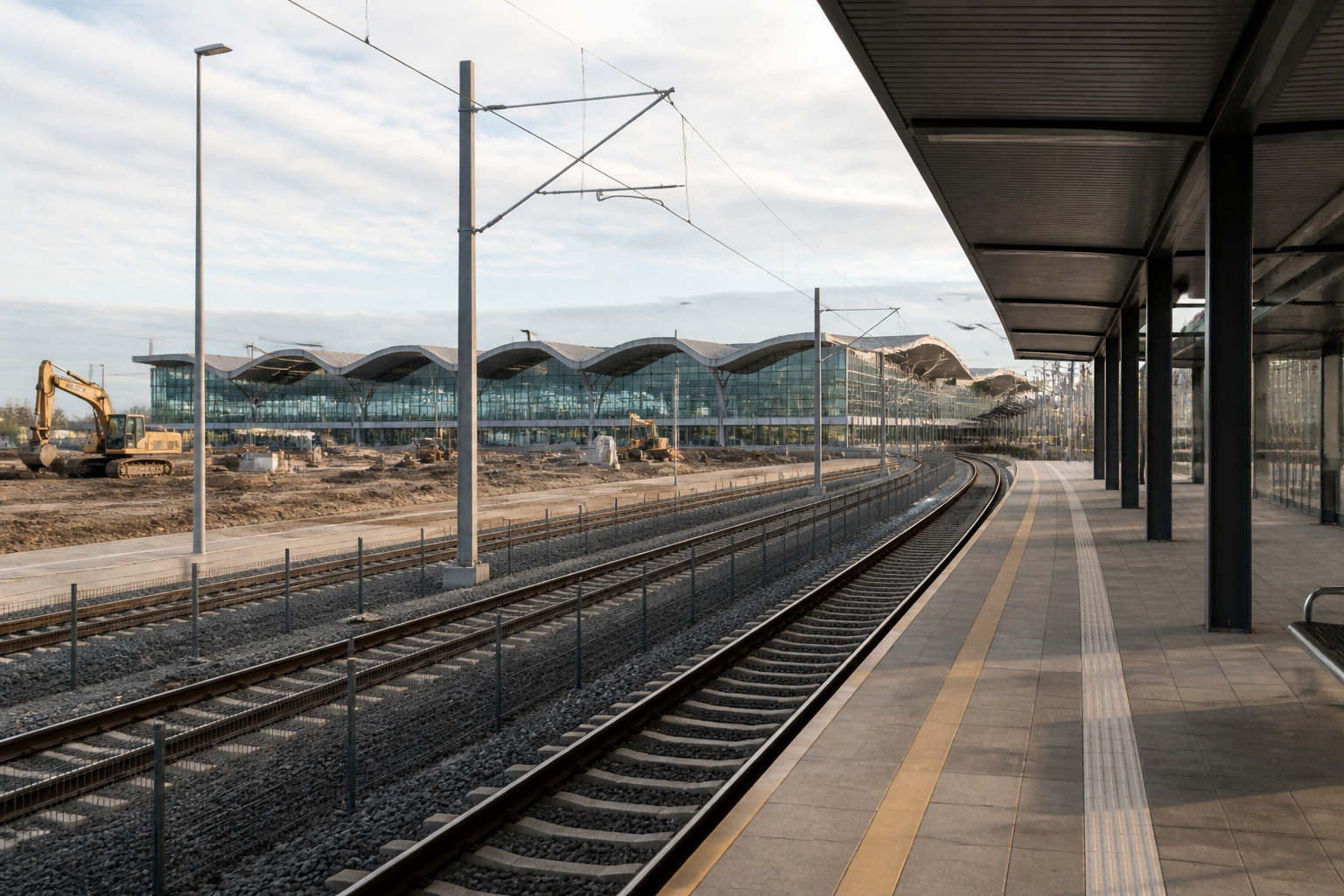
If this were my programme, I would re-price the estimate before I re-ran the tender. Eleven contractors do not all misread the same job. PKP Polskie Linie Kolejowe set a gross budget of PLN 315.367m for the rail link to Warsaw Modlin airport. The cheapest of eleven bids arrived at PLN 367.392m.
Skanska holds that cheapest bid. On 15 October 2026 Muratorplus reported that the infrastructure manager had named it the most advantageous offer. The award criterion was gross price alone.
Eleven bids said the same thing
The spread is the useful part. Skanska came in at PLN 367.392m gross. The next offer, from a consortium of Future Adventure Construction and Wysowa Mosty, stood at PLN 398.205m. The remaining nine ran between roughly PLN 415m and PLN 487m. Rynek Kolejowy reported the full list on 13 July 2026, with the highest price from Primost Poludnie and Przedsiebiorstwo Robot Kolejowych Wroclaw.
The market did not split. Its floor sits 16.5 per cent above the employer's number. Its ceiling sits 54 per cent above it. One outlier is a pricing error. Eleven offers in a band above the budget is a valuation.
What the money buys
The scope is short and dense. About 5.5 km of new double-track line number 247 runs from Modlin station to a new station at the airport terminal. Modlin station itself gains a track and a 200 m platform. Three road viaducts cross national road 62, county road 2413W and the airport access road.
A freight station, drainage, engineering structures, overhead traction, power supply, traffic control, telecoms and safety systems complete the package. The contract term is 30 months from signature. Works were planned for 2027 to 2029, with completion by the end of 2029.
The estimate aged faster than the consent
Look at the dates rather than the design. The design contract was signed in December 2023. The location decision followed on 6 October 2025. The works tender went out on 2 April 2026, and the winner was named in mid-October 2026.
Polish construction prices moved through all of that. Statistics Poland reported on 18 September 2026 that construction and assembly production prices rose 6.2 per cent year on year in August, with civil engineering up 5.7 per cent. Compound that across three years and a 16.5 per cent gap stops looking like greed. The number being defended is older than the permit.
A co-funder with a fixed contribution
This is a shared investment, and that is where it gets awkward. The Mazovian voivodeship is putting in close to PLN 167m of its own money alongside regional EU funds, and it paid for the design documentation. Its contribution was fixed in nominal terms.
PLK's own investment map still carries the project at PLN 187.037m over a 2027 to 2030 horizon. That register value is roughly half the lowest bid on the table. Two public bodies are therefore holding numbers that the market has already overtaken, and neither of them has an index clause to hide behind.
Signing costs money, cancelling costs the date
The choice is narrow. Accepting Skanska means finding PLN 52m, most plausibly from the voivodeship or from a reallocation inside the national rail programme. Cancelling and re-tendering buys a fresh estimate and loses a year, with the location decision ageing and the end-2029 target sliding into 2030 or beyond.
The demand case argues for signing. Modlin handled about 1.5 million passengers in 2025 and the airport's own plans point to more than 5 million by 2030. A rail link that opens after the ramp has happened earns far less than one that opens into it. Timing carries real money here, and it is not on the same ledger as the PLN 52m.
What happens next matters beyond Modlin
Polish rail has a wall of tenders coming through the national rail programme and the Recovery and Resilience Facility, and most of them rest on estimates prepared one or two cost cycles ago. If PLK signs above budget here, it concedes that its cost base needs re-indexing across the pipeline, which is expensive and honest. If it re-tenders, it buys a cheaper headline and pays for it in programme slip.
Contractors should read the eleven-bid spread as permission to hold price on similar work. Sponsors should re-base estimates at the point of award rather than at the point of design. Lenders and regional co-funders should assume that any contribution fixed in 2023 money is now short, and should ask for the gap to be named before the contract is signed rather than after.
📊 Analytics & Strategic Insight
The employer's estimate is a dated asset, and nobody writes it down until eleven bidders do it for them
The decision most in this industry are avoiding:
👉 Re-indexing the whole pipeline, not topping up one contract. Finding PLN 52m for Modlin is the easy version. The hard version is admitting that every estimate in the national rail programme built on 2023 or 2024 design pricing is short by a similar order. One top-up is a line item. A re-indexed pipeline is a budget conversation nobody wants to open.
👉 Treating a unanimous bid spread as market evidence rather than as a procurement failure. When one bid is high, the bidder is wrong. When eleven are high, the estimate is wrong. Public sponsors still default to re-tendering, which tests the same estimate against the same market and usually returns a worse answer plus a lost year.
👉 Pricing the cost of time on the same page as the cost of the gap. The PLN 52m sits in a capital budget. The value of opening before Modlin's passenger ramp sits in a traffic forecast. Those two numbers almost never meet in the same committee paper, so the cheaper decision wins by default.
Here's the full context:
→ December 2023: PKP PLK signs the design contract for the Modlin airport rail link, worth about PLN 4m net, with a consortium of Infra Centrum Doradztwa and YLE Inzynierowie. The cost base for the works estimate is set in 2023 money.
→ 6 October 2025: The Mazovian Voivode issues location decision 150/SPEC/2025, announced on 22 October 2025. Land acquisition for the State Treasury follows, with transfers to PKP PLK and GDDKiA.
→ 2 April 2026: PLK launches the construction tender for about 5.5 km of double-track line 247, a new airport station, an extra track and 200 m platform at Modlin, three road viaducts and a freight station. Gross price is the only award criterion. Contract term is 30 months.
→ 13 July 2026: Rynek Kolejowy reports eleven bids, none inside the PLN 315.367m gross budget. Skanska is lowest at PLN 367.392m, the next at PLN 398.205m, the rest up to about PLN 487m.
→ Most recent: On 15 October 2026 Muratorplus reports that PLK has selected Skanska as the most advantageous offer, with the contract unsigned and the financing not closed. PLK's own investment map still carries the project at PLN 187.037m over 2027 to 2030.
What this means for infrastructure operators, contractors and investors:
✅ Price-only tenders transfer estimate risk straight back to the sponsor. With gross price as the sole criterion there is no mechanism to absorb a cost-base error. The bids simply reveal it, publicly, in one opening session. Sponsors who want protection need a re-based estimate before the tender, not a scoring tweak inside it.
✅ Fixed nominal co-funding is a hidden single point of failure. The voivodeship committed close to PLN 167m and paid for the design. If that figure cannot move, the award cannot complete, however willing the national side is. Any co-funded scheme should carry an explicit indexation or top-up mechanism from day one.
✅ Consent-to-tender lag is now a pricing variable, not an administrative detail. Two years passed between the design contract and the location decision, and another year to award. At roughly 6 per cent annual construction inflation, that lag alone moves a number by double digits. Programmes should model the lag, not assume it away.
3 moves you can make this week:
1️⃣ Re-base every live estimate to the month of award, not the month of design. Take each tender you expect to open in the next two quarters and apply the published construction cost index from the date your estimate was priced. If the result exceeds your budget line, raise it now while the gap is still a forecast rather than a bid opening.
2️⃣ Name the co-funder gap in writing before the contract is signed. For every scheme with a fixed regional, municipal or grant contribution, write a one-page note stating the nominal amount, the date it was fixed, the indexed equivalent today, and who covers the difference. Circulate it to the funders rather than filing it.
3️⃣ Put the cost of delay next to the cost of the overrun in the same paper. Quantify what a one-year slip costs in forgone revenue, demand ramp and escalation, and set it beside the headline gap. Re-tendering decisions made without that comparison are being taken on half the numbers.
Share it with your peers
Help your network stay ahead of CEE capital projects.
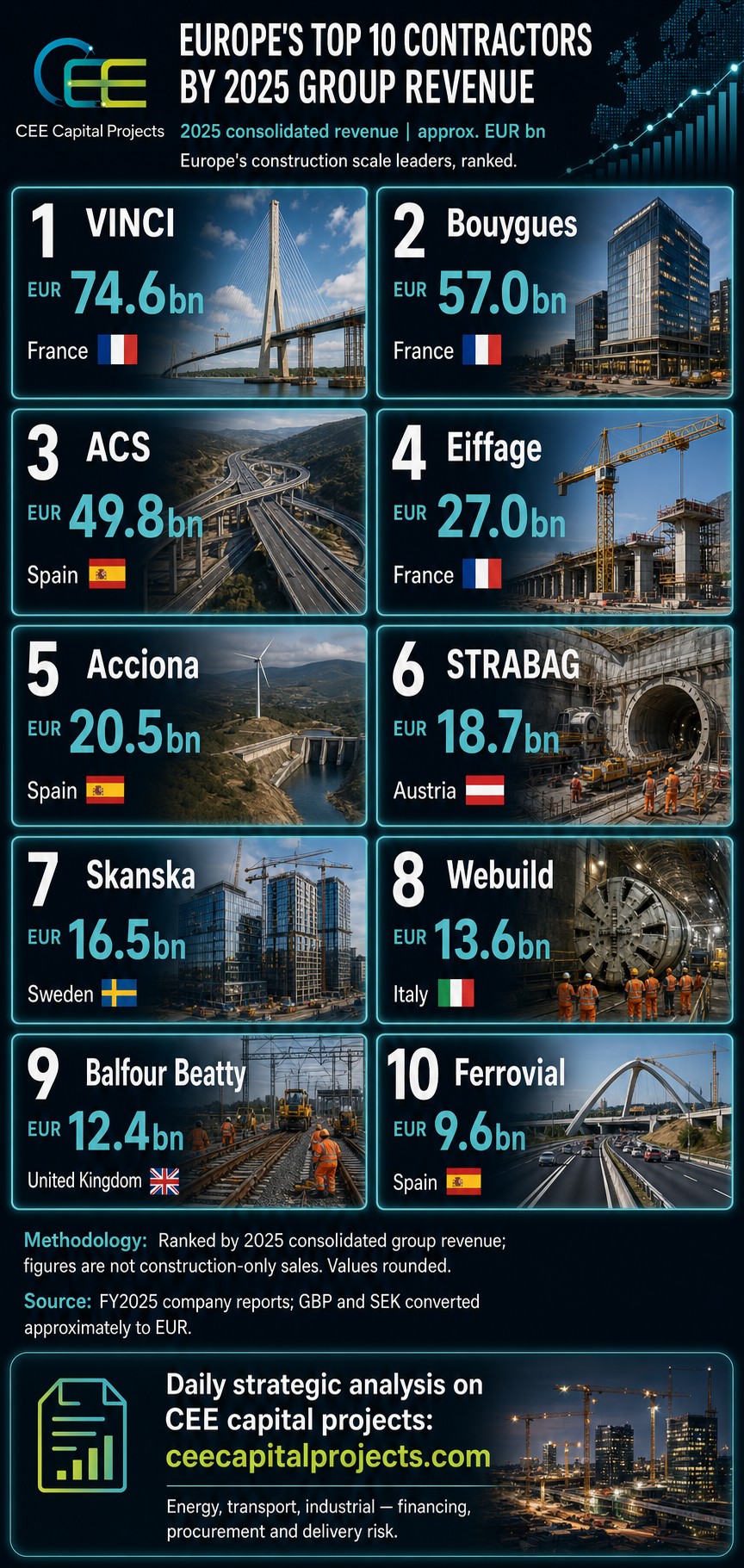
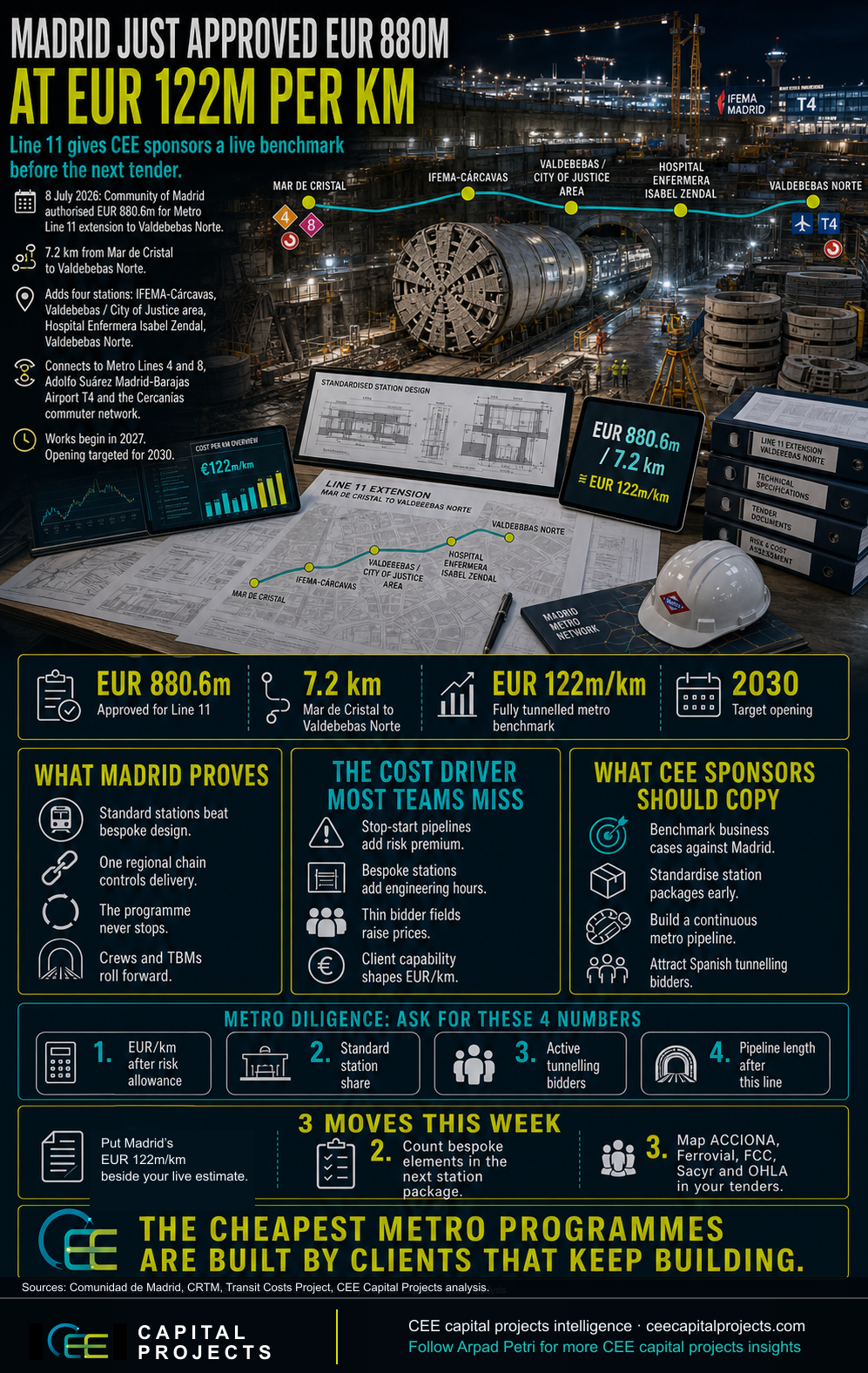
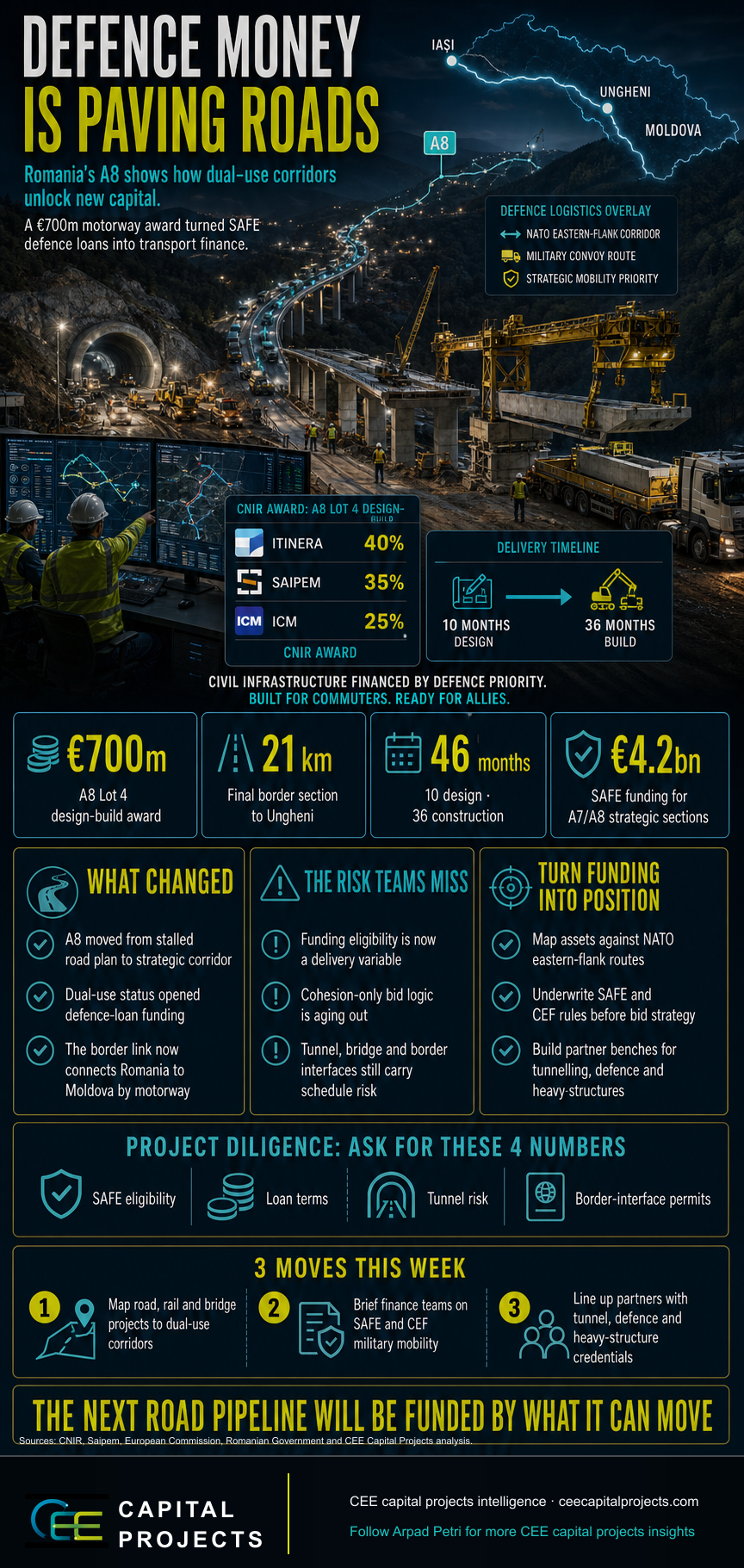
Explore our infograph library — strategic visuals for CEE capital projects leaders.
Project benchmarks, financing structures, tender dynamics and delivery risk — at a glance. Free access for investors, owners, contractors and strategy teams tracking CEE capital projects.
Browse the libraryRelated analyses
- Transport & Infrastructure
ViAlliance35 Wins the Czech D35 Motorway Concession, and the 2.9 Billion Euro Headline Is a Payment Stream
The Czech government has approved the ViAlliance35 concession contract for 35.4 km of the D35 motorway between Opatovec and Mohelnice. The headline of about 2.9 billion euro is the discounted value of 22 years of availability payments, which is a different product from a construction budget.
Read analysis → - Transport & Infrastructure
Poland's PLN 1.3bn A2 Widening: 89 km of Third Lane, and the Pre-2012 Design That Made It Cheap
GDDKiA has signed the fourth and final contract to widen 92 km of the A2 between Łódź and Warsaw, closing a programme worth about PLN 1.3bn. The cost is low because land and structures were sized for a third lane before the motorway opened in June 2012.
Read analysis → - Transport & Infrastructure
CTP Signs Pepco to a 55,619 Sqm Direct Lease at CTPark Bucharest West, and the Space Was Already Occupied
CTP has signed Pepco to a direct long term lease on 55,619 sqm at CTPark Bucharest West, replacing an arrangement the retailer held through a logistics provider. The deal adds no occupied space and changes who stands behind the rent.
Read analysis →
Get a second opinion before it gets expensive.
Contractor selection, tender strategy, a project drifting off track — send us the situation and we'll come back with a clear plan.