Serbia Shuts Corridor X for 200 Days, Then Romania Closes the Danube Crossing. Bulgaria's Rail Route to Turkiye Goes With Them.
Serbia will close the Nis-Dimitrovgrad line for about 200 days from September 2026, and Romania will suspend Giurgiu Nord-Ruse from April to December 2027. The two shutdowns run back to back on the same freight route from Central Europe to Turkiye, and the detour lines were never built to carry it.
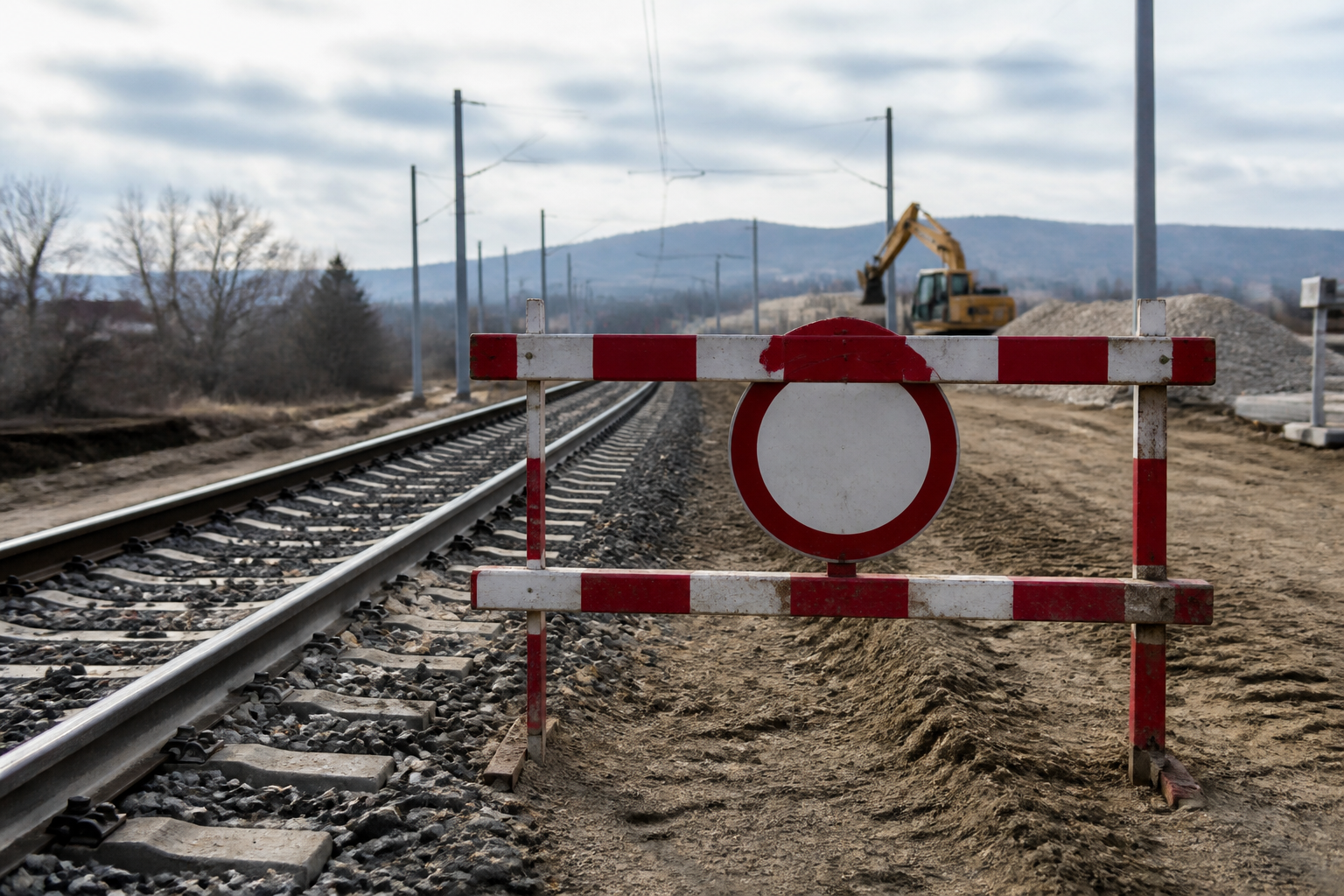
I had these two closures filed as separate national upgrades. Then I put the dates on one line.
Serbia will close the Nis-Dimitrovgrad railway for around 200 days from this month. Romania will suspend all traffic on the Giurgiu Nord-Ruse cross-border section from April to December 2027. The Serbian works finish within weeks of the Romanian ones starting. Bulgaria's Ministry of Transport warns that the simultaneous restriction of both routes "will seriously affect freight flows between Central Europe, the Balkans and Turkiye", in comments reported by RailFreight.com on 31 August 2026.
Bulgarian Transport and Communications Minister Georgi Peev took the problem to ministerial level on 28 August 2026, in an online meeting with Romania's Deputy Prime Minister and interim Transport Minister Radu Miruta and Serbia's Minister of Construction, Transport and Infrastructure Aleksandra Sofronijevic. Railway PRO reported the meeting on 31 August 2026.
Two gateways, closing one after the other
Nis-Dimitrovgrad is the last section of Pan-European Corridor X still running on diesel. The line is about 104 km from Nis to the Bulgarian border, carries a D3 axle-load classification against D4 on the Bulgarian side, and has been the recognised bottleneck on the route for years. The rebuild covers electrification, signalling, a bypass north of Nis and a reconstructed Sicevo-Dimitrovgrad section, financed with a EUR 134m European Investment Bank loan alongside Western Balkans Investment Framework grants.
Giurgiu Nord-Ruse is the other gateway, and the works behind it are larger. CFR SA is modernising the Bucharest Nord-Jilava-Giurgiu Nord-Giurgiu Nord Frontiera line with Connecting Europe Facility support, adding electrification, ERTMS Level 2 and 120 km/h running. Both programmes are correct engineering decisions. Both were approved by different sponsors, against different funding deadlines, in different capitals.
The detour routes were never built for this
CFR SA has offered operators two alternatives. Golenti-Vidin sits in the west and depends on the Danube crossing at Vidin-Calafat, which has limited capacity. Negru Voda-Kardam sits in the east, near the Black Sea, and is in poor condition. Neither route has been prepared to absorb the traffic that the Ruse bridge carries today.
This is where the plan gets thin. A diversion is only capacity if the track, the axle load, the loop lengths and the border staffing can actually take the trains. A line drawn on a network map is an assumption. Operators pricing 2027 contracts on the assumption that a spare route exists are pricing something nobody has tested.
A backlog that forces everyone to close at once
The overlap is a symptom of a much larger arithmetic problem. Romania's own 2026-2030 railway strategy records that over the past 36 years the share of the network overdue for maintenance rose from 10% to 73%, more than 9,000 route kilometres. That figure, reported by RailFreight.com on 31 August 2026, is the single most useful number in this story. A network in that condition cannot be renewed gently.
Every European infrastructure manager is now in the same position, and each has grant windows that expire. Germany is running its corridor-by-corridor Generalsanierung. The Baltic states are racing Recovery and Resilience Facility closure dates. The result is a continent closing its main lines simultaneously, on calendars set by finance rather than by traffic. ERFA, the European rail freight association, said on 24 August 2026 that the sector has reached its limit for disruption.
What Sofia is actually asking for
Peev's proposal is narrow and practical. He wants time windows for freight trains agreed in advance, so that restricted infrastructure still carries international services during defined periods instead of stopping them altogether. The three ministries agreed to move the discussion down to infrastructure manager level, where the possession plans actually live. That is the right venue, and it is the first time in this cycle that the three networks have been asked to plan as one.
Nobody owns the corridor
Here is the mechanic worth carrying away. Each infrastructure manager optimises its own possession plan, its own contract and its own grant deadline. Nobody optimises the corridor, because the corridor has no balance sheet, no manager and no revenue line. The country that closes a section captures the upgrade. The country downstream absorbs the lost months. Bulgarian carriers had no vote in either decision and will carry the cost of both.
That is a governance failure rather than a funding failure, and it will not be fixed by more money. TEN-T corridor coordinators can convene, but they cannot compel a possession calendar. Until somebody can, the scarce resource in European rail freight is not track, wagons or traction. It is an open route on the day the customer needs it.
For freight operators, the practical response is to price 2027 route risk now and to stop treating diversionary lines as free options. For contractors, the closures are the opposite of bad news, because a fifteen-month window of guaranteed possession is the most efficient production environment in the industry. For lenders and infrastructure funds screening Balkan corridor assets, the question to ask a sponsor is no longer whether the works are funded. It is who has authority over the calendar, and what happens to volumes on the day the neighbour closes too.
Share it with your peers
Help your network stay ahead of CEE capital projects.
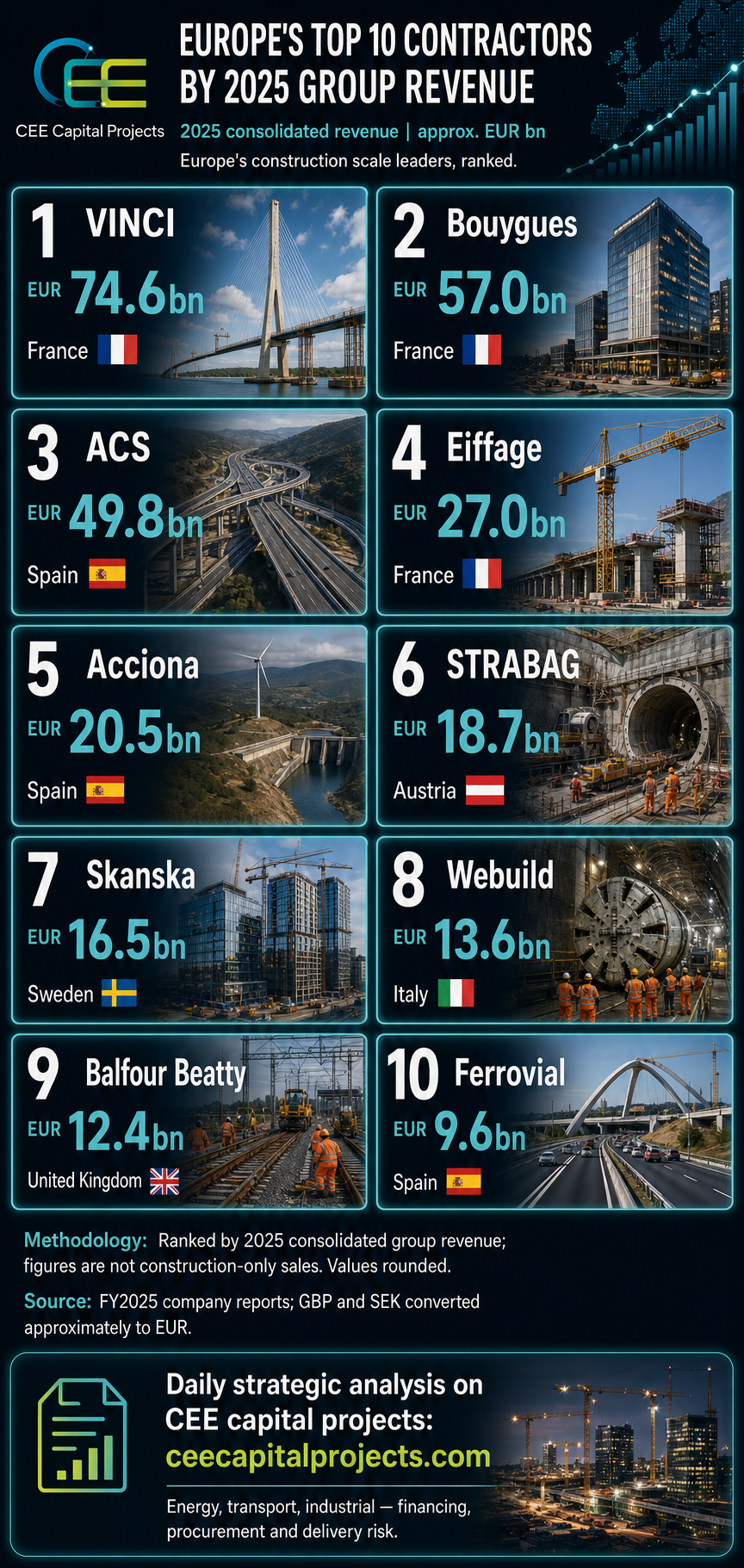
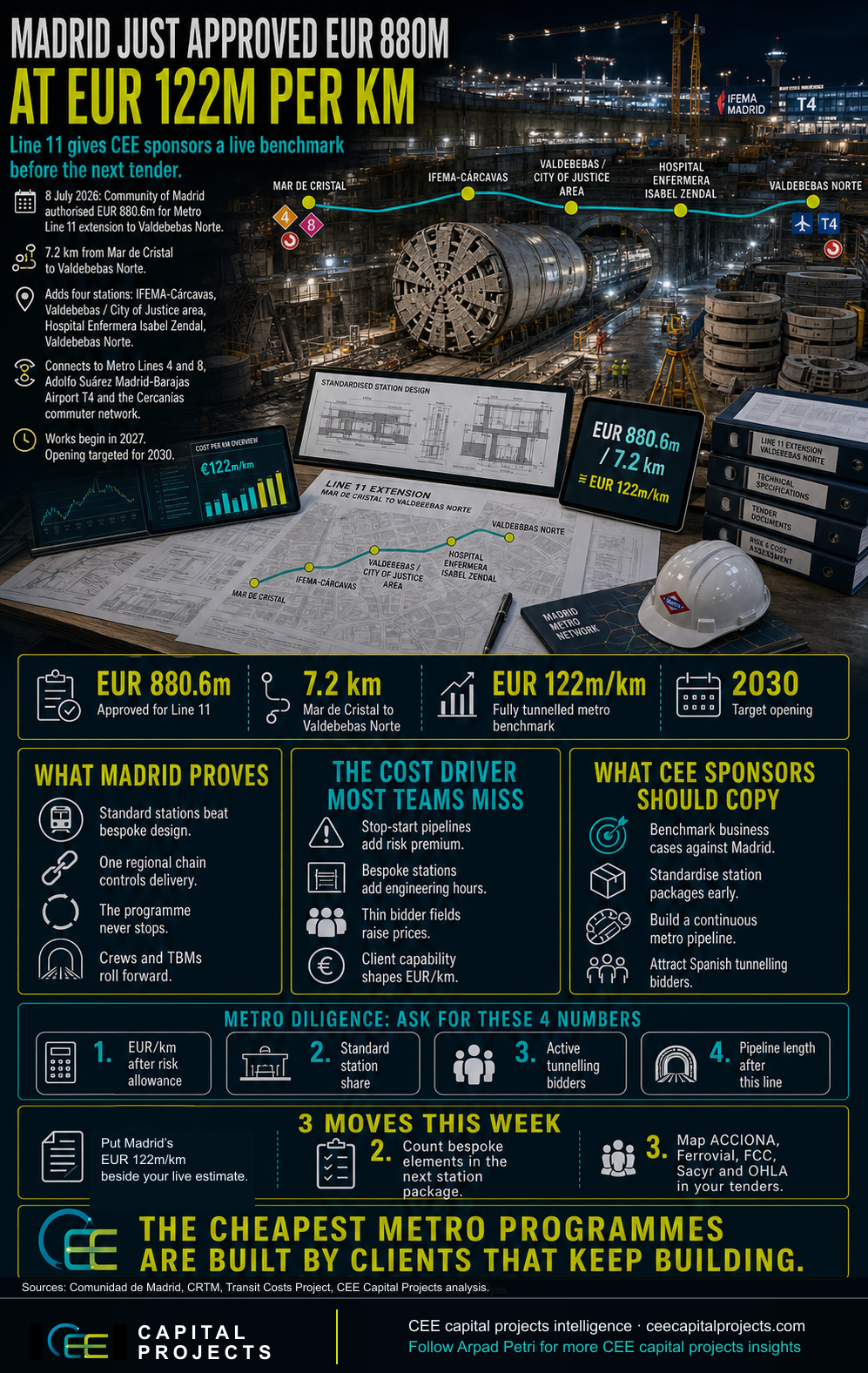
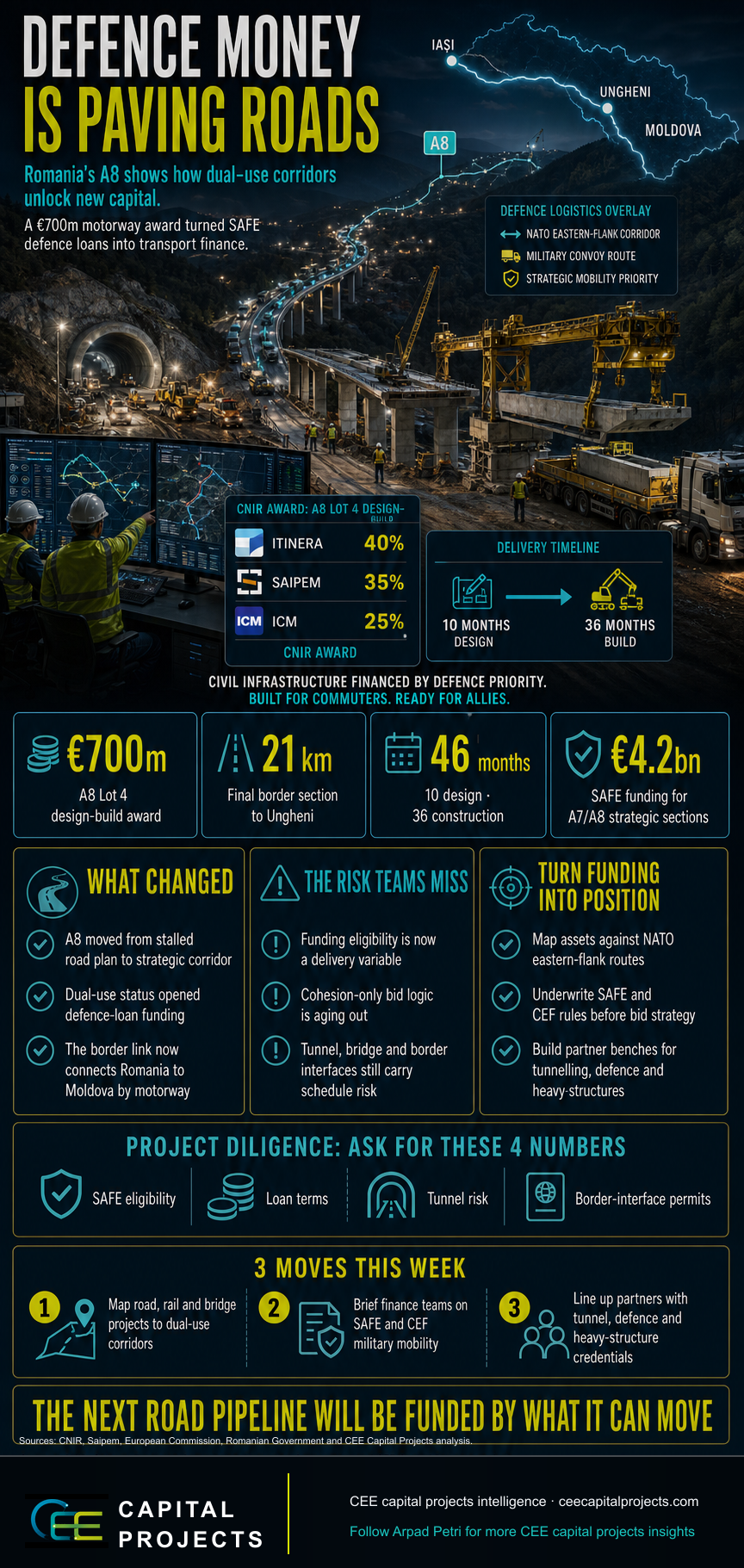

Explore our infograph library — strategic visuals for CEE capital projects leaders.
Project benchmarks, financing structures, tender dynamics and delivery risk — at a glance. Free access for investors, owners, contractors and strategy teams tracking CEE capital projects.
Browse the libraryStrategic Insights
📊 Analytics & Strategic Insight
The scarce thing in European rail is no longer track or trains. It is an open route on the day you need it.
The decision most in this industry are avoiding:
👉 Nobody adds the closures up. Each rail manager plans its own shutdowns. No one adds the dates across borders. So two countries can close the same freight route one after the other and neither of them is doing anything wrong.
👉 The country that closes the line does not pay for it. Serbia and Romania get new track. Bulgarian hauliers get the lost months. The bill lands on people who had no say in the decision.
👉 A detour is only real if the track can take the trains. Both spare routes here are weak. One depends on a Danube crossing with little spare capacity. The other is in poor condition. A line on a map is not capacity.
Here's the full context:
→ 1990 to 2026: Romania's own 2026-2030 rail plan says track overdue for repair went from 10% of the network to 73%, more than 9,000 km.
→ 2024: Serbia began rebuilding Nis to Dimitrovgrad, the last stretch of Corridor X with no overhead wires, using a EUR 134m loan from the European Investment Bank plus EU grants.
→ 24 August 2026: ERFA, the European rail freight association, said the sector has reached its limit for disruption.
→ 28 August 2026: Bulgaria's transport minister Georgi Peev called his Romanian and Serbian counterparts to an online meeting about the overlap.
→ Most recent: Serbia closes Nis to Dimitrovgrad for about 200 days from September 2026. Romania then shuts Giurgiu Nord to Ruse from April to December 2027.
What this means for infrastructure operators, contractors and investors:
✅ Track time is now the thing in short supply. Money and machines are available. A closed line that you are allowed to work on is not. Whoever holds the possession calendar controls the programme.
✅ Freight deals priced on one route are priced too low. If your 2027 offer assumes the Ruse bridge, you are selling something that will not exist for nine months of that year.
✅ Fixing the spare routes is the next job to be funded. Governments have paid for the main lines. The lines that carry traffic during the works are the gap, and that gap is now visible in three countries at once.
3 moves you can make this week:
1️⃣ Put every closure on one calendar. List the planned shutdowns on every route you use, in every country, with start and end dates. Look for the weeks where two of them overlap or run back to back.
2️⃣ Test your detour before you need it. Take your two busiest flows and check the alternative route for axle load, train length, loop capacity and border staffing. Get the answer in writing from the infrastructure manager.
3️⃣ Ask for freight windows in writing. Where a closure is coming, request agreed time slots for your trains now, before the timetable is fixed. A slot promised verbally in a meeting is worth nothing in December.
Related analyses
- Transport & Infrastructure
Duna Aszfalt Repays HUF 126 Billion of EXIM and MFB Bonds Early. Hungary's HUF 101 Billion Guarantee Comes Off a Half-Built African Toll Road
Duna Aszfalt has begun a voluntary early redemption of USD 400m of bonds subscribed by EXIM Bank and MFB Bank, cancelling the 80% Hungarian state surety of HUF 101bn attached to them. The Kasomeno-Mwenda toll road is half built, and the structure behind it was never project finance.
Read analysis → - Transport & Infrastructure
Rail Baltica's Riga Central Station Hits Its EUR 138.7m Deadline, Then Waits Two Years for a Train
The supervising engineer certified completion of the main works at Riga Central Station on 26 August 2026, one working week before the Recovery Fund grant that paid for it expired. Full passenger service waits on 1,520 mm gauge infrastructure scheduled for mid-2028, leaving Latvia with a finished terminal and 22 months of carrying cost.
Read analysis → - Transport & Infrastructure
EIB Weighs HUF 27 Billion for Záhony While Ukraine Moves the Gauge Break East
The European Investment Bank is appraising a HUF 27bn (EUR 74m) loan for Hungary's Záhony and Eperjeske rail freight terminals, part of a HUF 55.6bn programme under the EU Solidarity Lanes. The commercial question is whether the transhipment work will still be on the Hungarian side of the border when the new equipment is switched on.
Read analysis →
Building in Central Europe?
Tell us what you're building. We'll tell you what can go wrong — and how to prevent it.