Rail Baltica's Riga Central Station Hits Its EUR 138.7m Deadline, Then Waits Two Years for a Train
The supervising engineer certified completion of the main works at Riga Central Station on 26 August 2026, one working week before the Recovery Fund grant that paid for it expired. Full passenger service waits on 1,520 mm gauge infrastructure scheduled for mid-2028, leaving Latvia with a finished terminal and 22 months of carrying cost.
The question I keep putting to public sponsors is a simple one. Who carries an asset between the day it is finished and the day it earns? Riga Central Station is about to answer that for roughly 22 months.
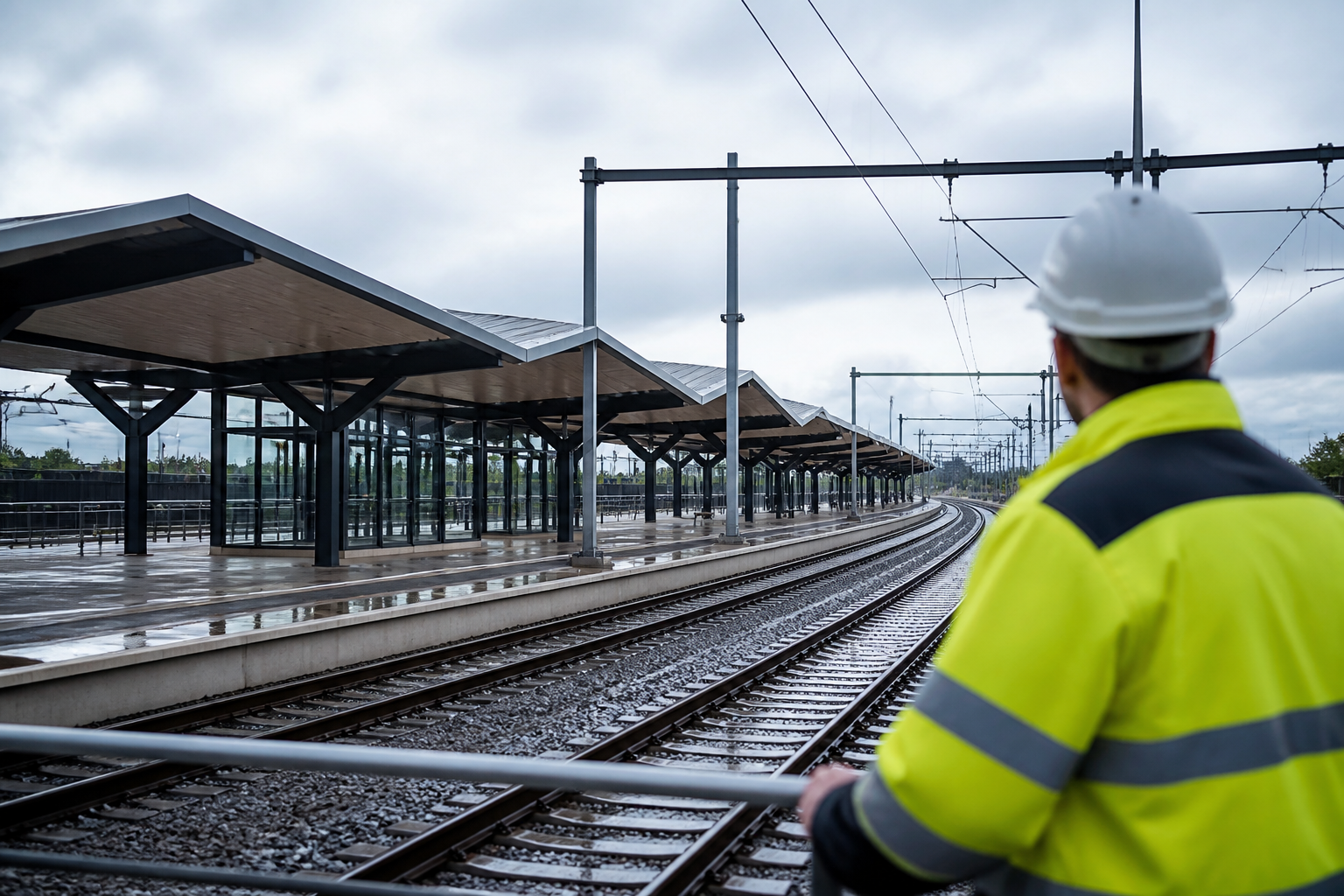
On Wednesday 26 August 2026 the supervising engineer issued the certificate confirming completion of the main works on the southern section of the new Riga Central Station, and Latvian Radio reported the following day that the building will not carry passengers for another two years. The station is the centrepiece of Rail Baltica in Latvia. It has a roof, a glazed facade, three covered high platforms, live information boards and CCTV. It has no trains.
The completion date came out of the grant agreement
The reason for the hurry sits in the financing paperwork. Eiropas Dzelzcela linijas, the Latvian implementer of Rail Baltica, signed a EUR 138.7 million financing agreement with the Central Finance and Contracting Agency in November 2025. EUR 114.6 million of that came from the Recovery Fund and EUR 24.1 million from the Latvian state budget. Railway PRO reported on 4 June 2026 that the agreement names exactly which works had to be finished by 31 August 2026: roof installation, facade, platform canopies, finishes, passenger access infrastructure, and the mechanical, electrical and plumbing packages. On that date the certificate of substantial completion falls due.
That date came from Brussels. It is the closing date of the Recovery and Resilience Facility (RRF), the EU's post-pandemic grant instrument. Under the closure rules every milestone and target across the Union must be met by 31 August 2026, payment requests must reach the Commission by 30 September 2026, and any commitment left unhonoured is decommitted. Latvia gave its contractor the same deadline the Commission gave Latvia. The building was finished to a funding calendar.
Twenty-two months between handover and revenue
Full passenger service in the southern section depends on the 1,520 mm gauge railway infrastructure around the station, currently scheduled for mid-2028. So the terminal is complete in August 2026 and useful in mid-2028. Landscaping and the ground-floor passenger areas run on under the same agreement to 31 December 2026.
Through that window the asset keeps spending. Permanent power was energised earlier this year through the 0.4/10 kV substation, which moved the building off construction-site supply and onto an operating electricity account. Lifts, escalators, ventilation, drainage, fire detection and security systems all have to be run, serviced and re-certified whether or not a passenger walks through the door. Latvijas dzelzcels (LDz) is named in the agreement as the future infrastructure manager and is already working through handover. Someone has to fund the standing cost of an empty terminal across two winters, and that line rarely appears in a capital budget.
The defects clock is the part sponsors miss
This is where I would concentrate the commercial effort. Under FIDIC conditions the defects notification period runs from taking-over, and SIA FORMA 2 provides the FIDIC engineering, supervision and expert assessment on this contract. If that clock started in late August 2026, a standard 24-month period expires at about the moment the first train arrives. The operator then inherits a building whose contractual cover is close to spent, and whose systems have never been proved under passenger load.
Manufacturer warranties on lifts, escalators, glazing and building-management systems behave the same way. They run on calendar time and ignore duty cycles. There are two commercial answers. Tie the defects period and the warranties to first operational use rather than to practical completion, or buy extended cover at handover. Both cost money, and both are hard to fund at the end of a project whose budget closed with the grant.
Latvia's arithmetic explains the hurry
The pressure to bank EUR 114.6 million is easy to understand once the programme numbers are on the table. The European Court of Auditors put phase one of Rail Baltica at close to EUR 24 billion against an original estimate under EUR 6 billion. Latvia's share of the first phase runs at roughly EUR 5.5 billion, and indexation could push it towards EUR 6 billion, against a funding gap on the Latvian stretch of about EUR 4.4 billion. Latvia spent the summer looking for savings on its own section. Against that backdrop, a grant expiring on 31 August is worth finishing a building for, even if the trains are two years behind it.
What it means from here
Expect more of this across the RRF cohort. Grant instruments with hard sunset dates force completion on the component that can be finished, and leave the components that cannot be finished to a later, thinner funding source. The result is a stock of certified, energised, empty European assets waiting on systems and track. For contractors the opportunity is in the aftercare contract, because a client with an idle building and an expiring defects period needs a maintenance and re-commissioning partner. For sponsors and lenders the discipline is to appraise the whole-life cost from taking-over rather than from opening day. For public clients the lesson is blunter. A completion certificate is a payment trigger. It is not a working railway station.
📊 Analytics & Strategic Insight
When the funding calendar sets the completion date, the operator inherits the bill
The decision most in this industry are avoiding:
👉 Practical completion has quietly become a financial event rather than an operational one. On grant-funded work the taking-over certificate exists to release a payment before a deadline. Nobody re-tests whether the asset can actually be used, because the contract never asked that question.
👉 The defects notification period is being burned on an empty building. A 24-month FIDIC defects period that starts at taking-over in August 2026 expires around mid-2028, which is exactly when the first passengers arrive. The cover ends where the risk starts.
👉 Nobody owns the dormancy budget. Capital budgets stop at completion and operating budgets start at opening. The 22 months in between have an electricity bill, a servicing schedule and a security roster, and no clear payer.
Here's the full context:
→ 2021: Regulation (EU) 2021/241 creates the Recovery and Resilience Facility as a performance-based instrument, paying against milestones instead of invoices, with a fixed closing horizon.
→ 2025: The European Court of Auditors puts phase one of Rail Baltica at close to EUR 24 billion against an original estimate below EUR 6 billion, with Latvia's share around EUR 5.5 billion and a funding gap near EUR 4.4 billion.
→ November 2025: Eiropas Dzelzcela linijas signs a EUR 138.7 million financing agreement with Latvia's Central Finance and Contracting Agency, EUR 114.6 million from the Recovery Fund and EUR 24.1 million from the state budget, requiring roof, facade, canopies, finishes, access and MEP works by 31 August 2026.
→ June 2026: Permanent power is energised at the southern section through the 0.4/10 kV substation, moving the station from construction supply to operating infrastructure and starting its standing cost base.
→ Most recent: On 26 August 2026 the supervising engineer certifies completion of the main works, five days inside the RRF deadline, while full passenger service still waits on 1,520 mm gauge infrastructure scheduled for mid-2028.
What this means for infrastructure operators, contractors and investors:
✅ Whole-life cost has to be modelled from taking-over, not from opening. Any appraisal that starts the operating cost line at first revenue understates the asset by the length of the dormancy window, and on grant-driven programmes that window is getting longer.
✅ Aftercare is a real revenue line for contractors on RRF-funded work. A client holding a finished, idle, energised building needs maintenance, system re-commissioning and re-certification before opening. Price that scope while the site team is still assembled.
✅ Grant sunset dates are now a schedule risk in their own right. A deadline that comes from a funding regulation does not move for weather, design change or a supply-chain slip, so the programme absorbs every delay in the last package rather than in the milestone.
3 moves you can make this week:
1️⃣ Find every taking-over date in your portfolio that lands more than six months before first use. List the assets, then work out who is funding electricity, servicing, security and insurance across each gap. Take the answer to your finance director in writing.
2️⃣ Re-read the defects notification period in your live contracts. Where the clock starts at practical completion on an asset that cannot be used yet, open a negotiation now to re-base it to first operational use or to buy extended cover while the contractor still wants the relationship.
3️⃣ Ask your sponsor which deadline is driving your programme date. If the answer is a grant regulation rather than an operational need, price the sequencing risk into your next bid and say so in the tender clarifications.
Share it with your peers
Help your network stay ahead of CEE capital projects.
Explore our infograph library — strategic visuals for CEE capital projects leaders.
Project benchmarks, financing structures, tender dynamics and delivery risk — at a glance. Free access for investors, owners, contractors and strategy teams tracking CEE capital projects.
Browse the libraryRelated analyses
- Transport & Infrastructure
Serbia Shuts Corridor X for 200 Days, Then Romania Closes the Danube Crossing. Bulgaria's Rail Route to Turkiye Goes With Them.
Serbia will close the Nis-Dimitrovgrad line for about 200 days from September 2026, and Romania will suspend Giurgiu Nord-Ruse from April to December 2027. The two shutdowns run back to back on the same freight route from Central Europe to Turkiye, and the detour lines were never built to carry it.
Read analysis → - Transport & Infrastructure
Duna Aszfalt Repays HUF 126 Billion of EXIM and MFB Bonds Early. Hungary's HUF 101 Billion Guarantee Comes Off a Half-Built African Toll Road
Duna Aszfalt has begun a voluntary early redemption of USD 400m of bonds subscribed by EXIM Bank and MFB Bank, cancelling the 80% Hungarian state surety of HUF 101bn attached to them. The Kasomeno-Mwenda toll road is half built, and the structure behind it was never project finance.
Read analysis → - Transport & Infrastructure
EIB Weighs HUF 27 Billion for Záhony While Ukraine Moves the Gauge Break East
The European Investment Bank is appraising a HUF 27bn (EUR 74m) loan for Hungary's Záhony and Eperjeske rail freight terminals, part of a HUF 55.6bn programme under the EU Solidarity Lanes. The commercial question is whether the transhipment work will still be on the Hungarian side of the border when the new equipment is switched on.
Read analysis →
Get a second opinion before it gets expensive.
Contractor selection, tender strategy, a project drifting off track — send us the situation and we'll come back with a clear plan.