Duna Aszfalt Repays HUF 126 Billion of EXIM and MFB Bonds Early. Hungary's HUF 101 Billion Guarantee Comes Off a Half-Built African Toll Road
Duna Aszfalt has begun a voluntary early redemption of USD 400m of bonds subscribed by EXIM Bank and MFB Bank, cancelling the 80% Hungarian state surety of HUF 101bn attached to them. The Kasomeno-Mwenda toll road is half built, and the structure behind it was never project finance.
I keep seeing the same shape in cross-border infrastructure. The paperwork says project finance, and the borrower turns out to be the parent company back home. Duna Aszfalt has now made that visible in the clearest way available to it.
On Monday 24 August 2026 the Hungarian road builder told the state news agency MTI it had initiated a voluntary early redemption of the bonds financing its GED Africa project, subscribed by EXIM Bank and MFB Bank. Minister of Economy and Energy Istvan Kapitany put the amounts at USD 200m to each bank, around HUF 126bn in total, and confirmed that the 80% Hungarian state surety of HUF 101bn attached to the transaction falls away at the same time.
A corporate liability wearing a project name
The most useful document in this story is the group's own account of the structure, published by Magyar Epitok on 3 August 2026. Duna Group set out three facts. The two state-owned banks made a state surety a condition of lending. The surety was security for those banks rather than a benefit to the borrower. And the loan went to Duna Aszfalt Zrt. rather than to the African project company, so Duna Aszfalt carries primary liability with its own assets.
Read together, those three sentences describe corporate debt with extra paperwork. There is no ring fence around the concession. Recourse runs to a Hungarian contractor first, to a sovereign surety second, and to Congolese and Zambian toll receipts only in the far distance. The group adds that the bonds pay an above-market coupon carrying a significant risk premium, and that toll revenue is applied first to prepaying them.
That structure also explains an otherwise awkward gap in the public numbers. Zambia's Road Development Agency puts the whole Kasomeno-Mwenda scheme at USD 260m. The bond raise was USD 400m. The two figures measure different things, and the difference is the point. The paper was written against a builder, not against a road.
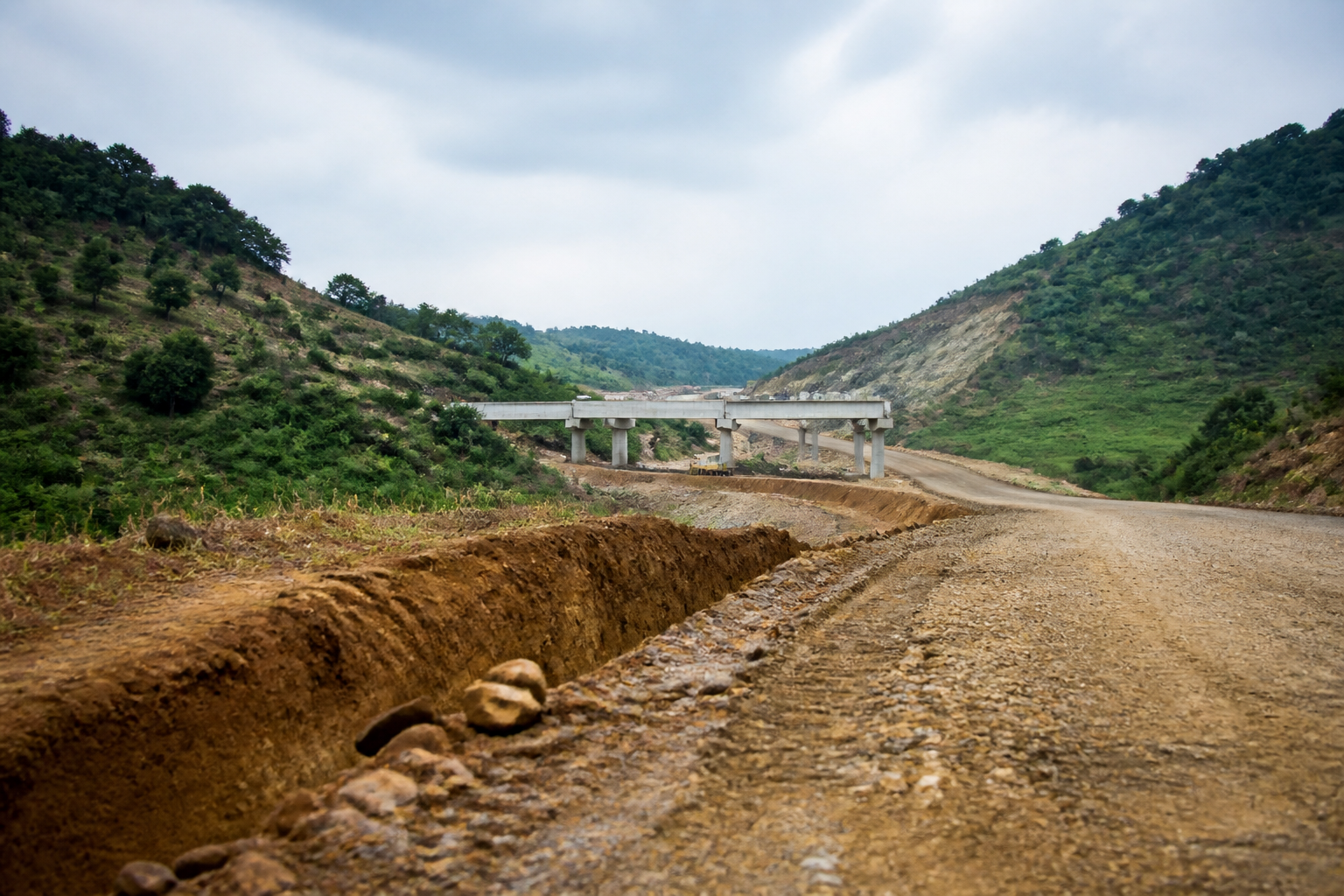
The asset is half built and on programme
Nothing in the financing row has stopped the concrete. Touring the site at Mwense in early August, RDA chief communications and corporate affairs manager Anthony Mulowa said the road, bridge and one-stop border post project was about 50% complete overall, with the Luapula river bridge past 60%, and both due to finish in the third quarter of 2027 (News Diggers, 6 August 2026). GED country manager Kanyika Mumba put local employment above 1,500 against a 30% local content requirement written into the concession agreement.
The route is a real corridor asset. It cuts roughly 500 km off the haul between the Haut-Katanga mining belt and the port of Dar es Salaam, and it takes pressure off the Mokambo crossing. Construction began in 2024 under a 25-year public-private partnership, three years of building followed by 22 of operation and maintenance.
Where HUF 126 billion has to come from
Timing is the commercial question. Duna Aszfalt says the redemption follows the issue terms, at nominal value plus interest accrued to the date of repayment, and should complete inside about ten working days of the notice. That is a fast call on a large sum.
Scope Ratings, which has held the company at BB- with a Stable Outlook, recorded accessible cash of HUF 35bn at the end of 2024, a HUF 30bn domestic bond with a bullet maturity in 2029, and new orders down 60% year on year to HUF 235bn in the twelve months to June 2025, with book-to-bill below 1.0. Duna Aszfalt states that financing for the project remains secured and that it has met every interest and debt-service obligation so far. Both of those things can hold at once. Lenders will still want to see what replaces the redeemed paper.
One quieter number works in the borrower's favour. The same USD 400m obligation was worth roughly HUF 156bn on the rates used in Scope's September 2025 report, and about HUF 126bn at the end of August 2026. On the published rates that is a fall of close to a fifth in forint terms, delivered by currency alone.
Why the rest of the market should read this
The Ministry of Economy and Energy filed a complaint against unknown persons on 24 July 2026 over four EXIM financing transactions worth about HUF 1,000bn, the GED Africa subscription among them. It said the subscription had been authorised by the owning ministry through a founder's resolution rather than by the bank's own board, and noted that both host countries sat in EXIM's highest risk category. Duna Group has said the guarantee decision lay entirely with the state and that the company had neither influence nor a decision right over it. That dispute will run its course.
The transferable lesson sits underneath the argument. Export credit and development bank support is a contract term, and a contract term is only as durable as the institution that granted it and the mandate of the people who signed it. Any European contractor now carrying concession exposure in a frontier market should treat its sovereign wrapper as callable, model the week it is withdrawn, and know today what the same asset costs to finance without it. The next Hungarian corridor deal will be priced by lenders who have watched this one unwound at par inside ten working days.
📊 Analytics & Strategic Insight
A state guarantee is a term in a contract, and terms get reopened when the other side changes
The decision most in this industry are avoiding:
👉 Treat every public guarantee as callable. A state surety is signed by people with a term in office. The next people read the same file their own way. Price it as help with an end date. Do not price it as cover that lasts.
👉 Read the borrower line before the project name. If the debt sits with the parent firm and not with the concession company, it is corporate risk. The real security is then the sponsor's order book at home.
👉 Buy the exit at the start, not in the argument. Repaying at face value in ten working days is a term agreed years earlier. Leave that to the lender and you cannot end a fight you did not start.
Here's the full context:
→ 2024: Work starts on the Kasomeno-Mwenda road, the Luapula river bridge and a one-stop border post. The deal is a 25-year PPP: three years of building, then 22 of operation. GED Africa Zambia Limited holds the concession.
→ 2025: EXIM Bank and MFB Bank buy USD 400m of Duna Aszfalt bonds. They spend about ten months checking the risk first. An 80% Hungarian state surety sits behind them. Final maturity is 2035.
→ September 2025: Scope Ratings keeps Duna Aszfalt at BB-. New orders have fallen 60% in a year, to HUF 235bn. Book-to-bill is under 1.0. Cash at the end of 2024 is HUF 35bn.
→ July 2026: The Ministry of Economy and Energy files a complaint over four EXIM deals worth about HUF 1,000bn. The GED Africa bond is one of them.
→ Most recent: On 24 August 2026 Duna Aszfalt starts the repayment. It pays face value plus interest and expects to finish in about ten working days. The HUF 101bn surety ends with it. The road is about half built.
What this means for infrastructure operators, contractors and investors:
✅ Export credit support now carries election risk. One government arranges a facility. The next one can reopen it. So ask at credit committee whether the deal survives a change of owner.
✅ A half-built road in a frontier market is hard to refinance. There is no traffic record and no completion certificate. The new lender prices build risk and country risk together. Open refinancing talks before you need them.
✅ Concession risk belongs in the cash plan, not only in the equity story. A full backlog can hide a slow intake. That sponsor has less room for a surprise repayment than the headline number suggests.
3 moves you can make this week:
1️⃣ Map your guarantee dependencies. List every facility where a public body or an export credit agency has to sign. Mark the ones that survive a change of government.
2️⃣ Put the prepayment terms on one page. For each facility write the notice period, whether you repay at face value or with a penalty, and how many days pass before the money leaves.
3️⃣ Stress the balance sheet for a two-week call. Assume your largest guaranteed facility must be repaid inside ten working days. Use only cash you hold and lines already committed. Take the gap to the board first.
Share it with your peers
Help your network stay ahead of CEE capital projects.
Explore our infograph library — strategic visuals for CEE capital projects leaders.
Project benchmarks, financing structures, tender dynamics and delivery risk — at a glance. Free access for investors, owners, contractors and strategy teams tracking CEE capital projects.
Browse the libraryRelated analyses
- Transport & Infrastructure
Serbia Shuts Corridor X for 200 Days, Then Romania Closes the Danube Crossing. Bulgaria's Rail Route to Turkiye Goes With Them.
Serbia will close the Nis-Dimitrovgrad line for about 200 days from September 2026, and Romania will suspend Giurgiu Nord-Ruse from April to December 2027. The two shutdowns run back to back on the same freight route from Central Europe to Turkiye, and the detour lines were never built to carry it.
Read analysis → - Transport & Infrastructure
Rail Baltica's Riga Central Station Hits Its EUR 138.7m Deadline, Then Waits Two Years for a Train
The supervising engineer certified completion of the main works at Riga Central Station on 26 August 2026, one working week before the Recovery Fund grant that paid for it expired. Full passenger service waits on 1,520 mm gauge infrastructure scheduled for mid-2028, leaving Latvia with a finished terminal and 22 months of carrying cost.
Read analysis → - Transport & Infrastructure
EIB Weighs HUF 27 Billion for Záhony While Ukraine Moves the Gauge Break East
The European Investment Bank is appraising a HUF 27bn (EUR 74m) loan for Hungary's Záhony and Eperjeske rail freight terminals, part of a HUF 55.6bn programme under the EU Solidarity Lanes. The commercial question is whether the transhipment work will still be on the Hungarian side of the border when the new equipment is switched on.
Read analysis →
Building in Central Europe?
Tell us what you're building. We'll tell you what can go wrong — and how to prevent it.