We Help International Investors and Project Owners Deliver Major CEE Projects Without Expensive Surprises
Independent project intelligence and advisory across energy, transport, real estate and industrial construction.
Saipem Just Won Romania's €700m A8 Motorway on the EU's Defence Budget. That Rewrites How CEE Roads Get Funded
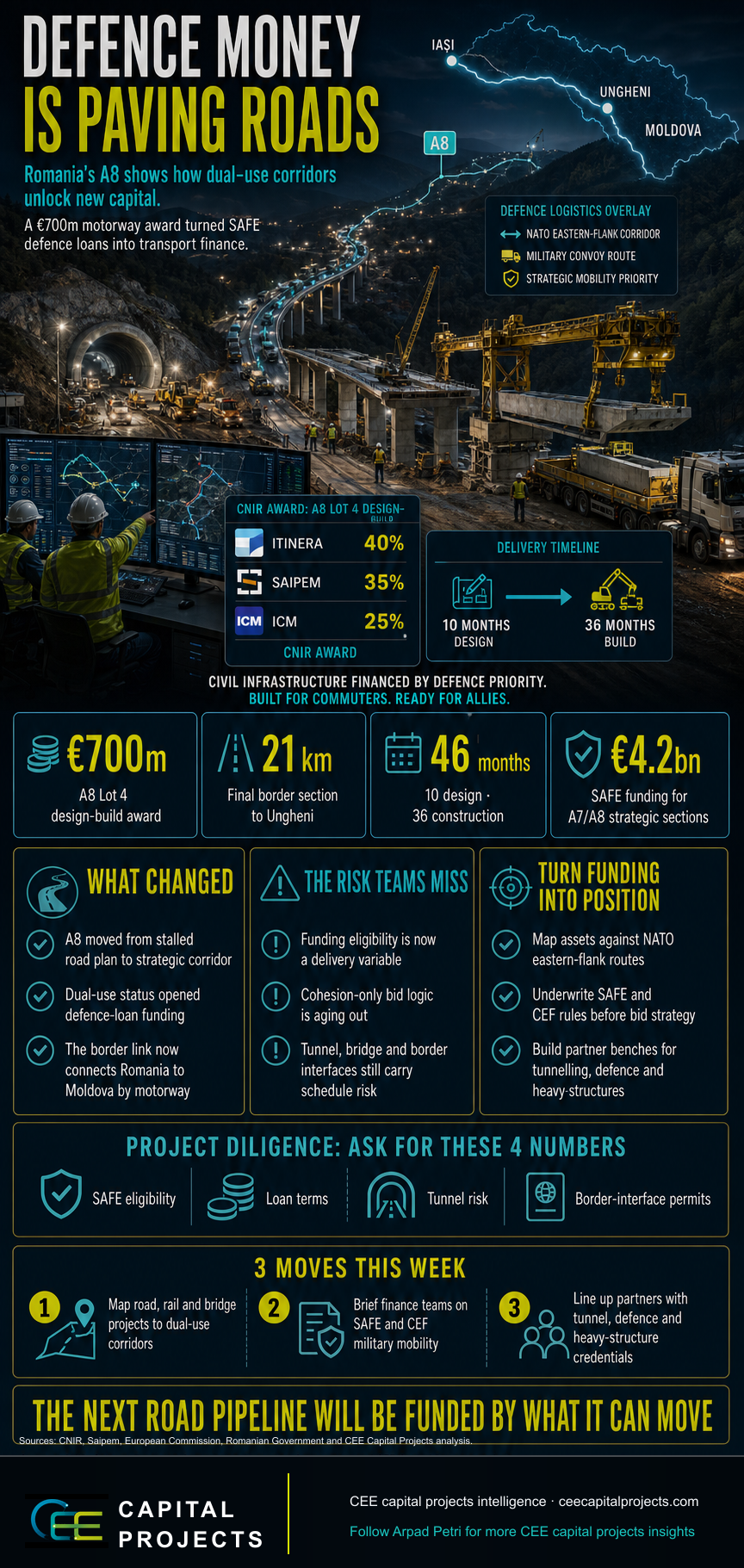
Saipem and its partners Itinera and ICM won the roughly €700m final section of Romania's A8 motorway on 2 July 2026, paid for not by cohesion grants but by the EU's SAFE defence-loan programme. Reclassified as dual-use military-mobility infrastructure, the long-stalled road shows how defence money is becoming a new funding channel for CEE transport.
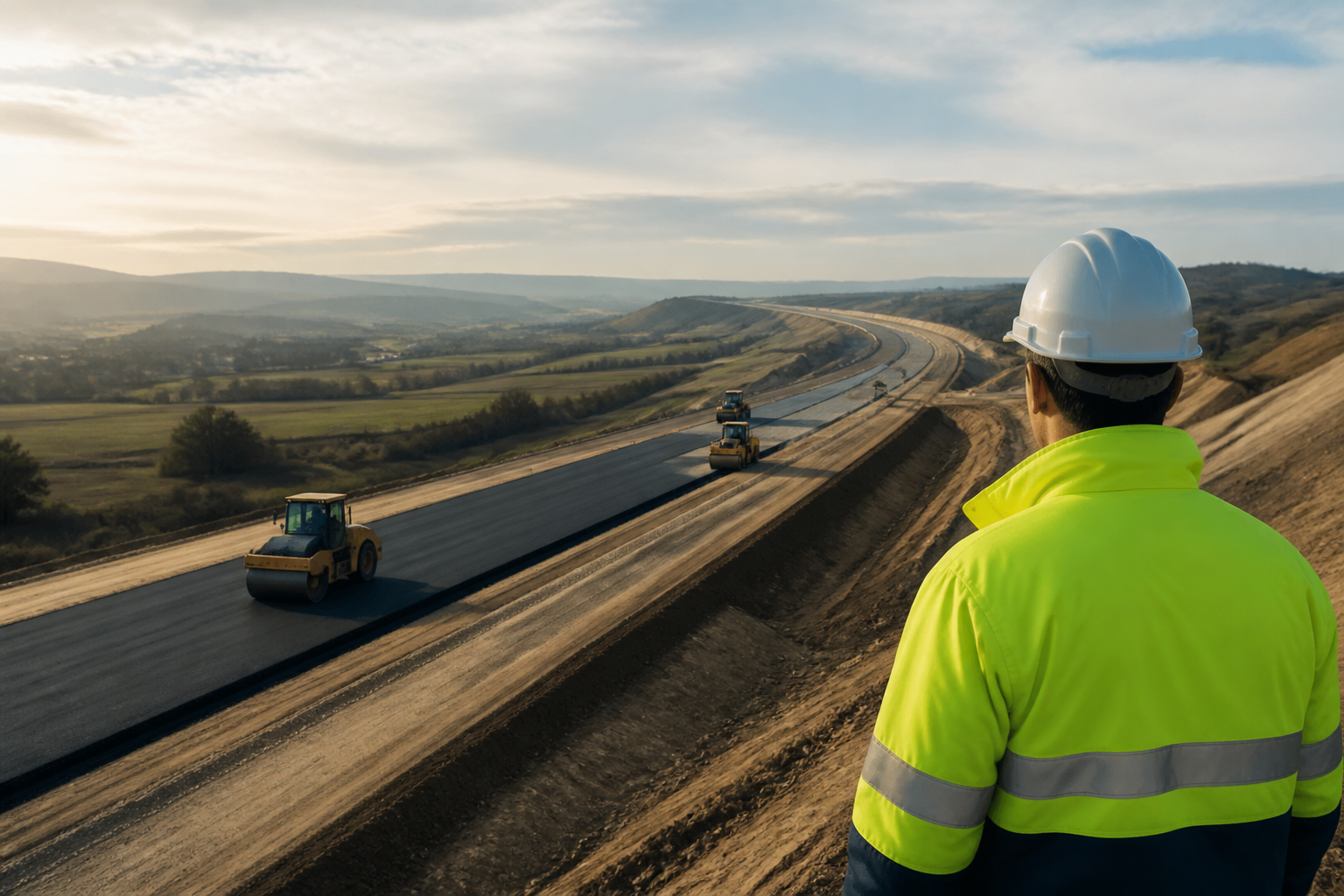
Saipem is best known for building oil and gas platforms and offshore pipelines. On 2 July 2026 it joined Italy's Itinera and ICM to win something rather different: the roughly €700 million contract for the final, most complex section of Romania's A8 motorway. The twist is who is paying. The money is not coming from the cohesion funds or the Recovery and Resilience Facility that bankroll most Central and Eastern European roads. It is coming from the European Union's defence budget.
The joint venture is led by Itinera (40%), with Saipem (35%) and ICM (25%). The award, made by road agency CNIR, covers Lot 4 of the A8 "Unirii" Motorway, the stretch that will carry a Romanian motorway across the border into the Republic of Moldova for the first time. It is financed through SAFE, the EU's new Security Action for Europe defence-loan instrument. For contractors and financiers watching the CEE road pipeline, the funding source matters as much as the ticket size.
A tunnel-heavy border crossing
Lot 4 runs about 21 kilometres, of which roughly 5 kilometres sit on Moldovan territory, linking Iași in north-eastern Romania to Ungheni across the Prut. Per Saipem's 2 July statement, the works include around 14 structures — bridges, viaducts and underpasses — three interchanges, a 500-metre cut-and-cover tunnel and a twin-bore tunnel of about 1.7 kilometres. Saipem's share is roughly €245 million. The design-and-build programme runs 46 months: 10 for design, 36 for construction.
It is the last piece of an A8 that has become a byword for delay. The "Union Motorway" is meant to run more than 300 kilometres across the Eastern Carpathians to connect Iași with Târgu Mureș, at an estimated €4 billion. Planned since the 2000s, it spent two decades stuck on the drawing board before the first works contract in 2023.
Why defence money is paving a Romanian road
SAFE is a €150 billion pot of low-interest EU loans, priced around 3% and backed by the EU budget, created to rearm the continent. Romania is its second-largest beneficiary after Poland, with a tentative €16.68 billion allocation (Poland requested about €43.7 billion). According to the Romanian government's own breakdown, €9.6 billion goes to defence procurement, €2.8 billion to interior-ministry and public-service equipment, and €4.2 billion to strategic sections of the A7 and A8 motorways in the north-east.
The bridge between a defence loan and a civilian motorway is the phrase "dual-use." The A7 and A8 end-segments toward Pașcani, Siret and Ungheni sit on the logistics corridor to Ukraine and Moldova. Reclassified as military-mobility infrastructure, they qualify for defence financing while still carrying trucks and commuters. Romania passed a dedicated legal framework, Law 4/2026, to draw the money down.
A cheaper, faster channel for a stalled pipeline
This is the strategic shift. CEE governments have leaned on EU cohesion grants and the RRF (Recovery and Resilience Facility) to fund roads, but the RRF's mid-2026 spending deadline is squeezing absorption and grant pipelines move slowly. SAFE offers a parallel channel: cheap, long-tenor debt a member state can direct at strategic corridors without the same competition for a shrinking grant envelope. For a road like the A8, stranded for years by funding and permitting, being redefined as a military-mobility asset is what finally moved it.
It also widens the contractor field. The Itinera–Saipem–ICM win puts an Italian consortium — Saipem better known for energy and offshore work — into the CEE motorway market on defence money. Expect more of this. The European Commission's latest Connecting Europe Facility transport call, worth €1.1 billion and announced on 19 June 2026, again prioritises rail and military mobility, with dual-use, multi-country projects favoured and a 6 October deadline. Brussels has bankrolled 95 military-mobility projects since 2021.
What it means for the market
The "military Schengen" push is quietly becoming one of the largest new funding streams for European transport infrastructure, and CEE, as NATO's eastern logistics backbone, is where it lands first. Contractors that can frame road, rail and bridge projects as dual-use, and financiers that can structure around SAFE and CEF money, will reach a pipeline that cohesion budgets alone could not unlock. The A8's leap into Moldova is the flagship, but it is a template. For anyone bidding CEE transport work over the next EU budget, the question is no longer only whether a project sits in the cohesion plan, but whether it moves troops as well as trucks.
Share it with your peers
Help your network stay ahead of CEE capital projects.
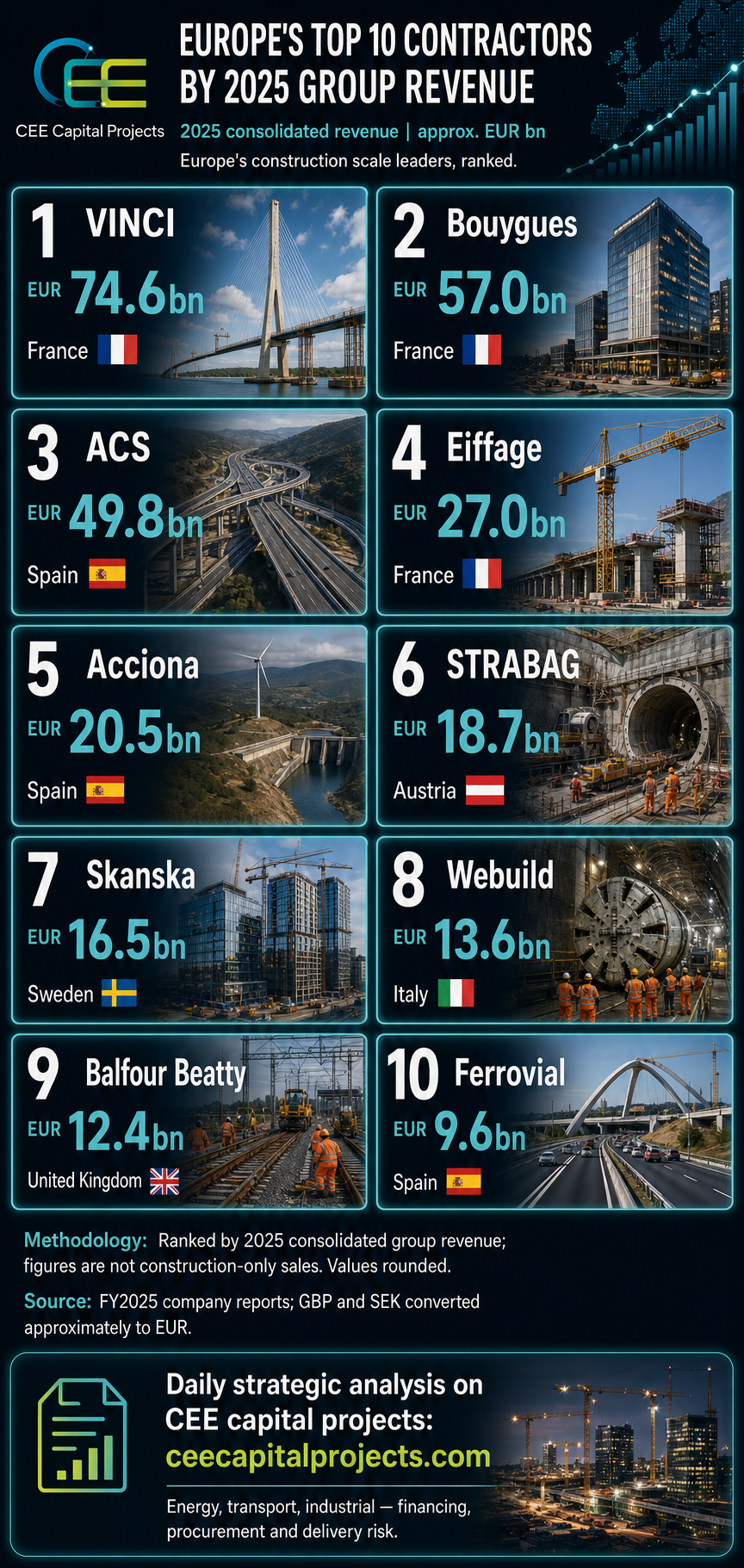
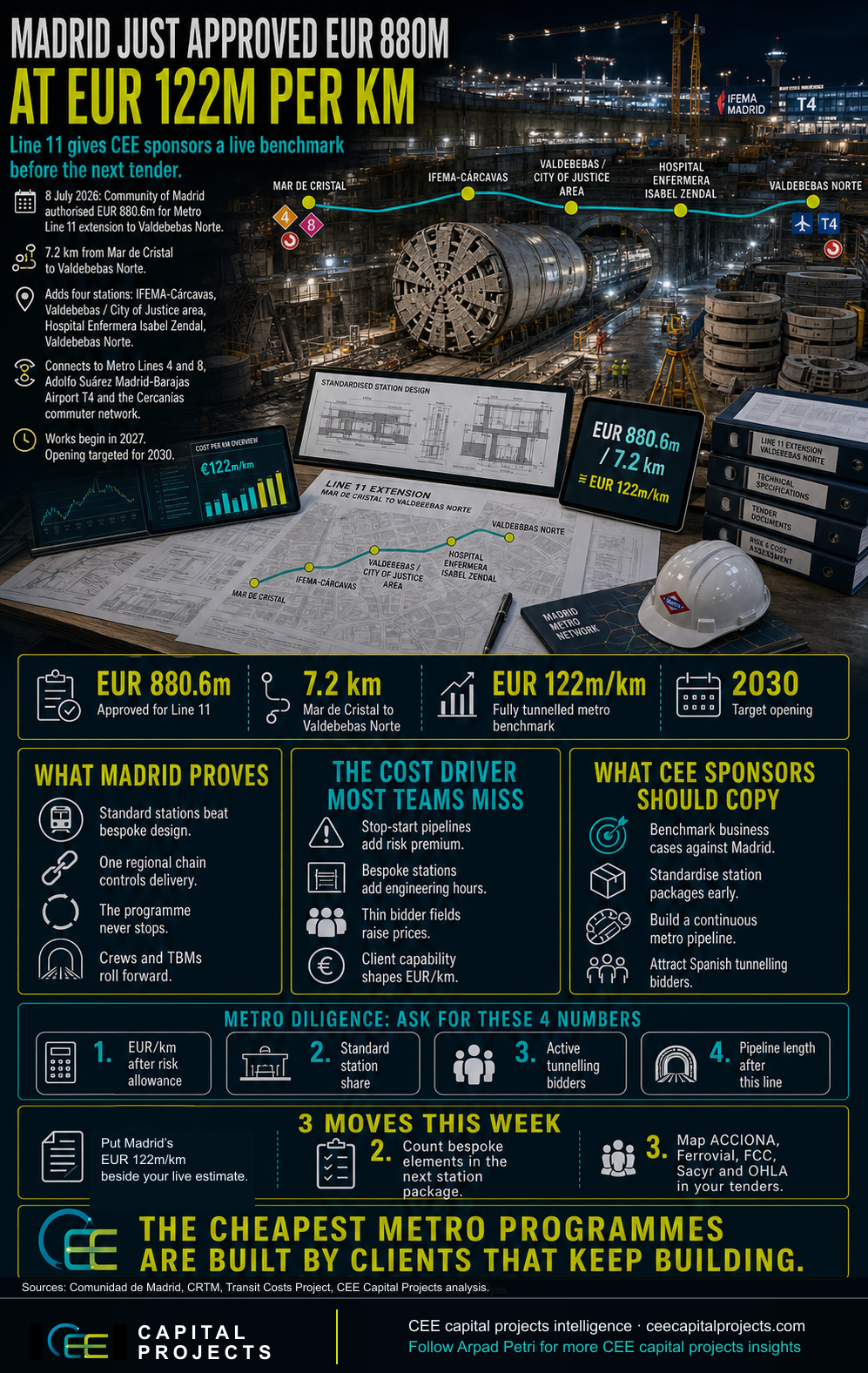
Explore our infograph library — strategic visuals for CEE capital projects leaders.
Project benchmarks, financing structures, tender dynamics and delivery risk — at a glance. Free access for investors, owners, contractors and strategy teams tracking CEE capital projects.
Browse the libraryStrategic Insights
📊 Analytics & Strategic Insight
Defence Budgets Are Becoming the New Infrastructure Bank
The decision most in this industry are avoiding:
👉 Stop filing defence money under "not for us." Most infrastructure teams still read SAFE and CEF military mobility as pure defence programmes and skip them. Turning a road into a dual-use asset is a routing and paperwork question, not an engineering one, and it is where the cheap capital now sits.
👉 The cohesion-grant reflex is aging out. Bidders still build financing plans around cohesion and the RRF as if those are the only pots. With the RRF deadline forcing a scramble and grants oversubscribed, the teams that win will be the ones that learned to underwrite loan instruments like SAFE first.
👉 "Strategic corridor" is a funding label, not a map. Whether a route counts as military mobility is decided by governments drawing lines toward Ukraine and NATO's eastern flank. Knowing which corridors ministries will tag as dual-use next is worth more than the traffic forecast.
Here's the full context:
→ 2000s: Romania plans the A8 "Union Motorway", more than 300 km across the Carpathians linking Iași and Târgu Mureș, with early hopes of opening by 2009.
→ 2023: After two decades on the drawing board, the first A8 construction contract is finally signed; the road becomes a symbol of CEE delivery delay.
→ 2025: The EU agrees SAFE, a €150 billion low-interest loan instrument to rearm Europe, with dual-use transport infrastructure eligible.
→ Jan–May 2026: The Commission approves a first wave of SAFE funding; Romania sets a €16.68 billion plan (Law 4/2026), earmarking €4.2 billion for A7 and A8 sections toward Ukraine and Moldova.
→ Most recent: On 2 July 2026 an Itinera–Saipem–ICM JV wins the roughly €700 million SAFE-financed Lot 4 of the A8, carrying a Romanian motorway into Moldova for the first time.
What this means for infrastructure operators, contractors and investors:
✅ A new, cheaper funding channel is open. SAFE's ~3% loans give member states a way to fund strategic roads outside the shrinking cohesion and RRF grant fight — expect more roads, bridges and rail reframed as dual-use.
✅ The contractor field is widening. Energy and offshore players like Saipem are entering CEE motorways on defence money; incumbents should expect new, well-capitalised competition on the eastern pipeline.
✅ Eastern CEE is the first landing zone. As NATO's logistics backbone, Romania, Poland and the Baltics will see the earliest and largest dual-use awards; western markets follow.
3 moves you can make this week:
1️⃣ Map your pipeline against the dual-use test. Flag every road, bridge, rail and port project that sits on a corridor to NATO's eastern flank or Ukraine — those are the SAFE and CEF military-mobility candidates.
2️⃣ Learn the loan instruments, not just the grants. Brief your finance team on SAFE eligibility and the CEF military-mobility call (€1.1 billion, deadline 6 October 2026) before your next bid plan.
3️⃣ Build a dual-use partner bench. Line up consortium partners with defence, tunnelling and heavy-structures credentials now; the winning A8 JV paired a roadbuilder with an energy contractor.
Related analyses
- Transport & Infrastructure
V-Híd Just Lost Hungary's HUF 338 Billion Déli Körvasút at 42 Per Cent Complete. The Grant Clock Is the Real Story
Hungary halted construction of the Budapest Southern Circle Railway on 9 October 2026 and barred V-Híd from every ongoing rail investment. The HUF 367 billion of EU money behind the job survives only if a lawful re-tender lands inside two years.
Read analysis → - Transport & Infrastructure
Afcons Wins Croatia's EUR 899m Dugo Selo-Novska Rail Contract: Four Bids, No European Prime
Croatia signed its largest ever railway contract on 1 October 2026, handing 83 km of double-tracking to India's Afcons Infrastructure at EUR 677.06m excluding VAT. Four bids were priced for the work and not one of them came from a European prime contractor.
Read analysis → - Transport & Infrastructure
STRABAG Closes BAWI Construction Buy in Romania as Rail Qualification Becomes the Scarce Asset
STRABAG has closed its purchase of BAWI Construction, a Bucharest rail specialist with 240 employees and about EUR 60 million of 2025 output. The number that matters is the qualification it buys, as Romania opens a EUR 5.99 billion rail programme with the EU recovery window shut.
Read analysis →
Get a second opinion before it gets expensive.
Contractor selection, tender strategy, a project drifting off track — send us the situation and we'll come back with a clear plan.