We Help International Investors and Project Owners Deliver Major CEE Projects Without Expensive Surprises
Independent project intelligence and advisory across energy, transport, real estate and industrial construction.
Riga Airport's EUR 98 Million Terminal Expansion: 17 Firms Prequalified and Only Two Priced the Job
Seventeen construction companies and consortia from nine countries prequalified for RIX Riga Airport's EUR 98 million terminal expansion and only two submitted a financial bid. The FIDIC Yellow Book contract starts on site while the design is still being adapted.
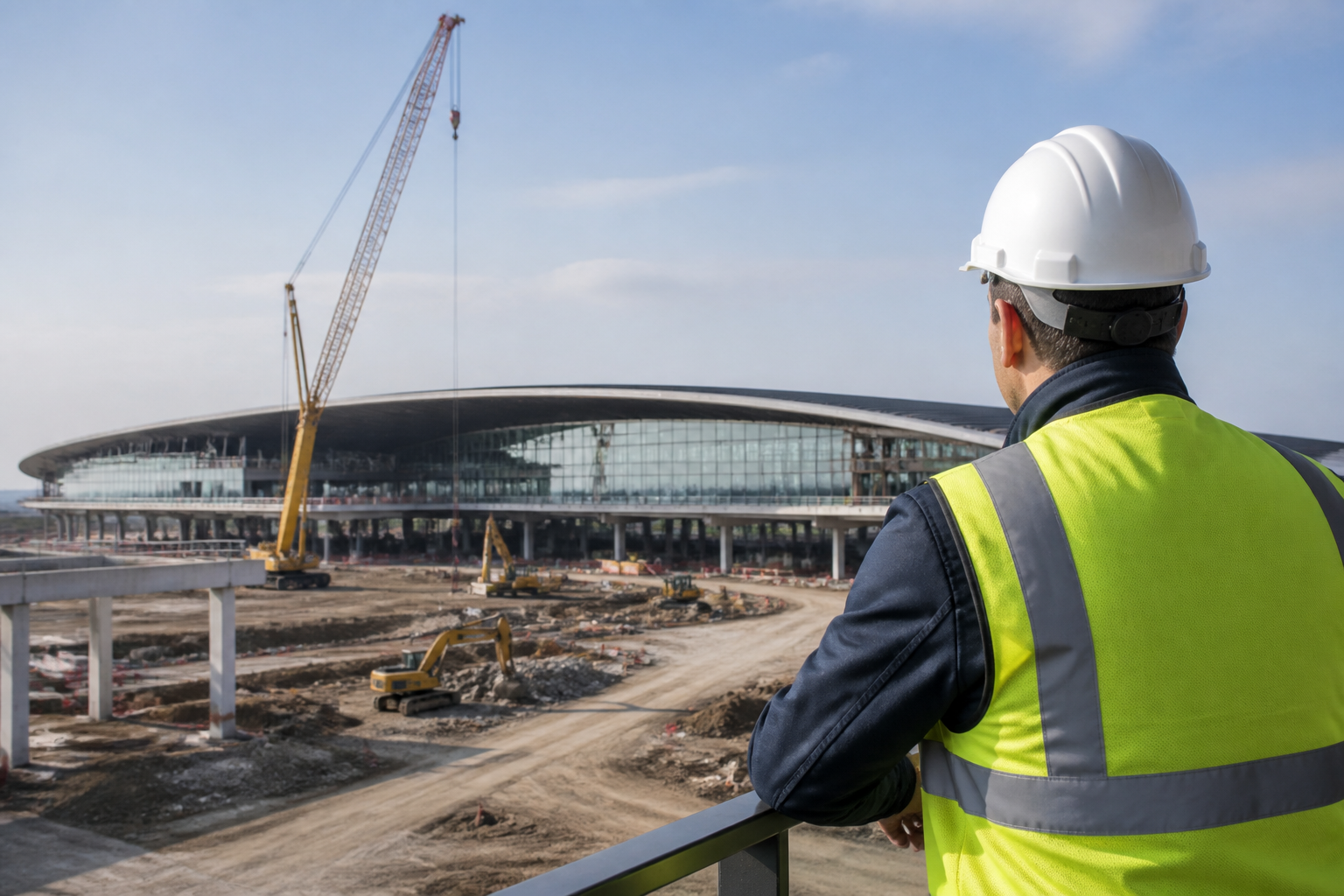
I keep seeing the same pattern on design and build jobs at working airports. The bid list thins out long before the price arrives. At Riga the numbers are on the record, and they are stark.
RIX Riga Airport set out the full procurement sequence in its announcement of 3 September 2026. Seventeen construction companies and consortia from nine countries applied for prequalification. Five submitted technical proposals. Four were invited to submit financial bids. Two actually priced the work. The RIXLA consortium of LNK Industries and Arčers won on the most economically advantageous basis.
The funnel is the risk assessment
That is an attrition of 88 per cent between the prequalification gate and a priced offer, on my own arithmetic from the airport's figures. The process ran under European Bank for Reconstruction and Development procurement rules, so it was open, competitive and visible across the European market.
Interest was never the constraint. Seventeen firms from nine countries is a healthy field for a EUR 98 million building contract. Something sat between that interest and a number on paper.
Builders read tender documents for one thing above all else. They look for the risks they are being asked to own, and they ask whether those risks can be priced. Fifteen firms decided this particular set could not.
Yellow Book with a design still in motion
The contract is concluded under the FIDIC Yellow Book. Under that form the contractor takes the design. It builds to the Employer's Requirements and it carries the consequences of getting the design wrong.
Now read the airport's own description of stage one. Works begin in the second half of September 2026 with site preparation and temporary infrastructure. They proceed, in RIX's words, while the original design is being adapted to meet the airport's updated development needs. Mobilisation starts before the requirements are settled.
Yellow Book has a clear answer for that situation. A change to the Employer's Requirements after signature is a variation, and a variation moves cost and time back to the employer. Every adaptation issued during stage one is a candidate for that treatment. Design risk transferred at signature comes home in instalments.
Two bidders looked at that and stayed in. Their price contains whatever they think the adaptation will cost. Nobody outside the room will ever see that figure, because it sits in contingency and preliminaries rather than in a rate.
The financing package has room built into it
Construction is estimated at EUR 98 million. The lending arrangements make up to EUR 150 million available. The EBRD is lending EUR 50 million, with the Nordic Investment Bank and OP Corporate Bank plc Latvian Branch taking equal shares alongside it.
The airport says the balance covers next generation passenger service and aviation security technology. It also gives the borrower headroom that the construction contract does not provide. Lenders who have just financed a Yellow Book job with a moving design usually want that space.
Two further details deserve attention. Due diligence was run twice, once by the lenders and once by international advisors the lenders engaged. And the three shares are equal, so no single institution carries a majority of a state owned Baltic airport exposure at a moment when the sponsor itself cites the geopolitical environment as a planning input.
Forty two months for a 20,000 square metre building
The programme runs 42 months. It delivers roughly 20,000 square metres of new terminal space plus 29,500 square metres of roads, pavements, public areas and landscaping. There are four consecutive stages, and the fourth removes the temporary facilities the first one builds.
Temporary works are pure cost. Nothing remains at handover. They are the price of keeping the airport open, and Riga is keeping it open at full capacity throughout. That single decision is why the stages run consecutively rather than in parallel, and why a modest building takes three and a half years.
The capacity case is not in doubt. The EBRD records 7.1 million passengers in 2025 across nearly 100 direct destinations and 17 airlines. The airport says its current terminal already exceeds the capacity it was designed for.
The scope was sized down before it was priced
Both sponsors chose their words carefully. Laila Odiņa, Chairperson of the Board of RIX Riga Airport, said the scope was designed around passenger demand, regional economic prospects and the current geopolitical environment. Andulis Židkovs, State Secretary at Latvia's Ministry of Transport, said the project is being adapted to realistic passenger traffic forecasts and Latvia's actual needs.
Read together those are trimming statements. The ambition was cut to fit the forecast, and it was cut before the contract was let. That is the right order and it is rarer than it should be.
What this sets up
The EBRD expects future integration with Rail Baltica, which turns this terminal into a multimodal node rather than a standalone building. The interface risk that creates has not been contracted yet, and it will land on a sponsor already managing a live construction site.
For contractors across the region, a field of two on a EUR 98 million airport job says something about where risk appetite now sits. For public sponsors, the prequalification funnel is free market intelligence and it arrives before award rather than after. Seventeen to two is a message. The useful question is whether anyone has asked the fifteen why they left.
Share it with your peers
Help your network stay ahead of CEE capital projects.




Explore our infograph library — strategic visuals for CEE capital projects leaders.
Project benchmarks, financing structures, tender dynamics and delivery risk — at a glance. Free access for investors, owners, contractors and strategy teams tracking CEE capital projects.
Browse the libraryStrategic Insights
📊 Analytics & Strategic Insight
The bid list prices your risk allocation before the winning contractor does
The decision most in this industry are avoiding:
👉 Nobody debriefs the bidders who walked away. Sponsors run lessons learned on the losing bidder and never on the firms that stopped before pricing. Those firms hold the sharpest read on your risk allocation, and asking them costs nothing but a phone call.
👉 Design and build with an unsettled design is not design and build. Signing Yellow Book while the Employer's Requirements are still being adapted keeps the label and loses the transfer. The contract says the contractor owns the design. The variation clause says otherwise every time an instruction lands.
👉 Facility headroom is a risk disclosure, not generosity. A loan package more than 50 per cent above the construction estimate is telling you what the lenders' advisers found. Read the gap as a number and put it in your own forecast.
Here's the full context:
→ 1991: The EBRD begins investing in Latvia and has since committed more than EUR 1.4 billion across sectors, making it one of the country's largest institutional investors.
→ 2025: Riga Airport serves 7.1 million passengers across nearly 100 direct destinations with 17 airlines, on a terminal that already exceeds its original design capacity.
→ 2026 prequalification: Seventeen construction companies and consortia from nine countries apply under EBRD procurement rules. Five submit technical proposals and four are invited to price.
→ 2026 award: Two financial bids arrive. The RIXLA consortium of LNK Industries and Arčers is selected as the most economically advantageous, under a FIDIC Yellow Book contract targeting BREEAM Very Good.
→ Most recent: On 3 September 2026 RIX marks the start of the next stage. EUR 98 million construction estimate, up to EUR 150 million of lending with the EBRD at EUR 50 million, four consecutive stages over 42 months, the airport at full capacity throughout, and site works from the second half of September 2026 while the design is adapted.
What this means for infrastructure operators, contractors and investors:
✅ A thin field is a pricing event. Two bidders on a EUR 98 million job means the winning number carries a risk premium you cannot itemise. Treat variations as a probability in your cost plan rather than an exception to it.
✅ Live operations set the programme, not the building. Forty two months for 20,000 square metres is an operations decision. If your business case turns on the opening date, the staging plan is where that date lives or dies.
✅ Two IFIs and one commercial bank in equal thirds is becoming a template. For mid sized state owned transport assets in the region, syndication with no majority holder is how this market now clears.
3 moves you can make this week:
1️⃣ Pull your own prequalification to bid conversion. Count how many firms took documents on your last three tenders and how many actually priced. If the ratio is worse than one in three, your risk allocation is doing the filtering.
2️⃣ Freeze the Employer's Requirements before you mobilise. If you cannot, list every item still open, attach a date to each one, and price the variation exposure now rather than arguing it eighteen months from now.
3️⃣ Ring fence the temporary works budget. Separate it from the permanent asset in the cost plan and report it monthly. It is the line that grows quietly whenever operations and construction share a site.
Related analyses
- Transport & Infrastructure
V-Híd Just Lost Hungary's HUF 338 Billion Déli Körvasút at 42 Per Cent Complete. The Grant Clock Is the Real Story
Hungary halted construction of the Budapest Southern Circle Railway on 9 October 2026 and barred V-Híd from every ongoing rail investment. The HUF 367 billion of EU money behind the job survives only if a lawful re-tender lands inside two years.
Read analysis → - Transport & Infrastructure
Afcons Wins Croatia's EUR 899m Dugo Selo-Novska Rail Contract: Four Bids, No European Prime
Croatia signed its largest ever railway contract on 1 October 2026, handing 83 km of double-tracking to India's Afcons Infrastructure at EUR 677.06m excluding VAT. Four bids were priced for the work and not one of them came from a European prime contractor.
Read analysis → - Transport & Infrastructure
STRABAG Closes BAWI Construction Buy in Romania as Rail Qualification Becomes the Scarce Asset
STRABAG has closed its purchase of BAWI Construction, a Bucharest rail specialist with 240 employees and about EUR 60 million of 2025 output. The number that matters is the qualification it buys, as Romania opens a EUR 5.99 billion rail programme with the EU recovery window shut.
Read analysis →
Building in Central Europe?
Tell us what you're building. We'll tell you what can go wrong — and how to prevent it.