We Help International Investors and Project Owners Deliver Major CEE Projects Without Expensive Surprises
Independent project intelligence and advisory across energy, transport, real estate and industrial construction.
Rataela and VDH Just Won a Czech Rail Contract at 63% of the State's Own Price Ceiling. Then a Firm That Never Bid Froze It for 80 Days
Five bidders, all under the state's maximum price, and a winner at 63 percent of it: Czechia's rail procurement reform has repriced a national market in under a year. Then a company that never submitted a bid froze the award for 80 days, and the regulator ruled it had standing to do so.
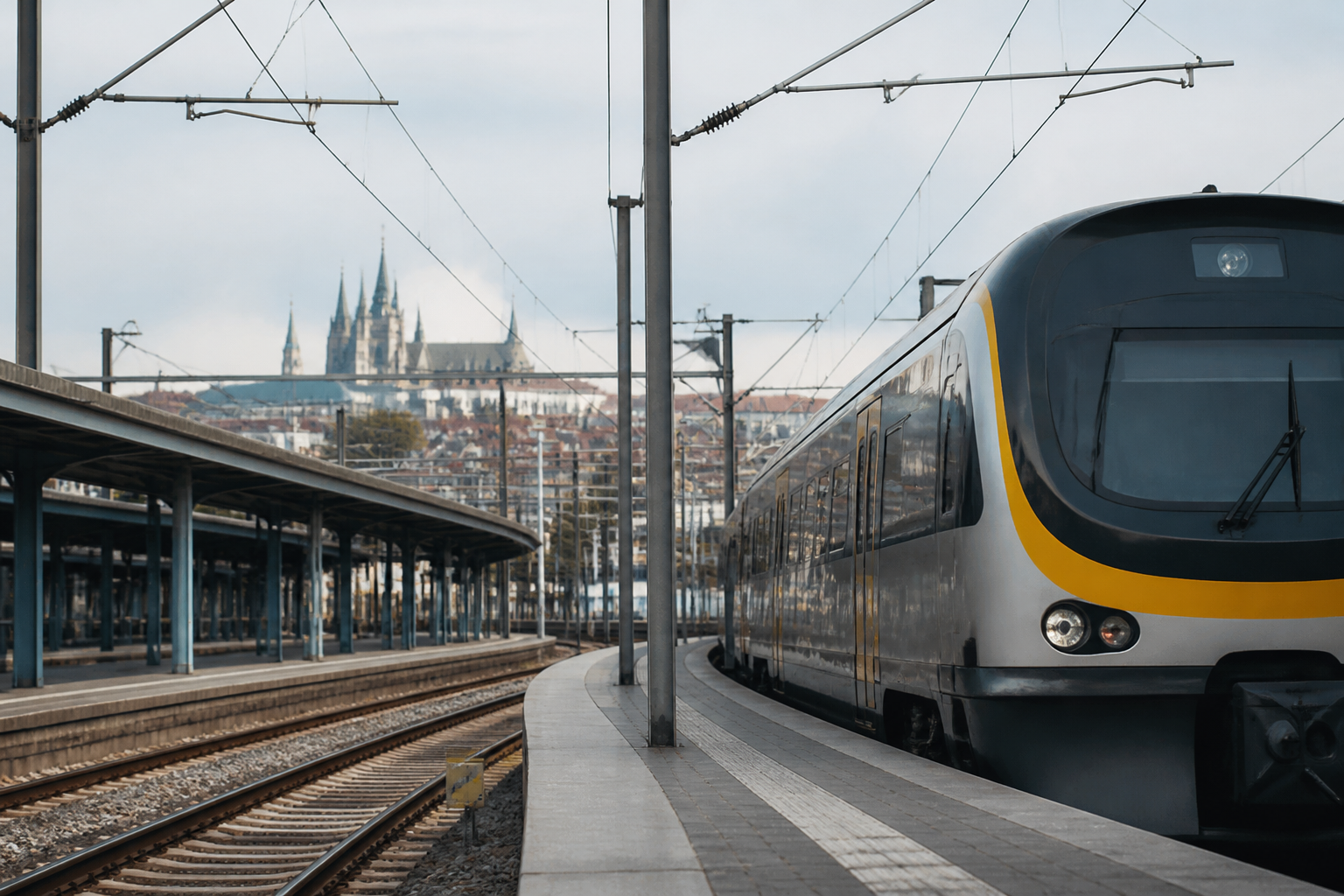
Five companies bid to electrify a nine-kilometre commuter branch in West Bohemia. All five came in under the state's maximum price. The winner came in at 63 percent of it.
On 11 August 2026 the Czech competition authority ÚOHS published the ruling that clears Správa železnic, the state rail infrastructure manager, to sign that contract, ending a standstill that had held the award since May. The winning consortium, Czech contractor Rataela with Bulgarian rail builder VDH, priced the job at CZK 1.051 billion against a ceiling of CZK 1.666 billion, according to Czech transport outlet Zdopravy.cz, which reported the ruling and confirmed all five bid prices on 11 August 2026. The runner-up, Elektrizace železnic Praha, bid CZK 1.076 billion. Two further offers landed below CZK 1.2 billion.
Správa železnic says this is the first time a purely capital investment project, rather than maintenance work, has drawn bids that significantly undercut its own estimate. For anyone building in Central Europe, that sentence is the story.
A nine-kilometre branch carrying a national price signal
Line 181, Nýřany to Heřmanova Huť, serves a community of roughly 1,900 people west of Plzeň. The scope is electrification at 25 kV AC, permanent way and subgrade reconstruction, 550 mm platform edges for level boarding, and the European Train Control System, with remote operation moving to Prague's central dispatch centre. A modest job with an outsized signal, because at Nýřany the branch meets the Plzeň–Domažlice corridor, the future 200 km/h link toward Bavaria.
That corridor's first phase went to a consortium of PORR, Elektrizace železnic Praha and Berger Bohemia in June 2026 at CZK 4.489 billion, against an estimated value of CZK 4.640 billion. Two awards, months apart, both below the owner's own number. One result is noise. Two is a pattern.
The reform that produced the discount
In February 2026 Správa železnic, under director general Tomáš Tóth, announced a procurement overhaul alongside CZK 335.6 million (EUR 13.4 million) of annual internal savings and the abolition of 121 non-operational posts, as reported by RAILMARKET.com on 24 February 2026. The procurement half matters far more than the headcount. Qualification criteria were revised. Selected foreign certifications are being recognised. Documentation rules that effectively demanded Czech-language submissions at the qualification stage were loosened. Large contracts are being split into lots, separating civil works from technology, to break the dependence on a short list of large suppliers.
The effect showed up in the bid tabulation. Rataela won its first track reconstruction contracts in 2025, and its arrival helped push maintenance prices down; Správa železnic has since recorded a 31 percent fall in routine line maintenance costs, worth more than EUR 64 million. VDH is one of Bulgaria's larger rail construction firms. Neither belonged to the circle that has historically priced Czech electrification work. That is the whole mechanism. The price of a national rail market is set by who is allowed to bid.
The 80-day standstill nobody prices
The discount was not free. On 20 May 2026 a company called Wenea, registered in the small town of Kouřim, filed two challenges at ÚOHS. Its only previous contract with Správa železnic was a CZK 300,000 drainage job on Prague's Negrelli Viaduct. One filing was stopped on procedure, because Wenea had never raised the complaint at the required objections stage. The second, attacking the cable duct specification, was dismissed on the merits: ÚOHS found the shift from a single duct geometry to a functional definition drawn from a published approved list legitimate, and noted that five bidders had priced the work without querying it.
The part worth reading twice is standing. Správa železnic argued Wenea had none. ÚOHS disagreed. Czech courts require only that a challenger be theoretically capable of performing the contract, not that it intended to bid at all. Wenea holds a building trade licence, so it cleared the bar. The ruling took legal force on 8 August 2026. The contract had been frozen for roughly 80 days.
Zdopravy.cz observed at the outset that larger firms unhappy with a tender result have in the past used smaller companies to manufacture delay. ÚOHS did not rule on motive and did not need to. The commercial lesson holds either way: every qualification barrier an owner removes to widen the bidder pool also widens the pool of parties with standing to suspend the award.
What the Bavaria corridor still needs
Czechia's 2026 rail programme is funded at roughly EUR 3 billion, its largest annual allocation ever, and the Plzeň corridor runs to 2029. The constraint sits on the other side of the border. The Czech–German frontier stretches 850 kilometres and carries a single double-track electrified crossing, and the German route toward Regensburg still contains unelectrified sections whose upgrade depends on Berlin and Munich rather than Prague.
What contractors and sponsors should take from this
A market effectively closed by paperwork opened in under a year, and the first firms through the door repriced it by more than a third. Incumbents in Poland, Slovakia and Hungary should assume their own infrastructure managers are reading the Czech bid tabulation with interest, and that ceilings published next year will reflect it. For sponsors and lenders the harder lesson is that cheaper awards arrive with longer and less predictable paths to signature. Eighty days between award and contract is now a planning assumption in Czech rail, and the party carrying that delay risk should be named in the contract before it bites.
Share it with your peers
Help your network stay ahead of CEE capital projects.
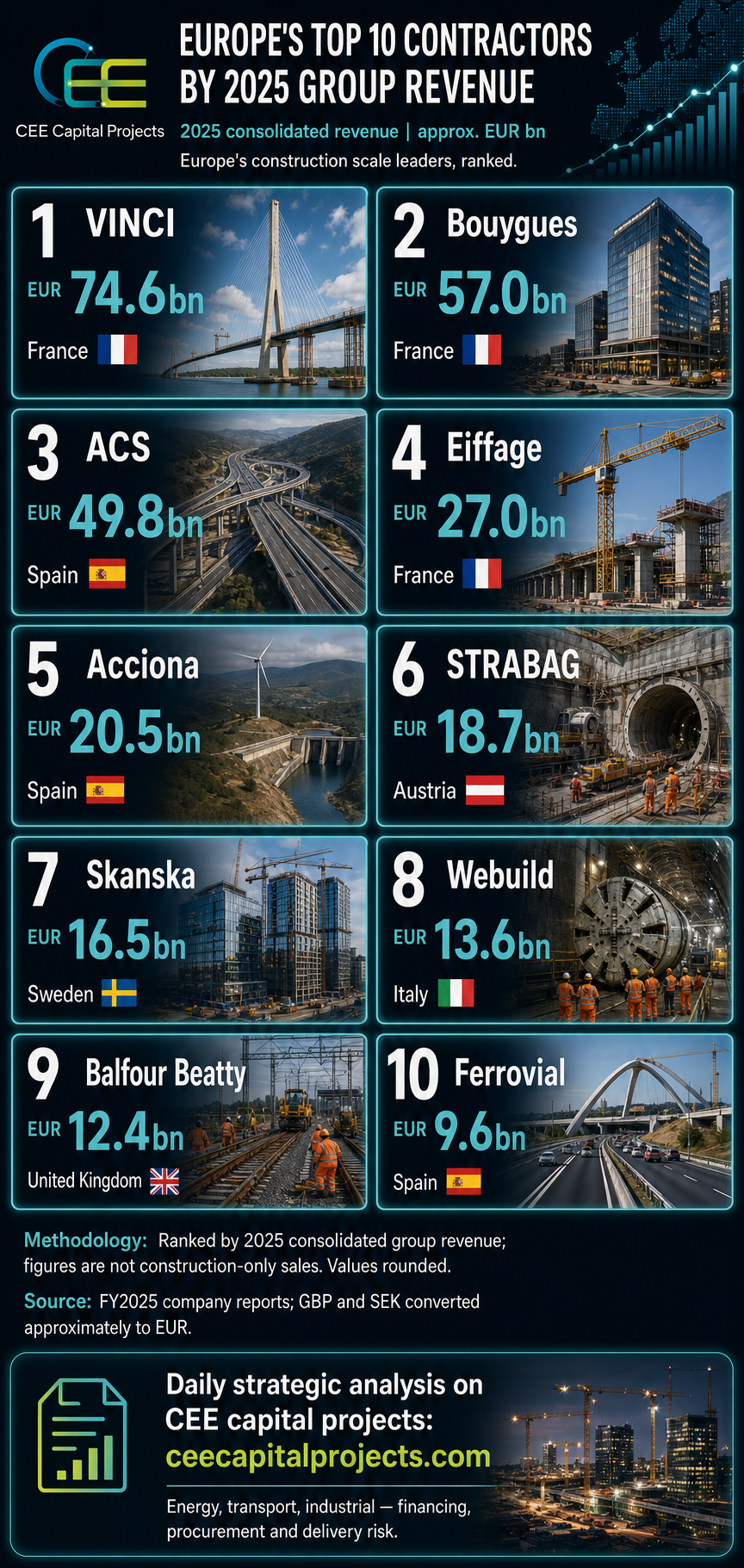
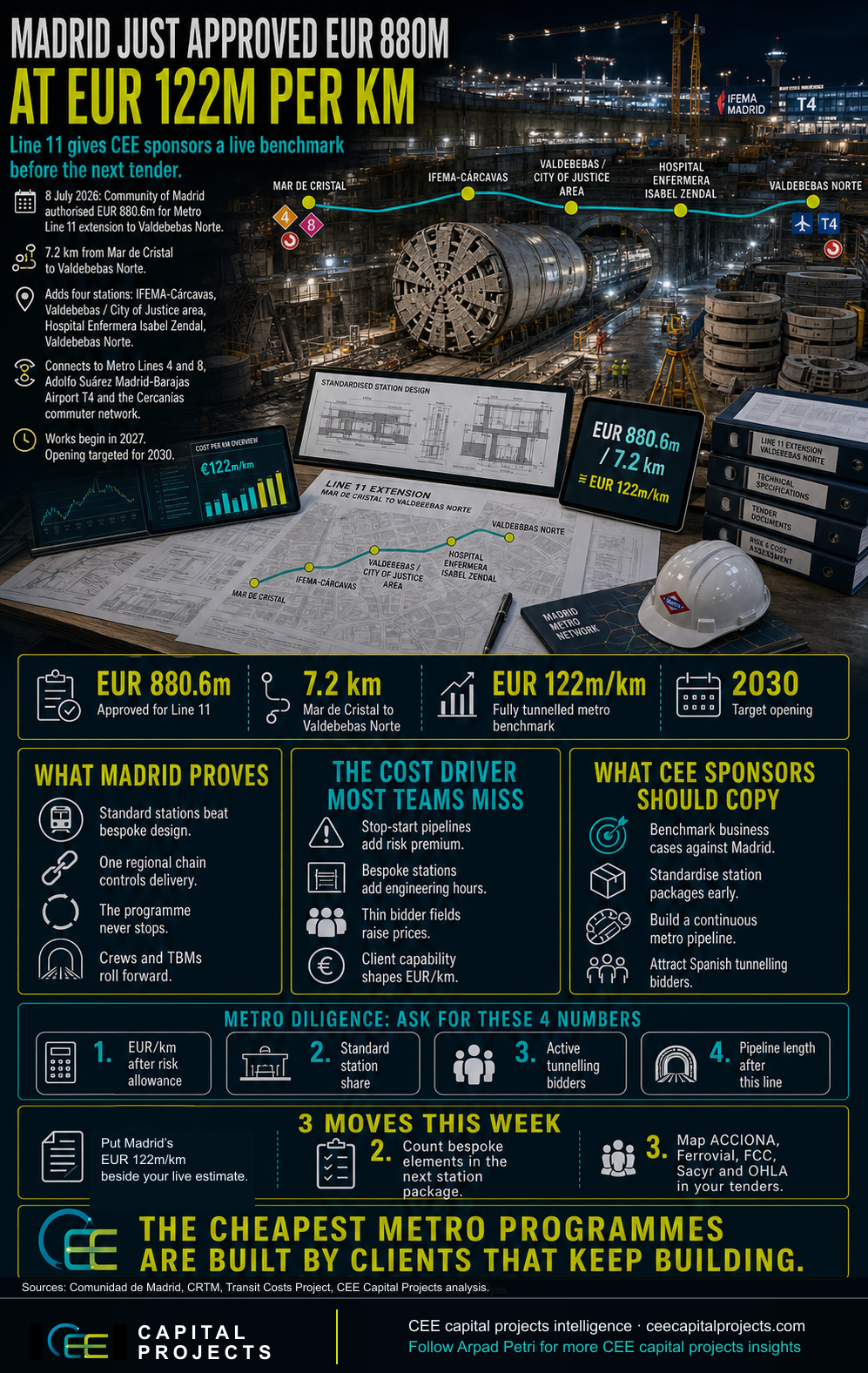
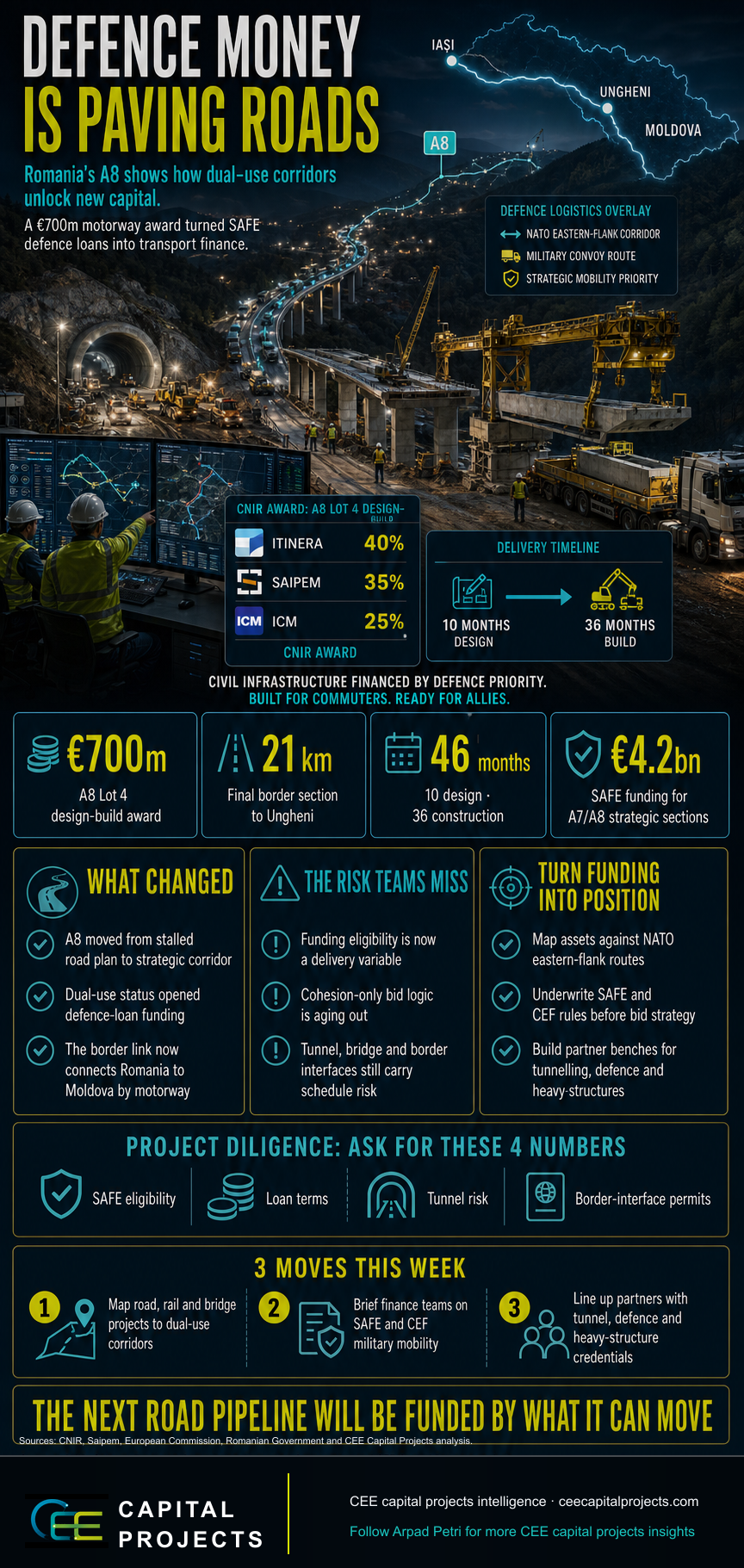
Explore our infograph library — strategic visuals for CEE capital projects leaders.
Project benchmarks, financing structures, tender dynamics and delivery risk — at a glance. Free access for investors, owners, contractors and strategy teams tracking CEE capital projects.
Browse the libraryStrategic Insights
📊 Analytics & Strategic Insight
Czechia just proved that a national construction price is a procurement setting, not a cost of production
The decision most in this industry are avoiding:
👉 Treating the owner's published ceiling as information rather than instruction. When five independent bidders all land under a maximum price and the winner lands 37 points under it, the ceiling was never a measure of what the work costs. It was a target the market had been trained to aim just below. Owners who publish an estimate are teaching bidders where to price, and most bidders have been happy to be taught.
👉 Confusing entry barriers with quality control. Language requirements at qualification, unrecognised foreign certifications and long local reference lists filter for administrative capacity, not for the ability to build a railway. Czechia removed several of those filters and the technical scope did not change at all. Any owner defending its qualification rules should be able to say which specific delivery risk each rule actually retires.
👉 Assuming that opening a market only affects who can win. It also affects who can stop you. Czech law grants standing to a challenger that is theoretically capable of performing the contract, without requiring that it ever intended to bid. Lower the entry bar and you lower the bar to challenge with it. That trade-off is real, and almost nobody prices it.
Here's the full context:
→ 2025: Rataela wins its first Czech track reconstruction contracts. Its presence in those competitions contributes to a measurable fall in maintenance segment pricing.
→ February 2026: Správa železnic announces a reform programme under new director general Tomáš Tóth: CZK 335.6 million of annual savings, 121 non-operational posts abolished, revised qualification criteria, recognition of selected foreign certifications, and large contracts split into civil and technology lots.
→ April 2026: Transport Minister Ivan Bednárik points to the Prague–Kladno line and the first Bavaria corridor section being awarded hundreds of millions of crowns below estimate. Routine line maintenance costs are down 31 percent, worth over EUR 64 million.
→ 20 May 2026: Wenea, whose only prior work for Správa železnic was a CZK 300,000 drainage job, files two challenges at ÚOHS against the Heřmanova Huť electrification tender. The automatic standstill begins.
→ Most recent: The ÚOHS ruling takes legal force on 8 August 2026 and is published on 11 August, clearing Správa železnic to sign with Rataela and VDH at CZK 1.051 billion, 63 percent of the CZK 1.666 billion ceiling, after roughly 80 days of suspension.
What this means for infrastructure operators, contractors and investors:
✅ Price benchmarks travel faster than cost bases. Once a national infrastructure manager sees 63 percent of ceiling delivered by a credible consortium, that number becomes the internal reference for the next tender and the one after. Contractors pricing off last year's accepted rates will start losing work they used to win comfortably.
✅ The cheapest route into a closed market is a consortium, not a subsidiary. A local licence holder who knows the forms plus a foreign specialist who knows the trade clears a qualification bar that neither clears alone, and does it without the fixed cost of standing up a country entity.
✅ Award-to-signature is now a schedule risk with a number on it. In jurisdictions with automatic suspension on challenge, the gap between winning and starting can run into months regardless of the merits. That period has a cost, and the contract should say who carries it.
3 moves you can make this week:
1️⃣ Run the ceiling ratio on your last five bids. Express each submitted price as a percentage of the owner's published maximum. If the answers cluster above 90 percent, you have been pricing off the client's estimate rather than your own cost model, and you are exposed the moment a new entrant does the arithmetic properly.
2️⃣ Read the qualification rules of the three national owners you most want to enter. Look specifically at language requirements and recognition of foreign certifications. Those two change fastest, cost the least to satisfy, and are the clearest signal that a market is about to reprice.
3️⃣ Add a standstill line to every programme between award and signature. Use a working assumption of 60 to 90 days in jurisdictions with automatic suspension, model the cost of holding mobilised resources through it, and agree in writing which party absorbs that cost.
Related analyses
- Transport & Infrastructure
V-Híd Just Lost Hungary's HUF 338 Billion Déli Körvasút at 42 Per Cent Complete. The Grant Clock Is the Real Story
Hungary halted construction of the Budapest Southern Circle Railway on 9 October 2026 and barred V-Híd from every ongoing rail investment. The HUF 367 billion of EU money behind the job survives only if a lawful re-tender lands inside two years.
Read analysis → - Transport & Infrastructure
Afcons Wins Croatia's EUR 899m Dugo Selo-Novska Rail Contract: Four Bids, No European Prime
Croatia signed its largest ever railway contract on 1 October 2026, handing 83 km of double-tracking to India's Afcons Infrastructure at EUR 677.06m excluding VAT. Four bids were priced for the work and not one of them came from a European prime contractor.
Read analysis → - Transport & Infrastructure
STRABAG Closes BAWI Construction Buy in Romania as Rail Qualification Becomes the Scarce Asset
STRABAG has closed its purchase of BAWI Construction, a Bucharest rail specialist with 240 employees and about EUR 60 million of 2025 output. The number that matters is the qualification it buys, as Romania opens a EUR 5.99 billion rail programme with the EU recovery window shut.
Read analysis →
Get a second opinion before it gets expensive.
Contractor selection, tender strategy, a project drifting off track — send us the situation and we'll come back with a clear plan.