We Help International Investors and Project Owners Deliver Major CEE Projects Without Expensive Surprises
Independent project intelligence and advisory across energy, transport, real estate and industrial construction.
PORR and Webuild Just Linked Italy and Austria 1,400 Metres Under the Alps. The German Line Feeding the Tunnel May Not Arrive Until 2050
The Brenner Base Tunnel's main bores broke through on 28 July 2026, leaving the world's longest underground railway around 90% excavated and on course to open in early 2032. Its German feeder line, the roughly EUR 15bn Brenner Nordzulauf, may not be finished until 2050 — and that date, not the tunnel, decides what the corridor is worth.
More than 2.5 million trucks cross the Brenner Pass every year, roughly one every twelve seconds around the clock. The railway tunnel built to take them off that road is now about 90% excavated and due to open in early 2032. The German railway line that is supposed to feed it may not be finished until 2050.
A breakthrough 1,400 metres under the border
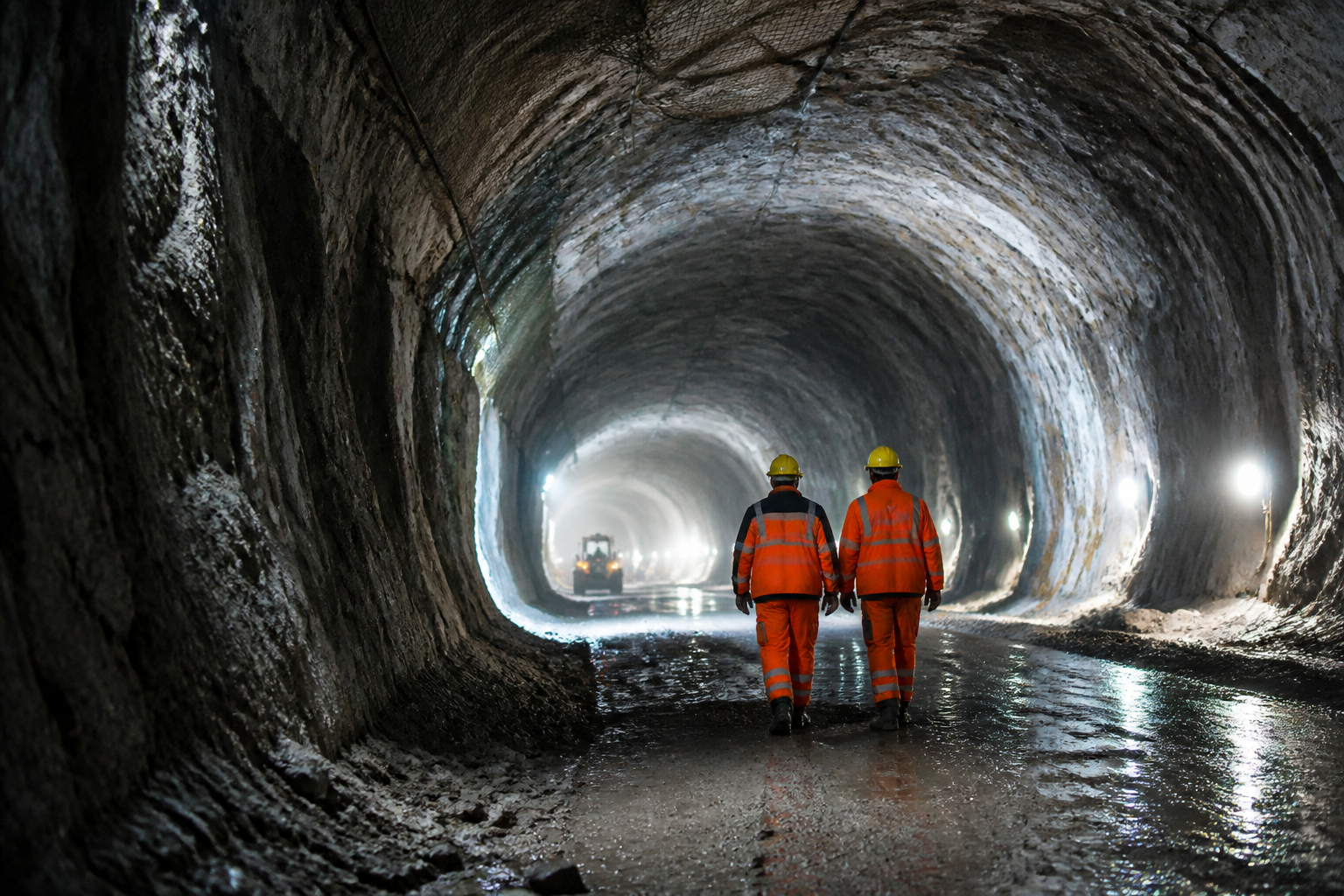
At 10:35 on 28 July 2026, miners linked the Austrian and Italian main bores of the Brenner Base Tunnel, 1,400 m below the surface close to the border, Railway Gazette International reported on 29 July. The 8.1 m diameter running tunnels join the Austrian H53 Pfons–Brenner section, driven by the ARGE H53 consortium of PORR and Marti using drill-and-blast, to the completed Italian H61 Mauls 2–3 section, bored by the BTC consortium of Webuild, Ghella, Cogeis and PAC. The project's 5 m exploratory tunnel had been connected across the border in September 2025.
At 55 km portal to portal, or 64 km including the Innsbruck bypass, the finished link will be the world's longest underground main line railway. BBT SE has put total project cost at roughly EUR 10.5bn: EUR 8.54bn of construction works, more than EUR 1bn of risk provision and EUR 903m covering expected inflation on future spend. The EU has committed EUR 700m from the second CEF2 call.
Ninety per cent is where the risk changes shape
For contractors the interesting figure is not the 90%. It is what the remaining 10% consists of. Excavation is now a residual activity. The value still to be delivered sits in track, traction power, ventilation, drainage, fire and life-safety systems, and ETCS fit-out inside a 55 km twin-bore tube with no daylight in the middle.
That is a different industry from tunnelling: different suppliers, different interfaces, different failure modes, and a commercial model built on interface management rather than muck volumes. It is also the phase in which long tunnel programmes tend to lose time, because systems work cannot start until the civil structure is handed over clean, and every access clash pushes commissioning to the right. The early-2032 opening is a systems date, not a mining date. Anyone pricing supply-chain exposure to the Brenner from here should be looking at rail systems integrators, not TBM fleets.
Then it opens into Bavaria
A base tunnel earns its capital only if trains can reach it. On the Austrian and Italian sides they largely can. On the German side they cannot.
The Brenner Nordzulauf, the new and upgraded line from Munich via Rosenheim to Kufstein, is the missing piece. Deutsche Bahn puts the cost at around EUR 8.6bn plus a buffer of more than EUR 7bn for inflation and risk, taking the scheme close to EUR 15bn. RailFreight.com reported in April 2026 that completion could slip to 2050 after the Bavarian state government rejected DB's proposed alignment towards Kufstein; the CSU and Freie Wähler want more of the Kufstein–Ostermünchen route placed in tunnel, which adds both cost and years. Federal parliamentary proceedings on the scheme were only due to begin this summer.
If those dates hold, the world's longest rail tunnel spends its first eighteen years discharging into a nineteenth-century alignment through the Inn valley. The corridor capacity that justifies the tunnel, the shift of tens of millions of tonnes of Alpine freight from road to rail, is set at the German end rather than under the Alps.
Italy is pouring concrete while Germany picks a line
The southern side reads very differently. RFI has awarded a Webuild–Implenia consortium, split 51:49, a EUR 1.07bn design-and-build contract for the 22 km high-capacity railway between Fortezza and Ponte Gardena, the first priority lot of the southern access. Bypasses at Trento, Bolzano and Rovereto follow, and the wider Fortezza–Verona programme is tied to CEF co-financing running through the second half of this decade, broadly in step with the tunnel itself. Italy and Austria have spent twenty years building the hard part. Germany has spent the same twenty years deciding where to put the easy part.
What a corridor is worth with one link missing
For sponsors and lenders this is the recurring lesson of European corridor building: the megaproject is bankable, the network around it is not. Base tunnels have identifiable owners, ring-fenced project companies, EU grants and a single delivery programme with a single set of dates. Approach routes are ordinary domestic rail schemes competing for ordinary domestic budgets against ordinary domestic opposition, and that is where corridor benefits get quietly deferred. Terminal operators, forwarders and freight buyers planning around a 2032 Brenner should model the German feeder as an open variable, not a date.
For contractors the read is more immediate. Excavation-led revenue on the Alpine corridors is winding down and systems-led revenue is starting, and the firms positioned for the second phase are not always the ones that won the first. PORR and Webuild have just banked a piece of engineering history 1,400 metres below the Brenner. The next decade of work on that corridor gets decided in a Bundestag committee room, and in the fit-out of a tunnel that is, in effect, already dug.
Share it with your peers
Help your network stay ahead of CEE capital projects.
Explore our infograph library — strategic visuals for CEE capital projects leaders.
Project benchmarks, financing structures, tender dynamics and delivery risk — at a glance. Free access for investors, owners, contractors and strategy teams tracking CEE capital projects.
Browse the libraryStrategic Insights
📊 Analytics & Strategic Insight
A finished tunnel is only worth what the track at each end can carry
The decision most in this industry are avoiding:
👉 A big asset can be finished and still be half useless. The tunnel should be ready in 2032. The German line into it may take until 2050. Few people want to say out loud that the later date sets the value.
👉 The last 10% is a different job. The digging is nearly done. What is left is track, power, fans, fire safety and signalling. Those are other firms, other skills and other risks. Teams that plan for "10% more of the same" get this badly wrong.
👉 One country can hold up three. Austria and Italy did the hard part under the mountain. Germany still has to choose a route across flat ground. On a through route, the slowest partner sets the speed for everyone.
Here's the full context:
→ 2007: Digging starts on the pilot tunnel under the Brenner Pass, the busiest lorry crossing in the Alps. More than 2.5 million trucks use the road each year, about one every twelve seconds.
→ Cost plan: BBT SE puts the whole bill at about EUR 10.5bn. That is EUR 8.54bn of building work, over EUR 1bn held back for risk and EUR 903m for expected price rises. The EU has put in EUR 700m through the CEF2 programme.
→ September 2025: The 5 m pilot tunnel is joined across the border. The ground and the line are proven before the main bores meet.
→ April 2026: RailFreight.com reports the German feeder line could slip to 2050. Bavaria has turned down Deutsche Bahn's route to Kufstein and wants more of it in tunnel. The cost is put at EUR 8.6bn plus a buffer of over EUR 7bn.
→ Most recent: At 10:35 on 28 July 2026 the main bores meet 1,400 m under the border. PORR and Marti dug the Austrian side; Webuild, Ghella, Cogeis and PAC dug the Italian side. About 90% of all digging is done and the opening is set for early 2032. (Railway Gazette International, 29 July 2026)
What this means for infrastructure operators, contractors and investors:
✅ Draw the whole route before you back the big job. A tunnel only earns money if trains can get to both ends. Ask who is building each link, who is paying, and when it opens. The weakest link sets what the route can carry.
✅ The money is moving from digging to fitting out. On the Alpine routes the earth-moving years are ending. The spend now goes on rail, power, fans and signals. That is a different set of firms and a different way of pricing work.
✅ The risk sits on the flat ground, not the mountain. The hard engineering got done. The delay is a local planning fight in Bavaria over how much of a valley line goes in tunnel. Treat local politics as a schedule risk, the same way you treat rock.
3 moves you can make this week:
1️⃣ Map your corridor end to end. Take the route you depend on and list every section, its owner, its funding and its opening date. Mark the one that opens last. That date is your real date.
2️⃣ Move people towards systems work. If your business is tied to civils on a long tunnel, start hiring or partnering for track, power and signalling now. The next contracts on these jobs are fit-out contracts.
3️⃣ Run the late-feeder case. Ask your team what happens to volumes, prices and payback if the connecting line is fifteen years late. If the answer changes your plan, change the plan now, not in 2032.
Related analyses
- Transport & Infrastructure
V-Híd Just Lost Hungary's HUF 338 Billion Déli Körvasút at 42 Per Cent Complete. The Grant Clock Is the Real Story
Hungary halted construction of the Budapest Southern Circle Railway on 9 October 2026 and barred V-Híd from every ongoing rail investment. The HUF 367 billion of EU money behind the job survives only if a lawful re-tender lands inside two years.
Read analysis → - Transport & Infrastructure
Afcons Wins Croatia's EUR 899m Dugo Selo-Novska Rail Contract: Four Bids, No European Prime
Croatia signed its largest ever railway contract on 1 October 2026, handing 83 km of double-tracking to India's Afcons Infrastructure at EUR 677.06m excluding VAT. Four bids were priced for the work and not one of them came from a European prime contractor.
Read analysis → - Transport & Infrastructure
STRABAG Closes BAWI Construction Buy in Romania as Rail Qualification Becomes the Scarce Asset
STRABAG has closed its purchase of BAWI Construction, a Bucharest rail specialist with 240 employees and about EUR 60 million of 2025 output. The number that matters is the qualification it buys, as Romania opens a EUR 5.99 billion rail programme with the EU recovery window shut.
Read analysis →
Get a second opinion before it gets expensive.
Contractor selection, tender strategy, a project drifting off track — send us the situation and we'll come back with a clear plan.