We Help International Investors and Project Owners Deliver Major CEE Projects Without Expensive Surprises
Independent project intelligence and advisory across energy, transport, real estate and industrial construction.
Strabag, Hochtief and Besix Want Poland's €1.2 Billion Airport Terminal. Poland Wrote the Tender So a Local Firm Leads Every Bid
Five consortia are in the final round for the €1.2bn main terminal at Poland's new central airport, and every one is led by a Polish-registered company. CPK's tender is a piece of industrial policy, and the European majors are riding in the passenger seat.
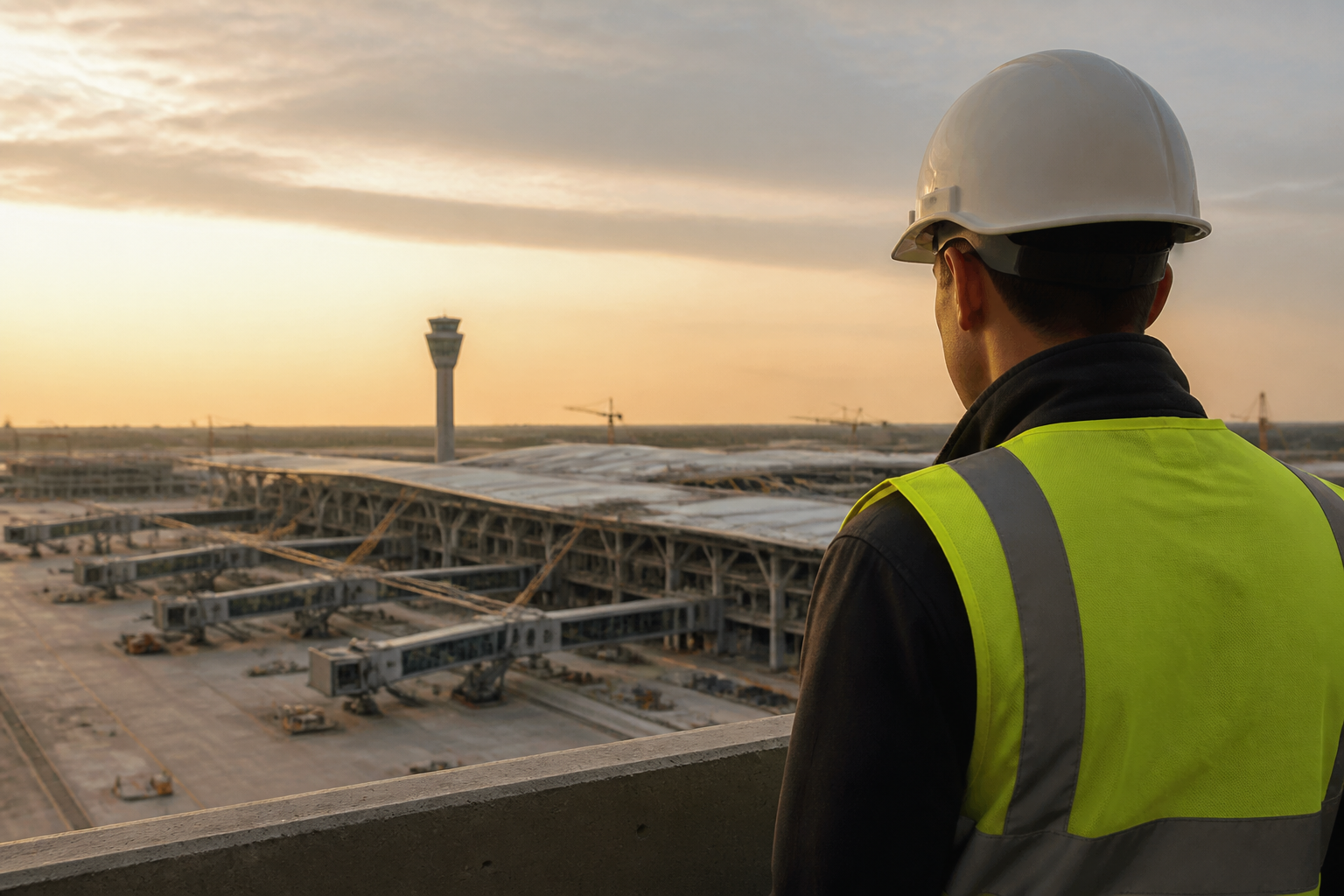
Five consortia are now in the final round of bidding to build the main passenger terminal at Poland's new central airport, a single building worth more than PLN 5bn (about €1.2bn, or US$1.3bn). Europe's biggest contractors are all in the room: Strabag, Hochtief, Porr and Belgium's Besix, alongside Budimex, the Polish builder whose largest shareholder is Spain's Ferrovial. Yet not one of them is bidding as a foreign prime. Every one of the five shortlisted teams is led by a Polish-registered company, and that is by design.
The five teams now in binding-bid talks
Centralny Port Komunikacyjny (CPK), the state company building the airport 50km west of Warsaw, invited the five shortlisted consortia to submit binding commercial and technical bids in July 2026, giving them a 60-day window, with the contract award expected around the turn of 2026/27 (Regional Gateway; Construction Briefing). Piling for the foundations starts this year, and the main terminal is due to complete by the end of 2031, ahead of a 2032 opening.
The line-up, confirmed by CPK, pairs Polish leaders with international partners (Airport Industry-News, 29 August 2025): Mirbud heads an all-Polish team; Polimex Mostostal leads with Hochtief Polska and Hochtief Infrastructure of Germany; Budimex leads with Strabag's Polish arm; NDI leads with Besix of Belgium; and PORR's Polish subsidiary leads with Doraco. Sixteen firms in total, fourteen of them Polish. The terminal itself, designed by Foster + Partners and Buro Happold, will cover roughly 450,000 sq m and open with capacity for 34 million passengers a year, rising to 44 million.
A tender written to build a Polish champion
The bidding rules read like industrial policy. To qualify, a contractor had to show annual revenue of about PLN 4bn (US$1bn) in each of the last four years, occupancy permits obtained in Poland or the wider EU/EFTA for aviation or large non-residential buildings, and a contract director, construction manager and BIM coordinator who speak Polish well enough to run the job. Extra points go to teams with airport-terminal experience inside Poland.
CPK chief executive Filip Czernicki has been candid about the goal. The approach, he said, can offer Polish companies "an opportunity to replicate a scenario similar to that seen in Spain, which, thanks to significant infrastructure investments partly funded by the EU, has built a strong construction sector" (Passenger Terminal Today, 3 June 2025). Keep the public money, the tax and the jobs at home, and use the airport to grow a domestic contracting industry. The foreign majors have read the signal and localised: Hochtief bids through its Polish and German units under Polimex Mostostal, Strabag through its Polish company under Budimex, Besix under NDI, and Austria's Porr through its own Polish subsidiary.
Budimex already poured the first contract
One package is already let. Budimex won the terminal's deep-foundation works with the lowest of six bids, at nearly PLN 146m gross (about €34m), after CPK opened that tender on 12 December 2025 and closed it on 20 February 2026 (Port Polska; New Civil Engineer, 2 April 2026). The job covers more than 8,194 piles and columns between 9 and 30 metres deep, starts on site in September 2026 and finishes in late 2027. Budimex is the thesis in one company: a Polish national champion whose largest shareholder is Spain's Ferrovial, the very market Poland now wants to copy.
Why it matters beyond Warsaw
CPK plans to launch tenders worth more than PLN 40bn (around US$10bn) across the airport, high-speed rail and roads in 2026, the largest procurement push in the project's history (CPK/Port Polska; Aviation Week). The terminal is the template for how that money gets spent: a local prime, local content and local site leadership, with foreign know-how riding in the passenger seat. For Europe's big contractors, the EU-funded pipeline in Central and Eastern Europe is enormous but increasingly gated on localisation, and a fly-in bid team no longer clears the bar. For Polish and CEE builders, CPK is a chance to graduate into a durable, exporting industry, exactly as EU-funded roads and rail did for Spain's majors a generation ago. The catch is competition: write a tender tightly enough around local capacity and the field thins, which can lift the price. The award at the turn of 2026/27 will show whether five Polish-led teams produce a keen number or a comfortable one, and every sponsor from Bucharest to Prague will be reading the result.
Share it with your peers
Help your network stay ahead of CEE capital projects.
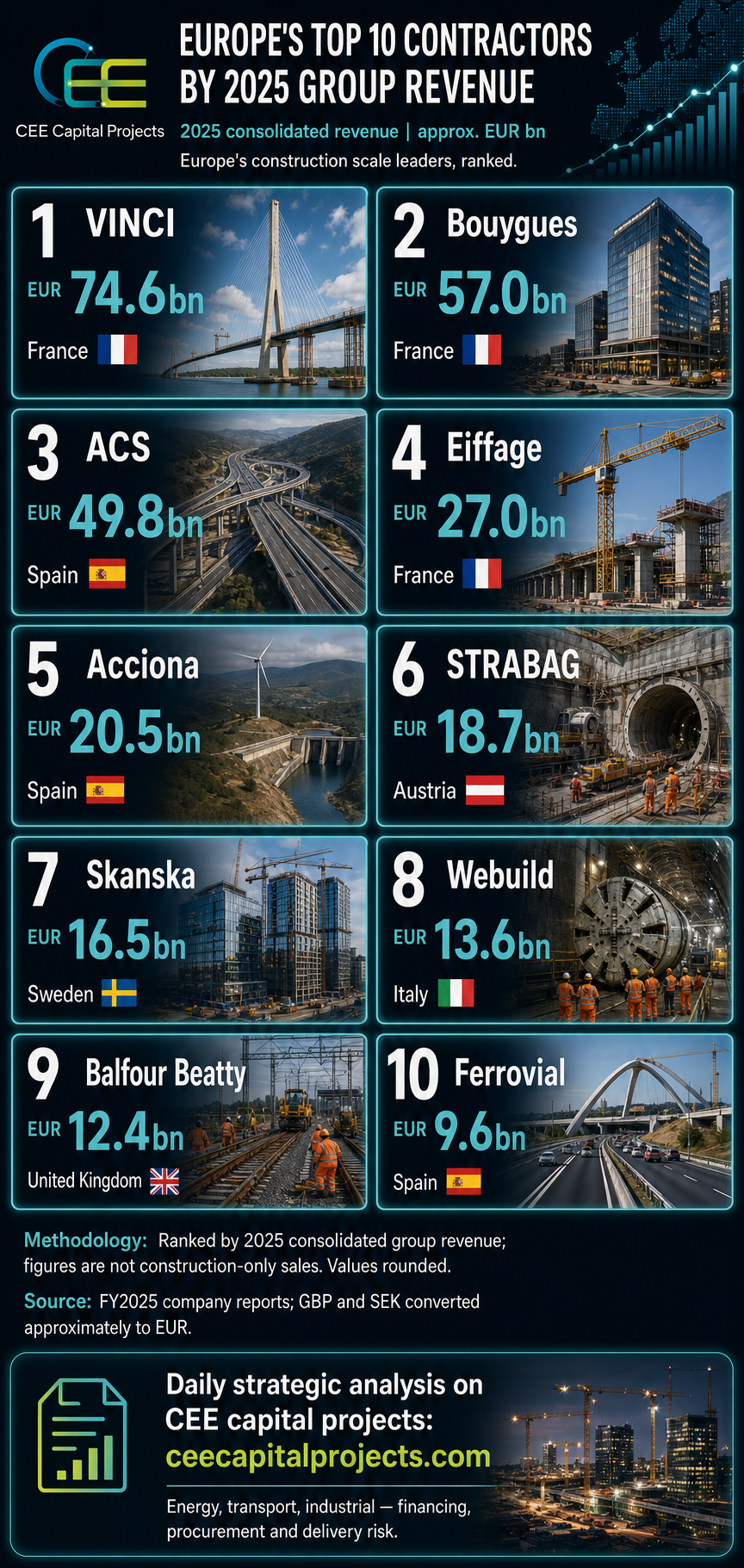
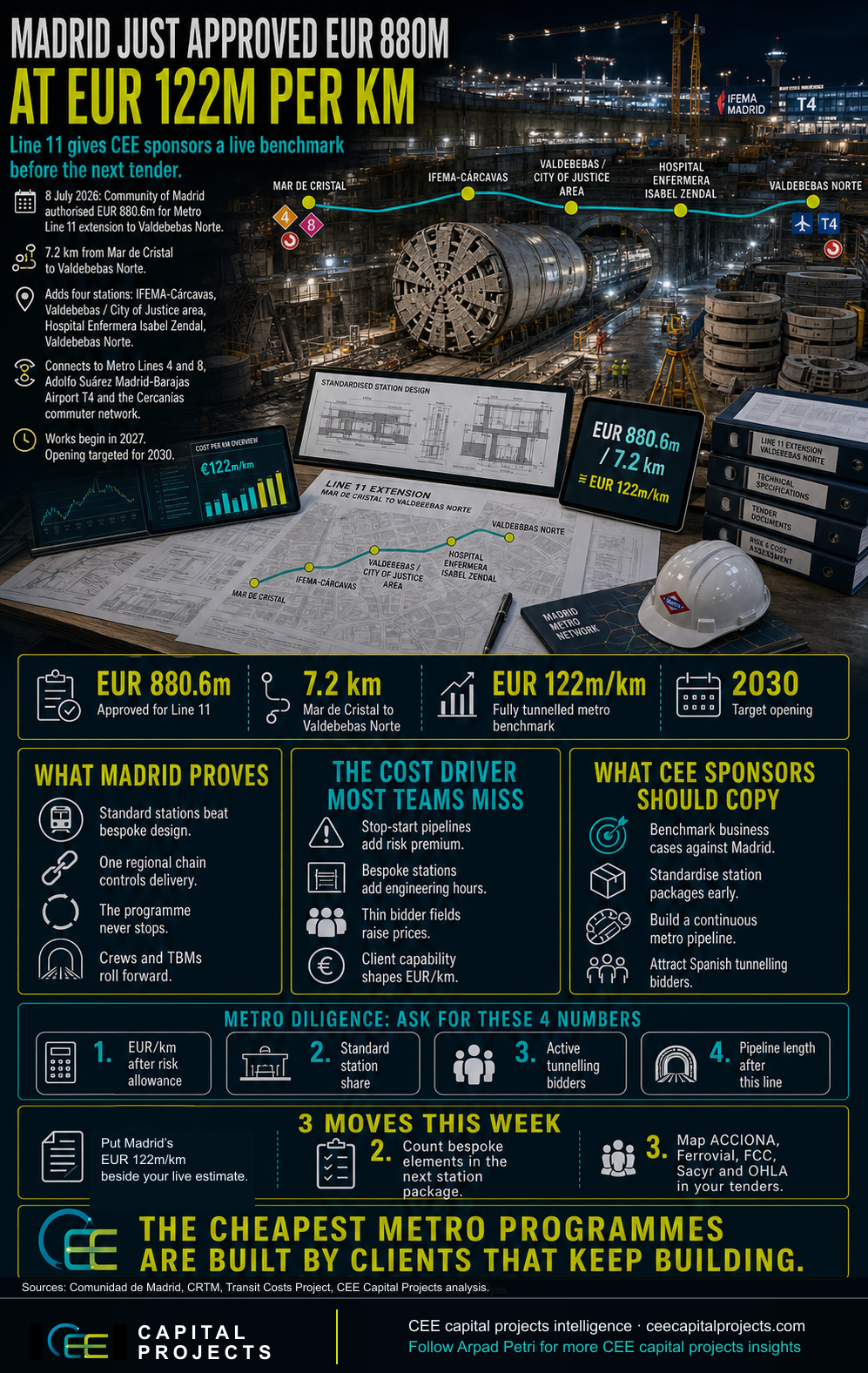
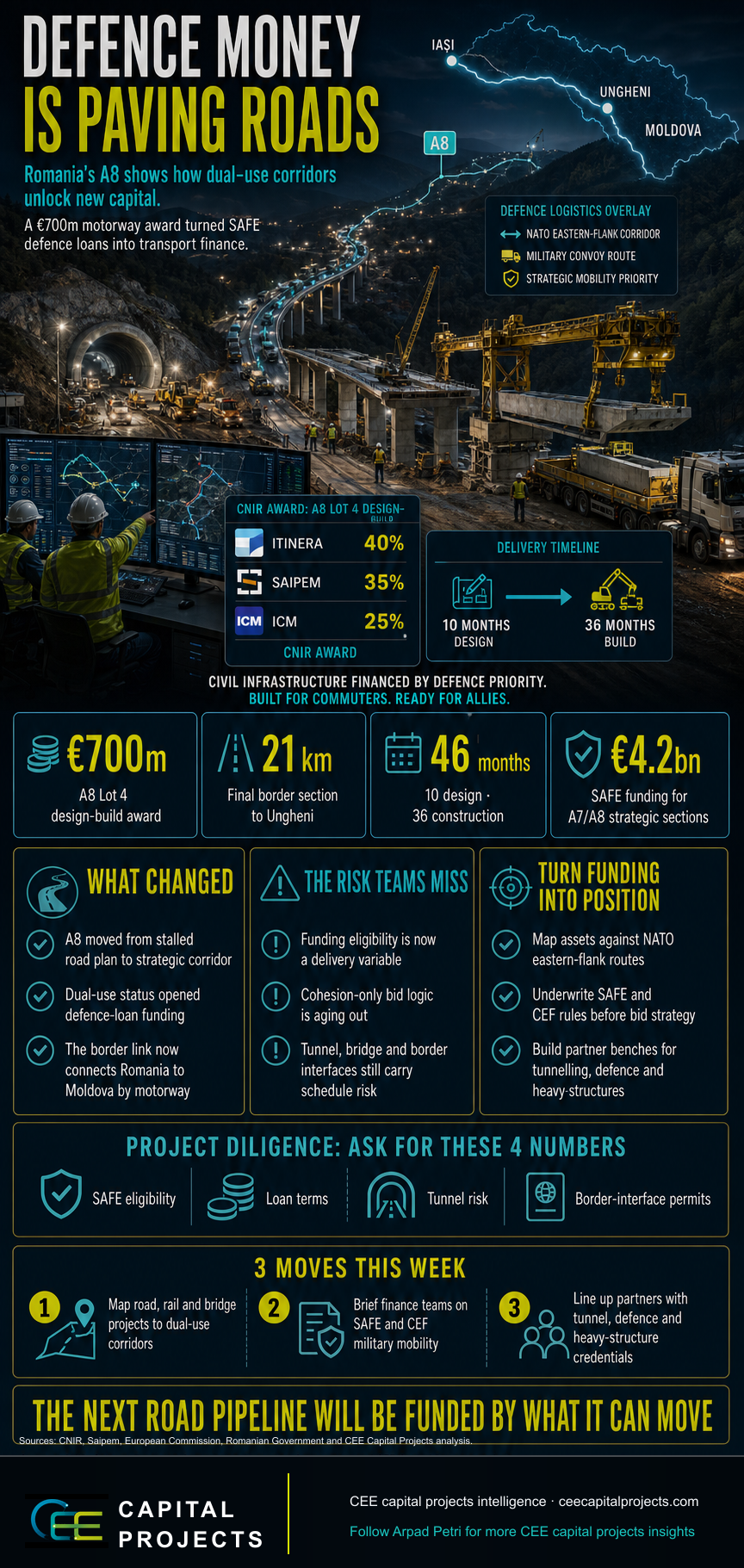
Explore our infograph library — strategic visuals for CEE capital projects leaders.
Project benchmarks, financing structures, tender dynamics and delivery risk — at a glance. Free access for investors, owners, contractors and strategy teams tracking CEE capital projects.
Browse the libraryStrategic Insights
📊 Analytics & Strategic Insight
The CPK terminal is a lesson in procurement as industrial policy, and a warning about who gets to bid for CEE's next decade of EU-funded building work.
The decision most in this industry are avoiding:
👉 Localisation is now a bid requirement, not a nice-to-have. The foreign majors that treated Central and Eastern Europe as a fly-in market are being quietly re-sorted into the passenger seat; the ones leading the teams built or bought a local operating company years ago.
👉 "Keep the money local" is a design goal, not a side effect. Poland is openly using a €1.2bn building as industrial policy, and the revenue thresholds, occupancy-permit rules and Polish-language site requirements are that policy written into the contract.
👉 The competitive risk sits with the sponsor, not the bidder. Writing a tender around local capacity can thin the field and lift the price; five Polish-led teams is either healthy competition or a comfortable club, and only the number at award will tell which.
Here's the full context:
→ May 2025: CPK launches a competitive-dialogue tender for the roughly PLN 5bn passenger terminal (Foster + Partners / Buro Happold design, 450,000 sq m).
→ August 2025: Five consortia confirmed (16 firms, 14 Polish); every team is Polish-led, with the foreign majors as partners (Airport Industry-News, 29 August 2025).
→ December 2025–February 2026: CPK runs the deep-foundations tender; six bids arrive; Budimex wins at PLN 145.95m gross (Port Polska; New Civil Engineer, 2 April 2026).
→ 2026: CPK plans more than PLN 40bn (about US$10bn) of tenders across the airport, rail and roads (CPK/Port Polska; Aviation Week).
→ Most recent: July 2026, CPK invites the five shortlisted consortia to submit binding commercial and technical bids, a 60-day window, contract award at the turn of 2026/27 (Regional Gateway; Construction Briefing).
What this means for infrastructure operators, contractors and investors:
✅ Foreign contractors: a local operating company is the price of entry. To bid the EU-funded CEE pipeline you need local revenue history, local occupancy permits and local-language site leadership, so build, buy or partner into it before the tender drops.
✅ Polish and CEE contractors: this is your graduation moment. A decade of CPK, road and rail work can turn a domestic builder into a regional exporter, the way EU-funded infrastructure did for Spain's majors, if you convert megaproject backlog into balance-sheet strength and skills.
✅ Investors and sponsors: watch the award price. A locally gated tender trades competition for capability and control; the turn-of-2026/27 terminal award is the first read on whether Poland's five-team field delivers a market price or a protected one.
3 moves you can make this week:
1️⃣ Map the localisation bar. For every CEE market you want, write down the revenue threshold, permit history and language requirements a prime must clear, then decide build, buy or partner.
2️⃣ Read the CPK 2026 tender calendar. More than PLN 40bn is being let across the airport, rail and roads; line up the packages that fit your balance sheet and the local partner who can lead them.
3️⃣ Benchmark the terminal price. When the turn-of-2026/27 award lands, compare the winning PLN per square metre against Western European terminal builds to see whether local gating cost Poland money or saved it.
Related analyses
- Transport & Infrastructure
V-Híd Just Lost Hungary's HUF 338 Billion Déli Körvasút at 42 Per Cent Complete. The Grant Clock Is the Real Story
Hungary halted construction of the Budapest Southern Circle Railway on 9 October 2026 and barred V-Híd from every ongoing rail investment. The HUF 367 billion of EU money behind the job survives only if a lawful re-tender lands inside two years.
Read analysis → - Transport & Infrastructure
Afcons Wins Croatia's EUR 899m Dugo Selo-Novska Rail Contract: Four Bids, No European Prime
Croatia signed its largest ever railway contract on 1 October 2026, handing 83 km of double-tracking to India's Afcons Infrastructure at EUR 677.06m excluding VAT. Four bids were priced for the work and not one of them came from a European prime contractor.
Read analysis → - Transport & Infrastructure
STRABAG Closes BAWI Construction Buy in Romania as Rail Qualification Becomes the Scarce Asset
STRABAG has closed its purchase of BAWI Construction, a Bucharest rail specialist with 240 employees and about EUR 60 million of 2025 output. The number that matters is the qualification it buys, as Romania opens a EUR 5.99 billion rail programme with the EU recovery window shut.
Read analysis →
Is your project leaking money through its subcontractors?
Most owners lose 3–8% in vendor packages without noticing. Tell us about your project — we'll tell you where we'd look first.