We Help International Investors and Project Owners Deliver Major CEE Projects Without Expensive Surprises
Independent project intelligence and advisory across energy, transport, real estate and industrial construction.
Onde Paid 8.6 Million Euros for a Polish Substation Builder. PSE's Price-Only Tenders Will Test the Deal
Polish renewables contractor Onde has bought substation builder Olmex and added EUR 82 million to its order book. The harder test is PSE's tender programme, where substation extensions are being awarded on price alone.
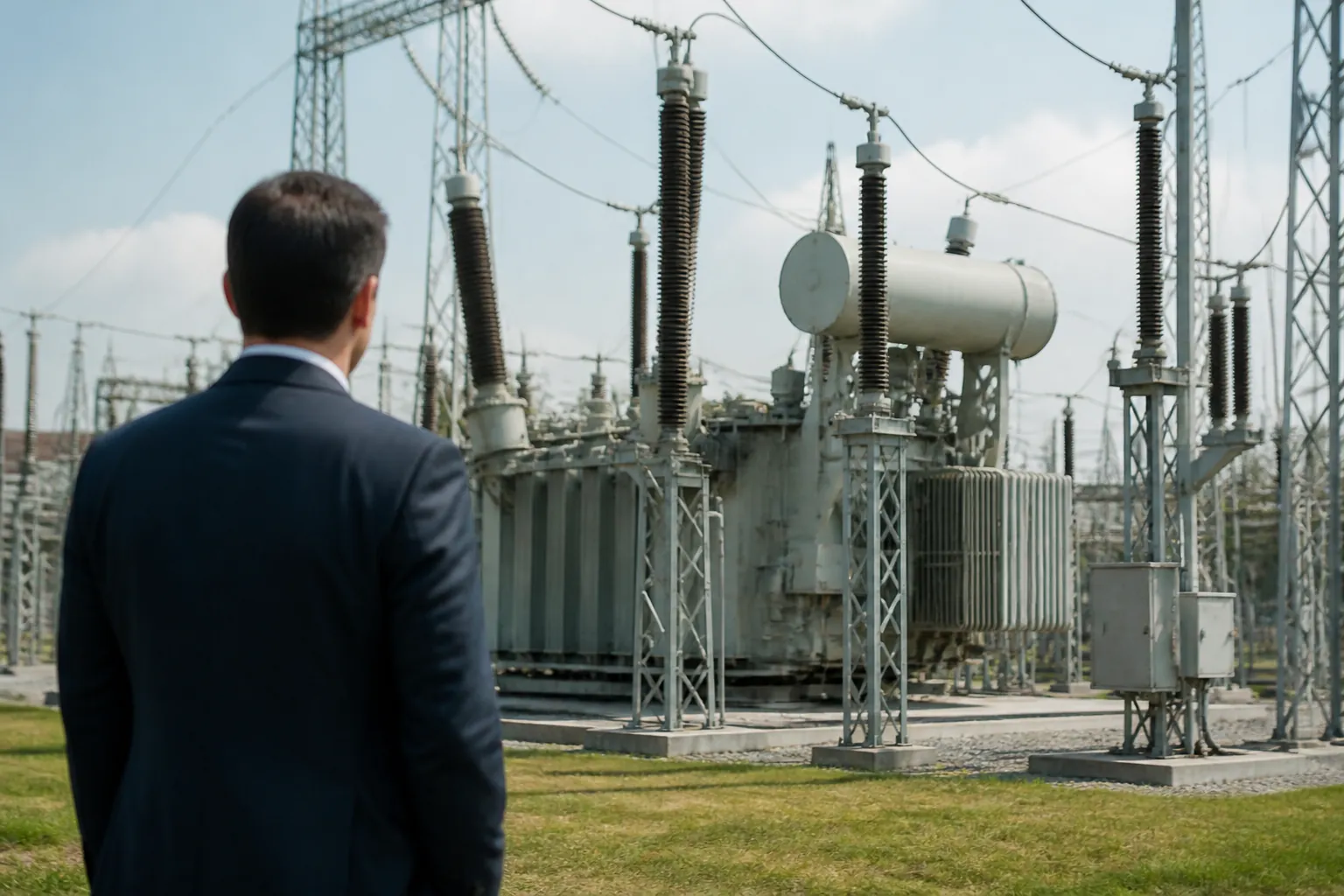
I put the same question to every contractor buying its way into grid work. What exactly did you pay for? Onde's answer looks cheap at EUR 8.6 million (PLN 38 million).
The Polish renewables contractor completed its purchase of Olmex, a substation builder and equipment distributor, at the end of September. Its third-quarter results showed what came with the company. Olmex added EUR 82 million (PLN 360 million) to Onde's order book. Conversions use the 17 November rate. The base price excludes an earn-out tied to Olmex's results over the next three years.
What the money bought
Olmex expected revenue of about EUR 39 million (PLN 170 million) in the year to September. Roughly half comes from construction and half from distributing high and medium voltage equipment. Operating profit was about 5% of revenue on the same estimates.
The order book therefore equals about two years of Olmex's revenue. The base price is about four times its operating profit. Both ratios look generous to the buyer.
The reason is simple. A small specialist struggles to turn its record into large contracts alone. Substation work needs qualified crews, a history with the grid operator and enough bank support to carry long jobs. Olmex has a long record in the first two. Its chief executive has said that joining a larger group should let it bid for bigger tenders. Onde brings the scale, and Olmex brings the way in.
Most of the work is smaller than the headlines
PSE, Poland's transmission operator, published its forward list of works in August. It names 28 procedures due to start by next September. Of these, 26 are substation jobs and two are high voltage lines. PSE gives only upper limits and calls them indicative.
On those limits, 18 of the 26 substation jobs sit at or below EUR 23 million (PLN 100 million). That is roughly one year of Olmex's construction revenue. The largest new substations on the list are a different business, and they demand far more bonding and cash.
The titles say more than the values. Some 13 procedures exist to connect new facilities to the grid. That matters because those facilities can include the wind farms, solar parks and batteries that Onde already builds. Its customers need these extensions before their projects can export power.
Price decides the award
Two live tenders show how this market works. PSE is extending its Czarna and Płock substations, and bids are due next week. In both tenders, price carries the entire award decision. Both contracts run for 36 months. Both require a performance security of 5% of the bid price. Neither notice shows who will bid.
PSE also runs a qualification system for contractors, with a category for this class of substation work. Here is why that combination matters. Qualification decides who may compete. A price-only award then pays nothing extra for being better. Once several firms clear the gate, a strong record stops earning a premium.
Both deadlines have moved repeatedly, four times at Czarna and five at Płock. The notices give no reason. Repeated extensions often point to bidder questions on scope or pricing. Either way, firms still working on these bids have gained time to firm up crews and equipment quotes.
Where the equipment line changes the sums
The Gdańsk Błonia substation shows how PSE splits the job. In June it signed a works contract worth EUR 91 million (PLN 402 million) with SPIE Energy Poland and Elfeko. It is supplying transformers and reactors worth a further EUR 43 million (PLN 190 million) itself.
The mechanism is risk allocation. By buying long-lead equipment directly, PSE keeps the delivery slot and the price risk on its own side. The contractor then prices civil works, assembly and the remaining installation.
Olmex earns on both sides of that line. It holds a EUR 25 million (PLN 111 million) contract to supply PSE with four reactors. It also has exclusive rights to distribute selected GE Vernova equipment to PSE. In a price-only contest, a bidder that knows its equipment cost and delivery date can carry less contingency.
The better margin may sit outside PSE
Onde needs that margin. Its gross margin fell to 8.4% in the first nine months, a drop of more than three points. Private connection work offers a different route. In June Onde agreed to design and build a substation in Lithuania for a wind farm client it already serves.
That happens because a private owner can weigh schedule and single-point responsibility. A public buyer running a price-only award cannot. Bundling pays where the client is free to choose its contractor.
Funding still sets the ceiling. Onde shares a multi-purpose bank facility with its parent Erbud. Its combined limit stands at EUR 31 million (PLN 137 million) after a May amendment. Parkiet reported that larger Olmex contracts should draw working capital mainly from outside sources. Onde guarantees or bridge loans would back that funding. That matters because every large grid job then competes for bank room with batteries and wind farms.
Where this lands
The likely result is a two-speed grid business. Olmex should win mid-sized PSE extensions first, drawn from the lower half of that tender list. Those jobs will build volume and references at thin margins. Private connections for Onde's existing customers should earn the better return. A large new substation won alone looks further away.
The figure that would change this view is gross margin on grid construction. That matters because the deal only works if scale arrives without margin loss. Onde would first need to report this work separately. If the margin holds above the group's 8.4% while PSE work grows, price-only tenders are leaving room. If it falls below that level, the extra volume is costing profit.
We are watching who bids for those substation extensions next week, and who wins the larger jobs that follow. Those names will show which contractors are really adding capacity in Poland's grid. Our upcoming CEE Grid and Energy Construction Pipeline is being built to track this work across the region. Join the waitlist and vote on which report we publish first.
Share it with your peers
Help your network stay ahead of CEE capital projects.
Strategic Insights
📊 Analytics & Strategic Insight
A cheap way into grid work still has to earn its margin
The decision most in this industry are avoiding:
👉 An order book is the easy part to buy. A large book next to a small price looks like a bargain. It only shows work promised. It says little about what that work will earn, and some of it may be equipment that simply passes through.
👉 A supplier owned by a rival changes the market. Other grid contractors may need equipment that Olmex sells. Now that it belongs to a bidder, they may think twice before sharing prices and project plans with it.
👉 Outage windows may matter more than company size. Extensions happen inside working substations, so parts of the site can only be touched when the operator allows it. A firm can win more of these small jobs than its crews can reach in time.
Here's the full context:
→ 2025: PSE's ten-year grid plan covers 28 new substations and work on 110 existing ones. Spending exceeds PLN 64 billion.
→ June 2026: PSE signs the Gdańsk Błonia contract with SPIE Energy Poland and Elfeko, for completion by November 2030.
→ July 2026: Onde signs a preliminary agreement to buy Olmex at a base price of PLN 38 million.
→ August 2026: PSE lists 28 works procedures. Their upper limits add up to about EUR 984 million (PLN 4.33 billion) on our count.
→ Most recent: On 17 November Onde reports an order book of EUR 381 million (PLN 1.68 billion) including Olmex. Czarna and Płock bids fall due on 23 and 24 November.
What this means for infrastructure operators, contractors and investors:
✅ Bid directors at rival grid firms should review their equipment supply. A competitor may now own a route to some of your switchgear. Your price and delivery date could depend on it.
✅ Grid operator procurement teams should watch what price-only awards do to capacity. Firms invest in crews when good work is rewarded. If only the lowest price wins, that reason to invest gets weaker just as the workload rises.
✅ Banks and guarantee providers should ask for the order book in three parts. Equipment supply, public works and private connections use cash in different ways. One total hides which part is using the credit line.
3 moves you can make this week:
1⃣ Split your grid order book three ways. Separate equipment, public works and private connections, then write the expected margin beside each one.
2⃣ Check who owns your switchgear supplier. Ask what happens to your quotes and delivery slots if that supplier's parent bids against you.
3⃣ Mark PSE's smaller extensions on your crew plan. List the jobs near your existing teams and ask how outage windows will shape each programme.
The analyst's read:
This deal proves that a mid-sized renewables contractor can buy a place in Polish grid work at low cost. It does not prove that the place will pay. The figure that settles it is gross margin on grid construction in Onde's full-year accounts, set against the group average.
CEE Capital Projects reports
📋 Coming next
CEE Grid and Energy Construction Pipeline, plus the CEE Contractor League Table and Financial Health Monitor and an EU-funded projects pipeline. Join a waitlist and vote on which we publish first.
→ Join the waitlist
🚆 CEE Rail Build-Out 2027-2030
Rail tender pipeline to 2030, contractor capacity and bid risk across Poland, Hungary, Czechia, Slovakia, Romania and the Baltic states. PDF report plus interactive Excel database listing every tender.
→ Get the free sample edition
Related analyses
- Energy & Power
Latvia's Grid Operator Now Borrows at 4.8%, and Its Build Plan Has to Carry It
Latvia's transmission operator AST is repaying its 0.5% green bond early, after raising replacement money at 4.768%. With most of its ten-year grid plan funded from its own balance sheet, the price of that money now shapes which lines and substations move first.
Read analysis → - Energy & Power
Croatia's Next 400 kV Lines Hang on One Data Centre's Grid Contract
Pantheon AI offers to build and pay for four 400 kV lines to connect its Topusko campus, after the state held HOPS to a minimal grid plan. Croatia's next big transmission build may come from a private customer, while generators in the queue are offered curtailment instead.
Read analysis → - Energy & Power
Balfour Beatty's 9 Percent Grid Margin Shows Where Contractor Profit Sits. CEE Price-Only Substation Tenders Keep It With the Client
Balfour Beatty expects a support services margin of around 9 percent, well over twice its UK construction margin, as power transmission work ramps up under National Grid's framework. In Poland, substation tenders awarded on price alone mean CEE contractors moving into grids should not expect the same premium.
Read analysis →
Get a second opinion before it gets expensive.
Contractor selection, tender strategy, a project drifting off track — send us the situation and we'll come back with a clear plan.