We Help International Investors and Project Owners Deliver Major CEE Projects Without Expensive Surprises
Independent project intelligence and advisory across energy, transport, real estate and industrial construction.
Croatia's Next 400 kV Lines Hang on One Data Centre's Grid Contract
Pantheon AI offers to build and pay for four 400 kV lines to connect its Topusko campus, after the state held HOPS to a minimal grid plan. Croatia's next big transmission build may come from a private customer, while generators in the queue are offered curtailment instead.
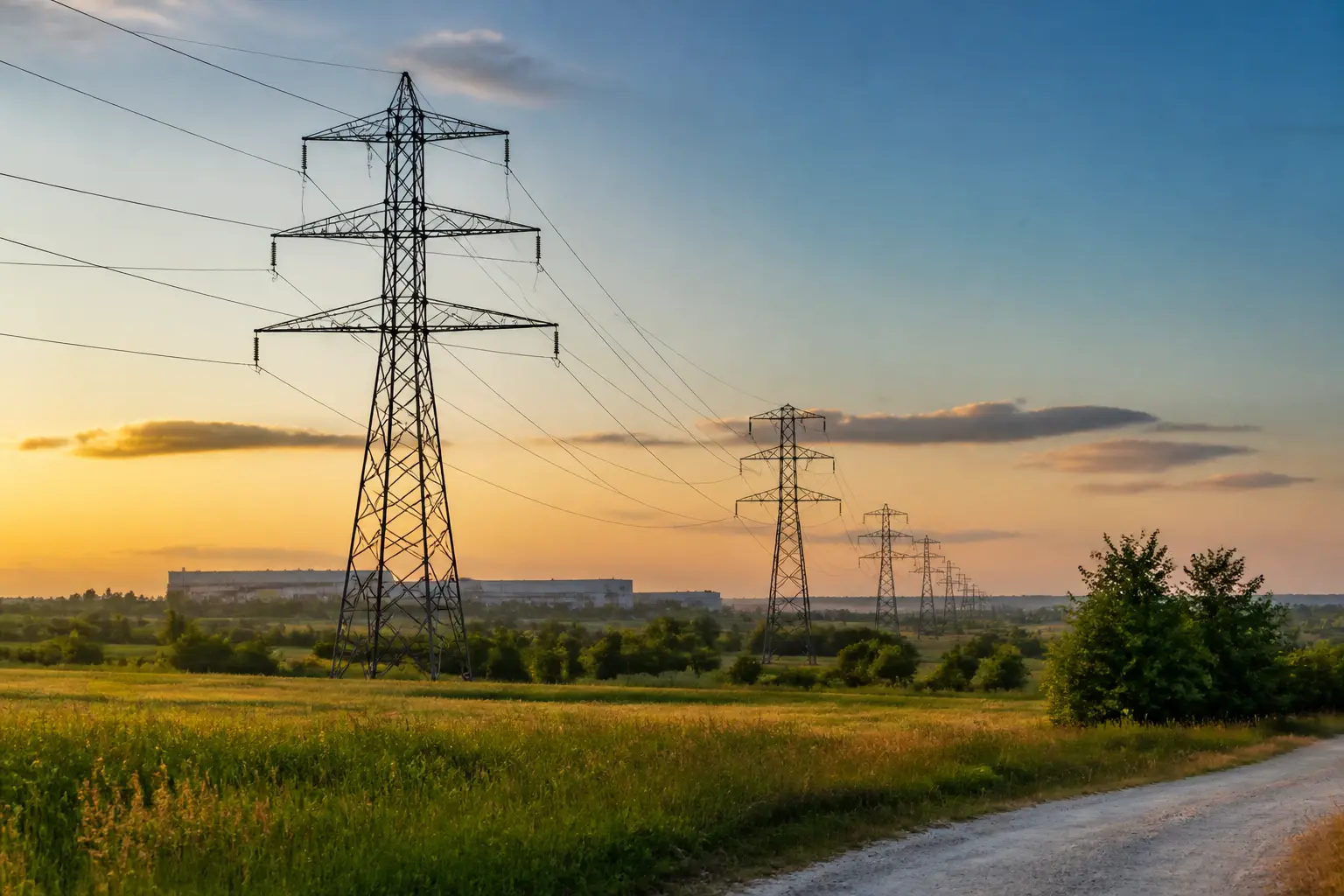
I think the boldest grid plan in Croatia this year was written by a customer. HOPS, the transmission operator, was told to plan small. One data-centre developer now offers to build the big lines itself.
The developer is Pantheon AI, which plans an AI campus at Topusko in Sisak-Moslavina County. On 29 October, HOPS and Pantheon told a trade fair panel they expected to sign a connection contract in November. The campus asks for one gigawatt (GW) of supply, about a third of Croatia's current system load. To deliver it, Pantheon proposes four new 400 kilovolt (kV) overhead lines. Together they run to about 300 kilometres (km), and Pantheon pays for all of them.
What the state allowed HOPS to plan
HOPS's ten-year development plan to 2035 carries at least 1.5 billion euro of investment, Lider reported in March. The economy ministry accepted only the least ambitious scenarios. It rejected the variants that added new high-voltage lines. Those variants were sized to connect every renewable project that applied in 2024 and 2025.
That matters because HOPS cannot spend money the regulator will not recover. A transmission operator builds on its allowed tariff and on connection charges. HERA, the energy regulator, has not yet set the unit connection charge HOPS asked for. Renewable developers say the method is years late. So new 400 kV corridors had no funding route, and the plan shrank to fit.
The minimal plan is a funding decision written up as a network plan. HOPS said as much in its own document. The minimal scenario cannot take all the output of plants that started connecting in those two years.
Why a customer can build what the operator cannot
Pantheon's offer breaks that funding loop. The developer pays all connection costs, so nothing lands on the tariff base. Its backers told Lider in May that they would hand the finished lines to HOPS free of charge. The project would also pull forward grid work HOPS had pencilled in only from 2034.
Here is why the trade suits both sides. HOPS gets 400 kV assets without raising tariffs or asking HERA for money. Pantheon gets a firm connection and skips the queue. Project lead Mario Gudelj says the campus would also pay HOPS about 80 million euro a year in network fees. By his comparison, that is roughly one year of HOPS investment.
A load with its own balance sheet can buy the grid that the regulated plan could not fund. That is new in this market. Until now, Croatian 400 kV work came from one buyer, spending tariff and EU money.
The generators get restrictions instead of lines
The generators in the queue face a different deal. On 9 November HERA ordered HOPS to redo its connection assessments for 45 generation projects. Each assessment must state the connection cost and the expected operating restrictions. It must say how long output may be curtailed in a typical year, and for how many years.
The mechanism is simple. Without reinforcement, a new plant can still connect if it accepts being switched off at peak flow. Curtailment hours stand in for a line that was never built. HERA wants that trade written down, so lenders can price it. A curtailment clause moves the grid shortfall onto the generator's revenue line.
HOPS is also squeezing more out of existing wires. Končar won an 11.5 million euro contract to install a phase-shifting transformer at the Gračac substation. The device steers power away from overloaded lines. The EU's Connecting Europe Facility (CEF) covers half of its eligible cost. In mid-November a 60 megawatt (MW) battery at Šibenik started selling balancing reserve to HOPS. That matters because both tools add capacity in months. A new line takes years. Until corridors are approved, flow control and storage are the HOPS order book.
What still stands between Pantheon and a construction site
The contract is the first gate, and it is the easiest one. Lines of this length need corridors in county spatial plans. HOPS told Financije.hr last year that missing county plans were the main obstacle to new 400 kV lines. Pantheon needs an amended Sisak-Moslavina County plan and an accepted environmental impact study. Gudelj expects the county process to finish by February or early March.
After that, the timetable is tight. Pantheon plans to start construction in 2027 and to operate from 2029. HOPS says it will test the connection for at least two years before full entry, as with any user. That happens because a load this size can shake system frequency if it trips. The operator has to prove the protection settings before it carries the full load.
Financing adds a second question. On 26 November Croatian media reported a possible US penalty on American companies building data centres abroad. The campus is largely backed by US money. No details of the measure have been published.
My read: the lines get signed before they get built
I expect the connection contract to be signed within weeks. Both sides have said so in public, and the terms cost HOPS nothing. I expect the line construction to slip past a 2027 start. The reason is simple. Corridor approval across several municipalities is the binding constraint, and it runs on planning law. Contractors should not book these lines as near-term work.
I also expect a second effect. Once one customer pays for 400 kV lines, other large loads will ask for the same model. Croatia's transmission pipeline is splitting into a public stream on EU money and a private stream on customer money.
The figure that settles this call is the date the Pantheon line corridors enter the amended county plan. If that happens by March, a 2027 start is credible and I am too cautious.
What we are watching is how those 300 km get procured. A customer-funded line may be let as a private contract, outside public tender notices. Our CEE Grid Procurement Pipeline 2027-2030 tracks transmission awards and named grid packages across 19 markets. The free sample shows how we log operator packages and their bidders.
Share it with your peers
Help your network stay ahead of CEE capital projects.
Strategic Insights
📊 Analytics & Strategic Insight
Croatia's grid is being built by whoever can pay, and the queue pays in lost hours
The decision most in this industry are avoiding:
👉 A customer-funded line hands design control to the customer. Route, conductor and supplier choices are made by a private sponsor before HOPS owns anything. HOPS standards must be written into that build contract early, or the operator inherits assets it never specified.
👉 The real cost of the minimal plan sits in generator financing. Every curtailment clause cuts the output a lender will count. The state avoided a tariff rise and pushed the cost into dearer capital for renewables.
👉 Free assets still cost the operator money. HOPS will carry maintenance, losses and eventual replacement on lines it never budgeted for. Those costs return to the tariff base later, and HERA will have to accept them.
Here's the full context:
→ January 2025: HOPS tells Financije.hr that missing county spatial plans are the main obstacle to new 400 kV lines.
→ March 2026: Lider reports the ministry accepted only the minimal scenarios of HOPS's plan to 2035.
→ July 2026: HOPS accepts Pantheon's grid connection study for the Topusko campus.
→ 9 November 2026: HERA orders HOPS to redo connection assessments for 45 generation projects, with curtailment spelled out.
→ Most recent: The Pantheon connection contract, expected in November, has no public confirmation of signature yet.
What this means for infrastructure operators, contractors and investors:
✅ Grid contractors face two Croatian buyers for high-voltage work. The bid team needs HOPS prequalification for public lots and a direct line to the sponsor's build contractor for private ones. The private lots may never show up in public tender data.
✅ Renewable sponsors must bank on restricted output. The project board should treat the reworked assessment as the base case. Lenders will size debt on the curtailed profile, so equity has to cover the gap.
✅ Equipment suppliers should sell flow control now. Phase-shifters, storage and substation upgrades are what HOPS can fund inside its current plan. That is the near-term order book while new corridors wait for planning.
3 moves you can make this week:
1⃣ Read HERA's decision on the reworked connection assessments. List the generation projects in your region and note the deadline HOPS must meet.
2⃣ Follow the Sisak-Moslavina County spatial plan consultation. The line corridors will appear there before any construction contract does.
3⃣ Ask your HOPS connection contact for curtailment terms in writing. Get hours per year and the number of years, and rerun your debt case on them.
The analyst's read:
The Pantheon offer proves that a private load can fund transmission where the regulated plan cannot. It does not prove the lines will be built on the developer's timetable. The settling point is the county plan amendment due in early spring, and whether it carries the corridors.
CEE Capital Projects reports
⚡ CEE Grid Procurement Pipeline 2027-2030
Contract opportunities, suppliers and bid risk in electricity transmission and distribution across 19 markets. PDF report plus Excel database, with grid awards since 2020 and a register of named grid packages to 2030.
→ See the report and free sample
📋 Coming next
CEE Contractor League Table and Financial Health Monitor: awards, order books and financial health across CEE contractors. Join the waitlist to hear when it is published.
→ Join the waitlist
🚆 CEE Rail Build-Out 2027-2030
Rail tender pipeline to 2030, awards since 2020, contractor capacity and bid risk across 17 markets. PDF report plus Excel database, one row per tender lot.
→ See the report and free sample
Related analyses
- Energy & Power
Latvia's Grid Operator Now Borrows at 4.8%, and Its Build Plan Has to Carry It
Latvia's transmission operator AST is repaying its 0.5% green bond early, after raising replacement money at 4.768%. With most of its ten-year grid plan funded from its own balance sheet, the price of that money now shapes which lines and substations move first.
Read analysis → - Energy & Power
Balfour Beatty's 9 Percent Grid Margin Shows Where Contractor Profit Sits. CEE Price-Only Substation Tenders Keep It With the Client
Balfour Beatty expects a support services margin of around 9 percent, well over twice its UK construction margin, as power transmission work ramps up under National Grid's framework. In Poland, substation tenders awarded on price alone mean CEE contractors moving into grids should not expect the same premium.
Read analysis → - Energy & Power
Bulgaria's 6.2 GW Battery Fleet: The Grant Deadline Built It, the Grid Decides What Gets Built Next
Bulgaria's grid operator ESO now publishes what its batteries do, and they supply more than 40% of evening demand. With the recovery-fund grants closed, the next battery must earn its spread, and construction money is moving to wires and substations.
Read analysis →
Facing a decision on a CEE capital project?
Describe the situation in a few sentences. Within 72 hours you get an experienced read: the risks we see, what we'd check, and whether we can help — no calls, no obligation.