We Help International Investors and Project Owners Deliver Major CEE Projects Without Expensive Surprises
Independent project intelligence and advisory across energy, transport, real estate and industrial construction.
ÖBB's EUR 2.6bn Signalling Award to Siemens and Hitachi Buys 25 Years of Service and Two Suppliers
ÖBB-Infrastruktur signed EUR 2.6bn of digital interlocking frameworks with Siemens Mobility and Hitachi Rail at InnoTrans on 22 September 2026, split evenly and covering around 300 installations. First pilot commissioning is set for the fourth quarter of 2030, so the contract that matters is the 25-year service obligation behind the equipment.
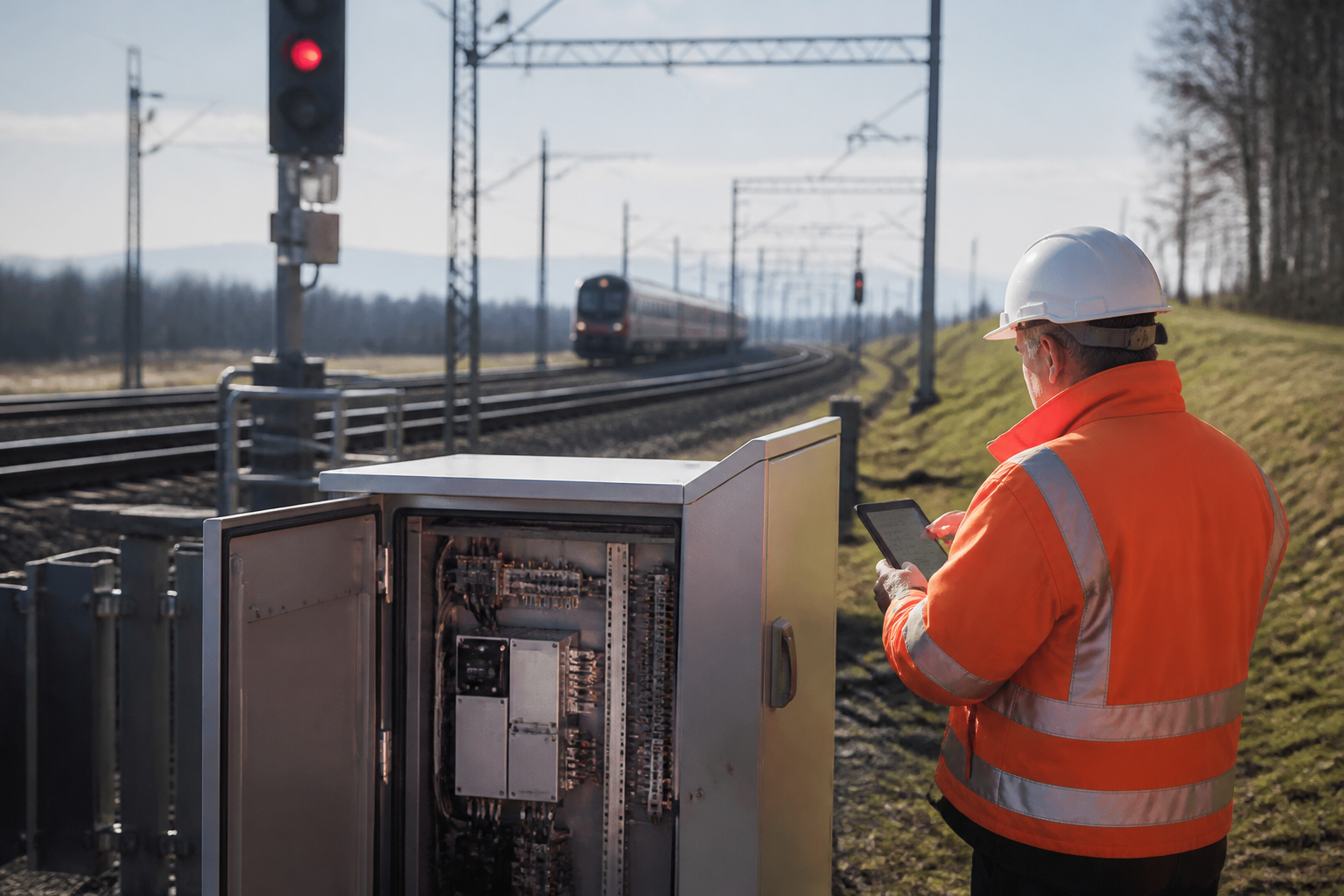
The coverage reads this as a EUR 2.6bn equipment order. I read it as a 25-year service subscription with an equipment invoice attached. The date that proves my point sits four years out.
ÖBB-Infrastruktur has awarded two framework agreements worth EUR 2.6bn in total for digital interlocking technology. Railway Gazette International reported the award on 23 September 2026. Siemens Mobility and Hitachi Rail take about EUR 1.3bn each. The scope covers roughly 300 digital interlocking installations, indoor logic, outdoor object controllers, engineering and 25-year support. First pilot commissioning is scheduled for the fourth quarter of 2030.
Two suppliers on one network is a deliberate cost
A 50/50 split buys duplication. ÖBB-Infrastruktur takes on two approval campaigns, two spares regimes, two training pipelines and two engineering interfaces. In return it holds a second source for a quarter of a century.
That trade makes more sense here than on a conventional works package. A software-defined interlocking moves value from relays and cabinets into a platform, an update cycle and a patching obligation. Whoever owns the platform owns the price of every change after year one. Siemens says its Signaling X architecture centralises safety-critical logic on standard servers in data centres. Outdoor object controllers then drive signals and points (Siemens press release, 22 September 2026).
Hitachi Rail is building the local side of the same bargain, with a Vienna facility and 40 new specialist posts. For a 25-year obligation, domestic engineering depth is part of the security package.
The date that matters sits in 2030
Four years separate signature from first pilot commissioning. On safety-critical software, authorisation supplies the long pole. A safety case, independent assessment, national authority approval and an operational trial all sit ahead of any volume rollout.
Siemens commissioned a pilot digital interlocking at Achau station near Vienna in 2020. Six years later the production platform carries a 2030 pilot date. Treat that gap as the honest industry clock, and price your own digital signalling business cases against it.
Austria's bottleneck is already on the record
The Austrian Court of Audit published its ERTMS review on 10 July 2026. It found ERTMS on about 12 per cent of the ÖBB network at the end of 2024. Austria's trans-European core network stood at roughly 44 per cent. ÖBB-Infrastruktur had invested about EUR 156.52m in ERTMS between 2020 and 2024. A further EUR 646.70m was planned for 2025 to 2030. Rolling stock investment reached EUR 287.83m by the end of 2024.
The sharpest finding had nothing to do with money. Approvals for five ERTMS subsystems were still pending with the federal ministry, so installations already built could not enter service. Finished assets were waiting in an authorisation queue.
The envelope this has to fit inside
The federal government approved ÖBB's Rahmenplan 2027-2032 in June 2026. It carries EUR 19.5bn of investment plus about EUR 5bn for maintenance and renewals. That is close to EUR 3bn a year. It funds the Semmering Base Tunnel for 2029 and the Vienna S-Bahn upgrade for 2027. The Brenner northern approach carries a 2039 date.
The plan also defers. Quadrupling between Köstendorf and Salzburg slipped to 2046, saving EUR 300m. The Vienna Airport link to Bratislava and Budapest moved two years to 2037. Digital interlockings now compete for room inside that envelope, and their heavy spend lands after 2030.
What this sets up for the rest of Europe
Every large network manager in Europe holds an ageing interlocking estate. Each also carries an ERTMS obligation with a 2050 horizon. Austria has shown one answer. A long framework, two suppliers, a service contract matched to asset life, and a pilot date four years out. The cost of that answer is visible. The alternative, a single vendor on a short capital contract, costs quietly in years eight to twenty.
The operators and investors who get this right will spend the next two years on the boring parts. Approval calendars, national authority capacity, patching and obsolescence terms. Exit and escrow provisions, and whether the domestic engineering base can staff two platforms at once. The signalling order is the easy part of the programme.
Share it with your peers
Help your network stay ahead of CEE capital projects.




Explore our infograph library — strategic visuals for CEE capital projects leaders.
Project benchmarks, financing structures, tender dynamics and delivery risk — at a glance. Free access for investors, owners, contractors and strategy teams tracking CEE capital projects.
Browse the libraryStrategic Insights
📊 Analytics & Strategic Insight
Austria has just priced 25 years of signalling risk, and the equipment is the cheap part
The decision most in this industry are avoiding:
👉 Buy the exit before you buy the platform. A software-defined interlocking makes the supplier the owner of every future change. Escrow, published interfaces and a defined migration route are worth more than a discount on the first tranche.
👉 Second-sourcing is an insurance premium with a visible price. Two suppliers cost more in engineering, approvals, spares and training. Networks that refuse to pay it are writing an unpriced option to a single vendor for 25 years.
👉 The approval authority is a delivery partner, and almost nobody resources it. Austria's auditors found completed ERTMS subsystems waiting on ministry approvals. A programme plan that assumes regulator throughput without funding it carries a hidden critical path.
Here's the full context:
→ 2020: Siemens commissions a pilot digital interlocking at Achau station near Vienna.
→ 2020 to 2024: ÖBB-Infrastruktur invests about EUR 156.52m in ERTMS and reaches about 12 per cent network coverage by the end of 2024 (Austrian Court of Audit, 10 July 2026).
→ June 2026: The federal government approves the Rahmenplan 2027-2032, EUR 19.5bn of investment plus about EUR 5bn of maintenance, with several schemes deferred.
→ 10 July 2026: The Austrian Court of Audit reports five ERTMS subsystems awaiting ministry approval, blocking installations that are already built.
→ Most recent: On 22 and 23 September 2026 ÖBB-Infrastruktur signs EUR 2.6bn of digital interlocking frameworks with Siemens Mobility and Hitachi Rail, split evenly, with first pilot commissioning in the fourth quarter of 2030.
What this means for infrastructure operators, contractors and investors:
✅ Signalling is turning into a service line. Revenue moves from delivery to a 25-year support obligation. Contractors and investors should model the annuity, the indexation and the obsolescence risk rather than the build margin alone.
✅ The 2030 pilot date resets credible business cases. Any European network promising volume digital interlocking before 2030 should be asked which safety case it is relying on and who has approved it.
✅ Domestic engineering capacity becomes a bid criterion. The 40 Vienna posts answer a question every sponsor now asks. Who maintains this system in year eighteen, and in which country do those people sit.
3 moves you can make this week:
1️⃣ Pull your signalling asset register and add approval status. Separate the assets that are built from the assets that are authorised. The gap between those two columns is your real position.
2️⃣ Read your framework agreements for change pricing. Find the clause governing software updates, cyber patching and obsolescence after year five. If there is no cap, that clause is your exposure.
3️⃣ Call your national safety authority about capacity. Ask how many parallel safety cases it can assess in a year. Build the programme calendar backwards from that number.
Related analyses
- Transport & Infrastructure
V-Híd Just Lost Hungary's HUF 338 Billion Déli Körvasút at 42 Per Cent Complete. The Grant Clock Is the Real Story
Hungary halted construction of the Budapest Southern Circle Railway on 9 October 2026 and barred V-Híd from every ongoing rail investment. The HUF 367 billion of EU money behind the job survives only if a lawful re-tender lands inside two years.
Read analysis → - Transport & Infrastructure
Afcons Wins Croatia's EUR 899m Dugo Selo-Novska Rail Contract: Four Bids, No European Prime
Croatia signed its largest ever railway contract on 1 October 2026, handing 83 km of double-tracking to India's Afcons Infrastructure at EUR 677.06m excluding VAT. Four bids were priced for the work and not one of them came from a European prime contractor.
Read analysis → - Transport & Infrastructure
STRABAG Closes BAWI Construction Buy in Romania as Rail Qualification Becomes the Scarce Asset
STRABAG has closed its purchase of BAWI Construction, a Bucharest rail specialist with 240 employees and about EUR 60 million of 2025 output. The number that matters is the qualification it buys, as Romania opens a EUR 5.99 billion rail programme with the EU recovery window shut.
Read analysis →
Is your project leaking money through its subcontractors?
Most owners lose 3–8% in vendor packages without noticing. Tell us about your project — we'll tell you where we'd look first.