We Help International Investors and Project Owners Deliver Major CEE Projects Without Expensive Surprises
Independent project intelligence and advisory across energy, transport, real estate and industrial construction.
MKIF Collected HUF 673 Billion to Run Hungary's Motorways and Booked a 0.4% Margin. The New Government Wants the 35-Year Concession Reopened Anyway
Hungary's new government has promised a full review of the 35-year motorway concession held by MKIF, the Mészáros–Szíjj-owned operator of 1,300 km of expressways. The company answered with numbers: HUF 673 billion received, 700 km resurfaced, and a 0.4% profit margin.

On 6 July, MKIF Magyar Koncessziós Infrastruktúra Fejlesztő Zrt. — the company operating more than 1,300 km of Hungary's motorway network under a 35-year concession — published a point-by-point rebuttal of press reports claiming it failed to deliver technical content commensurate with the money it received. The trigger sits one level up: Hungary's new government has promised a full review of the concession contract, and transport and investment minister Dávid Vitézy says the previous government channelled HUF 1,000 billion into the arrangement. MKIF chief executive Tamás Németh puts the real figure at roughly HUF 680 billion — and the company's 2025 profit at HUF 1.7 billion, a 0.4% margin on gross revenue of HUF 368 billion.
Five months after the same government reopened the Paks II nuclear contract, Hungary's second megacontract fight is now underway. This one runs through the middle of the country's biggest live motorway construction site.
A 35-year contract meets a new government
The concession began on 1 September 2022. MKIF — owned through private equity funds by businessmen Lőrinc Mészáros and László Szíjj — operates 13 motorways from 21 engineering depots with around 1,200 staff, under an availability-payment model: the company only receives the full contracted fee if it operates the network flawlessly and meets the agreement in full. The contract also carries a 10-year development obligation of 299 km of motorway widening and 279 km of new expressway, which MKIF finances from its own funds and market-rate debt.
In mid-June 2026, Vitézy announced that his ministry would review all concession contracts and the regulation behind them, after the governing TISZA party claimed concession fees had blown several-hundred-billion-forint holes in the state budget. Németh told HVG on 2 July that the government had not yet contacted the company about the review, adding that MKIF is open to the process and that the contract itself sets out the framework for any renegotiation.
Duelling numbers: HUF 1,000 billion or 680 billion?
The fiscal picture is genuinely murky. The outgoing government budgeted HUF 210 billion for the concession in 2026; post-election reconstructions by Telex and G7 suggest between HUF 100 billion and 175.6 billion of concession spending was left out of the budget altogether. MKIF itself expects a net availability fee of HUF 235 billion this year, HUF 298.5 billion gross. By the end of 2025 the company had received a cumulative net HUF 673 billion from the state — the number Németh sets against the minister's HUF 1,000 billion claim.
The review also reaches into the supply chain. Leaked stone-supply contracts priced at close to HUF 7,000 per tonne raised questions about Dolomit Kft., a quarry company owned by Győző Orbán, father of the former prime minister. Németh's answer: the concession company buys no stone — sourcing sits with the main contractors, and pricing reflects quality, haul distance and available volume.
The delivery record MKIF is pointing to
MKIF's 6 July statement is effectively a delivery ledger. The company says it has resurfaced roughly 700 km of main carriageway — 13 million square metres, using 2.5 million tonnes of asphalt over three years — and refurbished 315 bridges and 68 rest areas. Its strongest card is independent: according to National Road Data Bank figures cited in the statement, the share of pavement younger than five years on the MKIF network nearly tripled from 24.6% in 2022 to 66% by 2025 (MKIF statement, 6 July 2026).
The M1 rebuild continues in the middle of the fight
None of this has stopped the works. The 78 km M1 expansion between the M0 ring and the Concó rest area — a full demolition and reconstruction of the carriageway under live traffic, widening to 2x3 lanes plus intelligent hard shoulders — continues with V-Híd as main contractor and Duna Aszfalt among the participating firms. Contractual deadlines stand at 31 August 2028 for the M0–Bicske section and 31 August 2029 to Concó. After two accidents killed eight people in June, a government-ordered safety review of every traffic diversion on the M1 prescribed only minor modifications, and temporary diversions could start coming off in September, ahead of plan (Kisalföld, 1 July 2026). MKIF says the M1 project's value alone exceeds everything the state has paid it to date, and preparation is running for the M7, M200 and M3 developments behind it.
What happens if the state wants out
Németh is explicit that termination is contractually possible — and slow. The agreement defines the settlement mechanism, and he estimates closing out and reconciling a concession of this size would take years. For infrastructure investors, that is the live question: how a signed 35-year availability PPP behaves when the sponsor changes its mind. Contractors on the M1 keep building either way; lenders to future Hungarian concessions will read this episode, and the Paks II review before it, as a repricing event for sponsor risk. The next CEE availability-payment deal will be negotiated with this fight in the data room.
Share it with your peers
Help your network stay ahead of CEE capital projects.
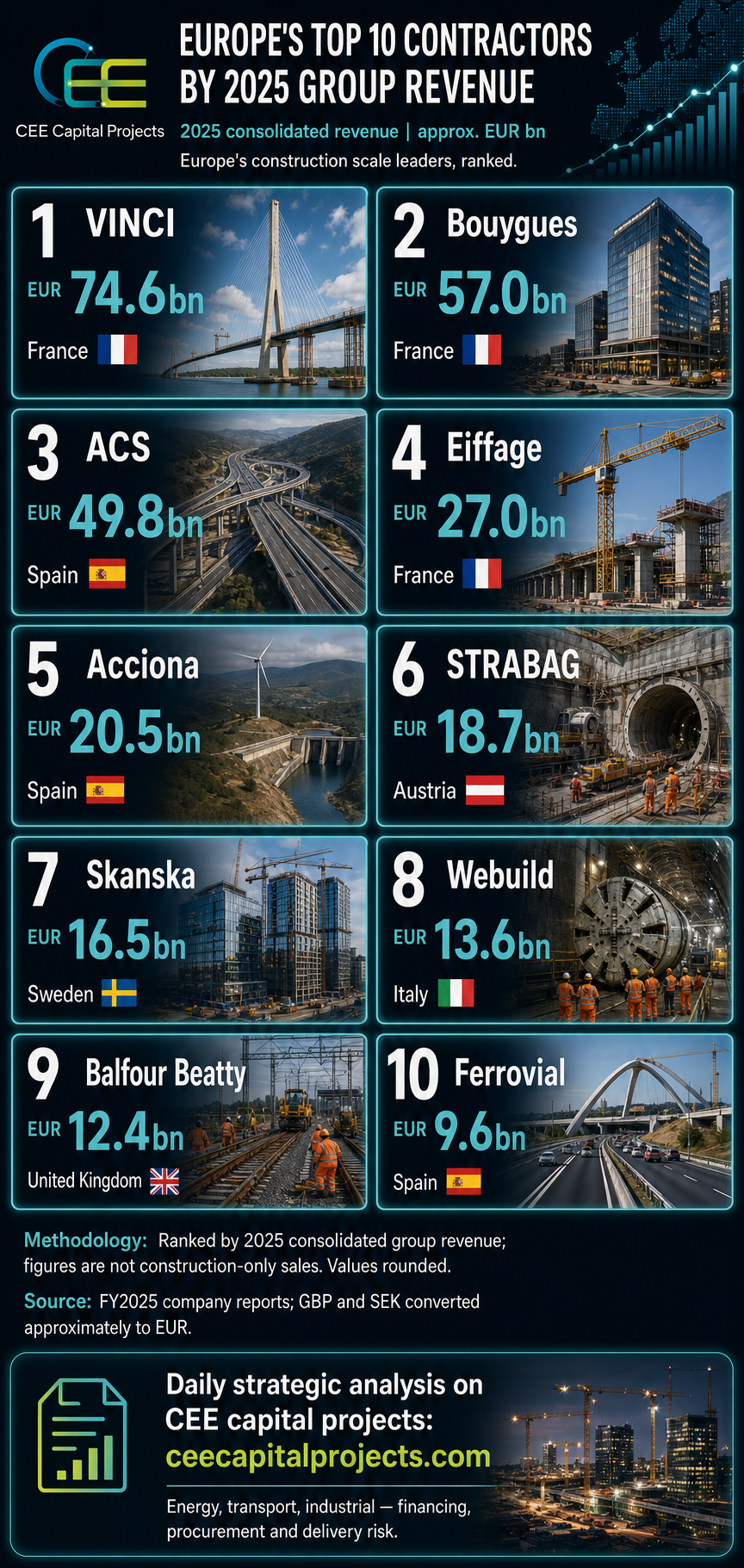
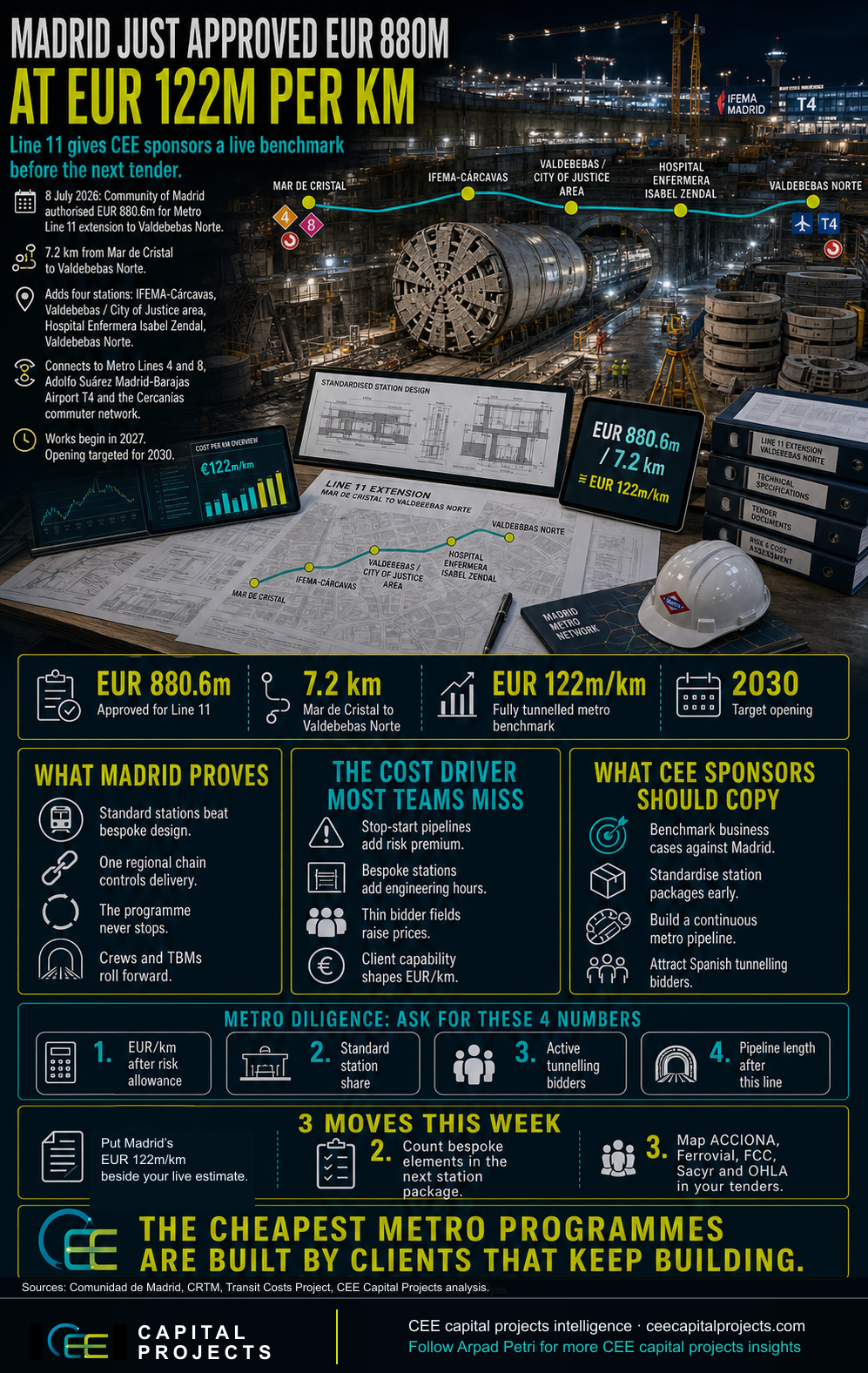
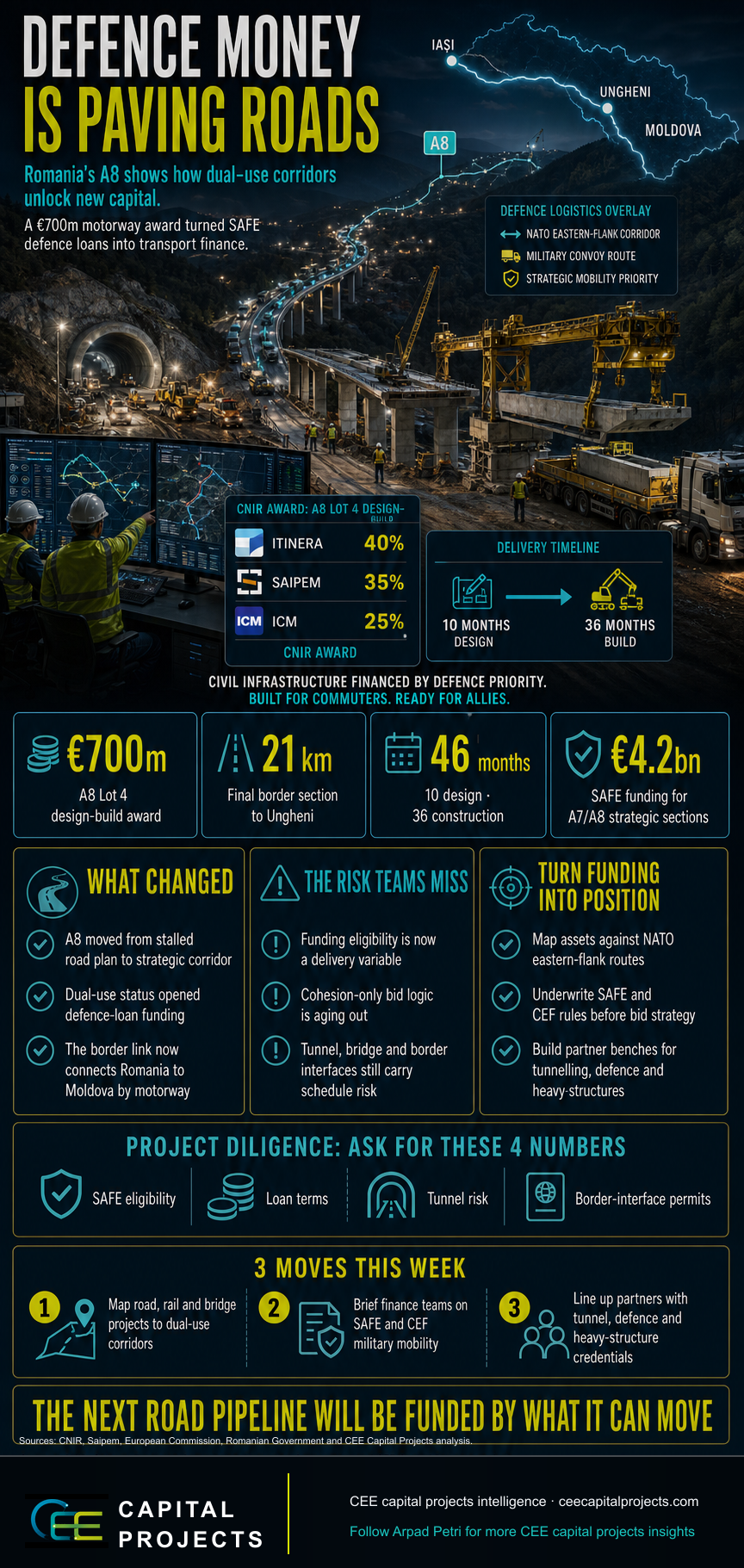
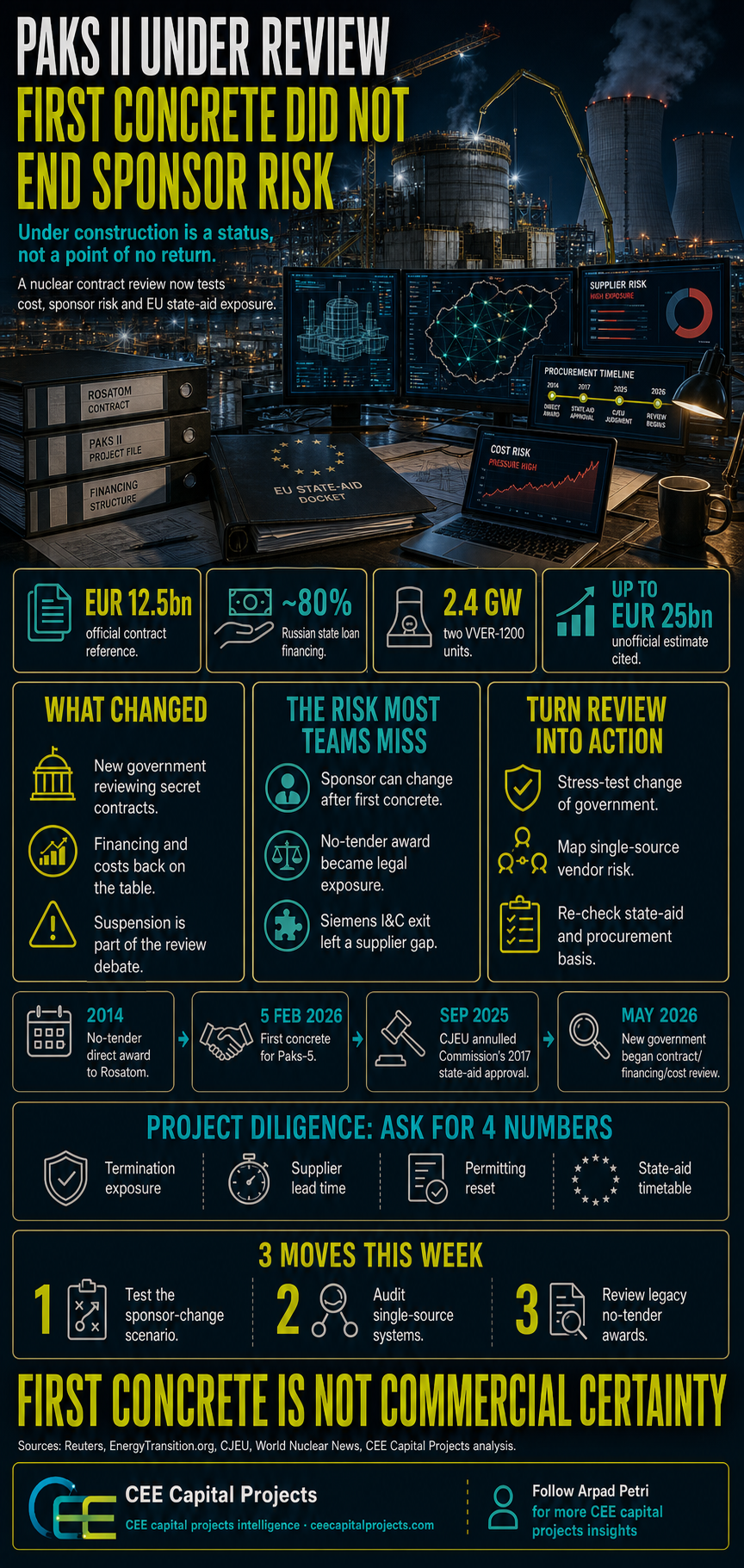
Explore our infograph library — strategic visuals for CEE capital projects leaders.
Project benchmarks, financing structures, tender dynamics and delivery risk — at a glance. Free access for investors, owners, contractors and strategy teams tracking CEE capital projects.
Browse the libraryStrategic Insights
📊 Analytics & Strategic Insight
When a concession becomes a political target, the gross number wins — unless you own the delivery data
The decision most in this industry are avoiding:
👉 The gross number always beats the margin in public debate. MKIF's 0.4% profit margin is analytically decisive and politically irrelevant; HUF 673 billion is the number that travels. Operators who let the cumulative fee become the headline have already lost the framing war — the counter-number (output delivered per forint) has to be published continuously, before scrutiny arrives.
👉 Availability-payment PPPs concentrate fiscal pain exactly where governments change. The model moves cost off the construction year and into a 35-year fee stream, which means every future government inherits a bill it never signed. That makes political review a structural feature of the model, and pretending otherwise misprices the asset.
👉 Supply-chain pricing is now part of the concession's political risk. The stone-contract leak shows scrutiny does not stop at the concessionaire — subcontractor input prices become evidence in the political case. Concession holders who cannot see their main contractors' sourcing carry a risk they cannot measure.
Here's the full context:
→ 2022: Hungary signs the 35-year motorway concession; MKIF — owned via private funds by Lőrinc Mészáros and László Szíjj — takes over 1,300+ km of expressways on 1 September under an availability-payment model with a 299 km widening and 279 km new-build obligation.
→ 2023–2025: MKIF runs Hungary's largest resurfacing programme: ~700 km of carriageway, 2.5 million tonnes of asphalt, 315 bridges, 68 rest areas; National Road Data Bank shows pavement under five years old rising from 24.6% to 66% of the network.
→ September 2025: The 78 km M1 expansion starts — full carriageway reconstruction under traffic with V-Híd as main contractor — with deadlines of August 2028 (M0–Bicske) and August 2029 (Concó).
→ May–June 2026: Hungary's new TISZA government finds concession fees under-budgeted (estimates of the 2026 gap run from ~HUF 100 billion to 175.6 billion), reopens the Paks II nuclear contract, and in mid-June minister Dávid Vitézy announces a full review of all concession contracts.
→ Most recent: 2 July — CEO Tamás Németh disputes the HUF 1,000 billion figure in HVG, citing ~680 billion and a 0.4% margin; 6 July — MKIF publishes its full delivery rebuttal while the M1 rebuild continues ahead of schedule.
What this means for infrastructure operators, contractors and investors:
✅ Termination clauses are the new due-diligence centrepiece. Németh's own estimate — that unwinding the concession would take years of settlement — is what keeps the contract alive in the short term. Investors in CEE concessions should price exit mechanics, compensation formulas and lender step-in rights as primary terms, because two Hungarian megacontracts are now being re-examined after signature.
✅ Political review and site delivery are separate tracks — treat them that way. The M1 rebuild continued through the June safety review and the July numbers war, and diversions may lift early. Contractors should contract for political noise (payment security, variation mechanisms) rather than assume it stops the works.
✅ Independent data is the cheapest insurance a concessionaire can buy. MKIF's strongest argument is the National Road Data Bank pavement-age series, precisely because the company does not control it. Operators should anchor performance reporting to third-party datasets from day one.
3 moves you can make this week:
1️⃣ Re-read the termination and compensation clauses in any CEE concession or PPP you hold. Map the settlement timeline, valuation basis and lender protections against the scenario of a hostile sponsor — before a government change does it for you.
2️⃣ Build a public delivery ledger for your asset. One page: money received versus output delivered, anchored to at least one independent dataset. Publish it annually, so the record exists before anyone demands it.
3️⃣ Verify your counterparty's budget line. If your revenue is an availability fee, confirm the sponsor has actually appropriated it for the next two fiscal years — Hungary's 2026 gap shows a signed contract and a budgeted contract are different things.
Related analyses
- Transport & Infrastructure
V-Híd Just Lost Hungary's HUF 338 Billion Déli Körvasút at 42 Per Cent Complete. The Grant Clock Is the Real Story
Hungary halted construction of the Budapest Southern Circle Railway on 9 October 2026 and barred V-Híd from every ongoing rail investment. The HUF 367 billion of EU money behind the job survives only if a lawful re-tender lands inside two years.
Read analysis → - Transport & Infrastructure
Afcons Wins Croatia's EUR 899m Dugo Selo-Novska Rail Contract: Four Bids, No European Prime
Croatia signed its largest ever railway contract on 1 October 2026, handing 83 km of double-tracking to India's Afcons Infrastructure at EUR 677.06m excluding VAT. Four bids were priced for the work and not one of them came from a European prime contractor.
Read analysis → - Transport & Infrastructure
STRABAG Closes BAWI Construction Buy in Romania as Rail Qualification Becomes the Scarce Asset
STRABAG has closed its purchase of BAWI Construction, a Bucharest rail specialist with 240 employees and about EUR 60 million of 2025 output. The number that matters is the qualification it buys, as Romania opens a EUR 5.99 billion rail programme with the EU recovery window shut.
Read analysis →
Building in Central Europe?
Tell us what you're building. We'll tell you what can go wrong — and how to prevent it.