We Help International Investors and Project Owners Deliver Major CEE Projects Without Expensive Surprises
Independent project intelligence and advisory across energy, transport, real estate and industrial construction.
Market Építő Grew to HUF 368 Billion While Hungary's Road and Rail Construction Fell 46%. Its Order Book Runs on Foreign Factories, Not Public Works
Hungary's construction output fell 10.7% year on year in May 2026, with road and rail building down 46%, yet Market Építő closed 2025 with record revenue of HUF 367.7 billion. Here is how Hungary's largest builder decoupled from the collapsing state pipeline by building foreign factories instead of public works.
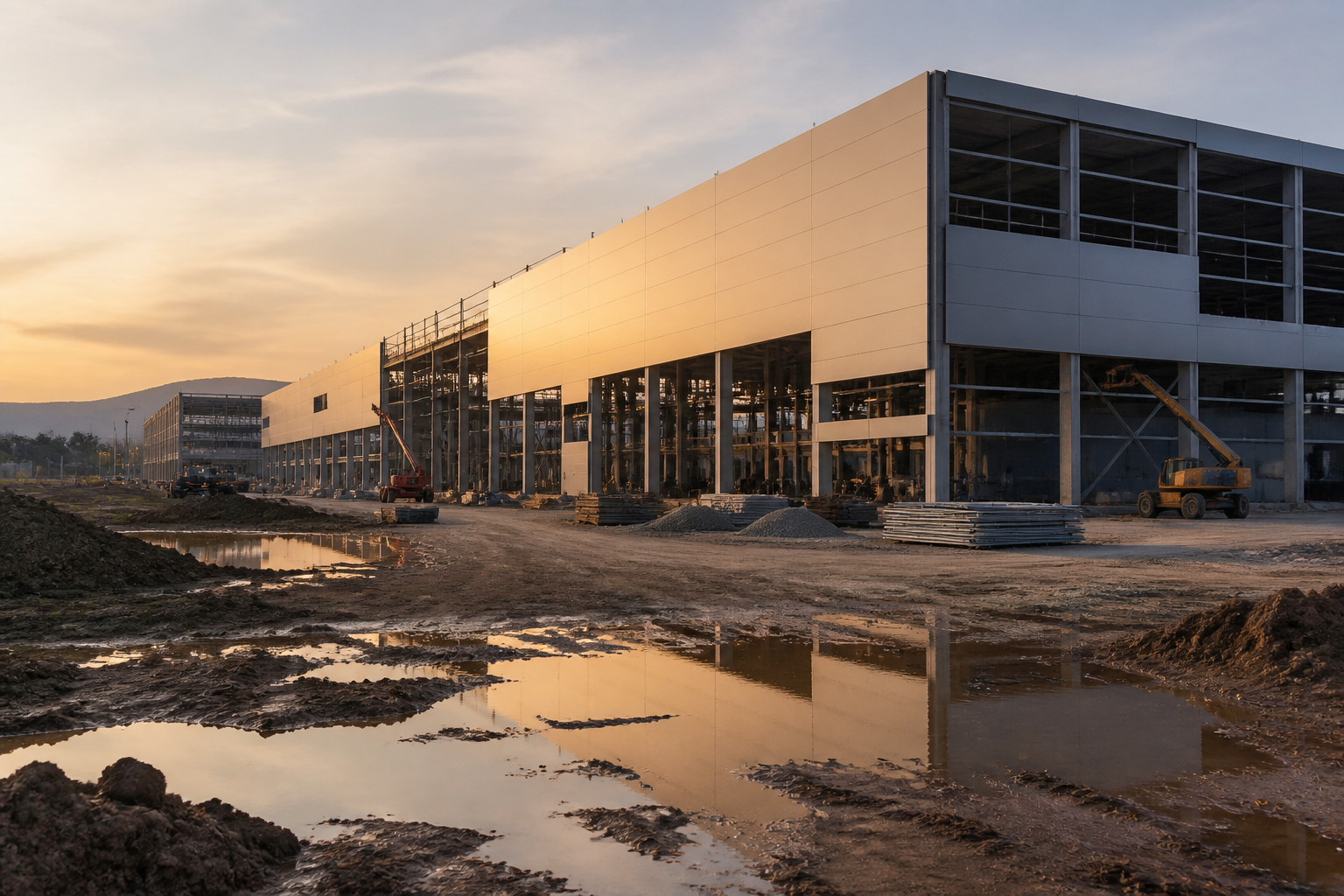
Hungary just published its worst construction number in years, and the country's biggest builder used the same season to confirm a record. On 14 July 2026 the Central Statistical Office (KSH) reported that construction output fell 10.7% year on year in May, with the road and railways group down 46.2%. A few weeks earlier, Market Építő Zrt. — Hungary's market leader in building construction for more than fifteen years — had closed its books on revenue of HUF 367.7 billion, up from HUF 307.4 billion the year before. One number says the market is collapsing. The other says the market leader grew by a fifth. Both are true, and the gap between them is the story.
A record year against a falling market
Market's 2025 accounts, published in the spring, show revenue up roughly 20% and after-tax profit rising from HUF 30.5 billion to HUF 40.9 billion. That is a builder expanding while national output shrinks. The contrast is not a rounding difference. KSH's May breakdown put civil engineering down 21.9% for the month, dragged almost entirely by roads and rail; building construction as a category fell a milder 4.2%. Portfolio caught the paradox on 3 June 2026 in a single line: money is pouring into the large privately owned contractors while the sector as a whole is weak.
The mechanism is simple once you see whose money is moving. Hungarian public works — the motorways, the rail lines, the EU-cohesion pipeline — are stalled by budget pressure, a standoff over EU funds and a change of government now reviewing its predecessor's contracts. State-dependent civil-engineering firms are feeling every point of the 46% road-and-rail drop. Market barely touches that pipeline.
An order book that decoupled from the state
Market's backlog is dominated by industrial and logistics work, and most of it is foreign-funded. The company built the structural works for the central production hall of CATL's Debrecen battery plant, a roughly HUF 3,000 billion Chinese investment that ranks as the largest single greenfield project in Hungarian history, and whose first-phase capacity is already fully booked by BMW, Stellantis and Volkswagen. It shares the BMW Debrecen electric-vehicle plant, opened in September 2025, with KÉSZ. Its reference list runs through the SK Innovation battery plant, the MOL Campus tower and the BudaPart district, and it is finishing the Hungaroring rebuild for this weekend's Grand Prix.
None of those clients depend on the Hungarian treasury. They depend on Europe's electric-vehicle supply chain and on foreign direct investment that keeps landing in eastern Hungary even as the domestic building cycle turns down. That is the decoupling: when your customers are German carmakers and Chinese and Korean cell makers, a freeze in national road spending never reaches your revenue line.
Two ways to survive a hostile home market
Central Europe's national champions are now running two different escape routes from the same problem. Duna Aszfalt, Hungary's largest road builder, watched domestic new orders fall about 60% in a year and responded by buying backlog abroad, in Poland, Romania, Czechia, Slovakia and an African toll road. It diversified out of Hungary geographically. Market stayed entirely domestic and diversified by client instead, trading public sponsors for private industrial ones. Same threat, a state that has stopped paying, two opposite answers.
The lesson for anyone financing or building in the region is that "Hungarian construction" is no longer one market. It is at least two, moving in opposite directions: an EU-and-state-funded civil-engineering market that is contracting hard, and an FDI-funded industrial-building market that is still growing. A contractor's exposure to one side or the other now explains more about its results than the national output figure does.
What it signals for 2026 and beyond
The risk is that the FDI cushion is thinner than it looks. Hungary's battery sector has been in recession since early 2024, and the wave of plant construction that lifted builders like Market is front-loaded. Once CATL and BYD move from building to producing, the shells are finished and the structural contracts end. If public works are still frozen when the industrial build-out tapers, even the winners lose their engine. For investors, the read is to track order intake by client type, not headline backlog. For contractors, Market's year is a reminder that the safest place in a state-funded downturn is a book someone else is funding, and the next question is what fills that book once the factories are built.
Share it with your peers
Help your network stay ahead of CEE capital projects.
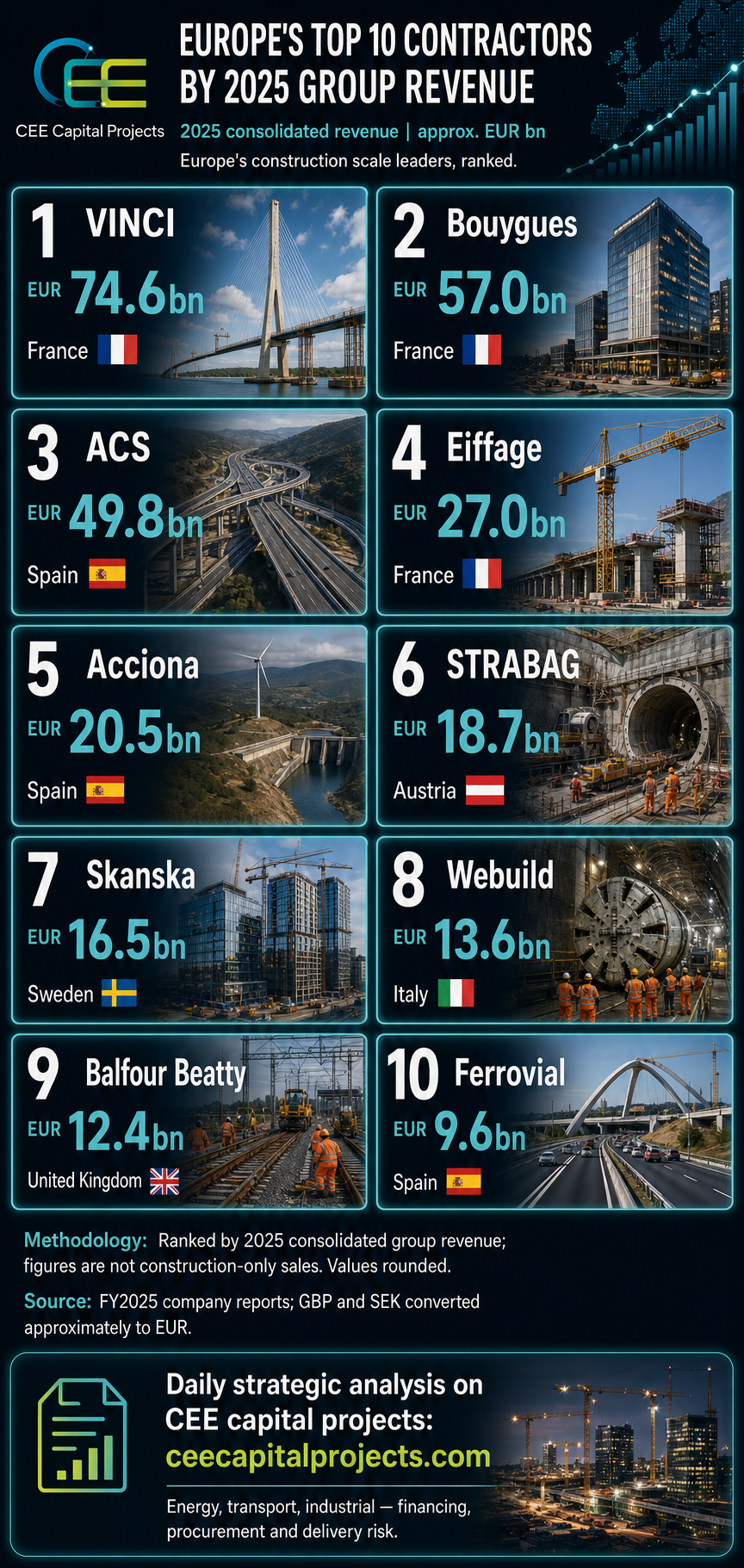
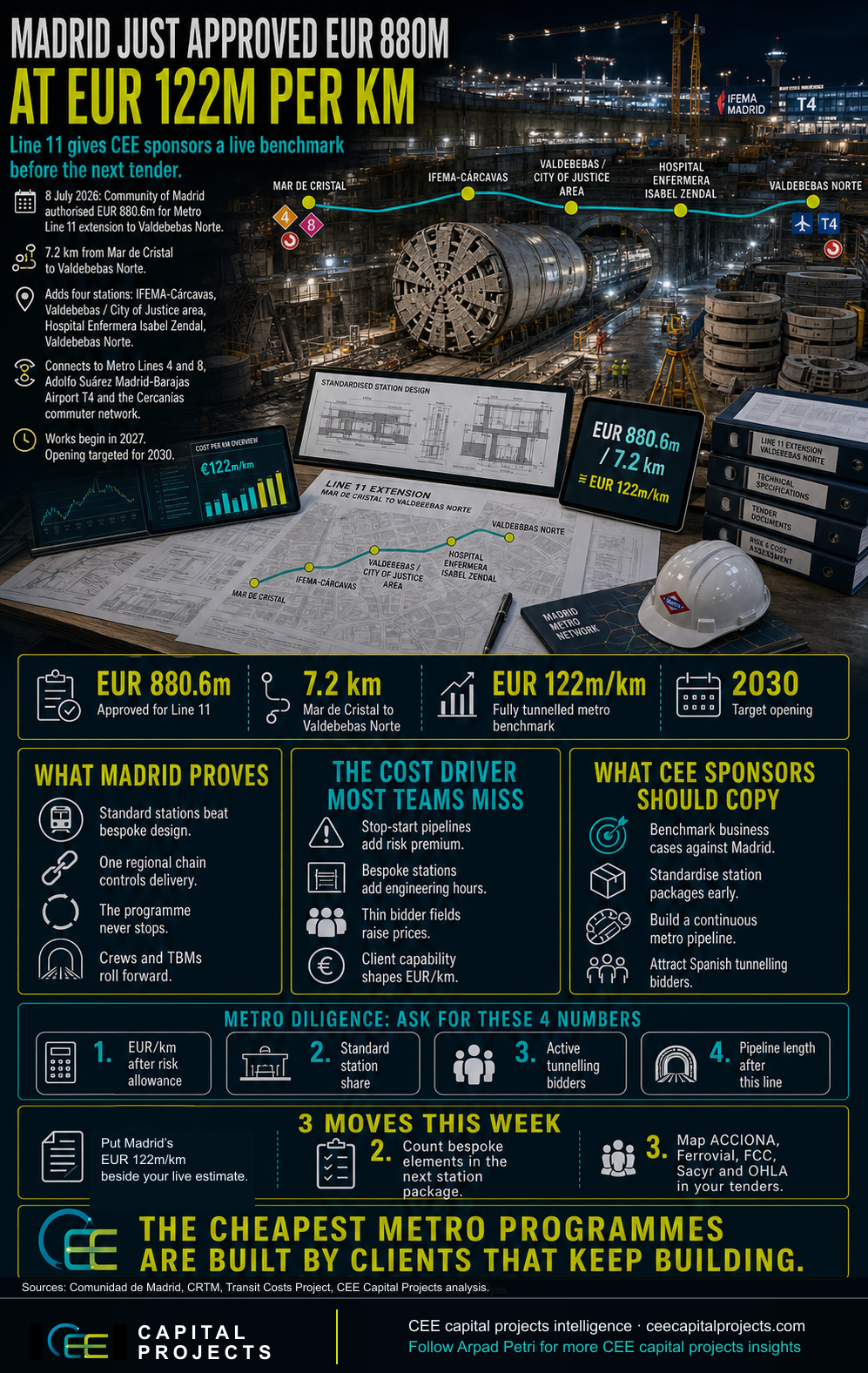
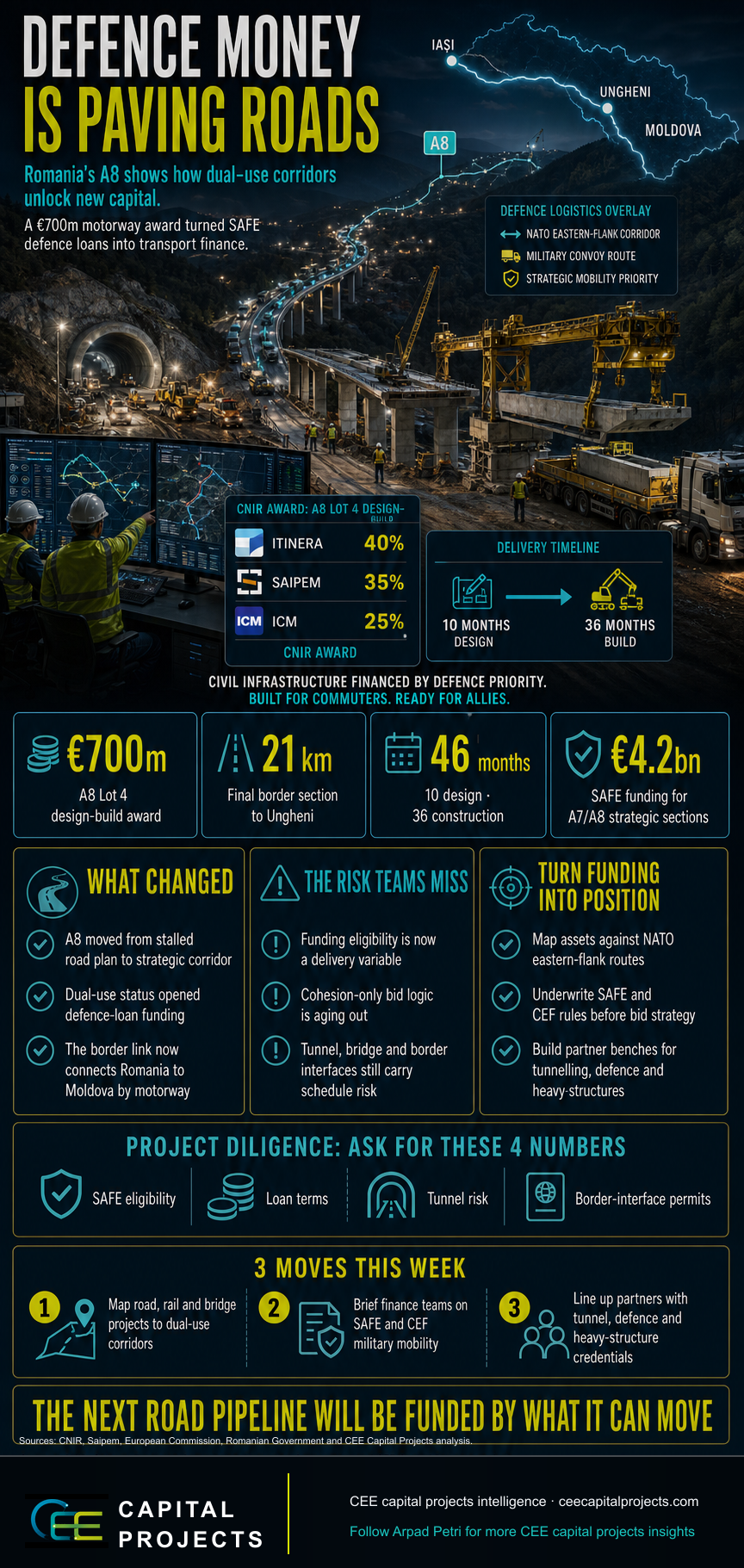
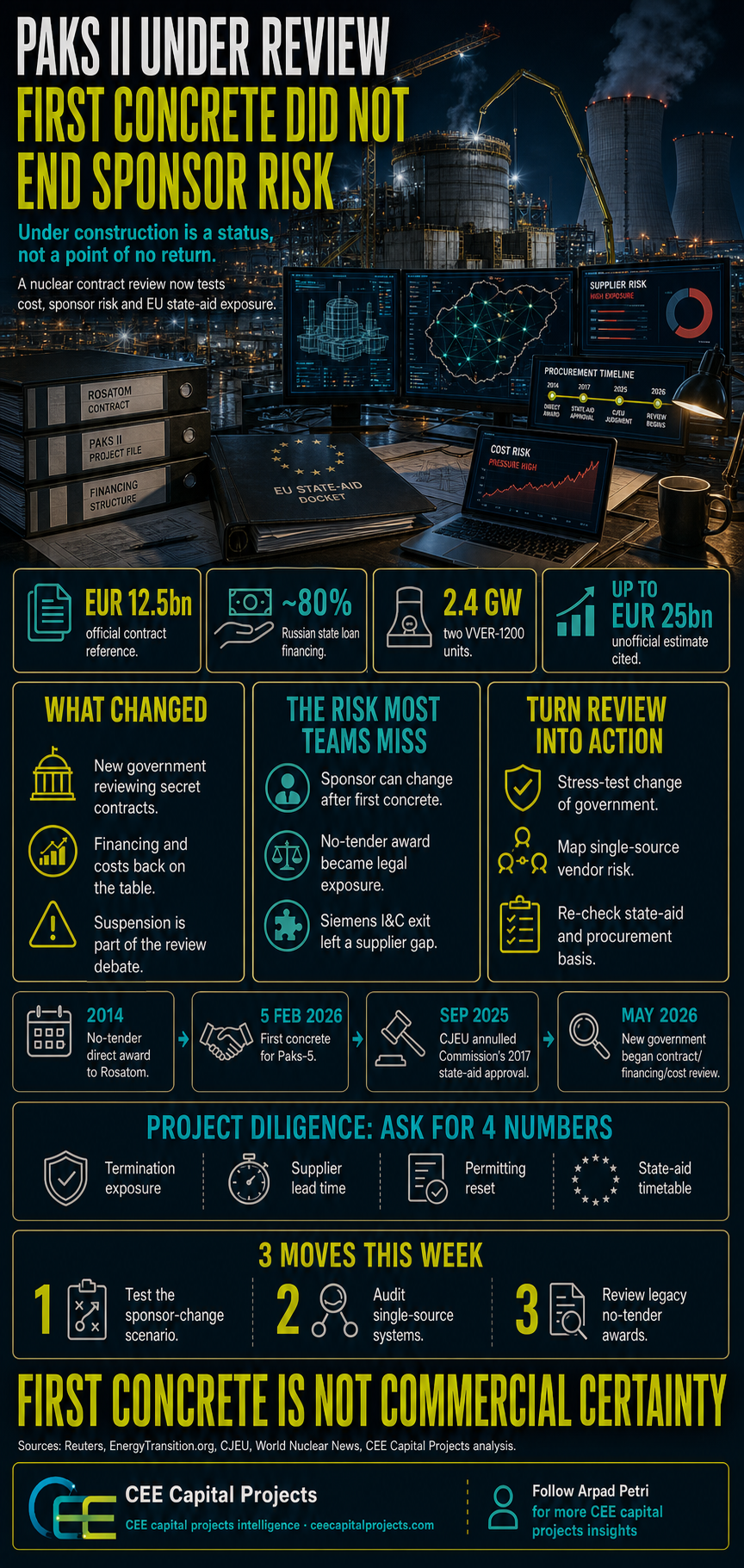
Explore our infograph library — strategic visuals for CEE capital projects leaders.
Project benchmarks, financing structures, tender dynamics and delivery risk — at a glance. Free access for investors, owners, contractors and strategy teams tracking CEE capital projects.
Browse the libraryStrategic Insights
📊 Analytics & Strategic Insight
Hungary Is Not One Construction Market Anymore. It Is Two, Moving in Opposite Directions
The decision most in this industry are avoiding:
👉 Stop reading the national construction index as one number. It now averages a collapsing public-works market with a growing FDI-industrial one, and the blend hides which side you are actually on.
👉 Client type is the real risk factor, not sector or geography. A builder sitting 100% inside Hungary can outgrow one that fled abroad, if its clients are foreign factories rather than the state.
👉 A record backlog built on a construction wave is a wasting asset. Battery and EV plant shells get finished; when they do, the contract ends whether or not anything replaces it.
Here's the full context:
→ 2022: CATL announces a ~HUF 3,000 billion battery plant in Debrecen, the largest greenfield investment in Hungarian history; Market Építő wins the structural works for its central hall.
→ 2024: Hungary's battery sector tips into recession while domestic public construction slows under budget pressure and an EU-funds standoff.
→ 2025: Market Építő posts revenue of HUF 367.7 billion (up from 307.4 billion) and profit of HUF 40.9 billion; BMW's Debrecen EV plant, part-built by Market and KÉSZ, opens in September.
→ 2026 (spring): Duna Aszfalt's accounts show domestic new orders down about 60%; it leans on foreign acquisitions to fill the gap, the opposite of Market's strategy.
→ Most recent: On 14 July 2026 KSH reports May construction output down 10.7% year on year, with roads and rail down 46.2%, even as the largest private builder reports a record year.
What this means for infrastructure operators, contractors and investors:
✅ Split your market view. Model Hungarian civil engineering and Hungarian industrial building as two separate cycles with different funders, different risk and different timing.
✅ Follow the FDI, not the flag. The growth is wherever private capital is landing, in EV, battery, logistics and data centres, regardless of whether the state is spending.
✅ Price the taper. The industrial-build boom is finite; underwrite the year after the plant tops out, not the year you sign.
3 moves you can make this week:
1️⃣ Re-cut your pipeline by funder. Tag every project public versus private/FDI and see what share of your backlog actually depends on the state.
2️⃣ Map the FDI calendar. List the battery, EV and logistics investors still in build phase in your market and when each moves from construction to production.
3️⃣ Stress-test the gap. Model your revenue if public works stay frozen and the current industrial shells finish on schedule, then decide what fills the hole.
Related analyses
- Transport & Infrastructure
V-Híd Just Lost Hungary's HUF 338 Billion Déli Körvasút at 42 Per Cent Complete. The Grant Clock Is the Real Story
Hungary halted construction of the Budapest Southern Circle Railway on 9 October 2026 and barred V-Híd from every ongoing rail investment. The HUF 367 billion of EU money behind the job survives only if a lawful re-tender lands inside two years.
Read analysis → - Transport & Infrastructure
Afcons Wins Croatia's EUR 899m Dugo Selo-Novska Rail Contract: Four Bids, No European Prime
Croatia signed its largest ever railway contract on 1 October 2026, handing 83 km of double-tracking to India's Afcons Infrastructure at EUR 677.06m excluding VAT. Four bids were priced for the work and not one of them came from a European prime contractor.
Read analysis → - Transport & Infrastructure
STRABAG Closes BAWI Construction Buy in Romania as Rail Qualification Becomes the Scarce Asset
STRABAG has closed its purchase of BAWI Construction, a Bucharest rail specialist with 240 employees and about EUR 60 million of 2025 output. The number that matters is the qualification it buys, as Romania opens a EUR 5.99 billion rail programme with the EU recovery window shut.
Read analysis →
Building in Central Europe?
Tell us what you're building. We'll tell you what can go wrong — and how to prevent it.