We Help International Investors and Project Owners Deliver Major CEE Projects Without Expensive Surprises
Independent project intelligence and advisory across energy, transport, real estate and industrial construction.
Madrid Just Approved an €880 Million Metro Extension at €122 Million per Kilometre. London and Paris Pay Multiples of That for the Same Tunnel
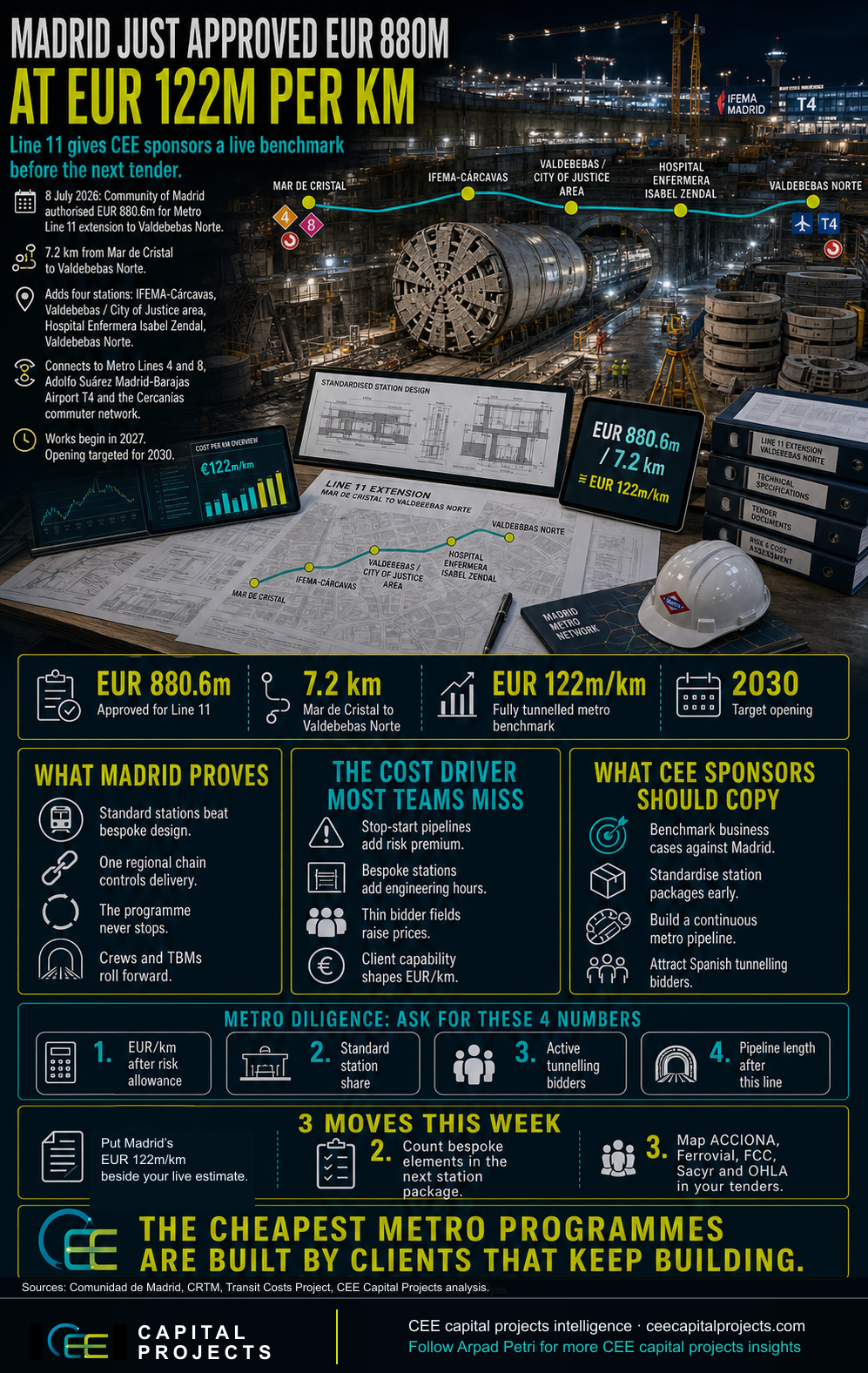
The Community of Madrid authorised €880.6 million on 8 July 2026 to extend Metro Line 11 by 7.2 km with four new stations — roughly €122 million per tunnelled kilometre. That number is a live benchmark that should reset how European metro sponsors, contractors and investors price underground construction.
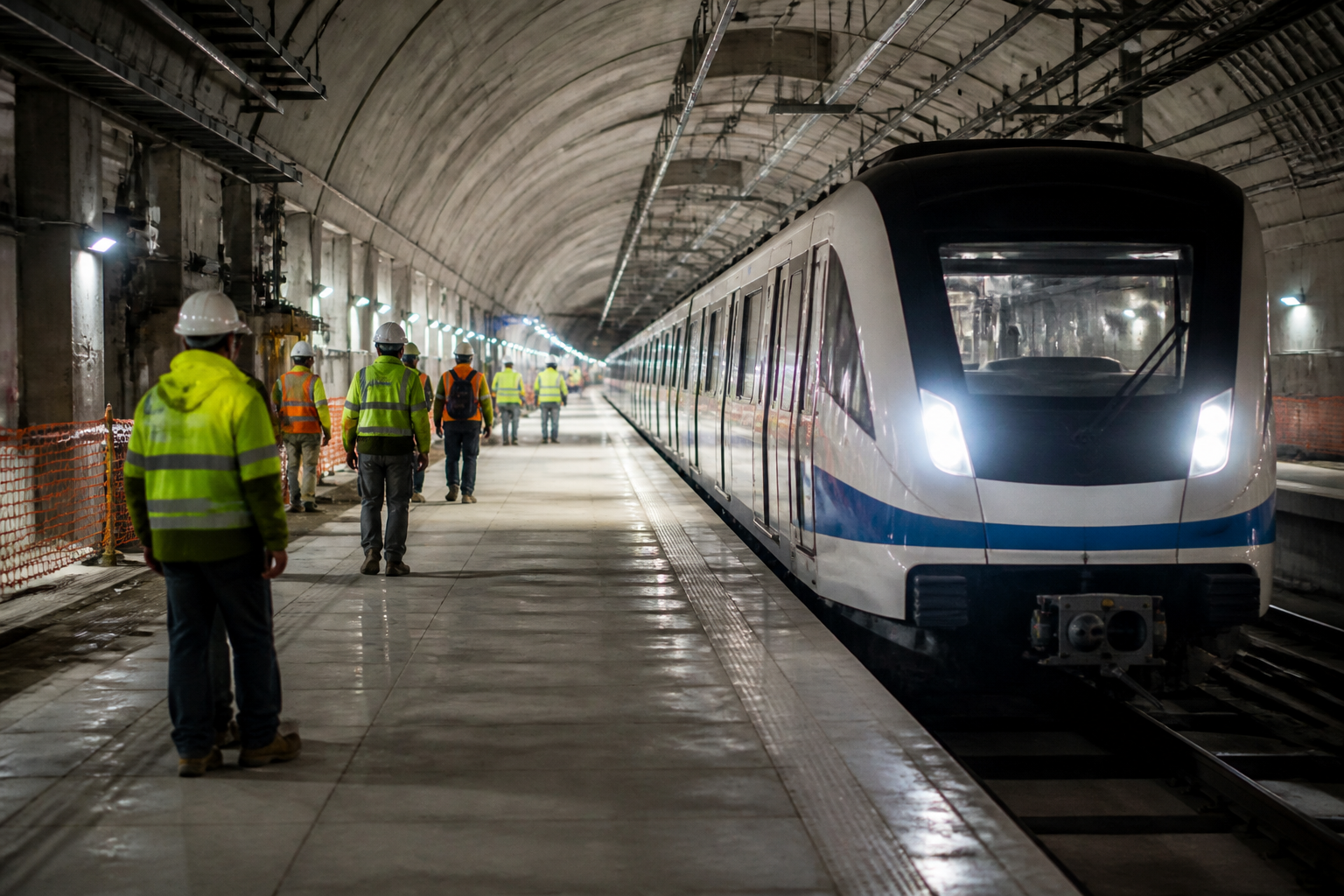
On 8 July 2026 the Community of Madrid authorised €880.6 million to extend Metro Line 11 by 7.2 kilometres, from Mar de Cristal to Valdebebas Norte, with four new stations. That works out at roughly €122 million per kilometre for a fully tunnelled urban metro with interchanges to two existing lines, the airport and the commuter rail network. Recent tunnelled projects in London and Paris have cost multiples of that figure per kilometre. The approval itself is routine business in Madrid. The unit price is the story every European metro sponsor should be reading.
The largest metro expansion of Madrid's current term
The Regional Government Council authorised the works contract on 8 July 2026, calling it the most extensive metro development project of the current legislature (Comunidad de Madrid press release, 8 July 2026). The new section adds four stations: IFEMA-Cárcavas, serving the exhibition centre's expansion and the future MADRING street circuit; Valdebebas, linking to Cercanías commuter lines C1 and C10 and the future City of Justice complex; Hospital Enfermera Isabel Zendal; and Valdebebas Norte, in one of the region's largest residential expansion zones. At Mar de Cristal the line connects with Metro Lines 4 and 8, and at Terminal 4 of Adolfo Suárez Madrid-Barajas Airport it meets Line 8 and the Cercanías network. Works are scheduled to begin in 2027, with opening targeted for 2030.
The extension is one piece of the Line 11 "diagonal" programme designed to cross the capital and relieve the saturated circular Line 6. The first section, between Plaza Elíptica and Conde de Casal, is already under construction and passed a milestone this month when the Mayrit tunnel boring machine arrived at the new Madrid Río station after crossing beneath the M-30 ring road (Railway PRO, 13 July 2026).
€122 million per kilometre is the number that matters
Madrid's cost discipline has history. Between 1995 and 1999 the region built 56 kilometres of new metro for roughly $50 million per kilometre in 2024 prices, a programme the World Bank described as "substantially below the levels that were internationally considered possible" (Works in Progress, "How Madrid built its metro cheaply"). London's Jubilee Line Extension, built over the same years, cost nearly ten times as much per mile.
The gap has narrowed since the 1990s, but it has not closed. Paris is delivering the roughly 200-kilometre Grand Paris Express against a budget that has climbed above €36 billion. London's Elizabeth Line closed out at £18.9 billion. Madrid, a quarter century after its legendary expansion round, is still ordering fully tunnelled metro with four stations at about €122 million per kilometre — after 25 years of construction inflation, tighter safety and accessibility standards, and more expensive tunnelling machinery. The Transit Costs Project research consistently places Spain among the lowest-cost builders of urban rail in the developed world.
The machine behind the price
Madrid's price is manufactured, and the components are visible. Stations are standardised on repeatable designs rather than commissioned as one-off architecture. The regional government controls planning, funding and delivery in a single chain, so decisions that take years of intergovernmental negotiation elsewhere take months. And the programme never stops: Madrid has been continuously designing, tendering or boring metro for three decades, which means client-side engineers, contractor crews and tunnel boring machines roll from one extension to the next without the demobilisation losses that plague stop-start programmes.
The final component is the contractor bench. ACCIONA, Ferrovial, FCC, Dragados (part of the ACS group, HOCHTIEF's parent), Sacyr and OHLA all maintain serious tunnelling capacity aimed at a client that keeps buying. Deep competition for every package, bid by teams that have each built Madrid metro before, produces prices that would be dismissed as typos in a London or Berlin business case.
What CEE sponsors should copy before their next tender
Central and Eastern Europe is entering a metro-building decade: Warsaw is preparing Line 3, Prague is building Metro D, and Bucharest is extending its network towards the airport. The Spanish lesson for all of them is that unit cost tracks client capability and pipeline continuity far more than it tracks geology or wage levels. Spanish wages are not low by CEE standards, yet Spanish unit costs beat most of the continent.
The discipline also travels. ACCIONA and Ferrovial already win major transport packages across Poland and Romania, and Spanish bidders repeatedly appear in CEE metro and rail shortlists, bringing the delivery model with them. Sponsors that put Madrid's €/km in their business cases as the reference point — and structure programmes as continuous pipelines rather than one-off projects — will get sharper bids from everyone.
For operators, contractors and investors, the practical takeaway is that Madrid's July approval will quietly become a reference number. EU-funded metro business cases in CEE will be measured against it, Northern European sponsors will be asked why their tunnels cost four times more, and Spain's contractor bench will keep converting home-market cost discipline into export wins. In metro construction, the cheapest builder in Europe is also the busiest one, and that is unlikely to be a coincidence.
Share it with your peers
Help your network stay ahead of CEE capital projects.
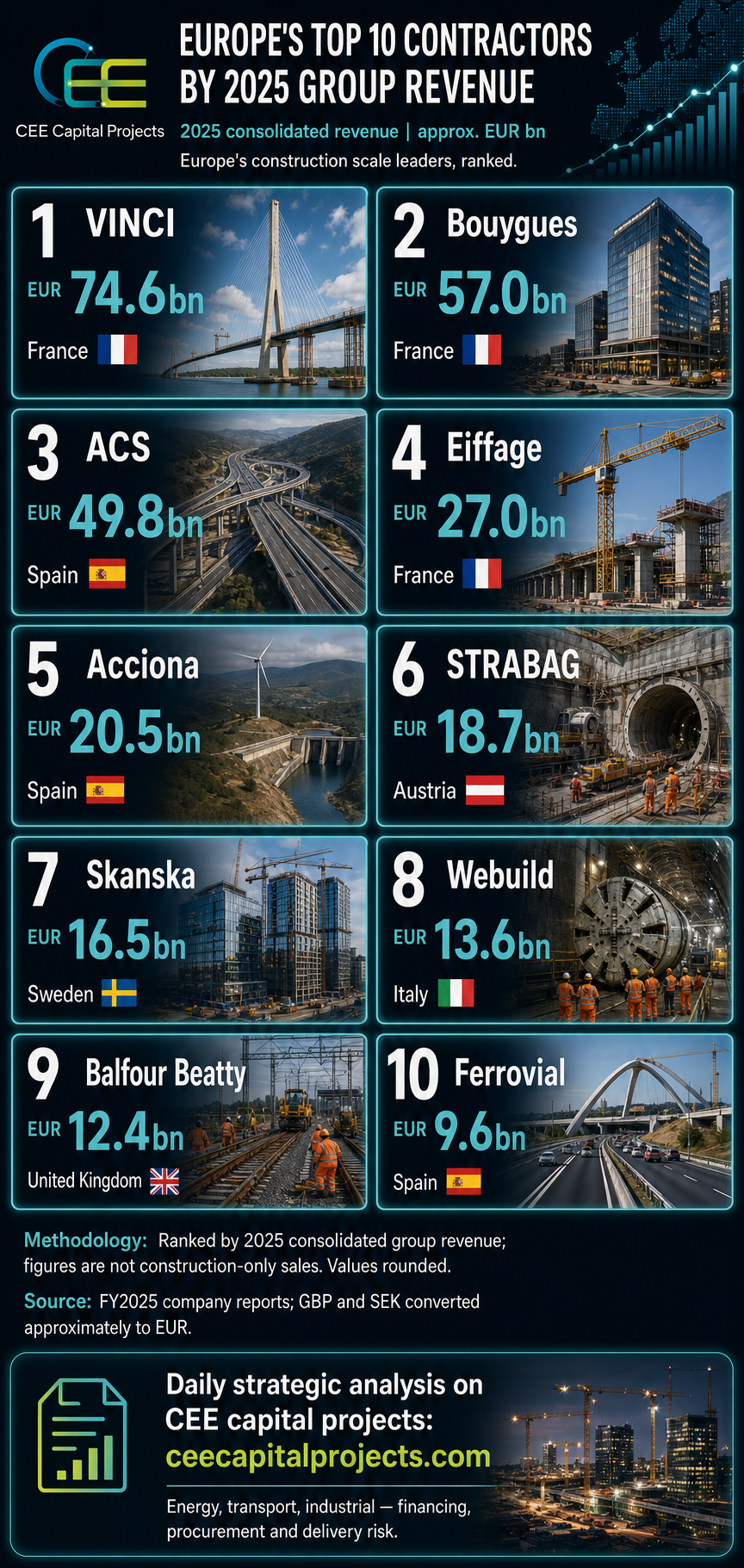
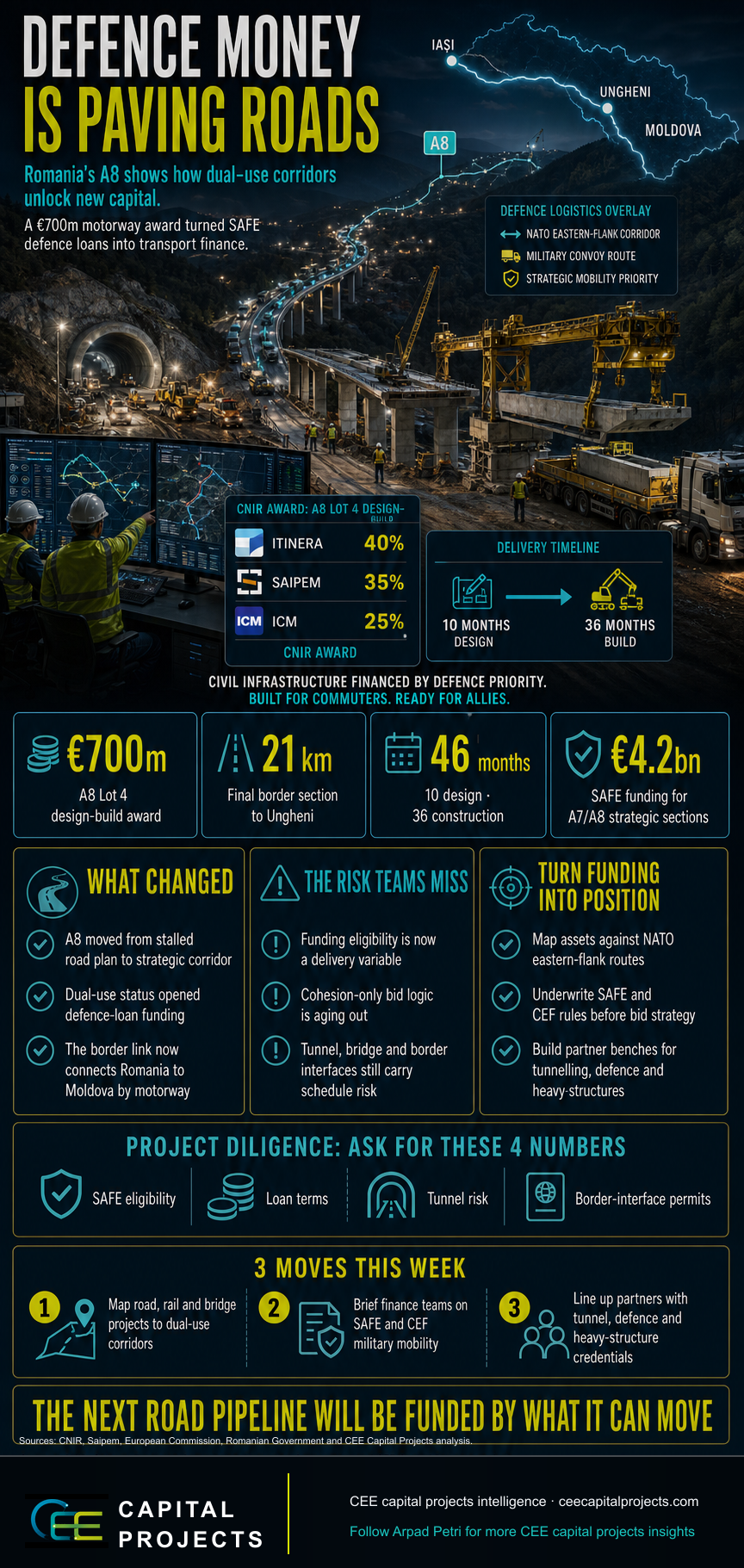
Explore our infograph library — strategic visuals for CEE capital projects leaders.
Project benchmarks, financing structures, tender dynamics and delivery risk — at a glance. Free access for investors, owners, contractors and strategy teams tracking CEE capital projects.
Browse the libraryStrategic Insights
📊 Analytics & Strategic Insight
Tunnelling cost is a client capability, and Madrid keeps proving it
The decision most in this industry are avoiding:
👉 Treating each metro line as a one-off procurement is the most expensive decision a sponsor can make. Madrid's cost advantage compounds because the programme never stops: client engineers, contractor crews and TBMs move directly to the next package. Sponsors who demobilise between lines pay to rebuild that capability every time, and it shows up as a risk premium in every bid.
👉 Standardisation outperforms signature architecture on every metric that reaches the balance sheet. Madrid's copy-paste station designs cut engineering hours, compress approval cycles and let crews repeat work they have done before. The bespoke station is the single most expensive line item most metro sponsors never question.
👉 A deep domestic contractor bench matters more than a low wage level. Spanish wages exceed CEE wages, yet Spanish unit costs are lower. Six experienced tunnelling contractors competing for a client that keeps buying beats two cautious bidders pricing a one-off — competition density is a cost input sponsors can actively manage.
Here's the full context:
→ 1995–1999: Madrid builds 56 km of new metro at roughly $50 million per kilometre in 2024 prices; the World Bank calls the costs "substantially below the levels that were internationally considered possible".
→ 1999: London's Jubilee Line Extension completes at nearly ten times Madrid's cost per mile, setting the pattern of a persistent North–South European cost gap.
→ 2016–2023: The Grand Paris Express budget climbs above €36 billion for roughly 200 km; London's Elizabeth Line closes out at £18.9 billion.
→ 2025–July 2026: Line 11's first section between Plaza Elíptica and Conde de Casal advances under construction; the Mayrit TBM crosses beneath the M-30 and reaches the new Madrid Río station.
→ Most recent: On 8 July 2026 the Community of Madrid authorises €880.6 million for the 7.2 km, four-station extension to Valdebebas Norte — about €122 million per kilometre, works from 2027, opening 2030.
What this means for infrastructure operators, contractors and investors:
✅ Sponsors: benchmark against Madrid, not against your neighbour. If your metro or urban rail business case carries a €/km figure three times Madrid's, the burden of proof has shifted to you. Funders — including EU evaluators scoring CEE metro applications — will increasingly ask the question, so answer it in the submission before they do.
✅ Contractors: expect the Spanish bench in your market. ACCIONA, Ferrovial and their peers convert home-market cost discipline into export bids across Poland, Romania and beyond. Competing with them means offering delivery-model credibility, local supply chains and repeat-crew economics rather than relying on incumbency.
✅ Investors: read pipeline continuity as construction-risk mitigation. A sponsor with a continuous, multi-line programme and standardised designs is structurally less likely to blow its budget than a first-time builder with a signature project. Price construction risk on the client's track record, not only the contractor's.
3 moves you can make this week:
1️⃣ Pull the Transit Costs Project dataset and benchmark your live projects. Put your €/km next to Madrid's €122 million and the dataset's medians; the gaps will tell you where your cost structure, not your geology, is the problem.
2️⃣ Count the bespoke elements in your next station design. Every non-repeatable component is engineering hours, approval risk and crew learning-curve cost. Set a standardisation target for the next package and make exceptions justify themselves.
3️⃣ Map the Spanish bidders in your pipeline. Identify which upcoming tenders in your market are likely to draw ACCIONA, Ferrovial, FCC, Sacyr or OHLA, study their recent winning structures, and decide now whether to partner with them or price against them.
Related analyses
- Transport & Infrastructure
V-Híd Just Lost Hungary's HUF 338 Billion Déli Körvasút at 42 Per Cent Complete. The Grant Clock Is the Real Story
Hungary halted construction of the Budapest Southern Circle Railway on 9 October 2026 and barred V-Híd from every ongoing rail investment. The HUF 367 billion of EU money behind the job survives only if a lawful re-tender lands inside two years.
Read analysis → - Transport & Infrastructure
Afcons Wins Croatia's EUR 899m Dugo Selo-Novska Rail Contract: Four Bids, No European Prime
Croatia signed its largest ever railway contract on 1 October 2026, handing 83 km of double-tracking to India's Afcons Infrastructure at EUR 677.06m excluding VAT. Four bids were priced for the work and not one of them came from a European prime contractor.
Read analysis → - Transport & Infrastructure
STRABAG Closes BAWI Construction Buy in Romania as Rail Qualification Becomes the Scarce Asset
STRABAG has closed its purchase of BAWI Construction, a Bucharest rail specialist with 240 employees and about EUR 60 million of 2025 output. The number that matters is the qualification it buys, as Romania opens a EUR 5.99 billion rail programme with the EU recovery window shut.
Read analysis →
Is your project leaking money through its subcontractors?
Most owners lose 3–8% in vendor packages without noticing. Tell us about your project — we'll tell you where we'd look first.