We Help International Investors and Project Owners Deliver Major CEE Projects Without Expensive Surprises
Independent project intelligence and advisory across energy, transport, real estate and industrial construction.
Litgrid's Harmony Link Review Tender: Why the Design Clock Sets the 900 Million Euro Link's Date
Litgrid has started buying the expert review of the Harmony Link technical design, next to a design-and-build tender for the Gižai substation. The short gap between contract signing and site works is where Lithuania's second power link to Poland will keep or lose its date.
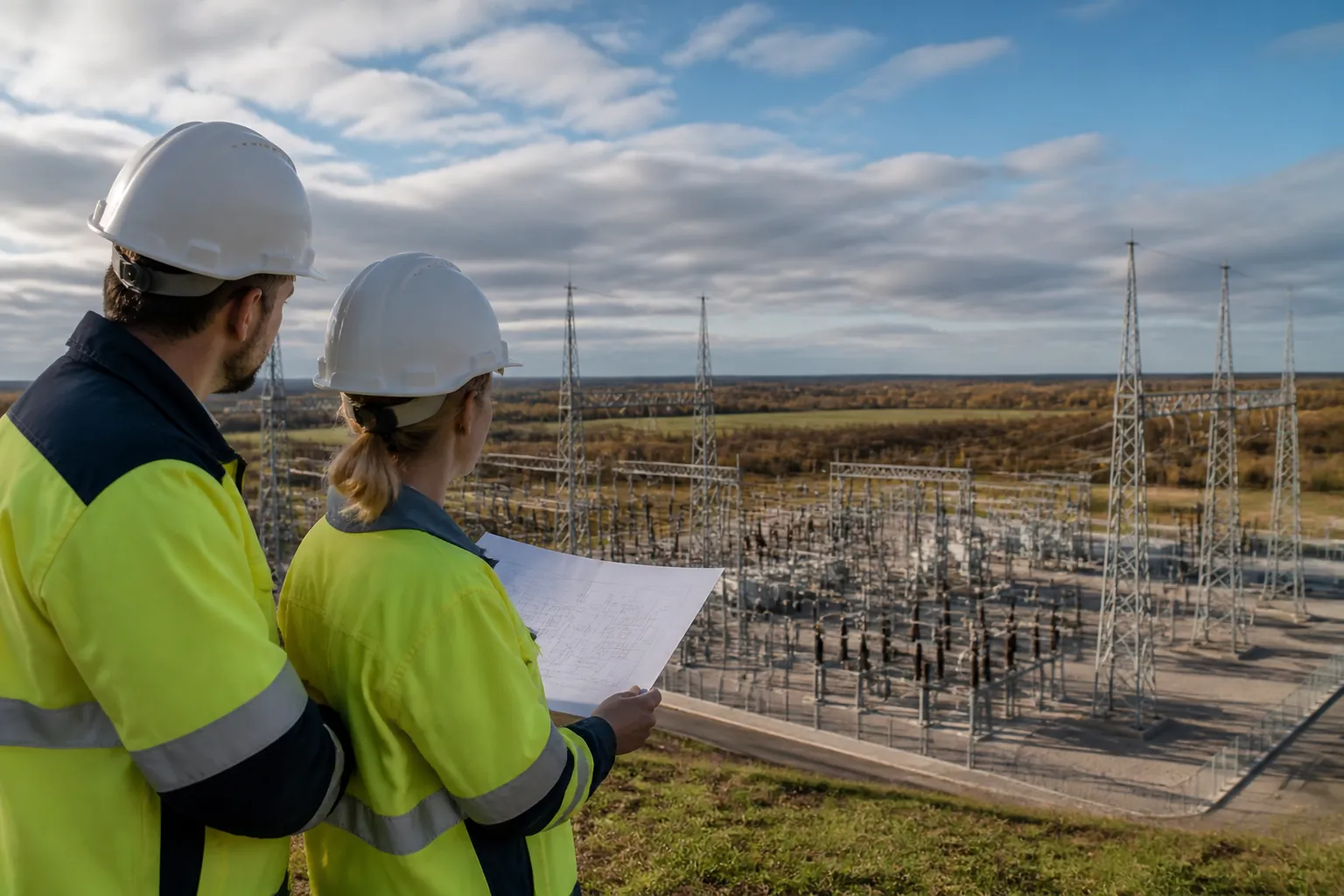
If I were running Harmony Link, I would watch the design reviewer before the builder. A substation designed after award moves only as fast as its review. Litgrid has just started buying that review.
On 20 November, Lithuania's transmission operator announced a procurement for the expert review of the Harmony Link technical design. It covers two services: a check of the project proposals and the general expert review the law requires. Litgrid says construction in Lithuania should start in the second quarter of 2027, with commissioning by the end of 2030. The joint project with Poland's operator PSE is worth more than 900 million euro, BNS reported in August.
What Litgrid is building, and what it is buying now
Harmony Link is a new double-circuit line at 220 kilovolts (kV). It runs from Ełk Bis in Poland through two new Polish substations, Norki and Wigry. It ends at a new substation at Gižai in Vilkaviškis district. Poland also rebuilds its existing line from Ostrołęka to Ełk Bis. The link will carry up to 1,200 megawatts (MW) in either direction.
The Lithuanian end is the Gižai substation. It will cover about 35 hectares and will be the largest substation Litgrid operates. Litgrid launched its design-and-build tender in August, the first of four Harmony Link construction tenders. The winner prepares the technical design, and only then does the general expert review begin. That matters because Lithuanian law requires that review before a project of this class is built. So the reviewer has to be under contract before the first drawing arrives.
Why the review clock sets the date
BNS gave the Gižai timetable in August. Contract signing is planned for the third quarter of 2027. Construction starts at the end of 2027. Connection to the 330 kV and 110 kV lines follows in 2029. That leaves roughly one quarter between signing and the first site works. In that quarter the contractor must produce a technical design, and an independent reviewer must clear it.
Here is why that is tight. In design-and-build, the client hands design risk to the contractor with the contract. Litgrid gains a single point of responsibility. It also loses control of the design pace until signing. Every review comment sends drawings back to the contractor, and each loop costs weeks. Litgrid's two-step review, proposals first and full design second, tries to catch problems early. The reason is simple. A proposal fixed early is cheaper to change than a finished design waiting for its permit.
The two sources also differ on timing. Litgrid's November notice puts the Lithuanian construction start in the second quarter of 2027. The August timetable puts the Gižai signing a quarter later. The likeliest reading is that line works begin first and the substation follows. Neither source says so directly.
Who pays, and who carries a slip
The money is mostly European. BNS reported a maximum Lithuanian budget of 220 million euro, including 147.2 million euro of EU support. Poland's share is about 703 million euro, with about 368 million euro of EU support. Litgrid's notice names the Connecting Europe Facility (CEF), the EU grant line for cross-border networks.
A grant this large turns schedule into money. The mechanism is the grant agreement. CEF grants pay eligible costs inside a fixed action period. Work that slips beyond it can fall outside the grant and back onto the operator. For Litgrid, that cost would then move into its regulated asset base and network tariffs. So every quarter lost at Gižai puts grant cover at risk.
The split also explains why Poland matters to Lithuania's timetable. Poland carries about three quarters of the cost and most of the new line. A link energises only when both ends are ready. Lithuania can finish Gižai on time and still wait for the Polish substations.
Batteries are moving faster than wires
The contrast with storage is sharp. Litgrid connected three battery systems in October, with 168 MW of installed power and 336 megawatt-hours (MWh) of energy. Lithuania now runs about 1.36 gigawatts (GW) of batteries across its transmission and distribution grids. Litgrid expects installed battery power to pass 2 GW by the end of this year if pending projects connect.
Batteries connect quickly because they plug into grid nodes that already exist. An interconnector needs land, two permit regimes, a border crossing and two operators on one timetable. That is why storage arrives within months while this line takes six years from route decision to power. Storage now gives the Baltic system much of its fast balancing. Harmony Link adds the bulk transfer capacity that batteries cannot supply.
My read: Gižai is the critical path
I think the Polish works and the Lithuanian line works can start on time. The risk sits at Gižai. That happens because one quarter from signing to construction is short for a design that must pass a statutory review. Unless the tender fixes most of the design before award, I expect Lithuanian commissioning to drift into 2031.
The figure that settles it is the number of bids at Gižai. The date that settles it is a signing in the third quarter of 2027. Several credible bidders would let Litgrid choose on schedule and design maturity. A thin field would push the price up and the design risk back onto the client. Contractors with a ready Baltic design team will hold the stronger hand.
For suppliers, the useful signal comes earlier. A substation of this size needs large power transformers, and those carry long delivery times. A contractor that can show a reserved transformer slot shortens the critical path more than any extra site crew.
The open question is how many contractors in the region can design a substation of this size and clear its review inside one quarter. Our CEE Grid Procurement Pipeline 2027-2030 tracks substation awards and competition across 19 markets, including the Baltic states. The free sample shows how we read bid competition by operator.
Share it with your peers
Help your network stay ahead of CEE capital projects.
Strategic Insights
📊 Analytics & Strategic Insight
Harmony Link will be won in the design office before it is built on site
The decision most in this industry are avoiding:
👉 The review contract is the first construction milestone. Most trackers log the works tender as the start of a project. For a design-and-build substation, the reviewer's capacity decides how fast drawings turn into a permit.
👉 A large grant share raises schedule risk for the operator. A project paid mostly by Brussels looks safe to lenders and regulators. Yet the grant's end date makes every delay costlier than on a job funded through tariffs.
👉 Batteries may quietly take the urgency out of the link. With storage covering fast balancing, a slipped energisation date draws less attention. Less attention usually means slower decisions on land, permits and design changes.
Here's the full context:
→ April 2023: PSE and Litgrid cancel the tenders for an offshore direct current version of the link.
→ July 2024: The two operators sign a cooperation agreement for an overland route, with energisation by the end of 2030.
→ August 2026: Litgrid launches the Gižai design-and-build tender, the first of four Harmony Link construction tenders.
→ 12 November 2026: Litgrid, Latvia's AST and Germany's 50Hertz apply for EU priority status for a 2 GW Baltic-German subsea link, due after 2037.
→ Most recent: On 20 November, Litgrid opens the procurement for the expert review of the Harmony Link technical design.
What this means for infrastructure operators, contractors and investors:
✅ Bid teams for Gižai should staff design before site. The contract will be won on how fast a compliant design reaches the reviewer. A strong civil crew with a thin design office is the wrong offer here.
✅ The project board should track review loops as a schedule metric. Each returned drawing set is an early warning of a late permit. Counting loops gives the grant monitor a signal months before the site shows it.
✅ Transformer makers should treat the Baltic substations as a slot decision. Contractors will ask for reserved production before they price. The maker that commits capacity early becomes part of the winning bid.
3 moves you can make this week:
1⃣ Read the Gižai tender file on the Lithuanian procurement portal. Check how much design Litgrid fixes before award, because that decides how long the review takes.
2⃣ Bid for the review work if you run an engineering consultancy. The contract is small, but it places your team inside the design loop of a flagship Baltic project.
3⃣ Line up a transformer slot before you price a Baltic substation. A written reservation from a maker is the strongest schedule proof a bidder can show.
The analyst's read:
This notice proves Litgrid is building review capacity ahead of the design. It does not prove the timetable holds, because the substation contract is not yet signed. The settling point is the Gižai bid opening and whether signing lands in the quarter Litgrid has set.
CEE Capital Projects reports
⚡ CEE Grid Procurement Pipeline 2027-2030
Contract opportunities, suppliers and bid risk in electricity transmission and distribution across 19 markets. PDF report plus interactive Excel database, with awards since 2020 and named packages to 2030.
→ See the report and free sample
📋 Coming next
CEE Contractor League Table and Financial Health Monitor, now in preparation. Join the waitlist to hear when it is published.
→ Join the waitlist
🚆 CEE Rail Build-Out 2027-2030
Rail tender pipeline to 2030, awards since 2020, contractor capacity and bid risk across 17 markets. PDF report plus interactive Excel database, one row per tender lot.
→ See the report and free sample
Related analyses
- Energy & Power
Latvia's Grid Operator Now Borrows at 4.8%, and Its Build Plan Has to Carry It
Latvia's transmission operator AST is repaying its 0.5% green bond early, after raising replacement money at 4.768%. With most of its ten-year grid plan funded from its own balance sheet, the price of that money now shapes which lines and substations move first.
Read analysis → - Energy & Power
Croatia's Next 400 kV Lines Hang on One Data Centre's Grid Contract
Pantheon AI offers to build and pay for four 400 kV lines to connect its Topusko campus, after the state held HOPS to a minimal grid plan. Croatia's next big transmission build may come from a private customer, while generators in the queue are offered curtailment instead.
Read analysis → - Energy & Power
Balfour Beatty's 9 Percent Grid Margin Shows Where Contractor Profit Sits. CEE Price-Only Substation Tenders Keep It With the Client
Balfour Beatty expects a support services margin of around 9 percent, well over twice its UK construction margin, as power transmission work ramps up under National Grid's framework. In Poland, substation tenders awarded on price alone mean CEE contractors moving into grids should not expect the same premium.
Read analysis →
Is your project leaking money through its subcontractors?
Most owners lose 3–8% in vendor packages without noticing. Tell us about your project — we'll tell you where we'd look first.