We Help International Investors and Project Owners Deliver Major CEE Projects Without Expensive Surprises
Independent project intelligence and advisory across energy, transport, real estate and industrial construction.
Kolektor Just Won €252 Million of Croatian Motorway. Not One Euro of It Comes From Brussels.
Croatia signed a €252 million contract on 31 July 2026 for the hardest 12.3 kilometres of its A7 motorway: eight tunnels, eleven bridges and viaducts, and no EU funding at all. Four Slovenian firms and one Bosnian firm won it, and the bill is being paid out of toll receipts.
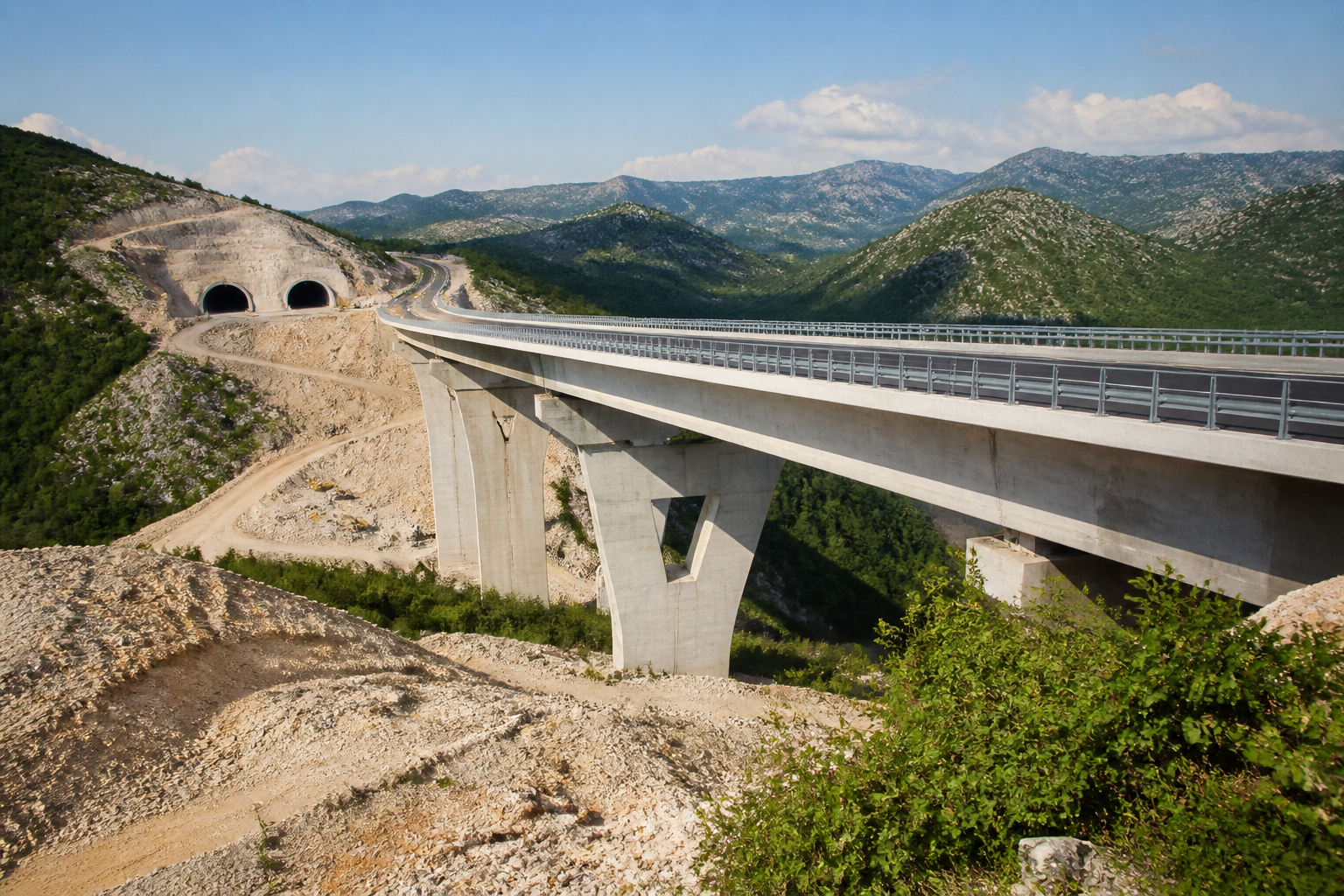
On Friday 31 July, in a seafront hotel in Crikvenica, the head of Croatia's state motorway company signed a €252 million construction contract. There was no European Commission logo on the backdrop. Deputy Prime Minister and transport minister Oleg Butković, who attended, was explicit that the project is being financed entirely through Hrvatske autoceste, without EU funding.
That is the most interesting thing about the deal, and almost nobody reported it as the story.
What was actually signed
HAC chairman Boris Huzjan and representatives of a five-company consortium signed for the Jadranovo–Selce sub-section of the A7: 12.3 kilometres, €252 million excluding VAT, 42 months from site possession. It is the second and harder half of the Križišće–Žuta Lokva route, the missing link between the northern Adriatic and the rest of the Croatian network.
The engineering content explains the price. Huzjan put the section at 11 bridges and viaducts and eight tunnels across 12.3 kilometres — a major structure roughly every 650 metres — with 200 to 300 engineers expected on the job. Butković called it the first significant road investment on this stretch of coast in more than 45 years.
The consortium tells you where the tunnel crews live
The winning group is Kolektor CPG, Kolektor Koling, CGP, Gorenjska Gradbena Družba and Euro-Asfalt. Four of the five are Slovenian. The fifth is Bosnian. No Croatian contractor leads the biggest package on the country's most demanding road corridor.
Compare that with the first sub-section. Križišće–Jadranovo, 5.2 kilometres and more than €150 million, was signed in March 2026 with GP KRK, a Croatian builder from the island of Krk, with Prime Minister Andrej Plenković attending. The shorter, simpler package went to a domestic firm. The long tunnelled one went across the border.
This is a capability map, not a procurement scandal. Kolektor CPG has worked this coast before, taking the Novi Vinodolski bypass with Italy's ICM in 2021. Slovenian road builders held their tunnelling and heavy-structures crews together through the lean post-2008 years; much of Croatia's own large-civils base did not survive that decade intact. When a package needs eight tunnel portals driven in parallel against a 42-month clock, the shortlist is whoever still owns the plant and the people. That shortlist ignores borders.
The arithmetic of a motorway paid for by tolls
HAC reported revenue of €415.2 million and net income of €68.45 million in its most recent annual business report filed with the Croatian finance ministry. The two A7 contracts together commit roughly €400 million over about four years. That is close to one and a half times annual net income spent every year of the build, carried on toll receipts and HAC's own borrowing capacity instead of grants.
Croatia is not short of European money in the abstract: its 2021–27 cohesion allocation is around €9 billion. What changed is what that money buys. EU transport funding has tilted hard toward rail, TEN-T bottlenecks and, lately, military mobility. Greenfield motorway capacity in a middle-income member state sits near the bottom of that list. So Croatia is doing what a mature network owner does — using the cash the existing asset throws off to finish the asset.
Why this matters well beyond Croatia
Every road programme in Central and Eastern Europe is heading toward the same wall. Poland, Czechia and Hungary have already watched co-financing rates for road work fall. Romania and Bulgaria are next. The question is not whether the roads get built; it is who becomes the sponsor when Brussels steps back. The answer, increasingly, is the toll operator.
That changes three things for anyone bidding into these markets. Payment certainty becomes a function of traffic volumes and tariff policy rather than grant drawdown, so the contractor carries a different counterparty risk. Scope discipline gets harsher, because a self-funding sponsor cannot absorb a variation by enlarging a grant envelope. And procurement stops being shaped by cohesion audit rules, which in practice widens the field to regional contractors who never chased EU-funded work in the first place.
The end state is the real trade
Butković said the quiet part out loud in Crikvenica: once Križišće–Žuta Lokva and the route toward Dubrovnik are complete, Croatia's motorway network is finished. A toll operator with no remaining greenfield programme is a different financial animal — a mature, cash-generative asset with a maintenance capex profile, which is exactly the shape infrastructure funds pay premiums for.
Croatia has been here before. In 2017 the government proposed monetising HAC and Autocesta Rijeka–Zagreb through a 30-to-50-year management concession, with an estimated €2.4–3.2 billion paid up front against more than €4 billion of debt, then shelved it under union and political pressure. That plan asked investors to buy an unfinished, indebted network. A completed one, self-funding its final packages from toll revenue, is a far easier sell. Contractors should read the A7 awards as the tail of the Croatian greenfield pipeline. Investors should read them as the pre-sale tidy-up.
Share it with your peers
Help your network stay ahead of CEE capital projects.
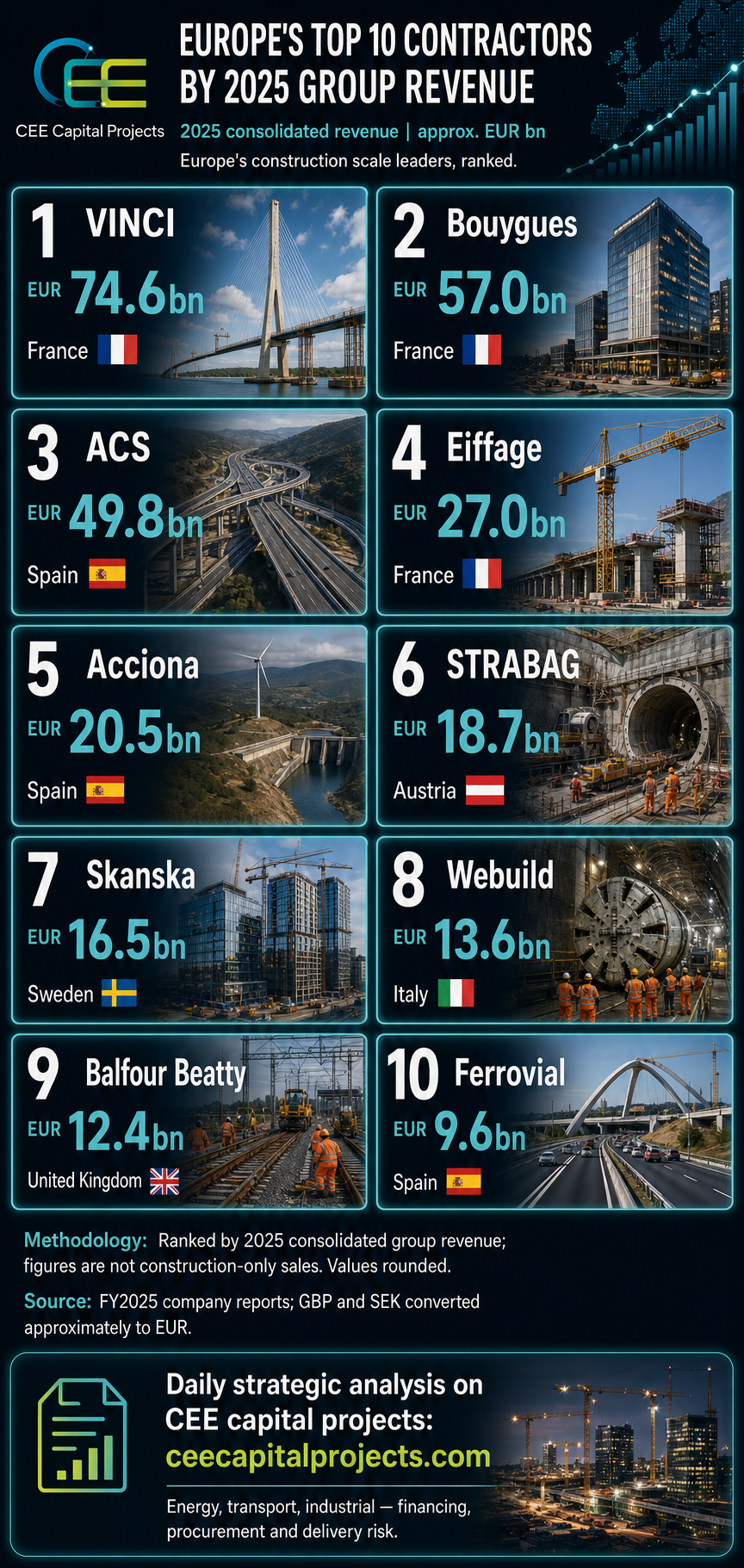
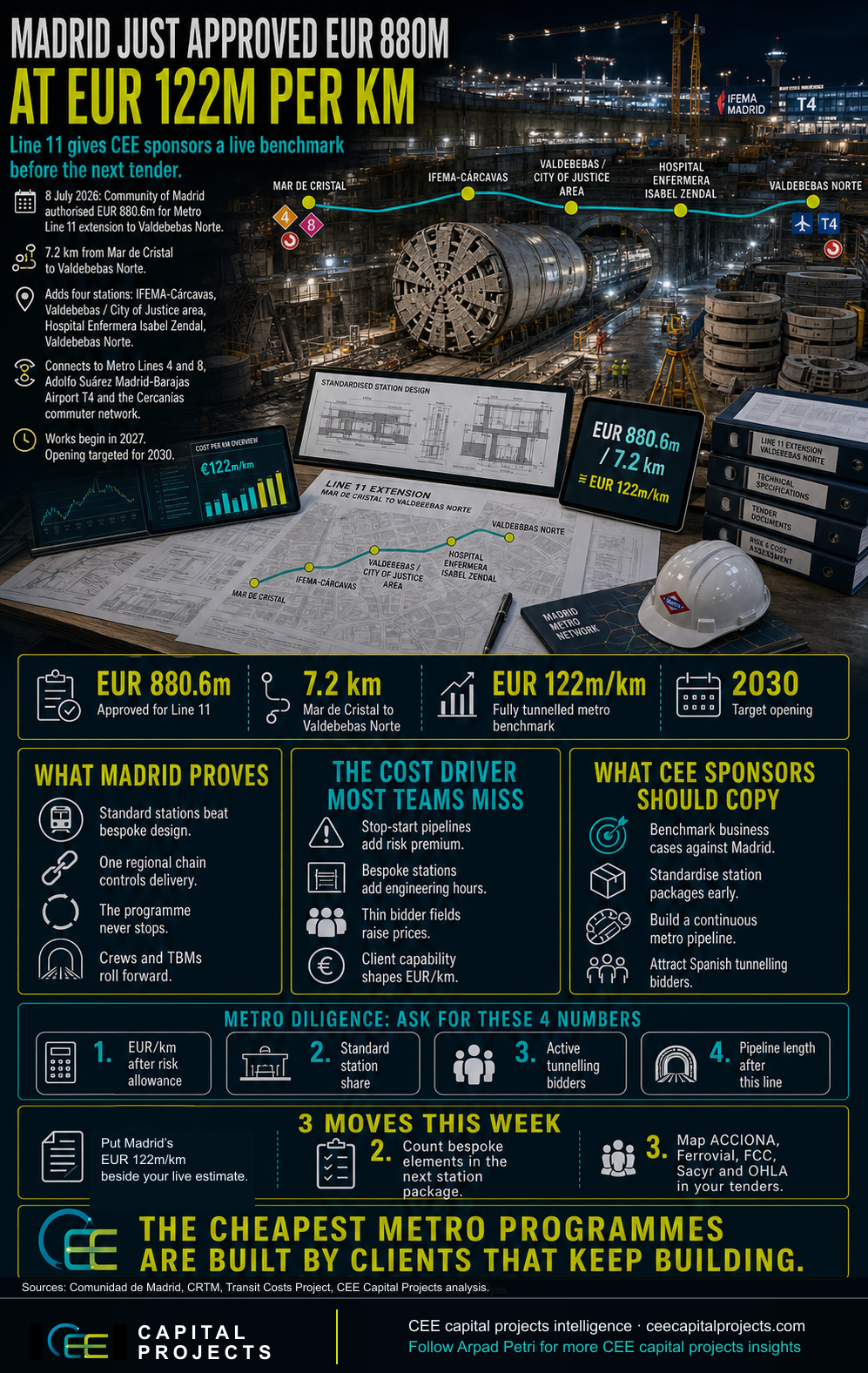
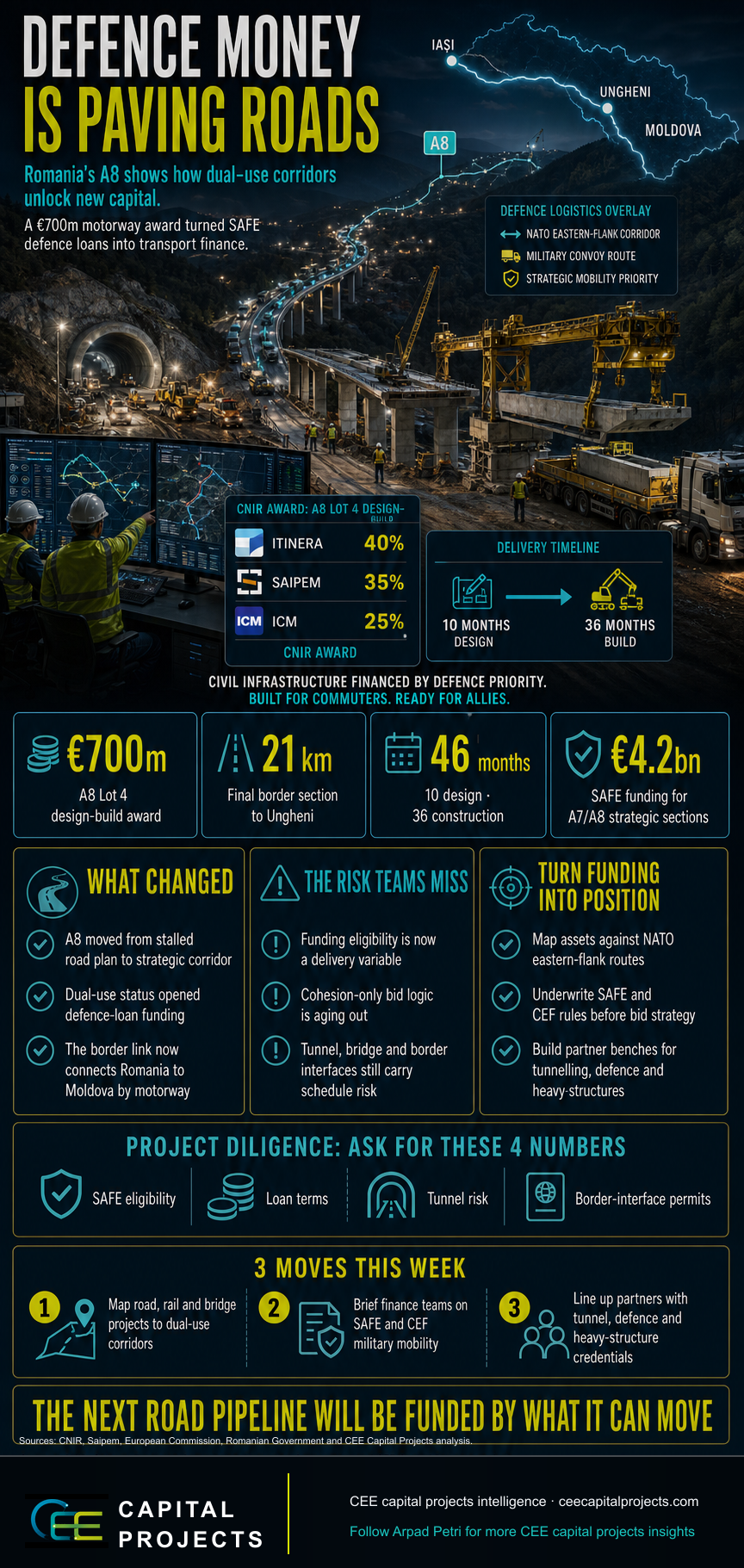
Explore our infograph library — strategic visuals for CEE capital projects leaders.
Project benchmarks, financing structures, tender dynamics and delivery risk — at a glance. Free access for investors, owners, contractors and strategy teams tracking CEE capital projects.
Browse the libraryStrategic Insights
📊 Analytics & Strategic Insight
When Brussels stops paying for tarmac, the toll booth becomes the bank
The decision most in this industry are avoiding:
👉 Nobody checks who pays after the grant ends. Bid teams price the job. Very few price the client. A road paid for by tolls has a different cash rhythm than a road paid for by a grant, and that shows up in payment delays years later.
👉 Tunnel crews are use them or lose them. Firms that kept their tunnel teams through the slow years can bid the hard jobs now. Firms that let them go cannot rebuild them inside one tender. That choice was made ten years ago.
👉 A finished network is a warning, not a party. When a country says its motorways are done, the local road market shrinks to repairs. Builders who only do new build have a few years to find their next thing.
Here's the full context:
→ 2001: Croatia sets up Hrvatske autoceste (HAC) to build and run its motorways. Toll money pays for the network.
→ 2017: HAC and its sister company owe more than €4 billion. The government plans to hand the motorways to a private operator for 30 to 50 years for €2.4 to €3.2 billion up front. Unions push back and the plan is dropped.
→ 2021–2027: Croatia has about €9 billion of EU cohesion money. Almost none of it is meant for new motorways. EU transport money has moved to rail and to fixing bottlenecks.
→ March 2026: HAC signs the first A7 piece, Križišće–Jadranovo. 5.2 km, more than €150 million. A Croatian builder, GP KRK, wins it.
→ Most recent: On 31 July 2026 HAC signs the second and harder A7 piece for €252 million: 12.3 km, eight tunnels, eleven bridges, 42 months. Four Slovenian firms and one Bosnian firm win it. The minister says there is no EU money in the job at all.
What this means for infrastructure operators, contractors and investors:
✅ Grants are drying up for roads, so tolls take over. Expect more road work in Central and Eastern Europe paid for out of the operator's own income. Read the operator's accounts before you read the drawings.
✅ Heavy structure work crosses borders easily. Tunnels and viaducts go to whoever still owns the crews and the kit. A home market no longer protects a national builder.
✅ A completed toll network is a sale waiting to happen. Once the building stops, the operator turns into a steady cash asset. That is what infrastructure funds like to buy.
3 moves you can make this week:
1️⃣ Read the client's accounts, not just the tender. On any toll-funded job, pull the operator's revenue and profit. If yearly spend is far above yearly profit, expect slow payment and price it in.
2️⃣ Count your tunnel people. Write down how many tunnel and bridge crews you can put on site within 12 months. If the number is low, hire or partner now. You cannot buy that team mid-tender.
3️⃣ Map the last packages in your market. Find the schemes that finish the national network. Those are the last big new-build jobs. Decide now whether you move into maintenance, into another country, or out.
Related analyses
- Transport & Infrastructure
V-Híd Just Lost Hungary's HUF 338 Billion Déli Körvasút at 42 Per Cent Complete. The Grant Clock Is the Real Story
Hungary halted construction of the Budapest Southern Circle Railway on 9 October 2026 and barred V-Híd from every ongoing rail investment. The HUF 367 billion of EU money behind the job survives only if a lawful re-tender lands inside two years.
Read analysis → - Transport & Infrastructure
Afcons Wins Croatia's EUR 899m Dugo Selo-Novska Rail Contract: Four Bids, No European Prime
Croatia signed its largest ever railway contract on 1 October 2026, handing 83 km of double-tracking to India's Afcons Infrastructure at EUR 677.06m excluding VAT. Four bids were priced for the work and not one of them came from a European prime contractor.
Read analysis → - Transport & Infrastructure
STRABAG Closes BAWI Construction Buy in Romania as Rail Qualification Becomes the Scarce Asset
STRABAG has closed its purchase of BAWI Construction, a Bucharest rail specialist with 240 employees and about EUR 60 million of 2025 output. The number that matters is the qualification it buys, as Romania opens a EUR 5.99 billion rail programme with the EU recovery window shut.
Read analysis →
Building in Central Europe?
Tell us what you're building. We'll tell you what can go wrong — and how to prevent it.