We Help International Investors and Project Owners Deliver Major CEE Projects Without Expensive Surprises
Independent project intelligence and advisory across energy, transport, real estate and industrial construction.
EU Innovation Fund Awards EUR 3.4 Billion to 77 Projects Against EUR 17.5 Billion of Grant Demand
The European Commission selected 77 net-zero projects for EUR 3.4bn on 19 October 2026, from a call that drew 358 applications requesting EUR 17.5bn. The 84 projects that passed evaluation and received nothing are the clearer signal for contractors, suppliers and lenders.
I keep seeing the same pattern in European industrial decarbonisation. The money announced is never the money asked for. The gap is where the real market sits.
On 19 October 2026 the European Commission selected 77 net-zero technology projects for EUR 3.4bn from the Innovation Fund. The call behind that decision had drawn 358 applications requesting EUR 17.5bn in grants, against a call budget of EUR 2.9bn. All five funding topics were oversubscribed.
Six euros of demand for every euro of budget
The award itself is straightforward. Twelve large-scale projects take about EUR 1.58bn. Clean-tech manufacturing takes almost EUR 895m across twelve projects. Seventeen medium-scale projects take about EUR 458m, sixteen pilots about EUR 394m, and twenty small-scale projects about EUR 124m. The Commission puts expected abatement at around 290 million tonnes of CO2 equivalent over the first decade of operation, which it describes as roughly one tonne per second.
Divide the money by the projects and the average grant is about EUR 44m. For a first-of-a-kind industrial plant, that sum sits closer to a contingency line than to a capital stack. Its main value is the credential. The large-scale band is the only one where the cheque approaches the capital cost, at roughly EUR 132m per project on the Commission's own split.
A seal is not a cheque
The number that matters for anyone selling engineering, equipment or construction into this market is 84. That is how many projects passed the evaluation and received no money. They can instead carry the STEP seal, a quality label meant to help them attract other European and national funding. A further 160 proposals remain eligible for project development assistance from the European Investment Bank.
So 161 projects of 358 cleared the technical bar, and fewer than half of those were funded. The rest now sit in a queue holding a credential rather than a capital stack. They do not disappear. They re-enter the next call, which the Commission plans for early December 2026 with a EUR 1bn clean-tech manufacturing topic, or they go looking for a different funding route.
For contractors and suppliers that queue is the forward pipeline, and it is a pipeline with no final investment decision behind any of it. Treating a STEP seal as a committed project is the mistake this market will make over the next eighteen months.
Where Central and Eastern Europe actually sits
The regional read is mixed. Greece took two selections: AegeanFloat, a 45 MW floating offshore wind project in the Aegean promoted by Terna Energy, and Talos, a Cretan microgrid pairing solar and wind with a 400 MWh solid-flow battery. Croatia took Koncar-Nexus, a modular 2.5 MW medium-voltage-to-direct-current conversion platform from Koncar. Romania and Hungary share Flow4EVE, a heat pump system for electric vehicles. Romania also took a tile project and Bulgaria a copper recycling project, while Cyprus took a virtual power plant built on bidirectional chargers.
The absence is more telling than the presence. Industrial carbon management took sixteen projects and close to EUR 1.2bn, about a third of the round, and Bellona Europa noted on 22 October 2026 that none of the selected projects sit in Central or Eastern Europe. The region carrying the heaviest industrial carbon intensity in the single market is missing from the part of the fund that pays for capturing it.
The fund and the projects share one price
The Innovation Fund is paid for out of EU Emissions Trading System auction revenue, and the Commission estimates it will draw on about EUR 40bn of that revenue between 2020 and 2030. That structure is elegant on paper and awkward in practice. The pool that subsidises decarbonisation moves with the same carbon price that makes decarbonisation worth doing. A softer carbon market shrinks the grant pool at the point where projects need it most.
What to watch between now and the first quarter of 2027
Promoters have been invited to begin preparing grant agreements with CINEA, and the Commission expects results from that process in the first quarter of 2027. That window is where the attrition happens. A selection is conditional, and projects drop out between selection and signature when sites, permits, offtake or an engineering price fail to arrive. Grant agreements for the 2025 hydrogen and industrial heat auctions are expected before the end of this year, which gives the market a near-term read on conversion.
Two further signals are worth logging. The fund's first nuclear award went to NetZeroHeat in France, a heat-only reactor expected to deliver about 131 GWh of low-carbon heat a year into a district heating network. The first direct air capture award went to Furu in Norway, removing about 4,000 tonnes of CO2 a year into the Northern Lights storage system. Nuclear entered this architecture through heat rather than power. Carbon removal entered at a volume a single steel mill emits in days. Both are reference plants, and their real output is a price for unit two. That price is what every sponsor behind the 84 unfunded projects will be reading.
📊 Analytics & Strategic Insight
The unfunded projects tell you more about European industrial capex than the funded ones
The decision most in this industry are avoiding:
👉 A grant is a credential before it is capital. At about EUR 44m per project across 77 selections, the Innovation Fund cheque covers risk and contingency on a first-of-a-kind plant. Sponsors who treat selection as financing discover the gap at the point where an engineering price is asked for.
👉 The queue is being read as a pipeline by people who should know better. Eighty-four projects passed evaluation with no money and a STEP seal. Order books built on that list will not convert at anything like a normal rate, and the firms resourcing against it carry the cost.
👉 Nobody wants to say that Central and Eastern Europe lost the carbon management round. Sixteen industrial carbon management projects took close to EUR 1.2bn and none of them sit in the region with the heaviest industrial carbon intensity in the single market.
Here's the full context:
→ 2020: The Innovation Fund is established, drawing on EU Emissions Trading System auction revenue, with an estimated EUR 40bn available across 2020 to 2030.
→ 2025: The Commission runs dedicated hydrogen and industrial heat auctions alongside the main calls, with grant agreements for those rounds expected before the end of 2026.
→ December 2025: The net-zero technologies call opens with a budget of EUR 2.9bn across five topics, from small-scale pilots to clean-tech manufacturing.
→ 2026: The call closes with 358 applications requesting EUR 17.5bn, roughly six euros of demand for every euro of budget, and every topic oversubscribed.
→ Most recent: On 19 October 2026 the Commission selects 77 projects for EUR 3.4bn in 23 European Economic Area countries, makes the fund's first nuclear and first direct air capture awards, leaves 84 evaluated projects unfunded with a STEP seal, and refers 160 proposals to the European Investment Bank for project development assistance.
What this means for infrastructure operators, contractors and investors:
✅ Price first-of-a-kind work as first-of-a-kind work. A reference plant has no productivity history, no settled method and no comparable. Open-book or target-cost arrangements with a tested gain-share belong here, and a lump sum priced off an analogue plant will be argued over for years.
✅ Read the grant conditions before the grant amount. Selection is conditional and the conversion step runs to the first quarter of 2027. Permits, offtake, site control and an engineering price all have to land before signature, and the sponsors who fail are usually short one of those four.
✅ The December call is a procurement event as much as a policy event. A EUR 1bn clean-tech manufacturing topic opening in early December 2026 sets the timetable for a cohort of factory projects. Front-end engineering capacity for those bids is bought months ahead of the deadline.
3 moves you can make this week:
1️⃣ Pull the selection list and sort it by country and category. Mark which selections sit in markets you already deliver in, and which of the 84 unfunded names you have already resourced against.
2️⃣ Ask every sponsor you support one question: which condition precedent are you furthest from clearing? The answer predicts the grant agreement date better than the project programme does.
3️⃣ Check your carbon price exposure on both sides of the balance sheet. If a client's subsidy and a client's business case both move with the emissions trading price, your order book carries a single risk factor wearing two names.
Share it with your peers
Help your network stay ahead of CEE capital projects.
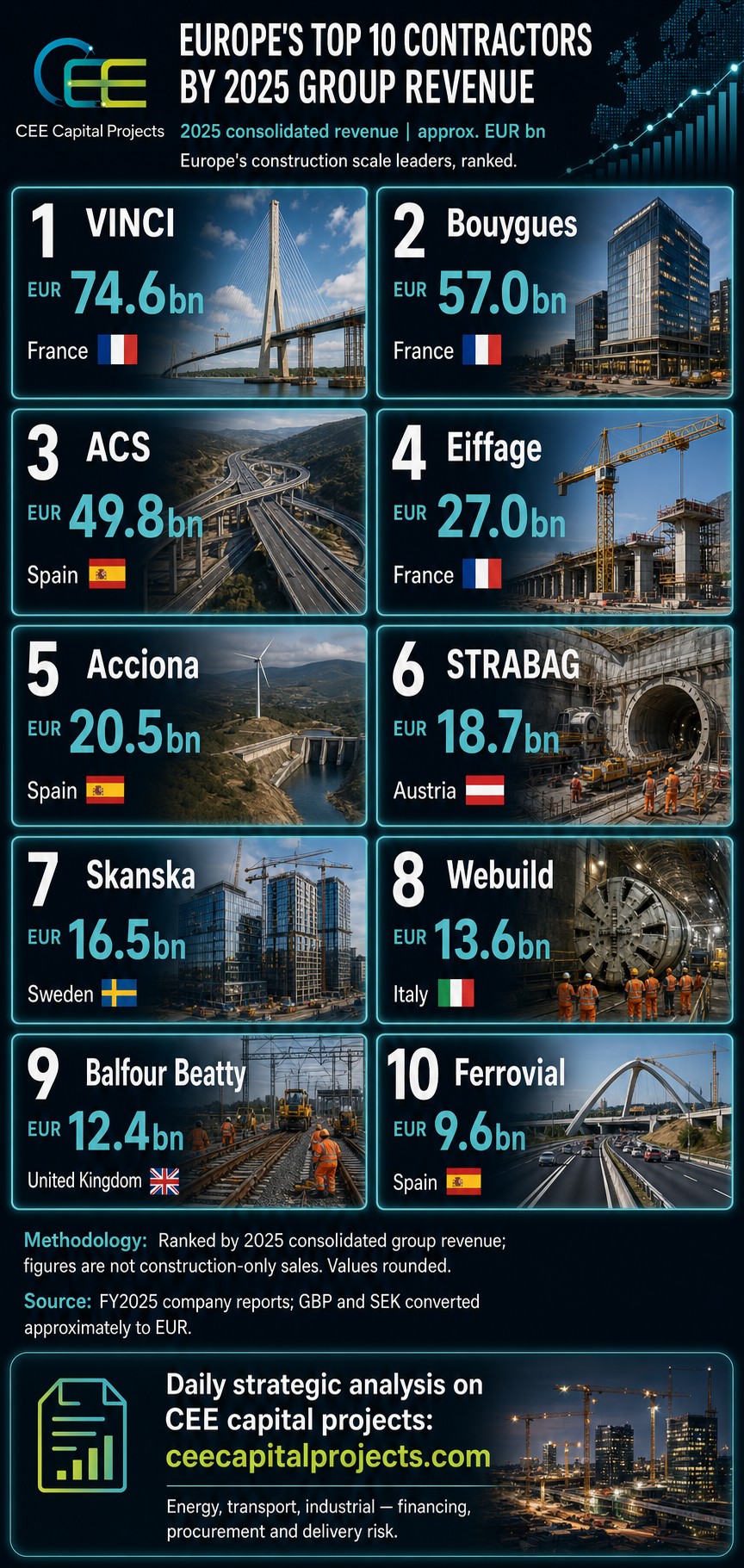
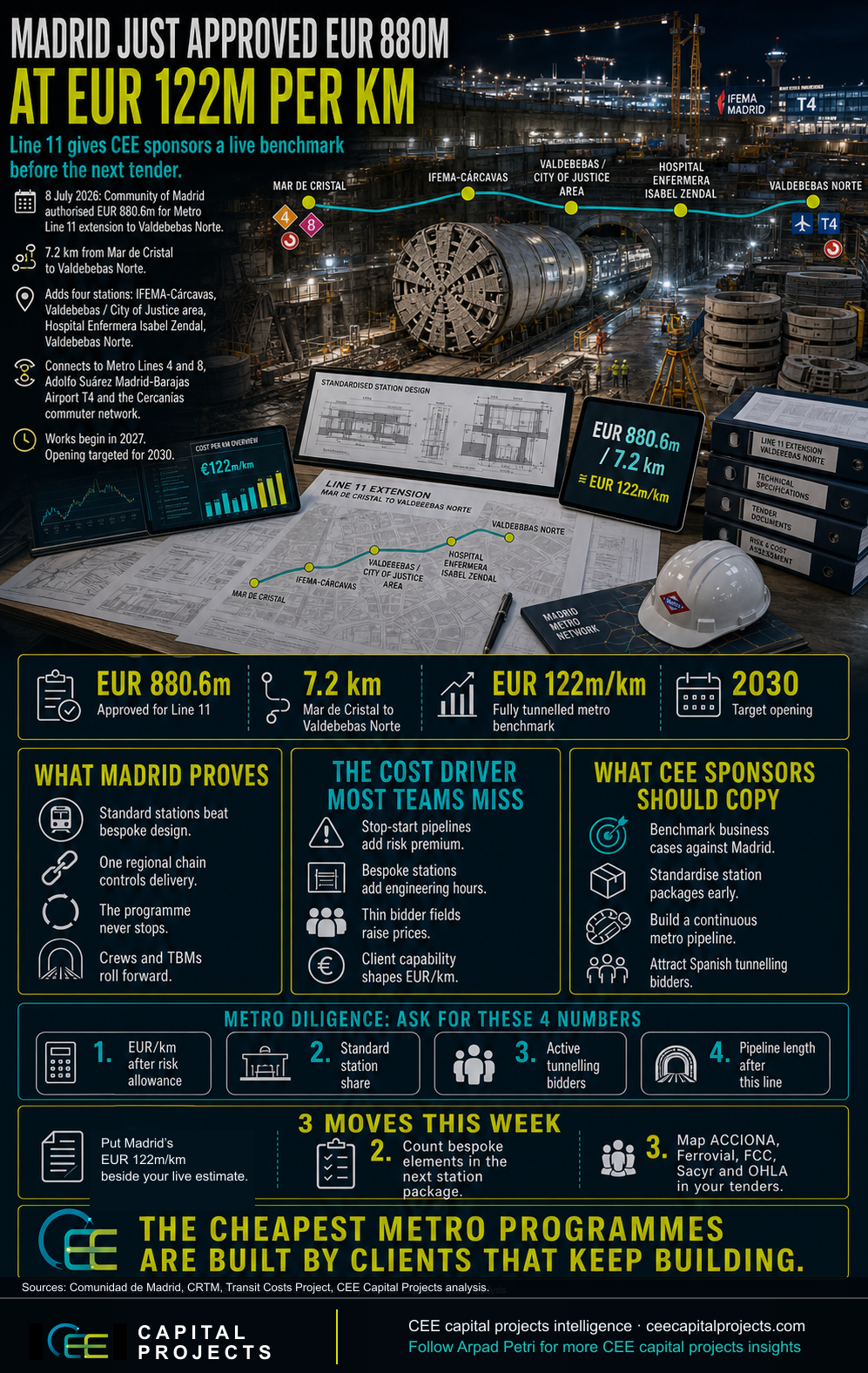
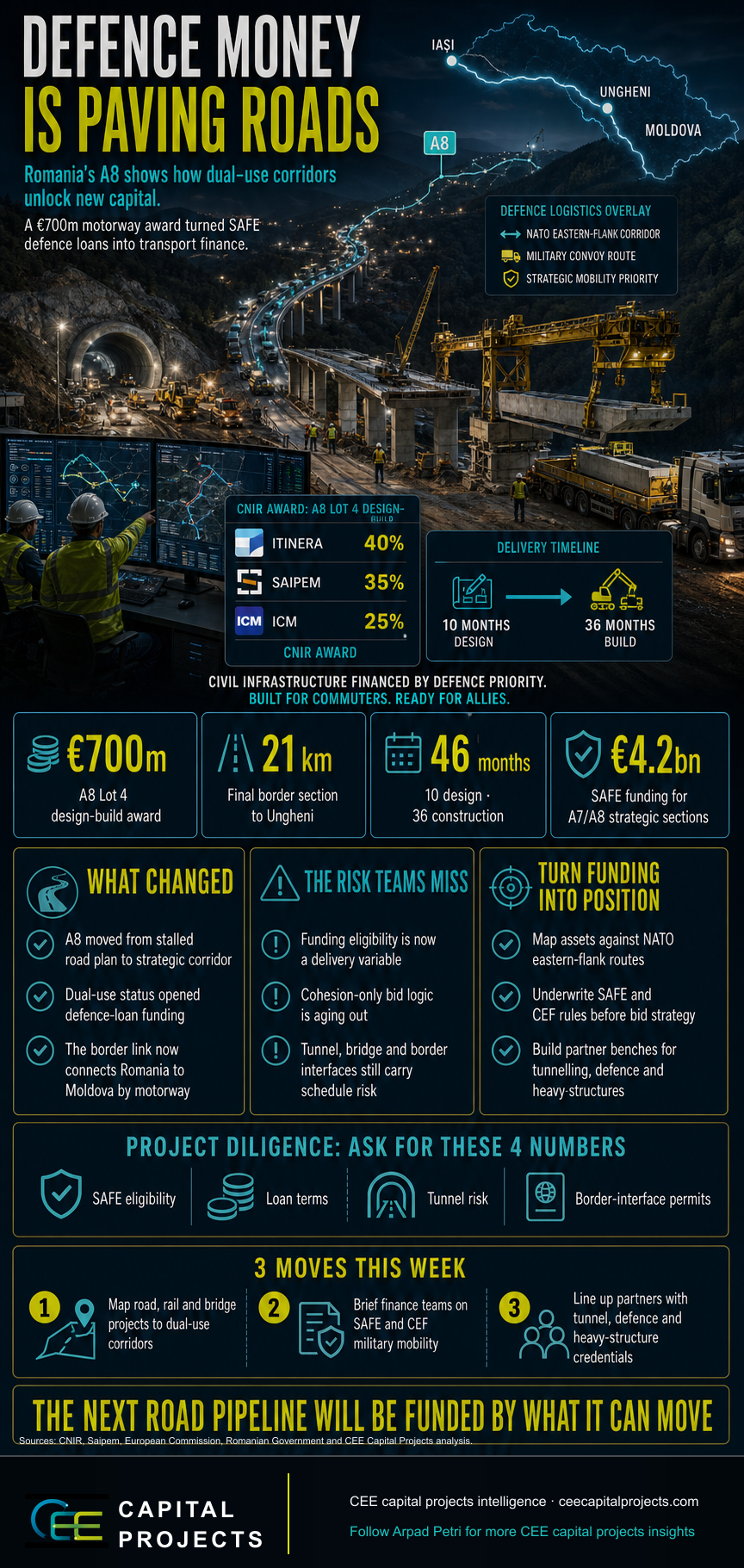
Explore our infograph library — strategic visuals for CEE capital projects leaders.
Project benchmarks, financing structures, tender dynamics and delivery risk — at a glance. Free access for investors, owners, contractors and strategy teams tracking CEE capital projects.
Browse the libraryRelated analyses
- Real Estate & Construction
Atenor Sells 87 Perspectiv Homes to the Luxembourg State: The Presale Threshold Is Now a Public Instrument
Atenor and Tracol Immobilier have sold 87 residential units at Perspectiv in Esch-sur-Alzette to the Luxembourg State, months before main construction starts. The deal shows how a public off-plan buyer now supplies the presale certainty that development banks demand.
Read analysis → - Transport & Infrastructure
ViAlliance35 Wins the Czech D35 Motorway Concession, and the 2.9 Billion Euro Headline Is a Payment Stream
The Czech government has approved the ViAlliance35 concession contract for 35.4 km of the D35 motorway between Opatovec and Mohelnice. The headline of about 2.9 billion euro is the discounted value of 22 years of availability payments, which is a different product from a construction budget.
Read analysis → - Transport & Infrastructure
Poland's PLN 1.3bn A2 Widening: 89 km of Third Lane, and the Pre-2012 Design That Made It Cheap
GDDKiA has signed the fourth and final contract to widen 92 km of the A2 between Łódź and Warsaw, closing a programme worth about PLN 1.3bn. The cost is low because land and structures were sized for a third lane before the motorway opened in June 2012.
Read analysis →
Is your project leaking money through its subcontractors?
Most owners lose 3–8% in vendor packages without noticing. Tell us about your project — we'll tell you where we'd look first.