We Help International Investors and Project Owners Deliver Major CEE Projects Without Expensive Surprises
Independent project intelligence and advisory across energy, transport, real estate and industrial construction.
Atenor Sells 87 Perspectiv Homes to the Luxembourg State: The Presale Threshold Is Now a Public Instrument
Atenor and Tracol Immobilier have sold 87 residential units at Perspectiv in Esch-sur-Alzette to the Luxembourg State, months before main construction starts. The deal shows how a public off-plan buyer now supplies the presale certainty that development banks demand.

The one question I keep putting to residential developers is simple. Who actually buys your first phase? In Luxembourg the answer is now a ministry.
On 20 October 2026 Atenor and its Luxembourg partner Tracol Immobilier signed a notarial deed. Their joint venture Lankelz Foncier sold 87 residential units to the Luxembourg State. The units total 9,822 square metres (m2). Main construction on the phase is scheduled for the first quarter of 2027. The buyer signed before the builder started.
A deed before a building site
Perspectiv is a mixed-use scheme in Esch-sur-Alzette, in the south of Luxembourg. The 87 units sit inside Lot 1 Zuid, which covers 14,319 m2 in total. The rest of that lot is retail, offices and private-market housing. Atenor announced the sale itself and disclosed no price.
That matters because of the way the State buys. It buys off-plan, under the route Luxembourg calls VEFA, a sale in the future state of completion. An off-plan buyer pays against construction progress, so this deed releases almost no cash today. What it releases is certainty. The exit on the phase is fixed before the first concrete is poured.
Why one state signature outprices 87 private buyers
A development loan is sized against presales. The bank wants to know the finished units are already sold. Here is the mechanism. A lender does not treat all presales as equal. It discounts each one for the risk that the buyer walks away. Eighty-seven private reservations carry eighty-seven credit risks and a cancellation rate. One sovereign counterparty carries almost none.
So the same share of presales buys a cheaper loan when the buyer is a state. The reason is simple. The lender's downside case stops being an unsold block. It becomes a delivery question instead. That lifts the loan-to-cost the bank will accept, and the developer adds no fresh equity.
This is why the identity of the first buyer now decides which schemes start. Two developers can hold the same site, the same consent and the same cost plan. The one with a public buyer draws its loan. The other waits for a private market that is still slow.
The ministry has said the quiet part out loud
Luxembourg's Ministry of Housing and Spatial Planning is explicit about what the instrument does. It says the State can take an anchor reservation at the start of sales. It says this builds buyer confidence and helps a project reach the presale threshold banks require. That is a sentence about construction finance, written by a housing ministry.
The scale has moved fast. The State had bought 460 homes off-plan by the close of 2025. Six months later the count bought or reserved stood at 830. Spending on affordable housing reached 474 million euro over the same year. The first off-plan programme carried a budget of 480 million euro, and a further 300 million euro has been allocated.
The driver is not generosity. When private demand fails the presale test, nothing starts at all. A developer that cannot clear the threshold cannot draw the loan. The site then stays empty and the pipeline shrinks. The State is buying the threshold rather than the output.
What it means on site
The funded part of a scheme sets the shape of its works packages. Only 9,822 m2 of the 14,319 m2 lot has a buyer. A lender funds what is pre-sold and little else, so only that part goes out to tender now. The shared substructure has to go with it.
Contractors should read that as a phasing problem rather than a volume win. A smaller first package still carries the full cost of site set-up, cranage and basement works. Those costs do not halve when the superstructure does. A bidder that spreads preliminaries across the whole lot will be undercut. The winner will be the one who prices the funded phase alone.
What the deed does to Atenor, and what it does not do
Atenor needs this kind of counterparty more than most. Its net financial debt stood at 484.8 million euro at the half year. It has told the market that no capital increase is planned. A developer without equity headroom has to buy its loan-to-cost with contract quality instead.
The timing invites a wrong conclusion. A 65 million euro bond matured on 23 October 2026, three days after the deed. The deed did not pay that bond and was never going to. Off-plan proceeds arrive with the concrete, spread over the build. Maturities are met by refinancing and by completed sales. Atenor reports 55 per cent of its strategic projects pre-sold or pre-let, and that ratio is what refinancing banks read.
The price nobody published, and who carries the index
Atenor gave no price, so the only public anchor is the State's last disclosed purchase. In September 2026 the ministry bought 30 apartments in the ROOTS scheme at Esch-Belval. It paid 20.6 million euro, or about 687,000 euro per apartment. That is a benchmark rather than this deal's price.
The more useful point is what a fixed off-plan price does to risk. The price is agreed now and the building happens later, so the developer owns every cost movement in between. Main works start in the first quarter of 2027. Material, labour and subcontract prices between deed and delivery sit on the seller's side. A public buyer removes the demand risk and hands back the cost risk.
The analyst's read
My call is that this route spreads, and that it changes who develops in Luxembourg. The developers that win phase-one funding will be the ones with a public buyer inside the structure. I expect more partial acquisitions, and more joint ventures with local builders who know the public process.
The figure that settles it is Atenor's next maturity. A 75 million euro bond falls due on 19 March 2027. Refinance that on bank terms with no discounted disposal, and the state-anchored model has done its job. Meet it by selling a project cheaply, and the anchor bought time rather than capital.
📊 Analytics & Strategic Insight
Luxembourg has turned housing policy into a development-finance instrument, and the presale threshold is where it bites
The decision most in this industry are avoiding:
👉 The State is underwriting development finance. The homes are the output of that. The instrument itself works as credit support, and a housing ministry runs it rather than a treasury.
👉 Partial acquisition moved the State from last buyer to first buyer. Buying a whole unsold block makes a state the residual purchaser of failure. Buying part of a block at launch makes it the anchor. It then carries the letting risk on the cheapest homes. The private units price off a de-risked scheme.
👉 A public buyer transfers construction cost risk onto the developer. A price fixed before a build, with the build starting later, is a position in the cost index. Most coverage reads these deals as pure de-risking. Half the risk moves the other way.
Here's the full context:
→ 2024: Luxembourg's state spending on affordable housing stood at 224 million euro.
→ 2025: Spending reached 474 million euro and 1,293 new subsidised homes were approved.
→ End of 2025: The housing fund covered 5,348 subsidised units in 351 projects, and 460 homes were bought off-plan.
→ Mid 2026: Homes bought or reserved off-plan reached 830, with 480 million euro committed and 300 million euro more allocated.
→ Most recent: Atenor and Tracol Immobilier sold 87 units at Perspectiv to the Luxembourg State on 20 October 2026.
What this means for infrastructure operators, contractors and investors:
✅ The lender's technical adviser gets a different brief. With the demand side closed, the diligence question becomes buildability and the cost plan. That report now carries more weight than the sales agent's.
✅ The main contractor's bid team should price the funded phase on its own. Site set-up, cranage and substructure land on a smaller area, so a masterplan-wide spread of those costs loses the job.
✅ The equity sponsor's treasury gains covenant room and no cash. A deed of this kind improves the presale ratio the banks read. It does nothing for a maturity falling due this quarter.
3 moves you can make this week:
1️⃣ Ask your bank what presale percentage it needs and what counts towards it. Get the discount it applies to private reservations in writing. Then test whether a single public buyer clears the test alone.
2️⃣ Price the index gap between signature and handover. Take the months between a fixed off-plan price and delivery. Apply the cost movement you expect. Put that figure in the bid as a line rather than a hope.
3️⃣ Map the public buyers in every market you develop in. Find out whether a partial purchase at launch is available, who signs it, and what per-unit ceiling applies.
The analyst's read:
This proves that a public buyer can start a residential phase the private market would have left on the shelf. It does not prove the model is cheap for the developer. The cost risk between a fixed price and a later build stays with the seller. The figure that settles it is the margin booked on this phase at completion. Read that against the construction cost index over the same months.
Share it with your peers
Help your network stay ahead of CEE capital projects.
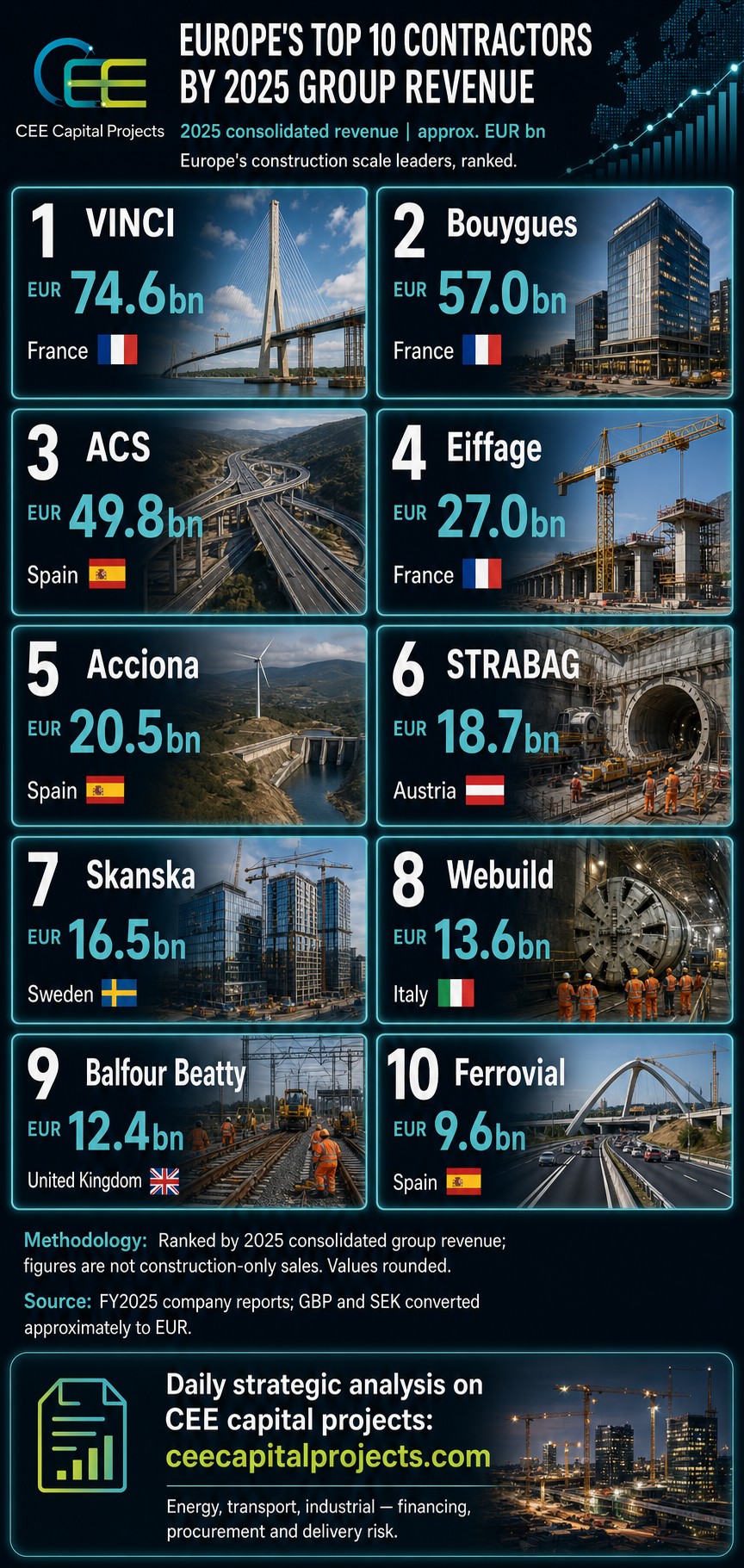



Explore our infograph library — strategic visuals for CEE capital projects leaders.
Project benchmarks, financing structures, tender dynamics and delivery risk — at a glance. Free access for investors, owners, contractors and strategy teams tracking CEE capital projects.
Browse the libraryRelated analyses
- Real Estate & Construction
Futureal Bought Hungary's Largest Outlet Centre at 99.7% Occupancy Instead of Building One. Budapest Developers Just Repriced New Build
Futureal Group has closed on Premier Outlet Budapest, 23,000 sqm of lettable space at 99.7% occupancy, and its chief investment officer says income-producing property can beat new development on risk and return. For Hungarian contractors the risk is the start date, not the award.
Read analysis → - Real Estate & Construction
RSJ and Na Jelenach Commit CZK 50bn to 5,500 Prague Rental Homes, Against a Czech Institutional Stock of 4,100
RSJ and Na Jelenach plan about 5,500 rental homes on 22 hectares in southern Prague, an investment above CZK 50bn delivered over roughly ten years. Prague's operational institutional rental stock is 4,100 flats, which moves the hard question from construction to ownership.
Read analysis → - Real Estate & Construction
One United Properties' EUR 10m Floreasca Plot: A EUR 130m Bucharest Tower Buyers No Longer Pre-Fund
One United Properties has paid EUR 10m for a 5,755 sqm plot on Barbu Vacarescu in Bucharest, for a 25-storey tower with a gross development value of about EUR 130m. Law 207/2025 caps reservations at 5 per cent and defers the rest of the buyer money to structure and installations, so land, permit and frame are now funded from the balance sheet.
Read analysis →
Is your project leaking money through its subcontractors?
Most owners lose 3–8% in vendor packages without noticing. Tell us about your project — we'll tell you where we'd look first.