We Help International Investors and Project Owners Deliver Major CEE Projects Without Expensive Surprises
Independent project intelligence and advisory across energy, transport, real estate and industrial construction.
EDF's EUR 14 billion EPR2 civil-works deal: the price rose before the first pour
EDF is close to signing the civil works for six EPR2 reactors with Vinci, Bouygues, Eiffage, NGE and Fayat. The price rose in real terms after preselection, and a published decision date explains who held the leverage.
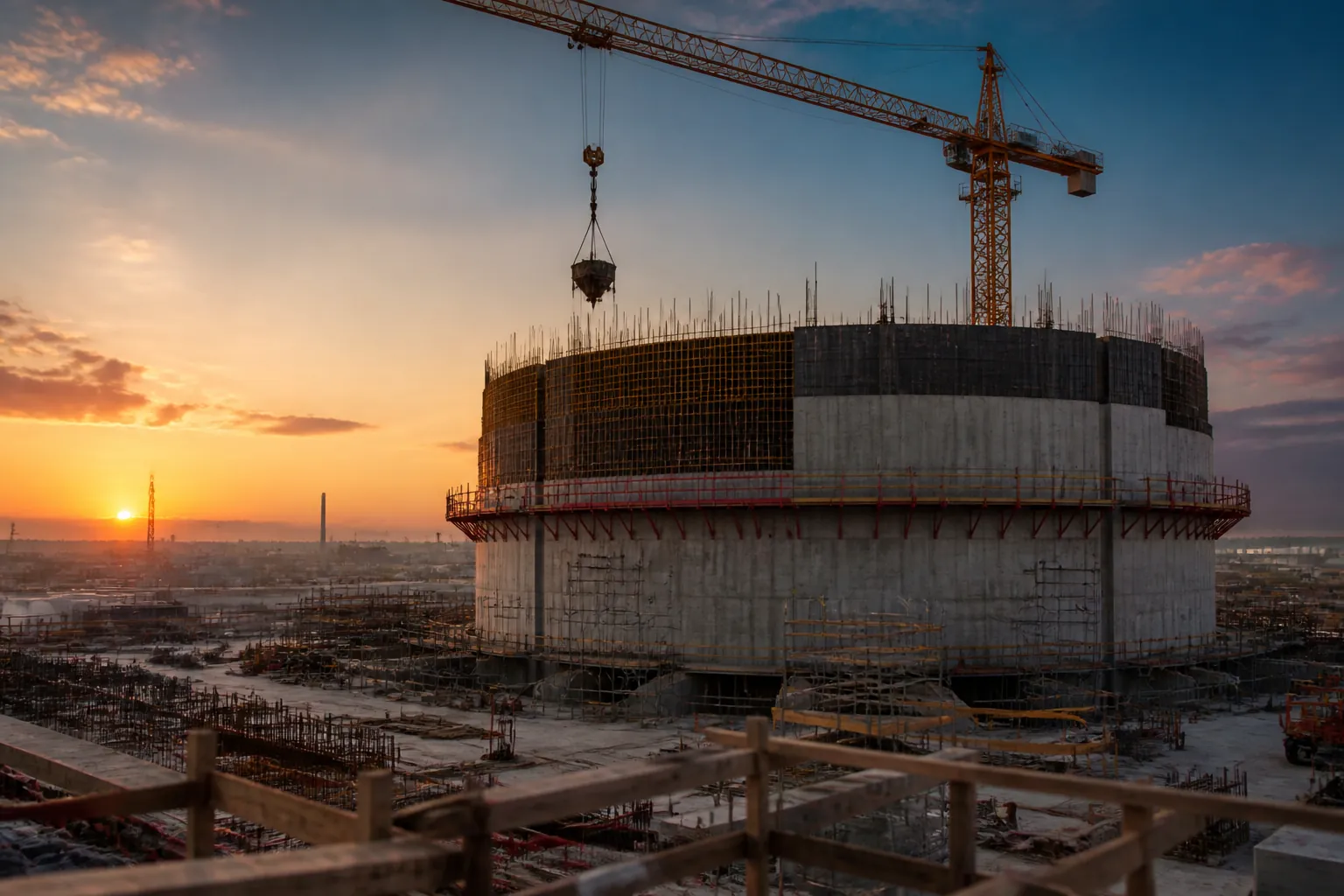
The coverage reads EDF's civil-works deal as a EUR 14 billion win for French builders. I read it as a price that moved before a single pour. The figure that changed between June and November shows who holds the leverage.
On 17 November, Les Echos reported that EDF is close to signing the civil works for its six EPR2 reactors. The grouping is Vinci, Bouygues, Eiffage, NGE and Fayat. The scope covers the foundations and the concrete buildings. The contract is worth about EUR 12 billion in 2020 money. That is close to EUR 14 billion at today's prices. The figures come from the Agefi-Dow Jones wire and the trade site Batiweb, both citing Les Echos.
The price rose in real terms
When the grouping was preselected on 3 June, the job was valued at about EUR 10 billion in 2020 money. The business site Upside reported that figure, also citing Les Echos. Both numbers use the same 2020 price base, so the rise of about a fifth is real. General inflation cannot explain it.
That matters because a constant-price figure removes the cost index from the comparison. The extra EUR 2 billion is scope, risk or margin. None of the sources says which. The gap between EUR 12 billion and EUR 14 billion is a different thing. It is indexation, the conversion from 2020 money into today's money.
Here is why the base year matters for risk. A price quoted in base-year money is normally paid through an index. The owner then carries inflation, while the builder carries quantities and productivity. EDF has not published the contract form. Lenders and auditors will read the index clause before they read the headline value.
One grouping and one deadline
EDF is negotiating with every large French builder at once, so there is no rival bid to price against. The five firms formed a single grouping for the whole programme. EDF confirmed to the news agency AFP that a proposal had been submitted and that talks continue.
The reason is simple. Nuclear civil works need large crews of qualified concrete, formwork and rebar trades. France has a limited pool of them. Splitting six reactors among rivals would set those firms bidding against each other for the same workers.
That choice removes price tension, and the calendar removes more. EDF's board is due to approve the deal by the end of November. The final investment decision follows in December. A buyer with a published decision date has less room to walk away than the seller. The builders know the date as well as EDF does.
What the financing does with a higher build cost
The state framework was set in March. The Élysée nuclear policy council confirmed a subsidised state loan covering 60 per cent of the programme. The money comes from the savings fund run by the Caisse des Dépôts. Output will be sold under a contract for difference capped at EUR 100 per megawatt hour (MWh), in 2024 money. A contract for difference pays the producer the gap when market prices fall below an agreed level.
Here is the mechanism. The strike price has a ceiling, but the build cost has none. Every extra billion of construction cost comes out of EDF's return under the cap. The loan can grow with the cost. The revenue per unit of power cannot.
That links the civil-works price to Brussels. The European Commission opened an in-depth state aid investigation on 31 March. It is testing whether the aid is limited to what is strictly necessary. A higher build cost raises the aid that counts as necessary. So the civil price feeds that test directly.
Why the share prices fell
Vinci closed 1.14 per cent lower on 18 November, according to Upside. Bouygues and Eiffage also slipped. The market read the news as neutral at best.
That happens because the market prices nuclear civil works as long, capital-heavy and thin-margin work. First concrete at Penly is planned for the end of 2028. The first two reactors are due online in 2038. Working capital and claims exposure sit on the builders' balance sheets for more than a decade.
Memory plays a part too. Flamanville 3, France's last new reactor, began construction in 2007. It reached the grid only in December 2024. A large order book is worth the margin and the claims position written into it, and little more.
The replication test
EDF says it has standardised methods to repeat each reactor pair as closely as possible. It wants build times to fall from one pair to the next. The order runs from Penly to Gravelines, then to Bugey.
That matters because the learning sits in crews and site supervisors. A drawing can be copied to the next site. A trained team must be kept together. If the gap between pairs is long, teams disperse and the next site relearns the work. One grouping holding all six reactors is EDF's answer to that risk. It is also the reason EDF accepted less competition.
My read: the deal signs, the programme budget is the test
My call is that EDF's board approves the deal this month. The investment decision then lands in December or early in 2027. The Commission's state aid ruling is the likely pacing item.
I also expect pressure on the programme estimate of EUR 72.8 billion, set in 2020 money. The civil works rose by about a fifth in real terms within five months. That matters because the rest of the budget uses the same trades and the same index. The figure that would change my call is the total cost EDF states at its final investment decision. If the total holds, savings were found elsewhere. If it rises, the civil-works move was the early signal.
For Central and Eastern Europe the lesson is direct. Dukovany, Paks II and Poland's first nuclear plant all face the same order of events. Trade press reports that Polish sponsor PEJ now expects to sign its main contract with Westinghouse and Bechtel in 2027. Sponsors there should fix the civil-works price and its index basis before their own decision date is public.
The data point we will track is what this order does to the builders' backlogs and margins. Vinci, Bouygues and Eiffage all bid for large work across Central and Eastern Europe. A decade of French nuclear work changes their risk profile and their appetite there. Our upcoming CEE Contractor League Table and Financial Health Monitor will track awards, order books and contractor finances. Join the waitlist to hear first when it is published.
Share it with your peers
Help your network stay ahead of CEE capital projects.
Strategic Insights
📊 Analytics & Strategic Insight
A published decision date is a price concession
The decision most in this industry are avoiding:
👉 The leverage moved when the deadline went public. Announcing an investment-decision date before the main civil price is fixed tells the seller when the buyer must say yes. The order of those two events matters more than the headline value.
👉 A constant-price quote hides who carries inflation. A figure in base-year money reads like a firm price. In practice it is usually an indexed one, and the owner holds the index for the whole build.
👉 Ending competition can be the cheaper choice on repeated work. Keeping one team across every reactor pair protects the learning curve. That is worth more than one competitive round, provided the gaps between pairs stay short.
Here's the full context:
→ 2022: In February, France announces a programme of six EPR2 reactors, with an option for eight more.
→ March 2026: The Élysée nuclear policy council confirms a state loan for 60 per cent of the programme, a contract for difference capped at EUR 100 per MWh in 2024 money, and a cost target of EUR 72.8 billion in 2020 money.
→ 31 March 2026: The European Commission opens an in-depth state aid investigation into the loan and the contract for difference.
→ 3 June 2026: The Vinci, Bouygues, Eiffage, NGE and Fayat grouping is preselected for the civil works, valued at about EUR 10 billion in 2020 money.
→ Most recent: On 17 November 2026, Les Echos reports EDF is close to signing at about EUR 12 billion in 2020 money, close to EUR 14 billion today. Board approval is due by the end of November and the investment decision in December.
What this means for infrastructure operators, contractors and investors:
✅ The owner's procurement team should publish the index basis with the award. Lenders, auditors and the state aid reviewers all need to see who carries inflation. A headline value without the index clause tells them very little.
✅ Bid teams in Central and Eastern Europe should expect thinner French competition on large jobs. Senior site managers and specialist trades committed to nuclear work stay committed for years. That leaves fewer of them for road, rail and energy tenders elsewhere.
✅ Equity sponsors of capped-revenue assets should model cost growth against a fixed ceiling. When revenue has a cap and construction cost does not, every overrun lands on the equity return first.
3 moves you can make this week:
1⃣ Check whether your largest contract is priced in base-year money. Read the index clause and write down who carries the gap between the base year and today.
2⃣ List every decision date you have announced against open price negotiations. Where a date is public before a price is fixed, prepare a fallback package or a staged award.
3⃣ Ask your main contractors how much senior site staff is tied to nuclear programmes. Their answer tells you how much real capacity sits behind their next bid to you.
The analyst's read:
This deal proves EDF can secure one civil-works partner for its whole reactor programme. It does not prove the programme budget holds, because the civil price rose in real terms before signing. The figure that settles it is the total cost EDF states at its final investment decision, expected around the turn of the year.
CEE Capital Projects reports
📋 Coming next
CEE Contractor League Table and Financial Health Monitor: awards, order books and financial health across CEE contractors. Join the waitlist to hear first when it is published.
→ Join the waitlist
⚡ CEE Grid Procurement Pipeline 2027-2030
Contract opportunities, suppliers and bid risk in electricity transmission and distribution across 19 markets.
→ See the report and free sample
🚆 CEE Rail Build-Out 2027-2030
Rail tender pipeline to 2030, contractor capacity and bid risk across 17 markets in Central Europe, the Baltic states, Greece, Bulgaria, Croatia and the Western Balkans. PDF report plus Excel database.
→ See the report and free sample
Related analyses
- Energy & Power
Latvia's Grid Operator Now Borrows at 4.8%, and Its Build Plan Has to Carry It
Latvia's transmission operator AST is repaying its 0.5% green bond early, after raising replacement money at 4.768%. With most of its ten-year grid plan funded from its own balance sheet, the price of that money now shapes which lines and substations move first.
Read analysis → - Energy & Power
Croatia's Next 400 kV Lines Hang on One Data Centre's Grid Contract
Pantheon AI offers to build and pay for four 400 kV lines to connect its Topusko campus, after the state held HOPS to a minimal grid plan. Croatia's next big transmission build may come from a private customer, while generators in the queue are offered curtailment instead.
Read analysis → - Energy & Power
Balfour Beatty's 9 Percent Grid Margin Shows Where Contractor Profit Sits. CEE Price-Only Substation Tenders Keep It With the Client
Balfour Beatty expects a support services margin of around 9 percent, well over twice its UK construction margin, as power transmission work ramps up under National Grid's framework. In Poland, substation tenders awarded on price alone mean CEE contractors moving into grids should not expect the same premium.
Read analysis →
Building in Central Europe?
Tell us what you're building. We'll tell you what can go wrong — and how to prevent it.