We Help International Investors and Project Owners Deliver Major CEE Projects Without Expensive Surprises
Independent project intelligence and advisory across energy, transport, real estate and industrial construction.
Duna Aszfalt and STRABAG Win EUR 219m North Macedonia Motorway as Hungary's Road Builders Bid Through the EBRD
STRABAG and Duna Aszfalt have won a EUR 219m contract for 11.5 km of the E65 motorway between Bukojcani and Kicevo, procured through the EBRD's electronic system from ten prequalified bidders. The award shows how Hungarian road builders are replacing domestic concession volume with development-bank work that carries a five-year maintenance tail.
I keep seeing the same move from Hungary's road builders. Their next four years of volume are bought outside Hungary, and the gatekeeper is a development bank. On 13 October 2026 STRABAG confirmed that its consortium with Duna Aszfalt Zrt. had won a EUR 219 million motorway contract in North Macedonia.
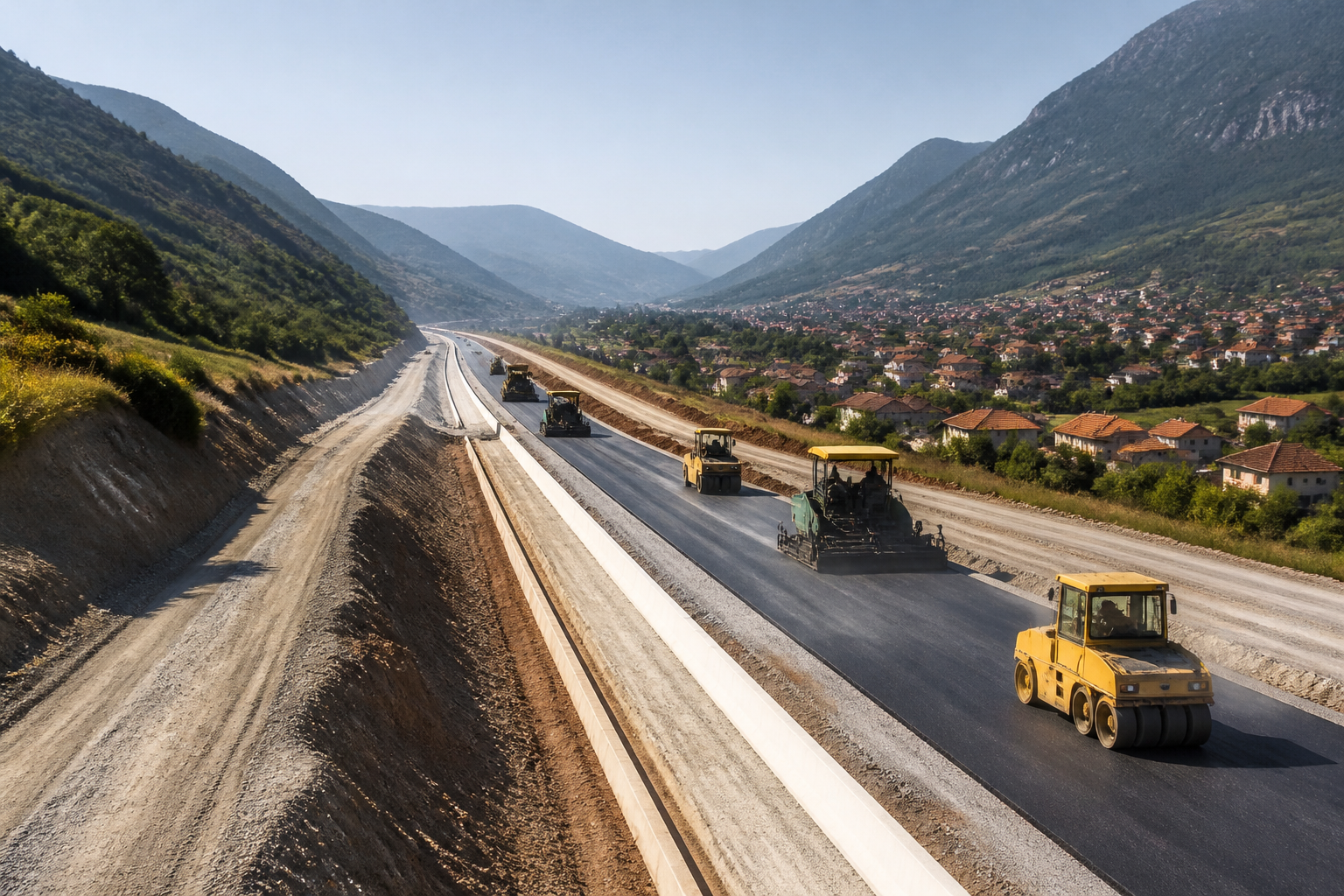
The award covers 11.5 km of 2x2-lane motorway between Bukojcani and Kicevo, part of the E65 and of Pan-European Transport Corridor VIII. The scope includes a twin-tube tunnel of about 370 metres, two viaducts and five bridges, plus junctions, retaining walls, drainage and road safety installations. STRABAG S.R.L. leads the consortium with a 50 per cent stake. The client is the North Macedonian Public Enterprise for State Roads. Index, citing an MTI release from Duna Aszfalt, reported works starting in early 2027 once the contract is signed.
The lender ran the tender, and that decides who can bid
This contract was not awarded through a national procurement portal. STRABAG's own release of 13 October 2026 states that the tender ran through the EBRD's electronic procurement system, that it lasted more than a year across several stages, and that the winning consortium was selected from ten prequalified bidders.
The money explains the process. The EBRD is providing a credit facility of EUR 110 million, backed by a sovereign guarantee, and the EU is adding about EUR 20 million of non-repayable grant through the Western Balkans Investment Framework. That is roughly EUR 130 million of the EUR 219 million contract value standing on institutional money. A lender funding that share writes the rules, runs the platform and decides the shortlist.
For a contractor, the practical consequence is that prequalification has become the asset. A multi-stage process over twelve months consumes bid resource long before any revenue appears. It rewards firms that already hold the audited accounts, the referenced tunnel and viaduct experience, and the bonding capacity the lender's rules demand. Ten names cleared that bar for a mountainous 11.5 km section. The firms that did not clear it were excluded by paperwork well before price mattered.
A nine-year commitment dressed as a four-year job
The scope runs further than the civils. Construction is planned over four years, and the consortium then maintains the road for five years after completion. Peter Glockler, the STRABAG SE management board member for the South and East segment, singled out that element when the award was announced.
That tail changes the shape of the contract. A four-year build carries construction risk, cost inflation and claims exposure. A five-year maintenance period carries availability obligations, pavement performance and a labour and plant commitment in a country where the contractor may hold nothing else once the site closes. The two are priced by different parts of a business, and in many bid rooms the maintenance years are priced last and thinnest. A 370 metre twin-tube tunnel with its own ventilation, lighting and drainage systems is where that habit gets expensive.
Why a Hungarian builder needs an export order book
The domestic backdrop makes the logic plain. Eurostat recorded Hungarian construction output down 12.2 per cent year on year in July 2026, the steepest annual fall in the European Union, and down 4.7 per cent month on month. Hungary's expressway programme is also being restructured. On 6 October 2026 Portfolio reported that the state had extended the operating agreement for the M6 between Erditeto and Dunaujvaros by eleven years for HUF 44 billion, against a prorated HUF 149 billion under the arrangement it replaced, with the minister describing the move as the first step in reforming the concession system.
Against that, a euro-denominated contract paid out of EBRD disbursements and EU grant is a different credit altogether. Payment certainty improves, currency exposure falls for a group with euro-cost inputs, and the revenue sits outside the Hungarian budget cycle. Duna Aszfalt has been building that position for several years, including a leading role on Slovakia's long-delayed D3 motorway. North Macedonia extends the same pattern into a market where almost every road euro arrives through an international financial institution.
What the bid list says about the regional market
Ten prequalified bidders for a tunnelled Corridor VIII section is a crowded list by current regional standards. It also shows the shape that keeps winning: a Western European prime with the balance sheet and the IFI track record, paired with a CEE volume builder that brings plant, crews and cost. That pairing has become the default on EBRD and EIB-funded roads from Croatia through the Western Balkans, and it is squeezing the space for a single national champion bidding alone.
For sponsors in the region, the award is a reminder that the procurement route is a market design decision. Running a tender on the lender's platform widens the field to firms with institutional experience and narrows it against local contractors who cannot carry a twelve-month bid. For contractors, the question is sharper. If the next cycle of CEE road volume is procured by development banks with maintenance tails attached, then prequalification files and O and M pricing capability are the two capabilities worth buying now. Groups that treat the maintenance years as a rounding error on the civils price will win the work and give back the margin.
📊 Analytics & Strategic Insight
When a development bank runs the tender, prequalification stops being admin and becomes the scarce asset
The decision most in this industry are avoiding:
👉 Pricing the maintenance tail properly, before the civils price is locked. Five years of operation and maintenance on a tunnelled mountain motorway is a standing cost base in a country where the contractor may have no other work. Most bid teams build the civils number first and treat O and M as a percentage add-on at the end.
👉 Treating prequalification as a capital expenditure item. A twelve-month, multi-stage EBRD process costs real bid resource with no revenue attached. Firms that fund that properly reach shortlists; firms that fund it from spare capacity do not, and they never find out why.
👉 Accepting that a domestic concession pipeline is no substitute for an exportable track record. Concession volume at home builds plant and crews. It does not build the audited IFI references that a lender's prequalification rules actually test.
Here's the full context:
→ 2021: Duna Aszfalt's leadership publicly set out an eastward expansion strategy, arguing that Western European road networks were largely complete and that the growth lay further east.
→ 2024 to 2026: Duna Aszfalt takes a leading role on Slovakia's long-delayed D3 motorway, establishing a cross-border delivery record outside the Hungarian procurement system.
→ July 2026: Eurostat records Hungarian construction output down 12.2 per cent year on year, the steepest annual fall in the European Union, and down 4.7 per cent month on month.
→ 6 October 2026: Portfolio reports the Hungarian state extending the M6 Erditeto to Dunaujvaros operating agreement by eleven years for HUF 44 billion, against a prorated HUF 149 billion under the replaced arrangement, with the minister calling it the first step in reforming the concession system.
→ Most recent: On 13 October 2026 STRABAG confirms that its consortium with Duna Aszfalt has won the EUR 219 million Bukojcani to Kicevo section of the E65, chosen from ten prequalified bidders through the EBRD's electronic procurement system, with a EUR 110 million EBRD facility and about EUR 20 million of Western Balkans Investment Framework grant behind it.
What this means for infrastructure operators, contractors and investors:
✅ The lender's rulebook is now the main entry barrier on Western Balkans roads. With roughly EUR 130 million of a EUR 219 million contract standing on institutional money, the EBRD sets the platform, the stages and the shortlist. Market entry is decided at prequalification, well before price.
✅ Build-plus-maintain awards shift risk from the claim file to the operating budget. A nine-year commitment on one award changes working capital, insurance and resourcing assumptions, and it rewards contractors who can run an asset rather than only hand one over.
✅ Export order books are repricing CEE contractor credit. Euro revenue paid from IFI disbursements and EU grant is less exposed to a single national budget cycle, which matters for lenders and bondholders looking at Hungarian construction groups through a 12.2 per cent output fall.
3 moves you can make this week:
1️⃣ Audit your prequalification file against one live IFI tender. Take an open EBRD or EIB road package and check, line by line, which prequalification criteria you would fail today on references, accounts or bonding. Fix the cheapest gap first.
2️⃣ Reprice one maintenance tail bottom-up. Pick a build-plus-maintain job in your portfolio or pipeline and rebuild the O and M years from crew, plant and consumables, with tunnel systems costed separately. Compare the result with the percentage you currently apply.
3️⃣ Map your revenue by paying authority, not by country. Split the order book into IFI-funded, EU-grant-funded, national-budget-funded and concession-funded work. The resulting picture is what your lenders will ask about next, and most groups cannot produce it on demand.
Share it with your peers
Help your network stay ahead of CEE capital projects.
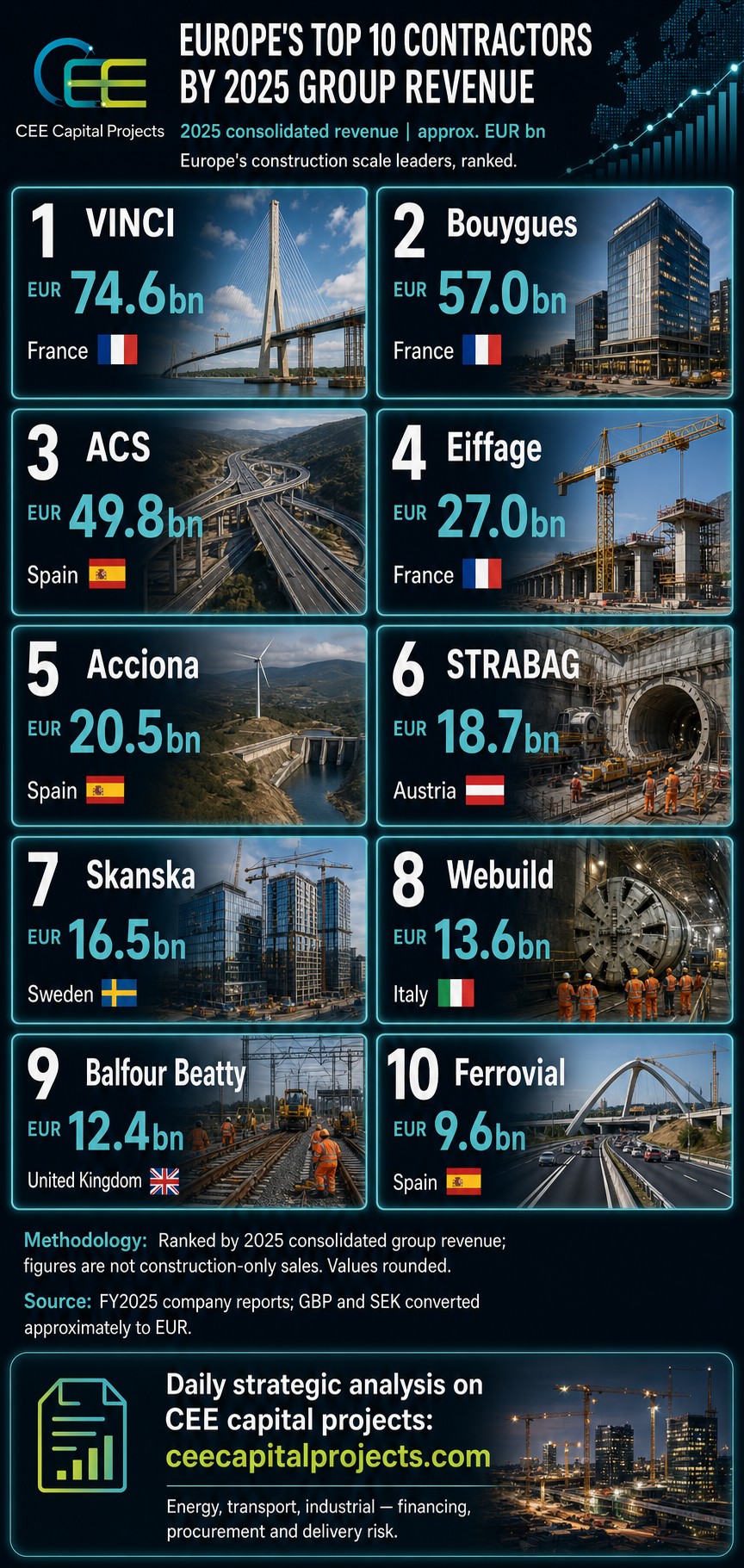
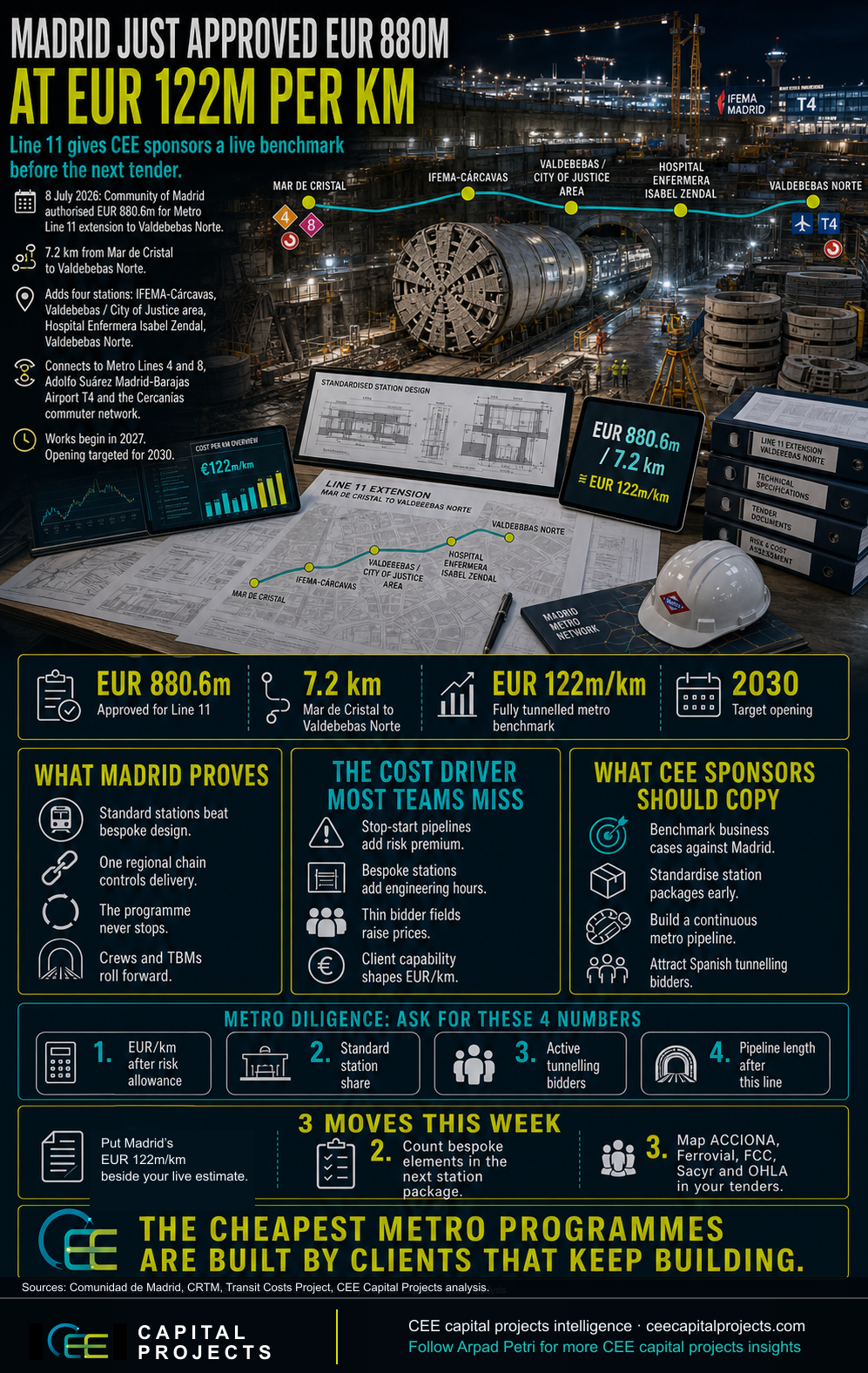
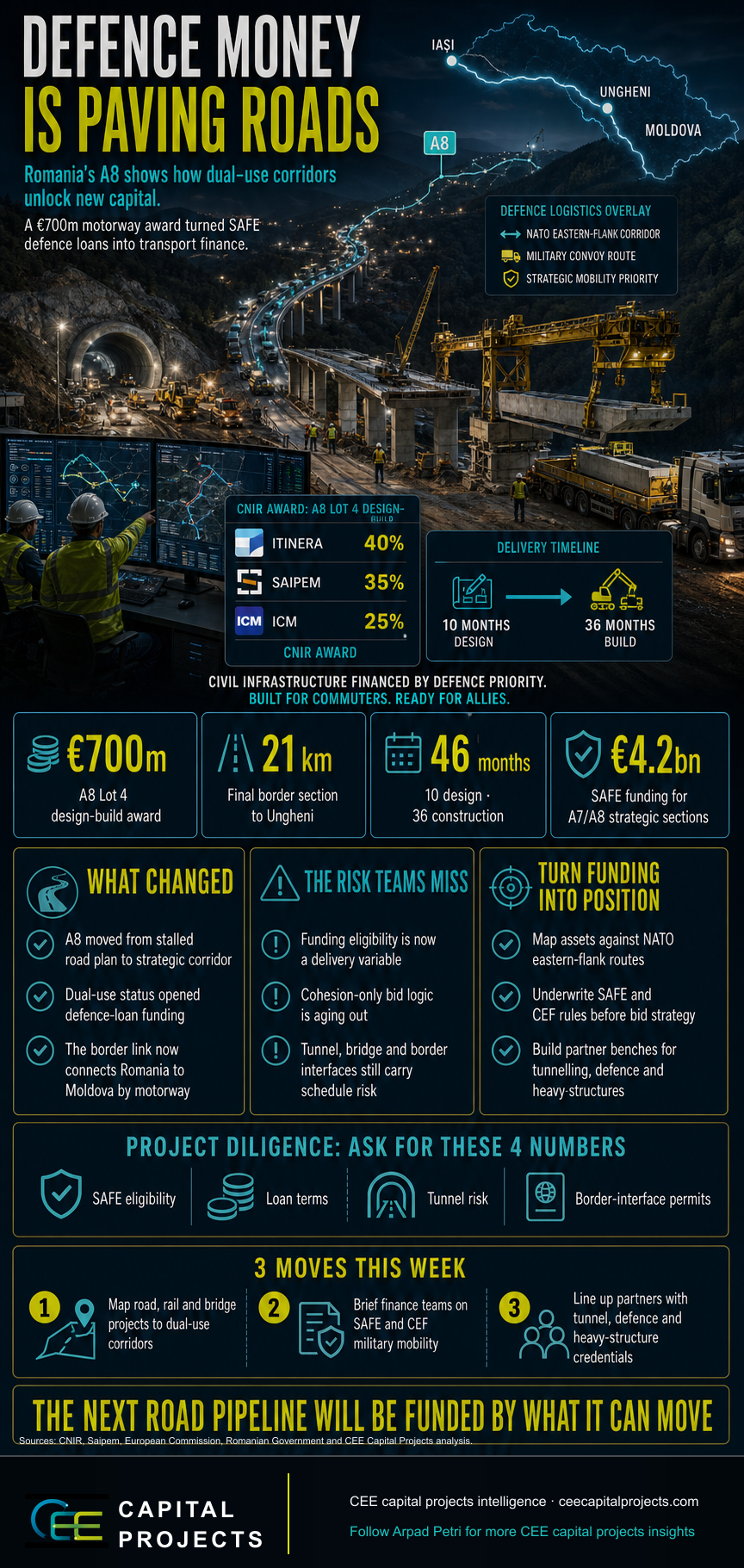
Explore our infograph library — strategic visuals for CEE capital projects leaders.
Project benchmarks, financing structures, tender dynamics and delivery risk — at a glance. Free access for investors, owners, contractors and strategy teams tracking CEE capital projects.
Browse the libraryRelated analyses
- Transport & Infrastructure
ViAlliance35 Wins the Czech D35 Motorway Concession, and the 2.9 Billion Euro Headline Is a Payment Stream
The Czech government has approved the ViAlliance35 concession contract for 35.4 km of the D35 motorway between Opatovec and Mohelnice. The headline of about 2.9 billion euro is the discounted value of 22 years of availability payments, which is a different product from a construction budget.
Read analysis → - Transport & Infrastructure
Poland's PLN 1.3bn A2 Widening: 89 km of Third Lane, and the Pre-2012 Design That Made It Cheap
GDDKiA has signed the fourth and final contract to widen 92 km of the A2 between Łódź and Warsaw, closing a programme worth about PLN 1.3bn. The cost is low because land and structures were sized for a third lane before the motorway opened in June 2012.
Read analysis → - Transport & Infrastructure
CTP Signs Pepco to a 55,619 Sqm Direct Lease at CTPark Bucharest West, and the Space Was Already Occupied
CTP has signed Pepco to a direct long term lease on 55,619 sqm at CTPark Bucharest West, replacing an arrangement the retailer held through a logistics provider. The deal adds no occupied space and changes who stands behind the rent.
Read analysis →
Get a second opinion before it gets expensive.
Contractor selection, tender strategy, a project drifting off track — send us the situation and we'll come back with a clear plan.