We Help International Investors and Project Owners Deliver Major CEE Projects Without Expensive Surprises
Independent project intelligence and advisory across energy, transport, real estate and industrial construction.
Duna Aszfalt's Home Orders Fell 60% in a Year. Hungary's Biggest Road Builder Is Buying Its Way Across Four Countries
Duna Aszfalt's new orders dropped 60% at home in the year to June 2025, yet the group's backlog hit HUF 1,200bn. Hungary's dominant road builder is buying motorway contractors across Central Europe and financing a highway in Africa to escape its dependence on one government's tenders.

A contractor that dominates its home market usually grows at home. Duna Aszfalt is doing the reverse. In the 12 months to June 2025, the Hungarian road builder's new orders fell 60% year on year to HUF 235bn, with a single major contract — the M1 motorway expansion — signed in the whole period. Its answer was not to wait for the domestic pipeline to recover. It went shopping across the border.
The number behind the strategy
Scope Ratings put hard figures on a shift that had been building for two years. In its issuer report dated 10 September 2025, which affirmed Duna at BB- with a Stable outlook, the agency flagged that the collapse in intake had pushed the book-to-bill ratio below 1.0x, down from 1.9x a year earlier. In plain terms, Duna is now delivering work faster than it is winning replacement work.
The headline backlog still looks comfortable. Consolidated order books stood at HUF 1,200bn as at June 2025, up from HUF 800bn, equal to 3.3 times average annual revenue. That buys roughly three years of visibility. But backlog is a lagging comfort; intake is the leading signal, and it turned down first. On 29 June 2026 Duna published its consolidated FY2025 accounts, the first full year presenting the business as a multi-country group rather than a Hungarian one.
The road builder that bought its neighbours
The buying spree started in Poland. In the third quarter of 2024 Duna acquired Mota-Engil Central Europe, a top-20 Polish motorway contractor with more than 800 staff, since rebranded Duna Polska. That single deal lifted non-domestic revenue to around 20% and raised pro-forma consolidated revenue to HUF 359bn. In May 2025 came two bolt-ons: Euro Strada in Romania (HUF 23bn of 2024 revenue) and VALCANO in the Czech Republic (HUF 8bn). In Slovakia, Duna sits in a consortium with Váhostav and Metrostav DS building a 5.3km section of the D3 motorway near Čadca for EUR 230m, including a 600m tunnel.
The rationale is structural. Hungary built out most of its motorway network over two decades, and the domestic market has turned. National construction output fell 0.4% in 2024 and investment volume dropped 15%, even as public procurement volumes rose. For a builder whose home programme is largely finished, growth has to come from somewhere else.
The African wildcard
The boldest bet is not in Central Europe at all. Through GED Africa, a 25-year public-private partnership, Duna is building a 184km highway and a 345m cable-stayed bridge linking the Democratic Republic of Congo and Zambia, with France's Egis as operator. To fund it, the group planned a USD 400m senior secured bond, roughly HUF 156bn, with an 80% principal guarantee, and targets first tolls in May 2027. Scope was blunt about the risk: sovereign transfer and convertibility exposure in two frontier markets, and no operating cash flow in the forecast horizon. The quiet CEE road builder's single largest project exposure is African project finance.
Why diversify now
Two clouds hang over the home model. Brussels has escalated legal action over the 35-year expressway concession linked to Duna's owner, László Szíjj, and to Lőrinc Mészáros, arguing it breached EU procurement and concession rules. Separately, changes to Hungary's public procurement law, sought as a condition of releasing EU funds, could sharpen competition in the tenders Duna has long won. Around 80% of the group's order book is tied to public contracts, state tenders make up roughly 75% of the backlog, and 79% to 81% of revenue is still Hungarian. Against that concentration, buying cash-flowing backlog in four other countries is less an expansion than an insurance policy.
What it signals
The trade has a price. Duna is buying lower-margin peers, and Scope expects group profitability to drift from around 21% toward 14% as Poland and the bolt-ons dilute the mix, with integration and African execution adding volatility. For the rest of Central and Eastern Europe's state-linked construction champions, Duna is a template worth studying: when your order book sits one election or one Brussels ruling away from freezing, buying backlog abroad is cheaper than waiting for the domestic pipeline to thaw. The number to watch is not the reassuring HUF 1,200bn backlog. It is the order intake behind it.
Share it with your peers
Help your network stay ahead of CEE capital projects.
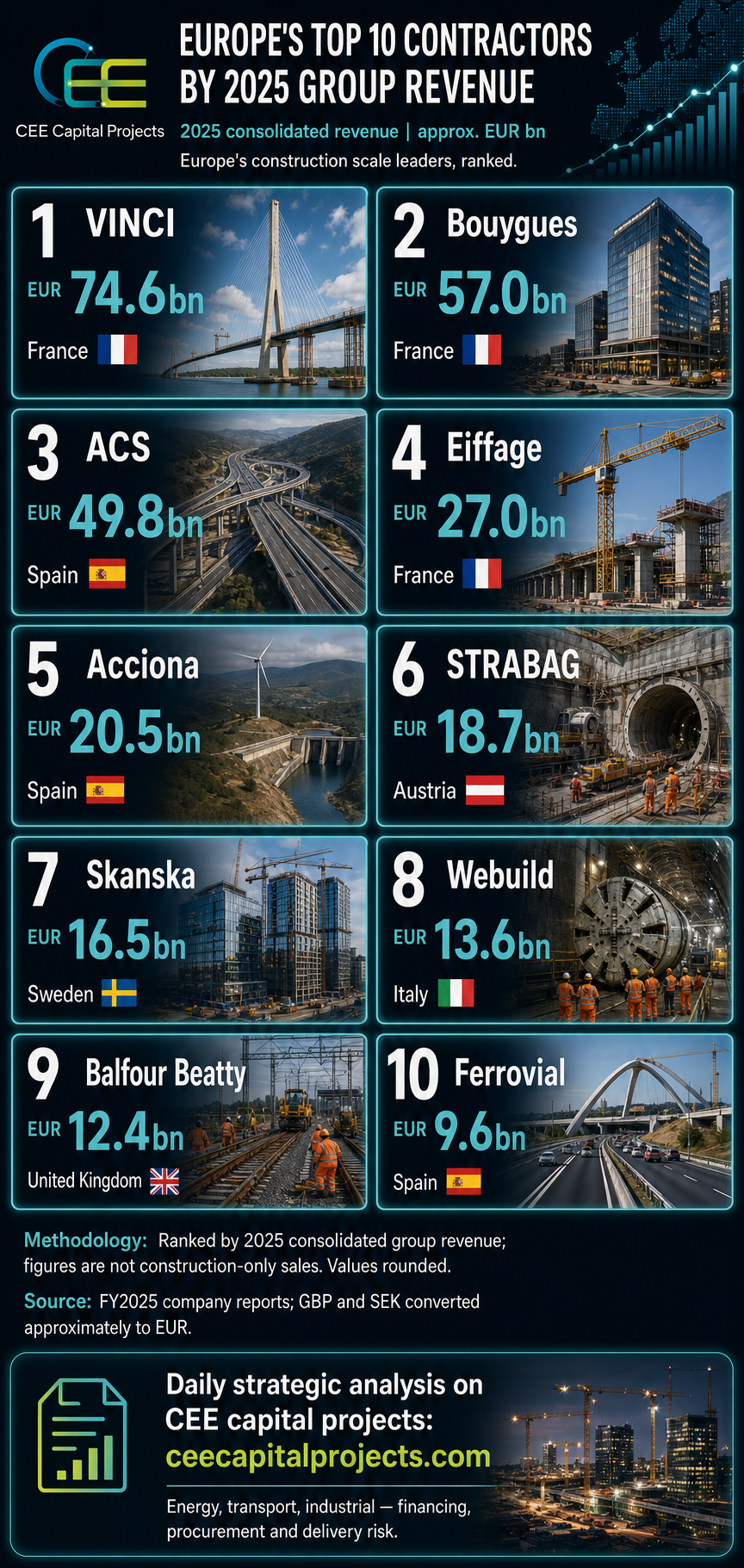
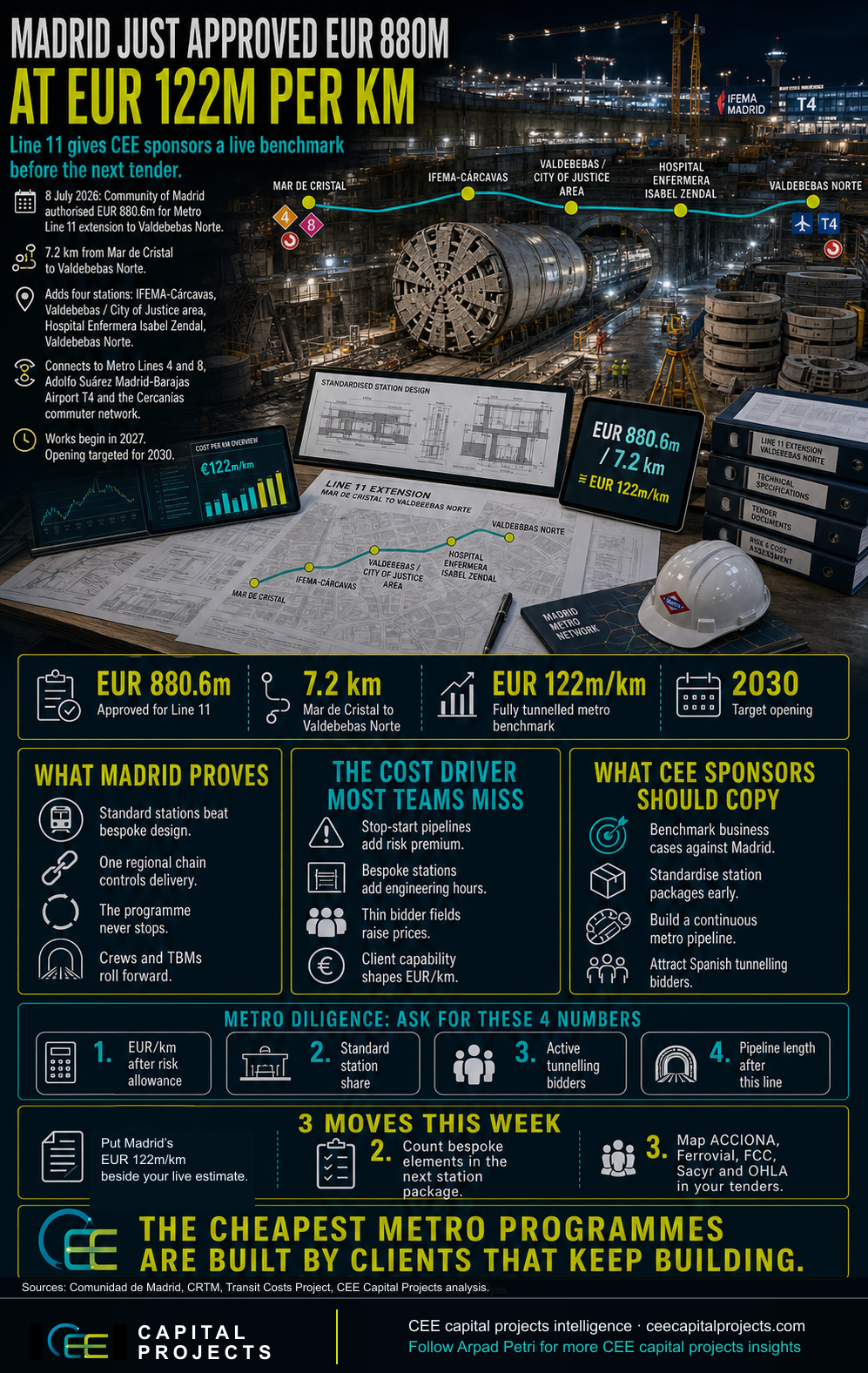
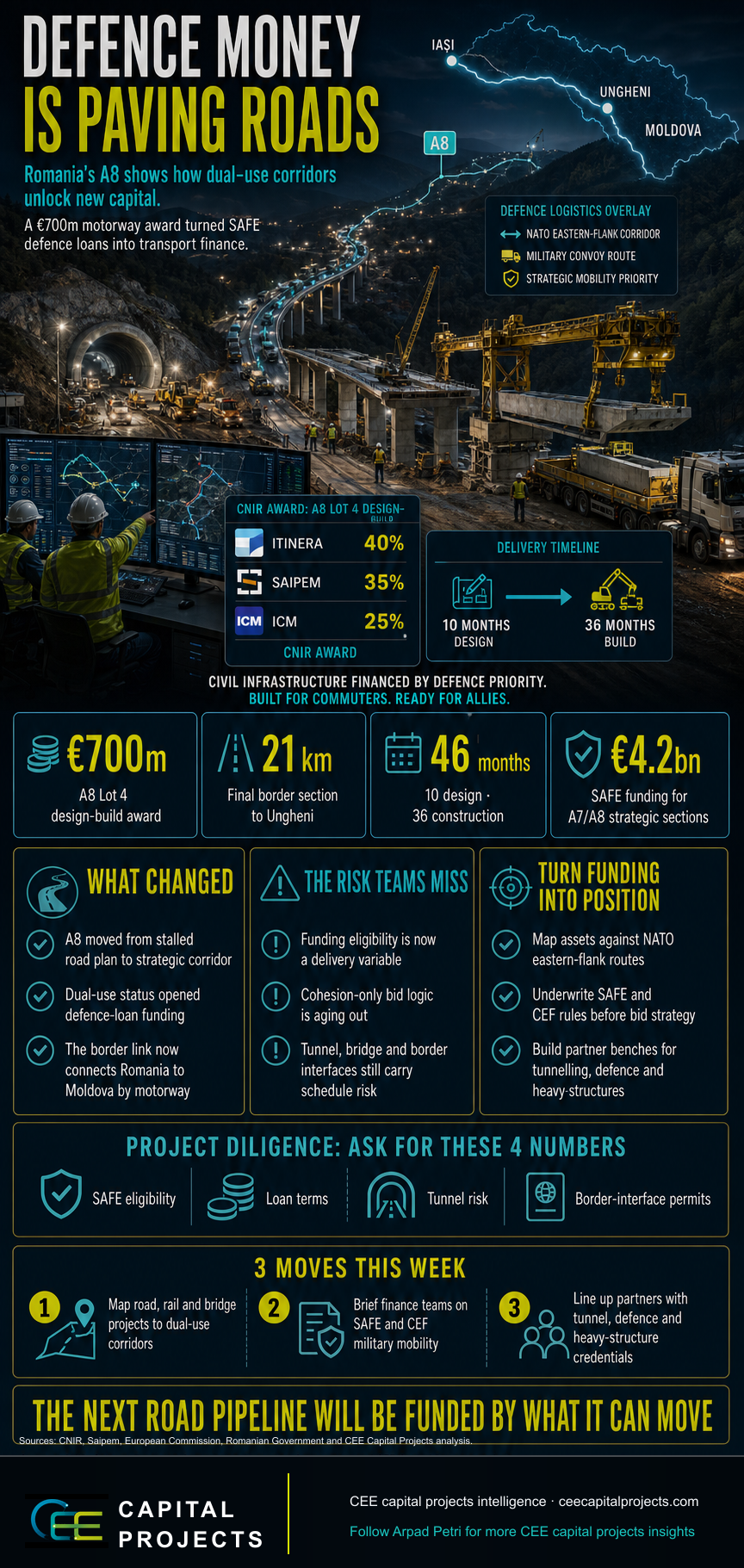
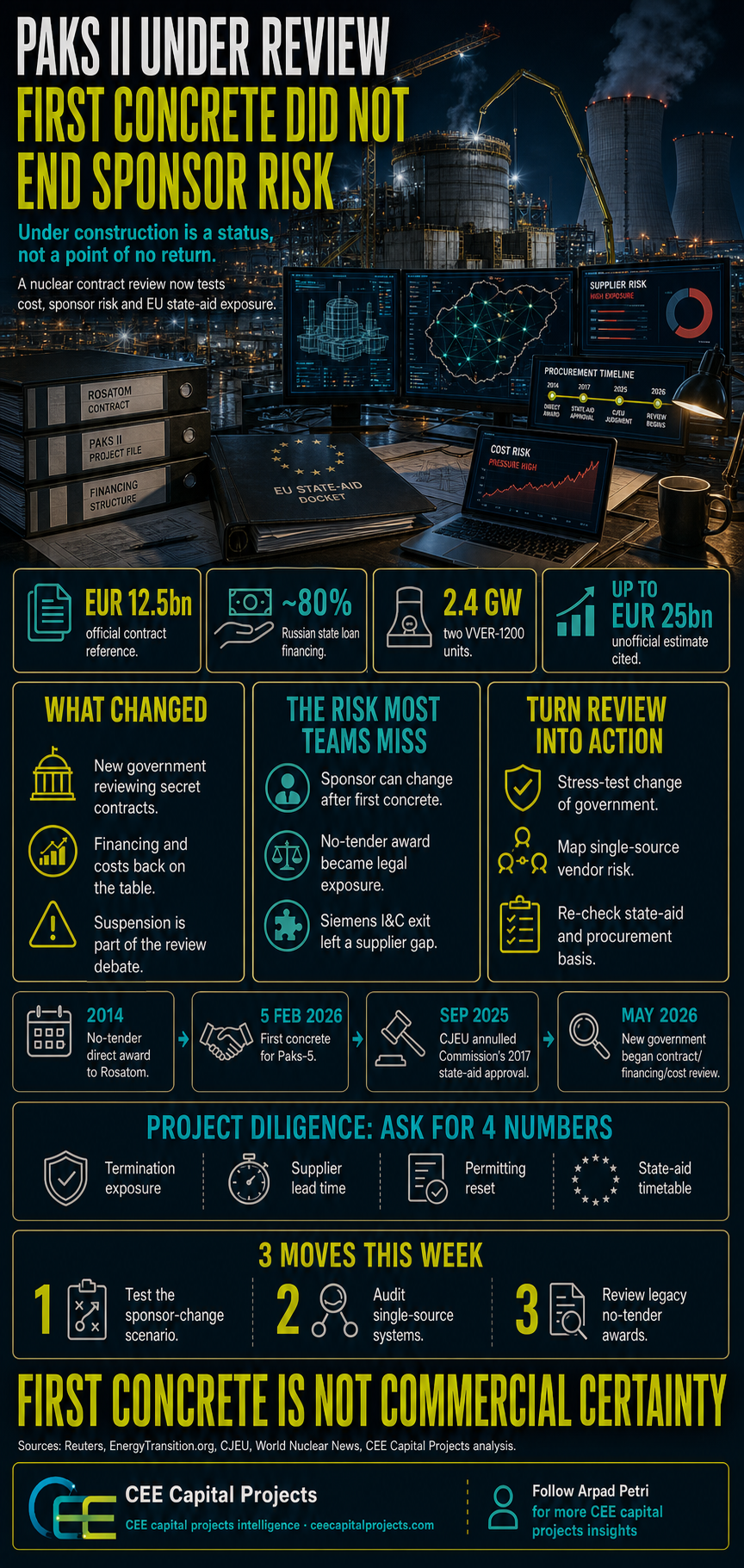
Explore our infograph library — strategic visuals for CEE capital projects leaders.
Project benchmarks, financing structures, tender dynamics and delivery risk — at a glance. Free access for investors, owners, contractors and strategy teams tracking CEE capital projects.
Browse the libraryStrategic Insights
📊 Analytics & Strategic Insight
Geographic M&A as political-risk insurance: how a state-tender champion escapes its own home market
The decision most in this industry are avoiding:
👉 Diversification by acquisition is a margin trade dressed as a growth story. Duna is buying lower-margin national builders to cut single-country risk, and Scope expects group EBITDA to slide from about 21% toward 14%. The market reads cross-border M&A as ambition; here it is closer to hedging a hostile home market.
👉 A fat backlog can hide a thinning pipeline. A HUF 1,200bn order book looks like strength, but a book-to-bill below 1.0x means work is leaving faster than it arrives. Intake turned down first at home and in Poland, where Duna Polska has won just HUF 12bn since being acquired.
👉 The riskiest exposure is the one nobody associates with a road builder. Duna's largest single project is a USD 400m-financed toll road across the DRC and Zambia, with sovereign transfer risk and no cash flow until 2027. The "safe" domestic contractor's biggest bet is African project finance.
Here's the full context:
→ 1996: Duna Aszfalt is founded and grows, wholly owned by László Szíjj, into Hungary's largest road and motorway contractor, with state-related work above 50% of revenue since 2017.
→ 2024: Hungary's construction market turns — output down 0.4%, investment volume down 15% — as the two-decade domestic motorway build-out nears completion.
→ Q3 2024: Duna buys Mota-Engil Central Europe in Poland (800+ staff, now Duna Polska), lifting non-domestic revenue to around 20% and pro-forma consolidated revenue to HUF 359bn.
→ May 2025: Bolt-on deals for Euro Strada (Romania) and VALCANO (Czech Republic), alongside the GED Africa 184km DRC–Zambia toll road, extend the group across four countries and a continent away.
→ Most recent: Scope's 10 September 2025 report flags a 60% fall in new orders to HUF 235bn and a sub-1.0x book-to-bill; Duna publishes its consolidated FY2025 accounts on 29 June 2026 as a multi-country group.
What this means for infrastructure operators, contractors and investors:
✅ State-dependent contractors are pricing political risk into their M&A. When a home order book is one election or one EU ruling from freezing, buying cash-flowing backlog abroad is cheaper than waiting. Expect more CEE champions to follow.
✅ The acquisition currency this cycle is profitable, mid-size national builders. Duna paid for backlog and certifications — a top-20 Polish contractor, live Czech and Romanian order books — not brands. Small national road builders with public pipelines are the targets.
✅ Order intake, not backlog, is the number to underwrite. A below-1.0x book-to-bill is the early warning a comfortable headline backlog conceals, and it should carry more weight than any single reassuring stock figure.
3 moves you can make this week:
1️⃣ Compute book-to-bill for every contractor you touch. Divide the last 12 months of new orders by revenue; below 1.0x means the pipeline is thinning behind the headline backlog, whoever you lend to, buy from or bid against.
2️⃣ Map your counterparties' state-tender dependence. If more than half of a partner's revenue comes from one government's procurement, model a change of government or a funding freeze the way you model currency risk. Duna's roughly 80% public backlog is the cautionary figure.
3️⃣ Price the diversification premium before you pay it. If you buy a national builder for geographic spread, underwrite the margin dilution and integration risk explicitly — Duna's slide from 21% toward 14% shows the cost is real, not theoretical.
Related analyses
- Transport & Infrastructure
V-Híd Just Lost Hungary's HUF 338 Billion Déli Körvasút at 42 Per Cent Complete. The Grant Clock Is the Real Story
Hungary halted construction of the Budapest Southern Circle Railway on 9 October 2026 and barred V-Híd from every ongoing rail investment. The HUF 367 billion of EU money behind the job survives only if a lawful re-tender lands inside two years.
Read analysis → - Transport & Infrastructure
Afcons Wins Croatia's EUR 899m Dugo Selo-Novska Rail Contract: Four Bids, No European Prime
Croatia signed its largest ever railway contract on 1 October 2026, handing 83 km of double-tracking to India's Afcons Infrastructure at EUR 677.06m excluding VAT. Four bids were priced for the work and not one of them came from a European prime contractor.
Read analysis → - Transport & Infrastructure
STRABAG Closes BAWI Construction Buy in Romania as Rail Qualification Becomes the Scarce Asset
STRABAG has closed its purchase of BAWI Construction, a Bucharest rail specialist with 240 employees and about EUR 60 million of 2025 output. The number that matters is the qualification it buys, as Romania opens a EUR 5.99 billion rail programme with the EU recovery window shut.
Read analysis →
Building in Central Europe?
Tell us what you're building. We'll tell you what can go wrong — and how to prevent it.