We Help International Investors and Project Owners Deliver Major CEE Projects Without Expensive Surprises
Independent project intelligence and advisory across energy, transport, real estate and industrial construction.
Deutsche Bahn Spent EUR 2.2bn Rebuilding Hamburg-Berlin. Punctuality Fell to 25.8%. Its Generalsanierung Rethink Points Straight at the Diversion Routes
Germany closed its busiest inter-city line for ten and a half months, renewed 165 km of track and 249 turnouts, and reopened to worse punctuality than before the works. The five-point revision of the Generalsanierung programme that surfaced on 11 August names the fix nobody budgeted for: the routes trains use while the main line is shut.
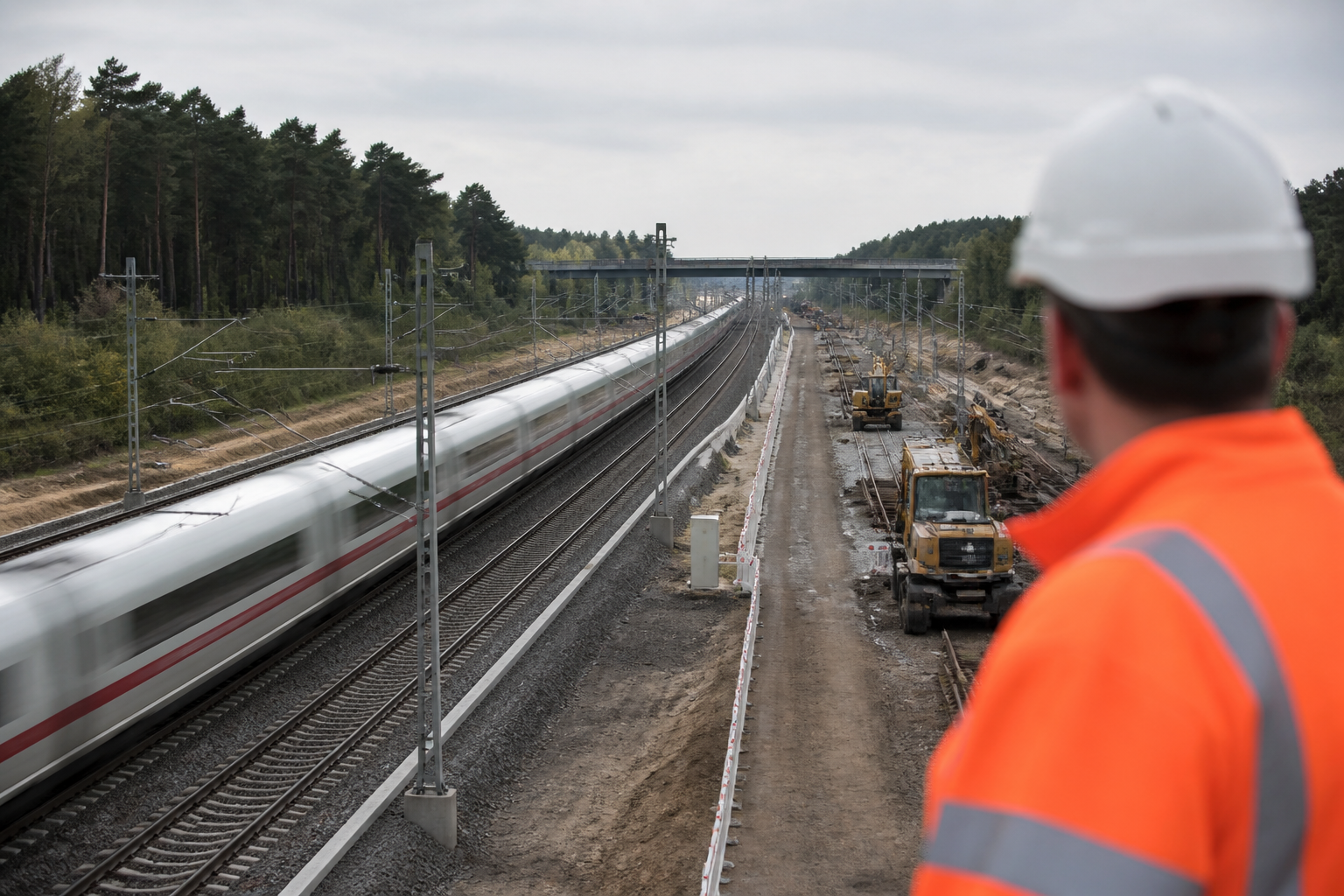
On 8 August 2026, 25.8% of trains on the rebuilt Hamburg-Berlin main line arrived on time. Before Deutsche Bahn shut the route and renewed it end to end, the figure was 49.6%. Germany spent EUR 2.2bn and ten and a half months of total closure on its busiest inter-city axis, and punctuality on the finished railway is now about half what it was on the worn-out one.
Three days later the outline of DB's answer became public. Manager Magazin reported on 11 August, and news agency dpa confirmed, a five-point revision of Generalsanierung, the programme under which more than 40 of Germany's densest corridors are closed completely, rebuilt in one concentrated effort and handed back free of construction for years. Chief executive Evelyn Palla ordered the review in early July after a run of late reopenings and rising costs. No corridor has been dropped and the calendar to 2036 stands. What has changed is the diagnosis.
What EUR 2.2bn actually bought
The scope was not cosmetic. DB InfraGO and its contractors replaced 165 km of track and 249 turnouts along the 278 km line, renewed 47 km of overhead line equipment, installed seven crossovers so faster passenger trains can overtake freight, delivered six new signal boxes, modernised 19 more and rebuilt 28 stations step-free. Leonhard Weiss and Spitzke SE took the largest trackwork lot between Dergenthin and Buechen. Rhomberg Sersa, VINCI's Eurovia and Axians units, SPL Powerlines and a Schweerbau, Joseph Hubert and Wiebe consortium took the remaining sections, with Hitachi Rail renewing signalling across 200 km between Paulinenaue and Schwanheide.
The delivery record is where it went wrong. DB proposed six months at the outset, stretched the window to nine before a spade went in as station and signalling work was added, and reopened after ten months and two weeks: the north on 15 May 2026, the south on 14 June. Residual works and interlocking software updates at Nauen and Buechen are still holding performance down. Nuernberg-Regensburg came back at the end of July, three weeks late.
The guarantee nobody funded
When DB sold the total-blockade model in 2022, it rested on two commitments: closures capped at roughly five months, and high-capacity diversionary routes for the traffic displaced. Hamburg-Berlin broke both, and freight took the worse end. DB Cargo routed trains via Uelzen, Stendal, Hannover and Magdeburg, adding 70 to 190 km per train onto corridors already at capacity and carrying their own engineering works.
The German rail freight association Die Gueterbahnen calculated that the project imposed well over 300 days of complete closure on 1% of the national network, and said the corridor concept had failed its primary test. Managing director Peter Westenberger linked the shortage of diversionary capacity to raw material shortages in German steel. Passengers fared little better: DB Fernverkehr declined to fund replacement buses on the Hamburg-Schwerin leg, leaving the Mecklenburg-Vorpommern transport ministry to put in EUR 25m of its own budget.
The diversion route is the project
The five-point plan now lists improved diversion routes for rail freight among its remedies, alongside spacing corridor renovations further apart, coordinating closures so they stop overlapping, preparing every corridor for later digitalisation, and returning renovated lines to service in stages. Reading that list the right way round, the fix DB has named is an asset it never built.
The money is not obviously there either. Financing for more than 90 enhancement projects outside Generalsanierung is frozen until the 2027 federal budget is settled, according to the government's reply to a Green party parliamentary question. Among them are capacity upgrades at the Hamburg and Hannover hubs and on the Hamburg-Hannover corridor, one of the diversionary routes that buckled. Schleswig-Holstein is putting around EUR 900m into 13 infrastructure projects in 2026, including the Neumuenster-Bad Oldesloe alternative route, with a noticeable effect expected from 2030. The substitute capacity arrives four years after the closure it was meant to serve.
Why this lands in Central Europe
Every large European renewal programme now leans on long possessions, and CEE leans harder because its diversionary networks are thinner. Hungary's HUF 3,550bn Gabor Baross railway plan, PKP PLK's renewal pipeline and the Czech corridor works all assume traffic can be pushed onto parallel lines that are frequently single-track, unelectrified or both. Germany had four-track alternatives and still lost control of them for two weeks in May. A Hungarian or Romanian client planning a nine-month blockade with one single-track alternative is running the same experiment with less margin.
A second warning sits inside the technical scope. Full ETCS fitment was dropped to avoid duplicating trackside equipment, so the line reopened only ETCS-ready, with the digital cutover pushed to the early 2030s. Under 2% of the German network has ETCS. That deferral means new possessions on a line promised construction-free for five years, down from an original pledge of ten.
DB is due to publish the revised concept within weeks, and the federal transport ministry under Steffen Bilger, in post since 27 July, has its own corridor review reporting in the autumn. Watch two things: whether any corridor leaves the 2036 calendar, and what survives of the construction-free guarantee. For contractors the reprioritisation cuts both ways, thinning the peak workload Leonhard Weiss, Spitzke, Rhomberg Sersa and the VINCI units have resourced against. For every client running a renewal programme, from DB InfraGO to NIF and CFR, the Hamburg-Berlin bill reads as one line: closing the railway was the easy half.
Share it with your peers
Help your network stay ahead of CEE capital projects.
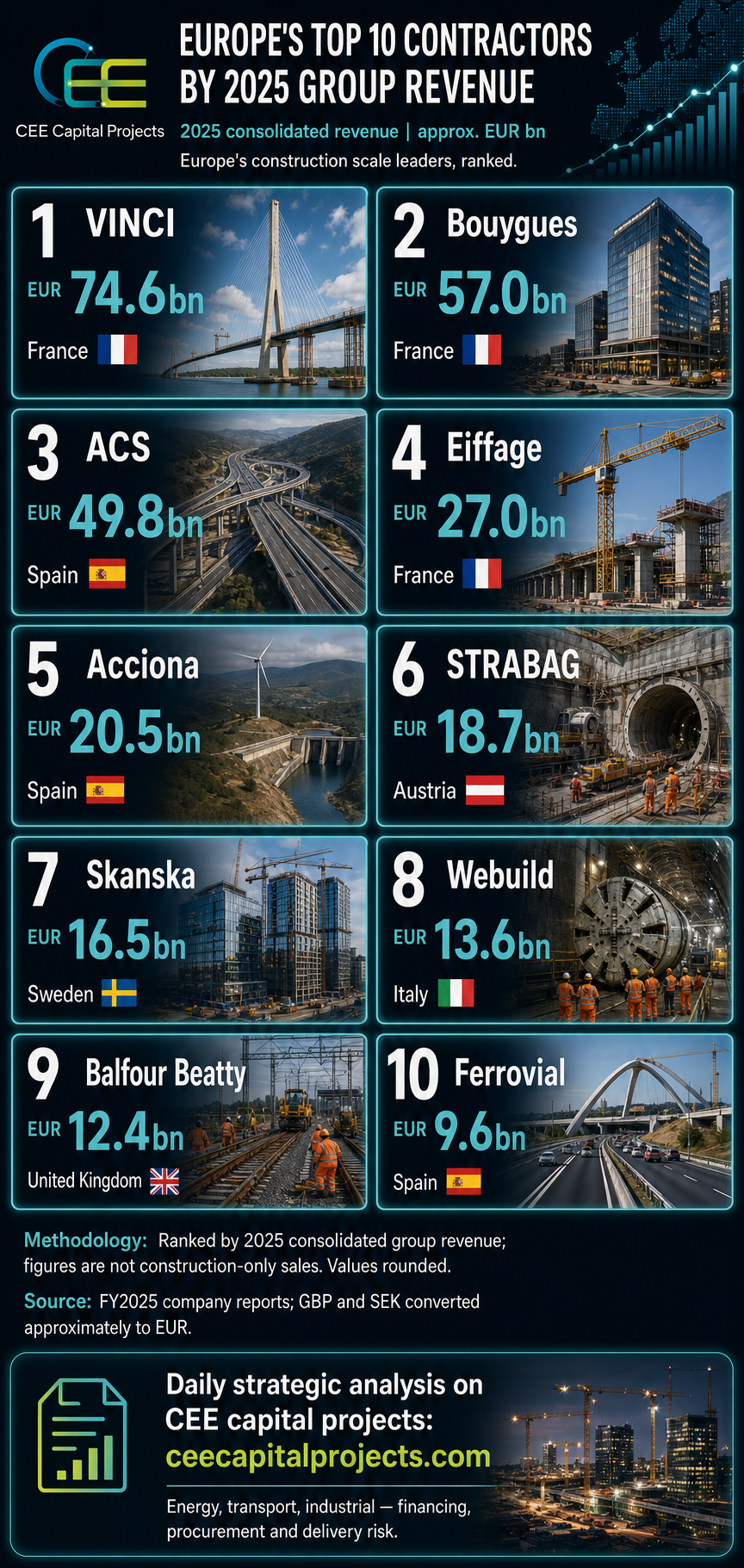
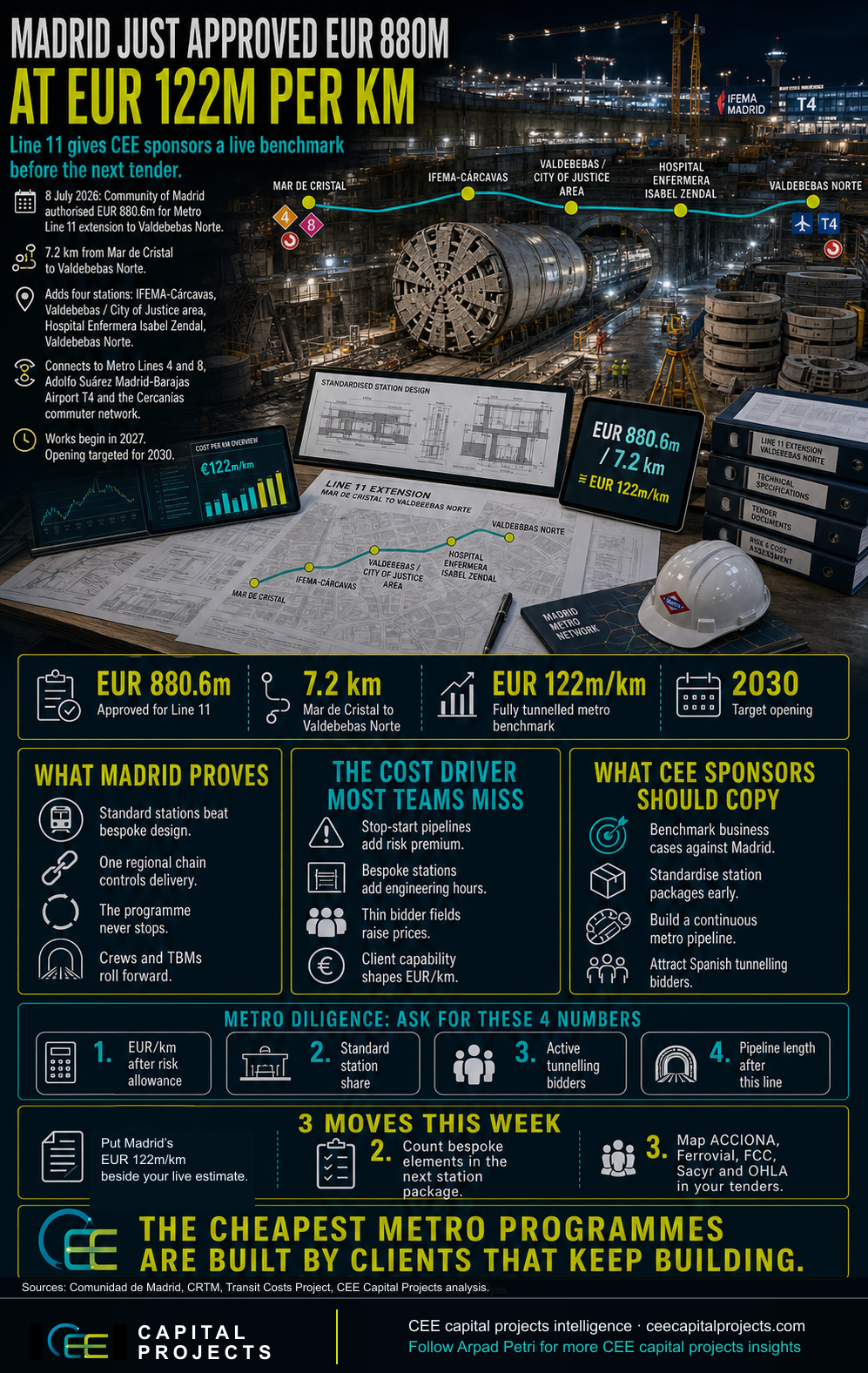
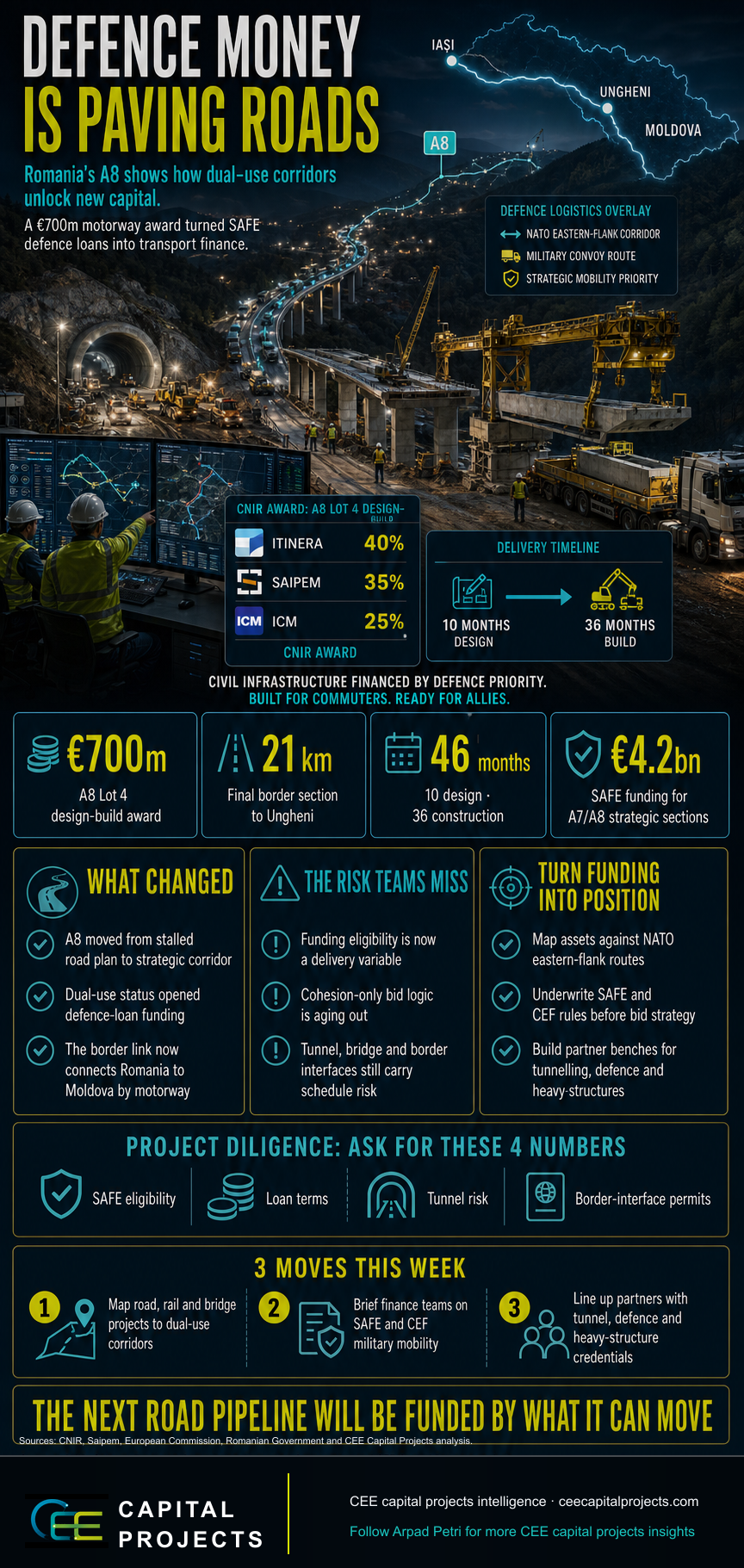
Explore our infograph library — strategic visuals for CEE capital projects leaders.
Project benchmarks, financing structures, tender dynamics and delivery risk — at a glance. Free access for investors, owners, contractors and strategy teams tracking CEE capital projects.
Browse the libraryStrategic Insights
📊 Analytics & Strategic Insight
Shutting a line is simple. Finding a way round it is the actual job.
The decision most in this industry are avoiding:
👉 Nobody puts a price on the way round. The closure has a budget, a contractor and a programme. The route trains use instead has none of those. It has no owner, no money and no deadline, so it fails first and takes the whole job down with it.
👉 A promise of "no works for five years" is worth nothing without a date and a penalty. DB first said ten years, then said five, then left out the signalling that will need the track back in the early 2030s. Freight firms cannot plan against a promise that keeps moving.
👉 Clients compare the wrong number. They argue about cost per kilometre. The number that decides whether the job was worth doing is how many days of traffic were lost, and what those days cost the people who move goods.
Here's the full context:
→ 2022: DB starts a new way of working. Close a busy line completely, do all the work at once, hand it back better. The old way, endless weekend jobs, never made anything better.
→ 2024: The first try, the Riedbahn between Frankfurt and Mannheim, takes five months and reopens in December. It looks like proof.
→ 1 August 2025: Hamburg-Berlin closes. It was meant to take six months. It was already planned for nine. Freight goes the long way, 70 to 190 extra kilometres a train.
→ June 2026: The line reopens six weeks late, after ten and a half months. One region has already paid EUR 25m for buses DB would not pay for.
→ Most recent: On 8 August only 25.8% of trains ran on time, worse than the 49.6% before the work. On 11 August DB's five-point rethink appears, and one of the five points is fixing the routes trains take while a line is shut.
What this means for infrastructure operators, contractors and investors:
✅ Check the alternative route before you agree the closure. If it is single track, or not electrified, or already has work planned on it, the closure date is fiction. Ask to see the plan for that route in writing.
✅ Freight customers will price this in. Steel makers in Germany cut output because material did not arrive. Once a factory has been let down, it moves the traffic to lorries and does not always move it back.
✅ Spreading the work out changes the order book. Fewer big jobs at once means a flatter, longer run of work. Firms that geared up for a peak will have idle crews and machines unless they chase other clients now.
3 moves you can make this week:
1️⃣ List your own detours. For every closure in your plan, write down the route traffic will take, who owns it, what state it is in, and who pays if it fails. If any box is empty, you have found your risk.
2️⃣ Put a number on lost days. Work out what one extra month of closure costs your customers, not just you. Take that number to the client before the contract is signed, not after.
3️⃣ Ask who pays for the buses and the long way round. On Hamburg-Berlin nobody had agreed that in advance and a regional government was left with the bill. Settle it in the contract while you still have leverage.
Related analyses
- Transport & Infrastructure
V-Híd Just Lost Hungary's HUF 338 Billion Déli Körvasút at 42 Per Cent Complete. The Grant Clock Is the Real Story
Hungary halted construction of the Budapest Southern Circle Railway on 9 October 2026 and barred V-Híd from every ongoing rail investment. The HUF 367 billion of EU money behind the job survives only if a lawful re-tender lands inside two years.
Read analysis → - Transport & Infrastructure
Afcons Wins Croatia's EUR 899m Dugo Selo-Novska Rail Contract: Four Bids, No European Prime
Croatia signed its largest ever railway contract on 1 October 2026, handing 83 km of double-tracking to India's Afcons Infrastructure at EUR 677.06m excluding VAT. Four bids were priced for the work and not one of them came from a European prime contractor.
Read analysis → - Transport & Infrastructure
STRABAG Closes BAWI Construction Buy in Romania as Rail Qualification Becomes the Scarce Asset
STRABAG has closed its purchase of BAWI Construction, a Bucharest rail specialist with 240 employees and about EUR 60 million of 2025 output. The number that matters is the qualification it buys, as Romania opens a EUR 5.99 billion rail programme with the EU recovery window shut.
Read analysis →
Is your project leaking money through its subcontractors?
Most owners lose 3–8% in vendor packages without noticing. Tell us about your project — we'll tell you where we'd look first.