We Help International Investors and Project Owners Deliver Major CEE Projects Without Expensive Surprises
Independent project intelligence and advisory across energy, transport, real estate and industrial construction.
Copenhagen's 28 km Orbital Light Rail Is Open. The DKK 1.1 Billion Overrun Gets Paid Off in 2069
Greater Copenhagen Light Rail opened along its full 28 km on 22 August 2026, thirteen years after the principle agreement that created it. The construction overrun was settled by raising owner payments by DKK 33m a year and pushing the debt repayment date out a decade to 2069.
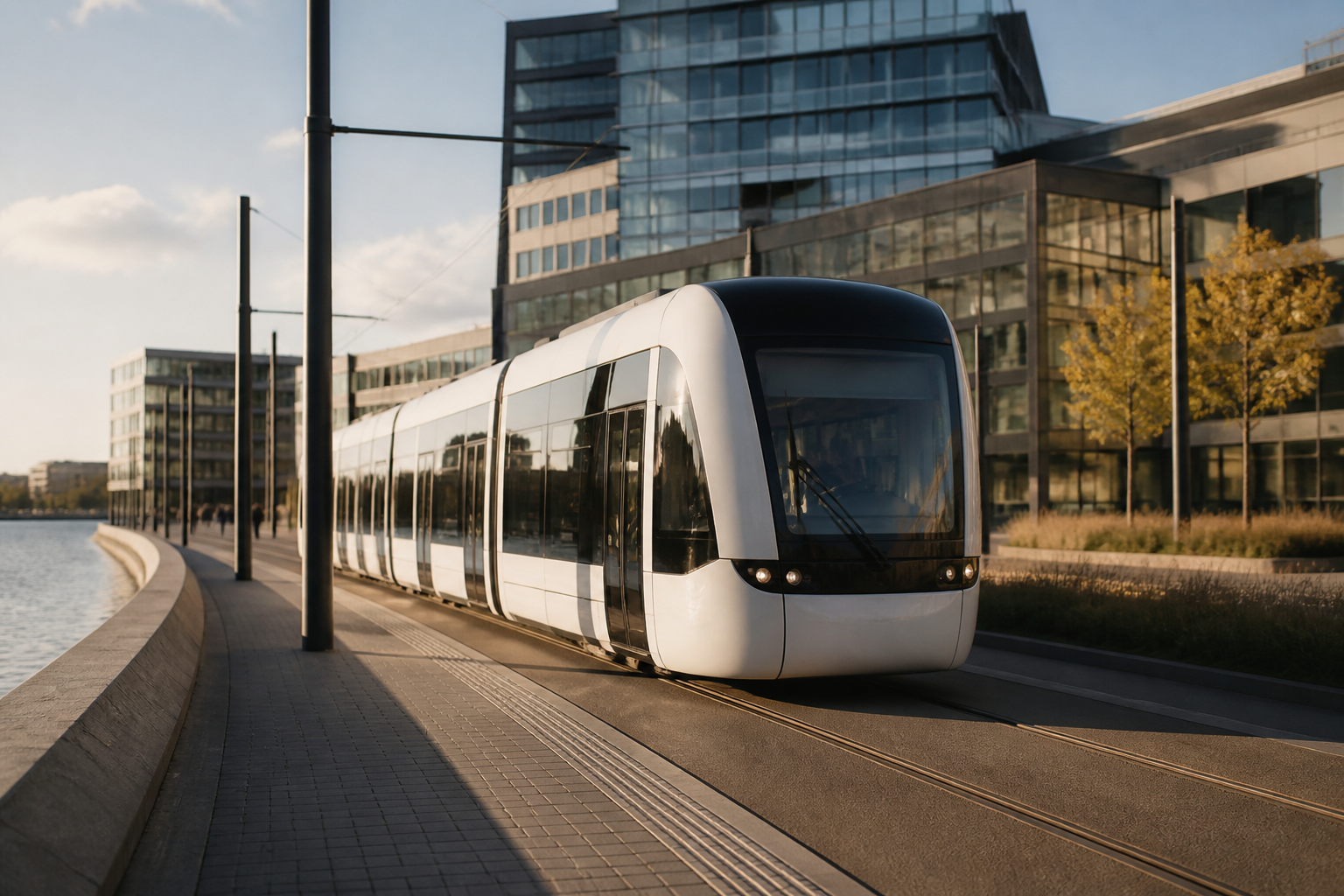
If this were my programme, I would read the repayment schedule before the ribbon-cutting photographs. Greater Copenhagen Light Rail opened along its full 28 km on 22 August 2026. Its construction budget is DKK 9.6bn, against the DKK 6.2bn first put to sponsors.
Hovedstadens Letbane, the company that owns the line, revalued that budget upward by DKK 1.1bn including reserves, about 13%. Director Erik Skotting attributed the rise to supply-chain disruption and a shortage of qualified labour. He named Covid-19 and the war in Ukraine as the causes. The company did not close the gap with one supplementary cheque. It raised the owners' fixed annual contribution by DKK 33m. The municipalities carry DKK 19m of that and the Capital Region DKK 14m. It also extended the date by which the company's construction debt must be repaid by ten years, to 2069.
A rail line built to avoid the city centre
The line runs 28 km between Ishøj in the south west and Lundtofte, north of Lyngby. It follows the Ring 3 orbital corridor for most of that distance. It has 29 stations across eight municipalities. Six of them interchange with the S-train network: Lyngby, Buddinge, Herlev, Glostrup, Vallensbæk and Ishøj. Almost every other rail service in the region points at central Copenhagen. This one points across the suburbs.
The first 12 stations, between Ishøj and Rødovre Nord, opened on 26 October 2025. The remaining 17 opened on 22 August 2026. Civil works were let in five packages in 2018 to MJ Eriksson, Per Aarsleff and CG Jensen. Siemens Mobility took the turnkey systems contract with Aarsleff Rail. The scope covers electrification, signalling, communications, depot equipment and system integration, plus 15 years of maintenance. Operations run for 15 years under Metro Service, a subsidiary of Milan's ATM. Twenty-nine Siemens Avenio vehicles carry about 260 passengers each at an average speed of around 30 km/h.
The overrun was paid in years
A project company with fixed owner contributions and a target debt-free date has three ways to absorb a cost increase. It can raise the annual payment, move the payoff date, or cut scope. Copenhagen used the first two and kept the scope. That decision is the story.
The capital figure moved by 13%. The liability moved by a decade. A supply-chain and labour shock from 2022 and 2023 will still sit on municipal balance sheets in the 2060s. DKK 9.6bn across 28 km works out at roughly DKK 343m per kilometre. That is about EUR 46m per kilometre at the krone's euro peg, on my own arithmetic. The cost per kilometre is ordinary for light rail. The repayment horizon is the unusual part.
Who holds the variable end
Construction is funded 40% by the Danish state, 34% by the municipalities and 26% by the Capital Region. The state stopped being a partner in Hovedstadens Letbane I/S on 1 January 2019. Its capital obligation to the project continued. The eleven municipalities and the region also carry all operating and maintenance costs.
So the largest single contributor holds a defined, capped exposure and sits outside the company. The smallest balance sheets hold the variable end. The ten-year extension still had to be discussed with the state, which tells you where the real approval sits. Formal sign-off ran through the partnership meeting, then each owner council and the region separately. Eleven councils each had to vote for a longer debt.
The passenger ramp is a second call on the same budgets
The line is expected to carry about 12,000 passengers a day in early operation. The long-run forecast is 14 million a year. That is roughly 38,000 a day by my calculation, about three times the opening number. Lyngby is expected to be the busiest station at around 6,500 weekday passengers.
Fare income sits inside the same long-term budget that carries the debt. If the ramp arrives late, the shortfall lands on the same eleven councils that just agreed to pay until 2069. Ridership forecasting on an orbital line is harder than on a radial one. The trips are dispersed, and the alternative is usually a car already in the driveway.
What the next orbital scheme has to price
Metroselskabet screened five possible extensions in 2021. They included Lundtofte to Kokkedal and Glostrup to Avedøre Holme. Whether any proceed depends on eleven councils signing a second cost-sharing agreement. They have just lived through the first.
For contractors and systems suppliers, municipal co-sponsors run out of headroom before national ones do. That headroom shows up as delayed tender releases rather than cancelled projects. Read council capital plans as a pipeline indicator. For investors, the tenor is the real variable on a co-owned transport vehicle. Fixed contributions and a moving payoff date make it a credit story. Strip the completion date out and look at the debt maturity instead. For sponsors, the question to settle before signature is simple. If costs rise 15%, which owner writes the cheque, and in which budget year.
📊 Analytics & Strategic Insight
When a sponsor cannot raise the cheque, it raises the calendar
The decision most in this industry are avoiding:
👉 Pricing the tenor as carefully as the total. Boards approve a capital number and a completion date. Very few approve the repayment horizon with the same rigour, even though that is the line that actually moves when costs rise.
👉 Naming the owner who absorbs variance before signature. Cost-sharing percentages describe the base case well. They rarely describe who funds an overrun, in which budget year, and under whose borrowing limit.
👉 Treating a stretched payoff date as a warning rather than good housekeeping. Extending debt keeps a project alive and quiet. It also consumes the sponsor's capacity to fund the next scheme, which is where a regional pipeline quietly disappears.
Here's the full context:
→ 2013: The principle agreement creates Hovedstadens Letbane on the Ring 3 corridor at an estimated DKK 6.2bn, funded 40% by the state, 34% by eleven municipalities and 26% by the Capital Region.
→ 2018: Civil works are let in five packages to MJ Eriksson, Per Aarsleff and CG Jensen. Siemens Mobility and Aarsleff Rail take the turnkey systems contract, with 29 Avenio vehicles ordered and 15 years of maintenance attached.
→ 2019: The state stops being a partner in Hovedstadens Letbane I/S on 1 January while keeping its capital obligation, leaving the municipalities and the region holding the variable end.
→ 2022 to 2023: The company flags a 10% to 15% overrun risk, then revalues the construction budget up by DKK 1.1bn, about 13%, citing supply chains and labour scarcity. Owners add DKK 33m a year and push the debt payoff out to 2069.
→ Most recent: The final 17 stations open on 22 August 2026, completing 28 km and 29 stations at a construction budget of DKK 9.6bn, with about 12,000 passengers a day expected at first.
What this means for infrastructure operators, contractors and investors:
✅ Municipal co-sponsors ration by delay. A council rarely cancels a scheme outright. It slows the next tender, trims the next phase and waits a budget year. Contractors reading only cancellation notices will miss the slowdown entirely.
✅ The credit to underwrite is duration. On a co-owned transport vehicle with fixed owner payments, cost risk converts into tenor risk. A ten-year extension changes the debt profile far more than a 13% capital uplift does.
✅ Orbital demand ramps slower than radial demand. Suburb-to-suburb trips are dispersed and compete with a car already parked outside. Build the operating case on a slower curve and identify who funds the gap in year three.
3 moves you can make this week:
1️⃣ Pull the repayment schedule on every co-sponsored scheme in your pipeline. Note the target debt-free year and whether it has moved since financial close. A moved date is the clearest public signal that a sponsor is under pressure.
2️⃣ Write the overrun waterfall into the shareholders' agreement. Set out the order in which owners are called, the trigger threshold, the cash timing and the fallback if one owner cannot pay. Percentages alone leave the hardest question open.
3️⃣ Re-read your demand ramp as a funding assumption. Model the case where volumes reach two thirds of forecast by year four, then name the owner who covers the operating shortfall. Put that name in the board pack.
Share it with your peers
Help your network stay ahead of CEE capital projects.
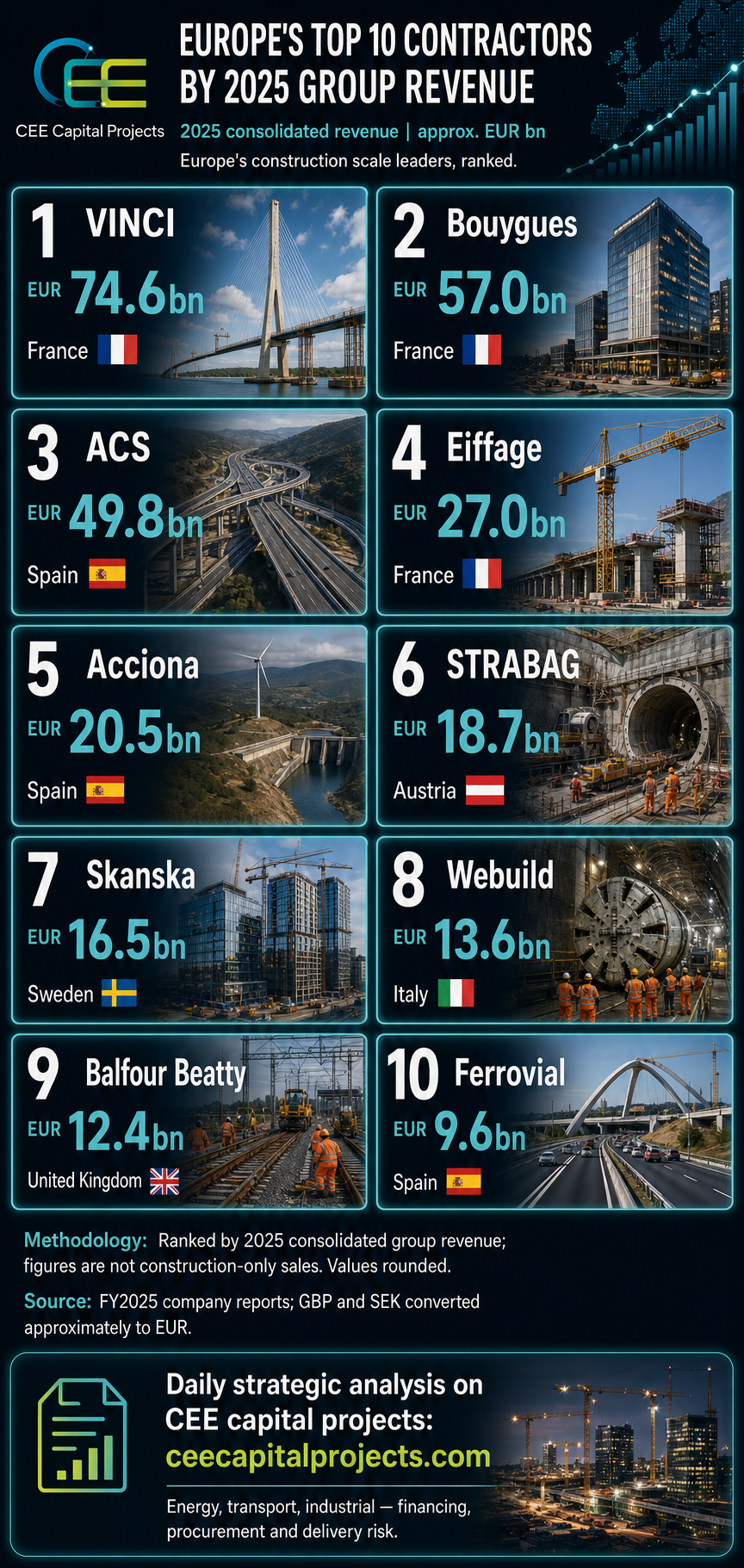
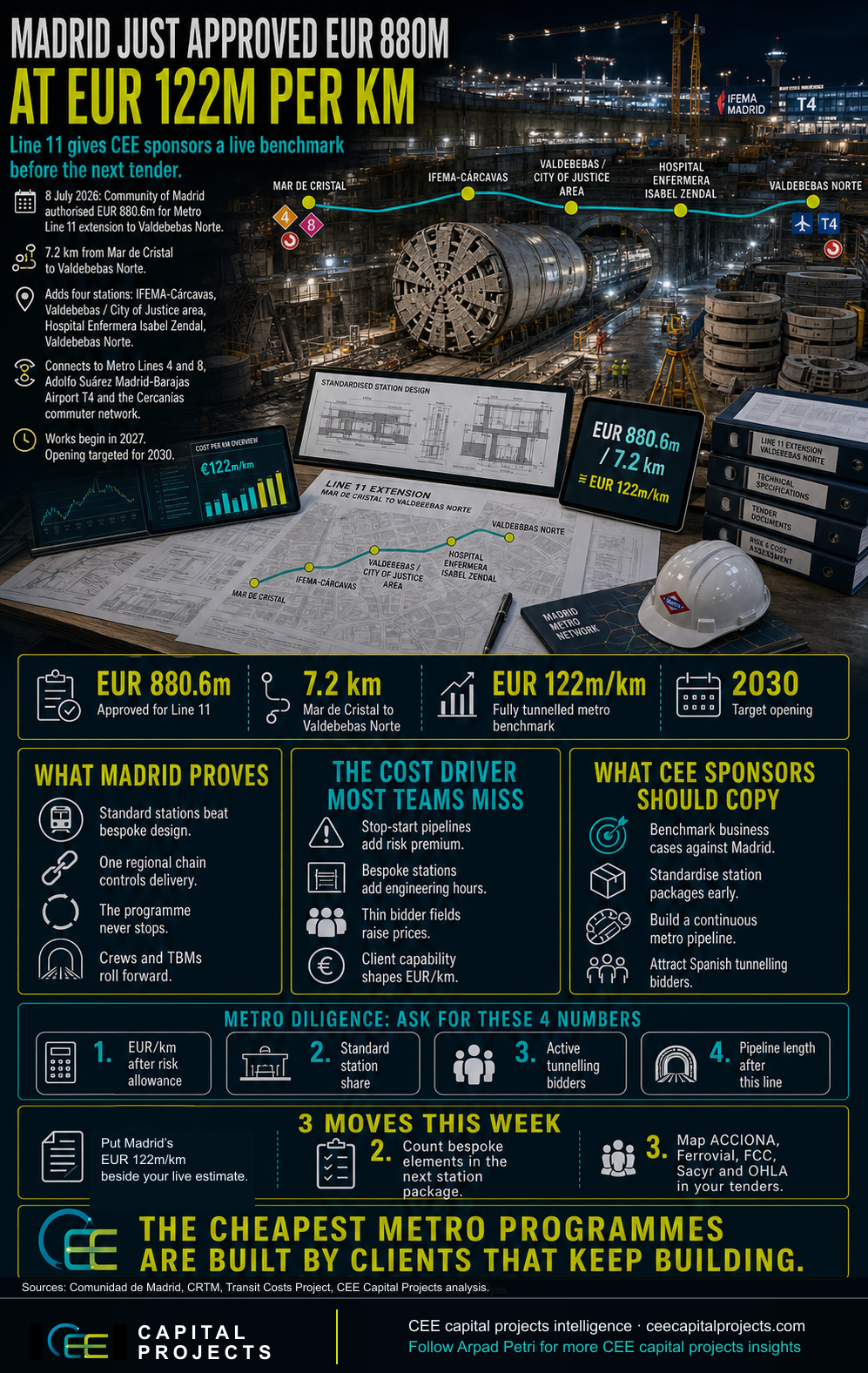
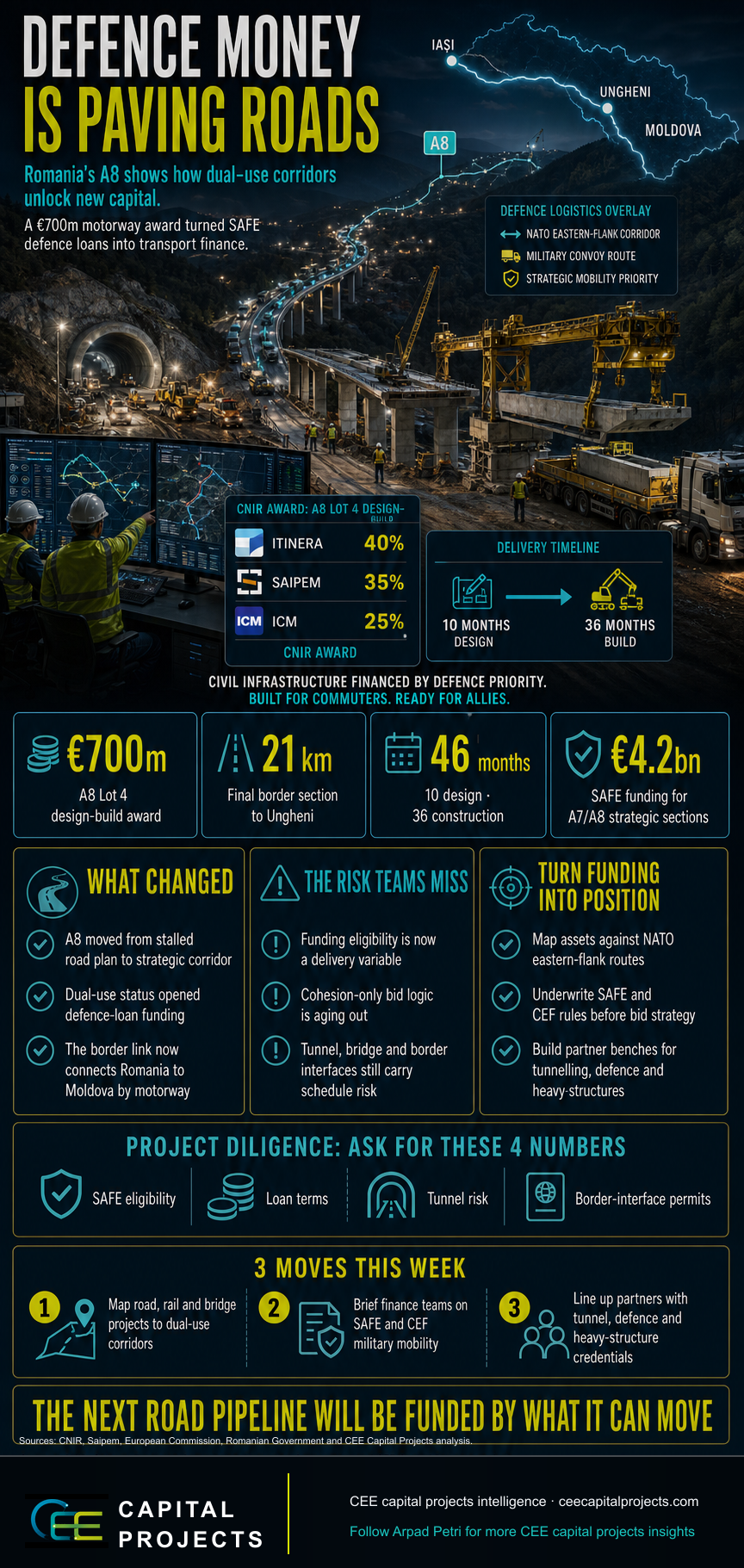
Explore our infograph library — strategic visuals for CEE capital projects leaders.
Project benchmarks, financing structures, tender dynamics and delivery risk — at a glance. Free access for investors, owners, contractors and strategy teams tracking CEE capital projects.
Browse the libraryRelated analyses
- Transport & Infrastructure
V-Híd Just Lost Hungary's HUF 338 Billion Déli Körvasút at 42 Per Cent Complete. The Grant Clock Is the Real Story
Hungary halted construction of the Budapest Southern Circle Railway on 9 October 2026 and barred V-Híd from every ongoing rail investment. The HUF 367 billion of EU money behind the job survives only if a lawful re-tender lands inside two years.
Read analysis → - Transport & Infrastructure
Afcons Wins Croatia's EUR 899m Dugo Selo-Novska Rail Contract: Four Bids, No European Prime
Croatia signed its largest ever railway contract on 1 October 2026, handing 83 km of double-tracking to India's Afcons Infrastructure at EUR 677.06m excluding VAT. Four bids were priced for the work and not one of them came from a European prime contractor.
Read analysis → - Transport & Infrastructure
STRABAG Closes BAWI Construction Buy in Romania as Rail Qualification Becomes the Scarce Asset
STRABAG has closed its purchase of BAWI Construction, a Bucharest rail specialist with 240 employees and about EUR 60 million of 2025 output. The number that matters is the qualification it buys, as Romania opens a EUR 5.99 billion rail programme with the EU recovery window shut.
Read analysis →
Building in Central Europe?
Tell us what you're building. We'll tell you what can go wrong — and how to prevent it.