We Help International Investors and Project Owners Deliver Major CEE Projects Without Expensive Surprises
Independent project intelligence and advisory across energy, transport, real estate and industrial construction.
Colas Won 21 Sites in Hungary's 594-Kilometre Road Renewal. Its Own Quarry Chief Says Nobody Has Planned Where the Stone Comes From
Hungarian road and rail construction output fell 46.2% in May 2026, yet Magyar Közút is running its largest secondary-road renewal year on record: more than HUF 149 billion, 594 kilometres, 152 sites, nine contractors. The constraint on delivering it sits upstream of every tender, in quarries nobody is planning centrally.
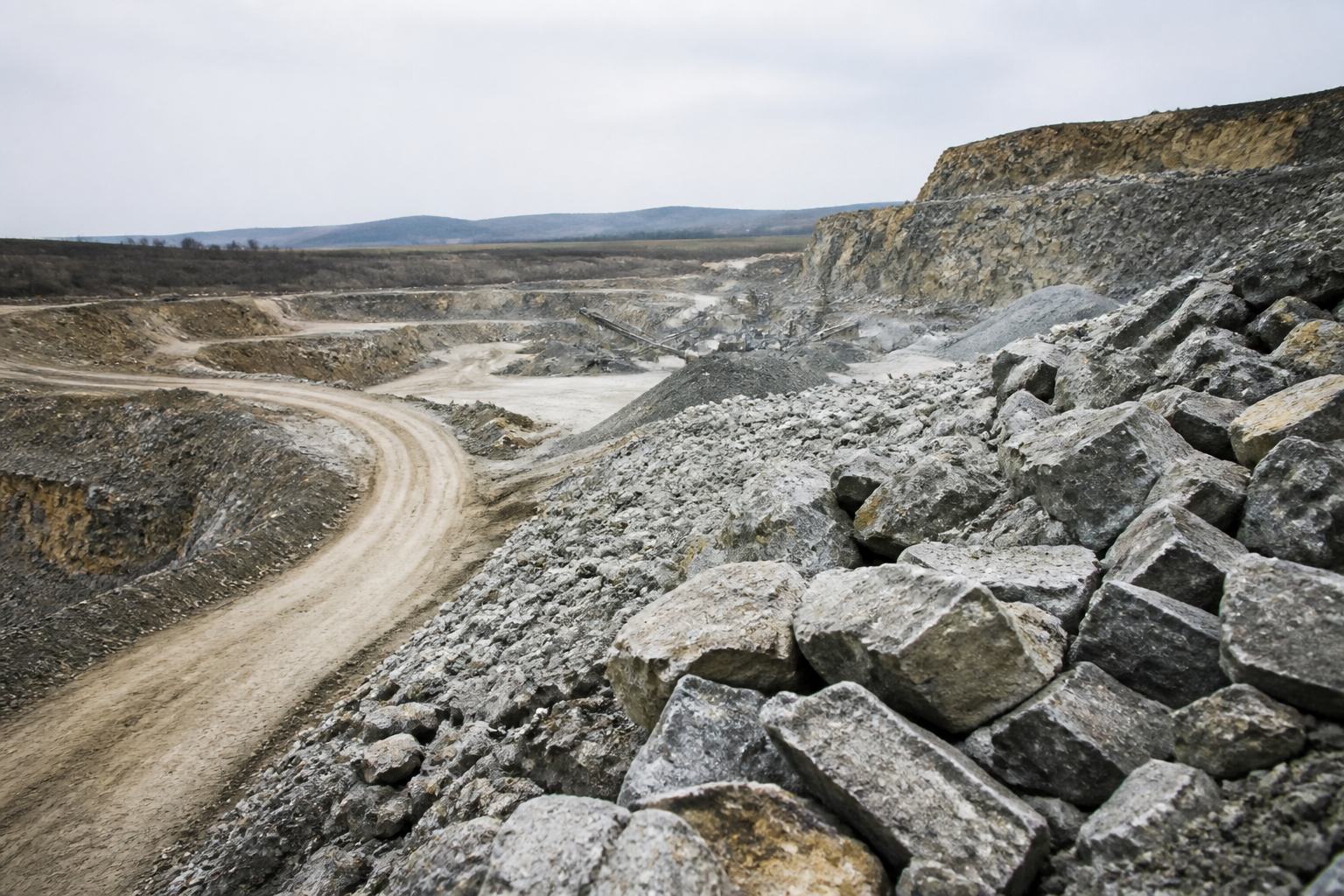
Hungarian road and rail construction output fell 46.2% year on year in May 2026. In the same year, Magyar Közút is renewing 594 kilometres of road across all 19 counties, and Colas holds 21 of the construction sites. Both statements are true, and the space between them is where the money in Hungarian civils has quietly moved.
A framework scoped at HUF 80 billion is spending HUF 149 billion
Magyar Közút Nonprofit Zrt. told trade title Magyar Építők on 25 July 2026 that it is delivering more than HUF 149 billion of renewal work this year under a framework originally set at HUF 80 billion for 2021–2025. The work covers 594 kilometres of four- and five-digit roads, Hungary's secondary and local network rather than its motorways. Some 239 renewals sit inside the EU co-funded TOP_PLUSZ programme; a further 33 national roads are being renewed under six domestically funded programmes worth roughly HUF 60 billion across 65 kilometres.
Delivery is well advanced. Construction started at 152 locations in 2026. Sixty-nine sections totalling 153.4 kilometres have had full pavement replacement completed, and another 72 sections covering 219.6 kilometres are live. Scope runs past resurfacing to sub-base and earthworks repairs, minor widening, curve corrections, drainage and, in places, bridge refurbishment and utility diversions.
Set that against the Central Statistical Office (KSH) release of 14 July 2026: road and rail construction fell 46.2% in May, contributing close to 38 percentage points of a 10.7% decline for the sector as a whole. The megaproject layer is emptying out. The renewal layer is at record volume. They are not the same business, and they do not run on the same assets.
Nine contractors, 152 sites, and the length of a hot-asphalt haul
The contract award notice (TED 493377-2026) splits the programme nine ways: STRABAG at 50 locations, Duna Aszfalt at 41, Colas at 21, HE-DO at 19, SWIETELSKY Magyarország at 16, Soltút at 11, KE-VÍZ at 7, Euroaszfalt at 5 and Zemplénkő at 3.
Read as a league table of bidding skill, that split says little. Read as a map, it says almost everything. Hot mix asphalt leaves the plant at 160–180°C and must be laid and compacted before it cools, which caps haul distance. A programme of 152 scattered sites across 19 counties is therefore settled less by tender-room tactics than by who has a mixing plant, an aggregate source and a paving crew within range of each village bypass. Price picks the winner among those who can bid. Plant geography decides who can bid at all.
The input nobody tendered for
Which is what makes Colas the interesting name on that list. Alone among the nine, its Hungarian business starts underground. Colas Északkő, 35 years old in July, runs eight quarries between the Danube Bend and Sárospatak, plus three demolition-material processing sites and a logistics centre, with 146 staff and more than 80 million tonnes of crushed stone sold to date. Colas SA took majority control of the then state-owned Északkő Bányászati Kft. in May 1991, its opening move in Central Europe, and spent close to €11 million modernising the Tállya plant in 2020–21.
In an interview published by Magyar Építők on 18 July 2026, Északkő managing director Zoltán Cseh used the anniversary to make a blunt point: Hungary has no genuine mineral resource management strategy. The 1993 mining act and its institutions register exploration areas, operating and closed mines and declared reserves, he argued, but have no visibility of what product grades those reserves can yield, or how much has been placed out of reach by conservation, heritage or local planning restrictions. Nor is there a national picture of recycled and secondary material from demolition and industrial by-products, which is what a mature market uses to relieve pressure on primary aggregate.
Roads and rail are now buying from the same rock
Cseh reserved his sharpest doubt for rail. He questioned openly whether the quantity and quality of ballast needed for Hungary's track renewal programme can be supplied, given deferred quarry investment and newer barriers to reserve access. That is no abstract worry. MÁV raised its own-source track renewal budget to HUF 60 billion for 2026, some HUF 25 billion above 2025, and ballast is a narrow product — hard volcanic rock, tight grading, high abrasion resistance — produced by a small subset of the same quarries feeding the road programme.
So two state renewal programmes are ramping at once into one production base that nobody plans centrally. The road programme alone is spending 86% more in a single year than its five-year envelope implied. Neither procurement process asks the aggregate question, because aggregate is treated as a purchasing line rather than a delivery constraint.
What to watch
For contractors, the 2026 allocation previews how Hungarian roads work will be bought for the rest of the decade: many small sites, framework call-offs, thin per-site margins, and delivery risk sitting in logistics rather than engineering. The firms that hold this work will own plant and material close to it, a capital decision made years before the tender appears.
For investors, the asset to underwrite here is no longer the order book. It is the plant and quarry footprint that makes the order book deliverable, and vertically integrated positions of the Colas Északkő type are harder to replicate than any bid team. For public sponsors, the uncomfortable question sits upstream of every notice: a programme can be fully funded, fully awarded and still slip, if the material it depends on has never been counted.
Share it with your peers
Help your network stay ahead of CEE capital projects.
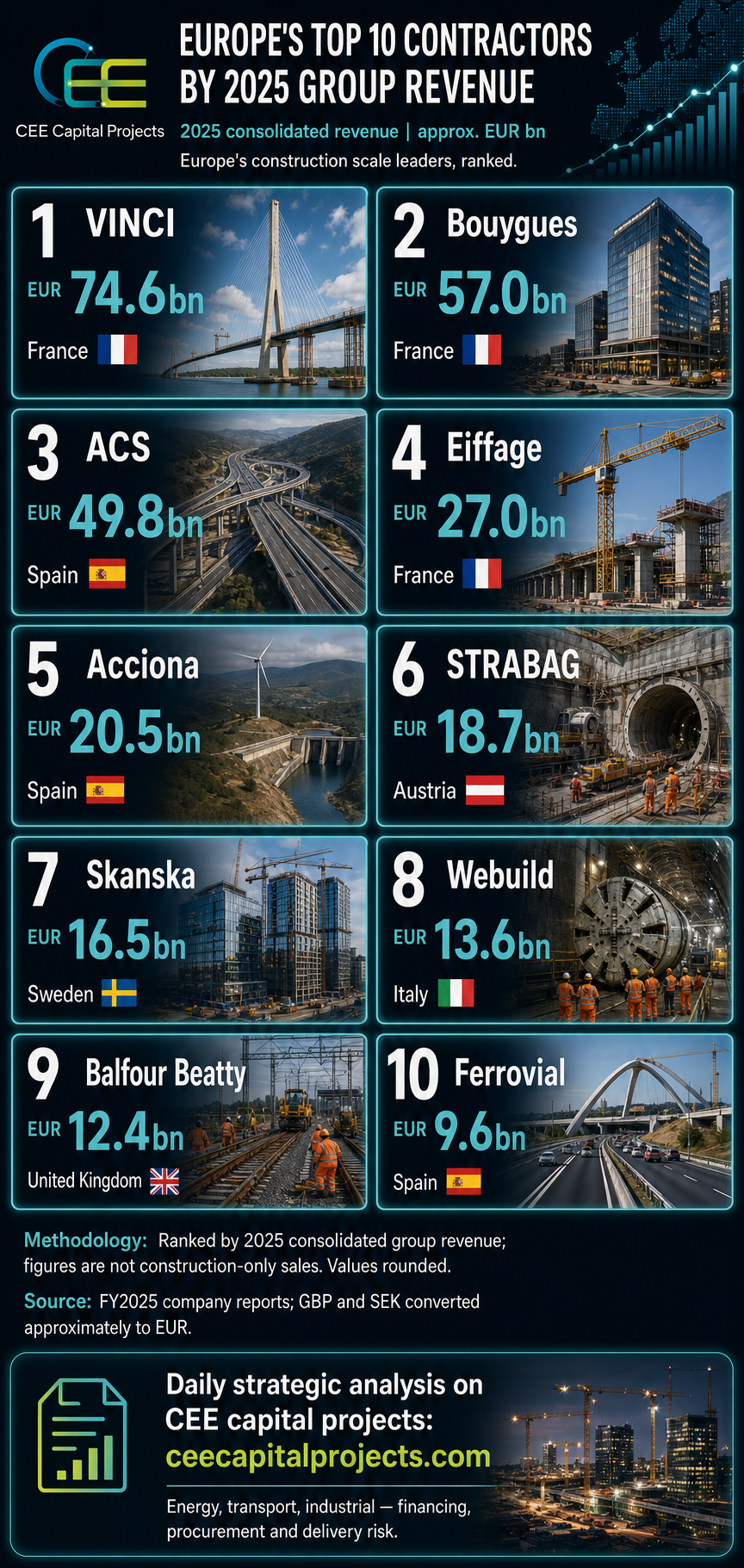
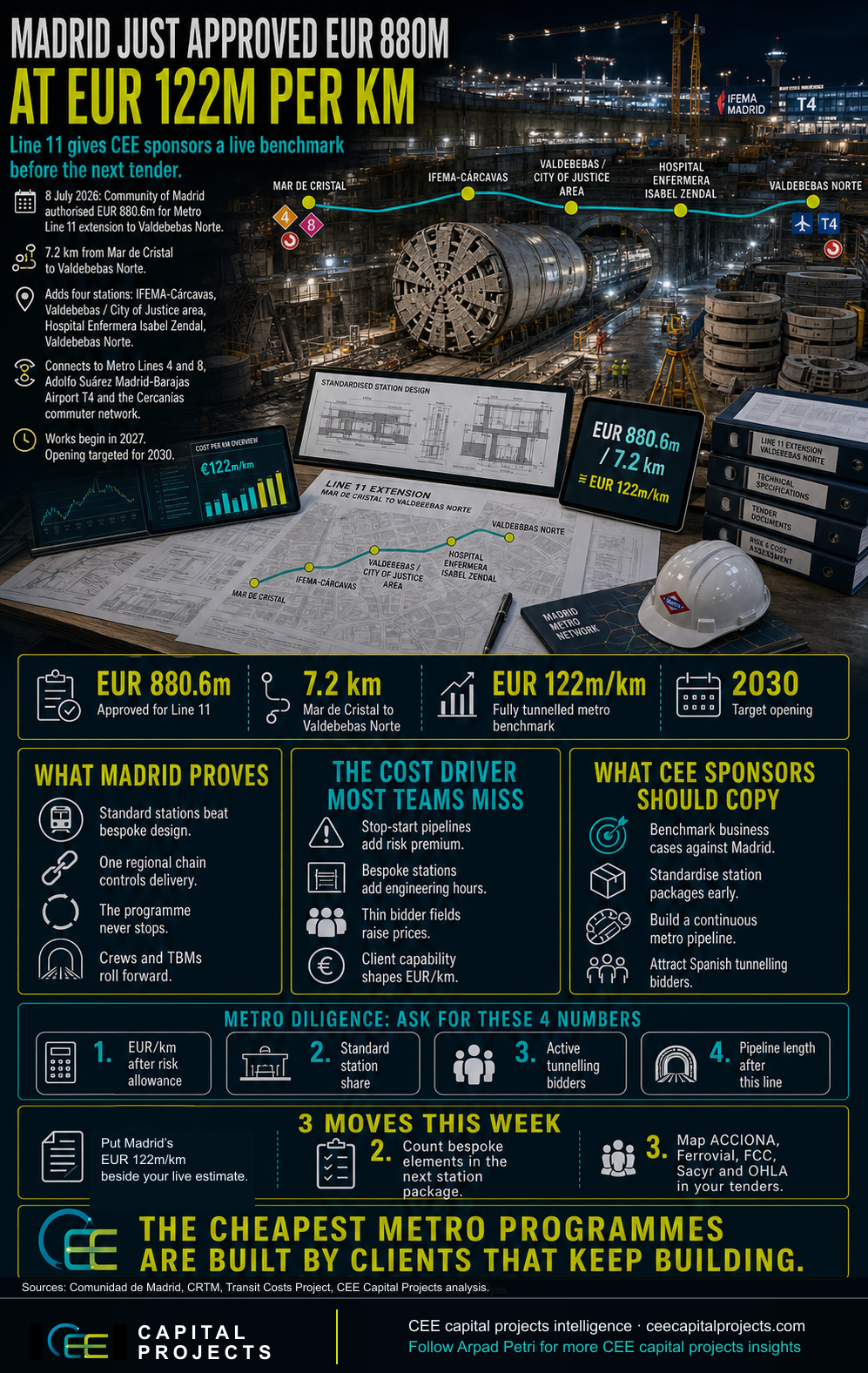
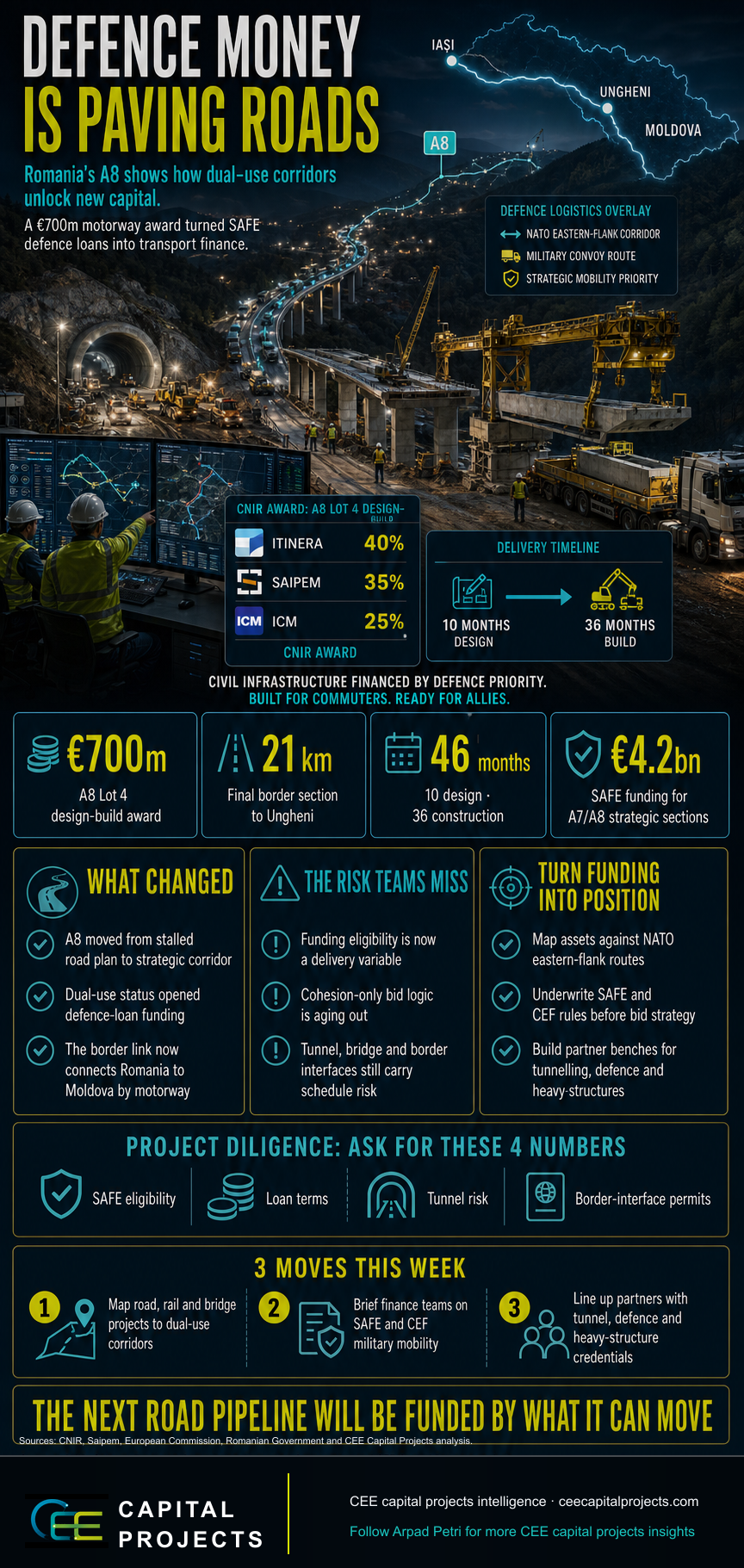
Explore our infograph library — strategic visuals for CEE capital projects leaders.
Project benchmarks, financing structures, tender dynamics and delivery risk — at a glance. Free access for investors, owners, contractors and strategy teams tracking CEE capital projects.
Browse the libraryStrategic Insights
📊 Analytics & Strategic Insight
Winning the job is the easy part. Getting the stone is not.
The decision most in this industry are avoiding:
👉 Nobody checks the rock before signing. Firms check crews, machines and price. Almost nobody asks where the stone will come from, or how far it must travel. On a job spread over 150 sites, that one question decides the whole programme.
👉 Lots of small jobs is a different business from one big job. A single big site rewards engineering. A hundred small sites reward logistics: trucks, plants, planning and driving time. Firms keep pricing the second as if it were the first, then wonder where the profit went.
👉 Two public plans can starve each other. Roads and rail are being renewed at the same time. They buy stone from many of the same quarries. No single office is checking whether both plans can be fed.
Here's the full context:
→ 1991: Colas bought most of the state quarry firm Északkő. It now runs 8 quarries and has sold more than 80 million tonnes of crushed stone.
→ 2020-21: Colas spent close to €11 million on a new plant at Tállya, one of its bigger upgrades in the country.
→ 2021-2025: Magyar Közút set up a road renewal framework worth HUF 80 billion.
→ May 2026: Road and rail building work fell 46.2% against a year earlier (KSH, 14 July 2026). The whole building sector fell 10.7%.
→ Most recent: On 25 July 2026 Magyar Közút said it is spending more than HUF 149 billion this year on 594 km of road at 152 sites. Nine firms share the work and Colas got 21 sites. A week before, its own quarry boss said Hungary has no plan for its stone.
What this means for infrastructure operators, contractors and investors:
✅ The plant map is the real order book. If your asphalt plant is an hour away, you cannot bid, whatever your price. Firms that want this work must own plants and quarries near it, and that takes years to arrange.
✅ Material supply is a delivery risk, not a buying job. A funded, awarded job can still slip if the stone runs short. Put the material question in the risk register, next to labour and weather.
✅ Small repeat jobs pay less but last longer. Big projects come and go. Renewal work runs every year. It pays thin, yet it keeps crews and plants busy through a downturn, and that is worth real money.
3 moves you can make this week:
1️⃣ Map your plants against the job list. Draw a one-hour driving circle around each asphalt plant and quarry you can use. Lay the coming tender sites on top. That picture tells you which jobs to chase and which to leave.
2️⃣ Ask your stone supplier one question in writing. How much of the grade you need can they deliver next year, and what happens if a bigger customer turns up? Get the answer on paper before you price the work.
3️⃣ Price the driving, not just the laying. Rebuild your rate for a small, far site using real haul and waiting times. Compare it with your standard rate. The gap is the money you have been giving away.
Related analyses
- Transport & Infrastructure
V-Híd Just Lost Hungary's HUF 338 Billion Déli Körvasút at 42 Per Cent Complete. The Grant Clock Is the Real Story
Hungary halted construction of the Budapest Southern Circle Railway on 9 October 2026 and barred V-Híd from every ongoing rail investment. The HUF 367 billion of EU money behind the job survives only if a lawful re-tender lands inside two years.
Read analysis → - Transport & Infrastructure
Afcons Wins Croatia's EUR 899m Dugo Selo-Novska Rail Contract: Four Bids, No European Prime
Croatia signed its largest ever railway contract on 1 October 2026, handing 83 km of double-tracking to India's Afcons Infrastructure at EUR 677.06m excluding VAT. Four bids were priced for the work and not one of them came from a European prime contractor.
Read analysis → - Transport & Infrastructure
STRABAG Closes BAWI Construction Buy in Romania as Rail Qualification Becomes the Scarce Asset
STRABAG has closed its purchase of BAWI Construction, a Bucharest rail specialist with 240 employees and about EUR 60 million of 2025 output. The number that matters is the qualification it buys, as Romania opens a EUR 5.99 billion rail programme with the EU recovery window shut.
Read analysis →
Building in Central Europe?
Tell us what you're building. We'll tell you what can go wrong — and how to prevent it.