We Help International Investors and Project Owners Deliver Major CEE Projects Without Expensive Surprises
Independent project intelligence and advisory across energy, transport, real estate and industrial construction.
A-Híd Bid HUF 10 Billion Under the Client's Own Estimate to Fix Hungary's Worst Rail Bottleneck. The Bid Was Rejected for Being Too Cheap, and the New Government Just Agreed
A-Híd and Swietelsky Vasúttechnika bid a net HUF 16.62bn for Budapest's Gubacsi railway bridge, almost HUF 10bn below the ministry's own estimate, and had the bid declared invalid as abnormally low. On 29 July 2026 Hungary's new transport ministry confirmed it is proceeding with the higher-priced HE-DO bid instead.
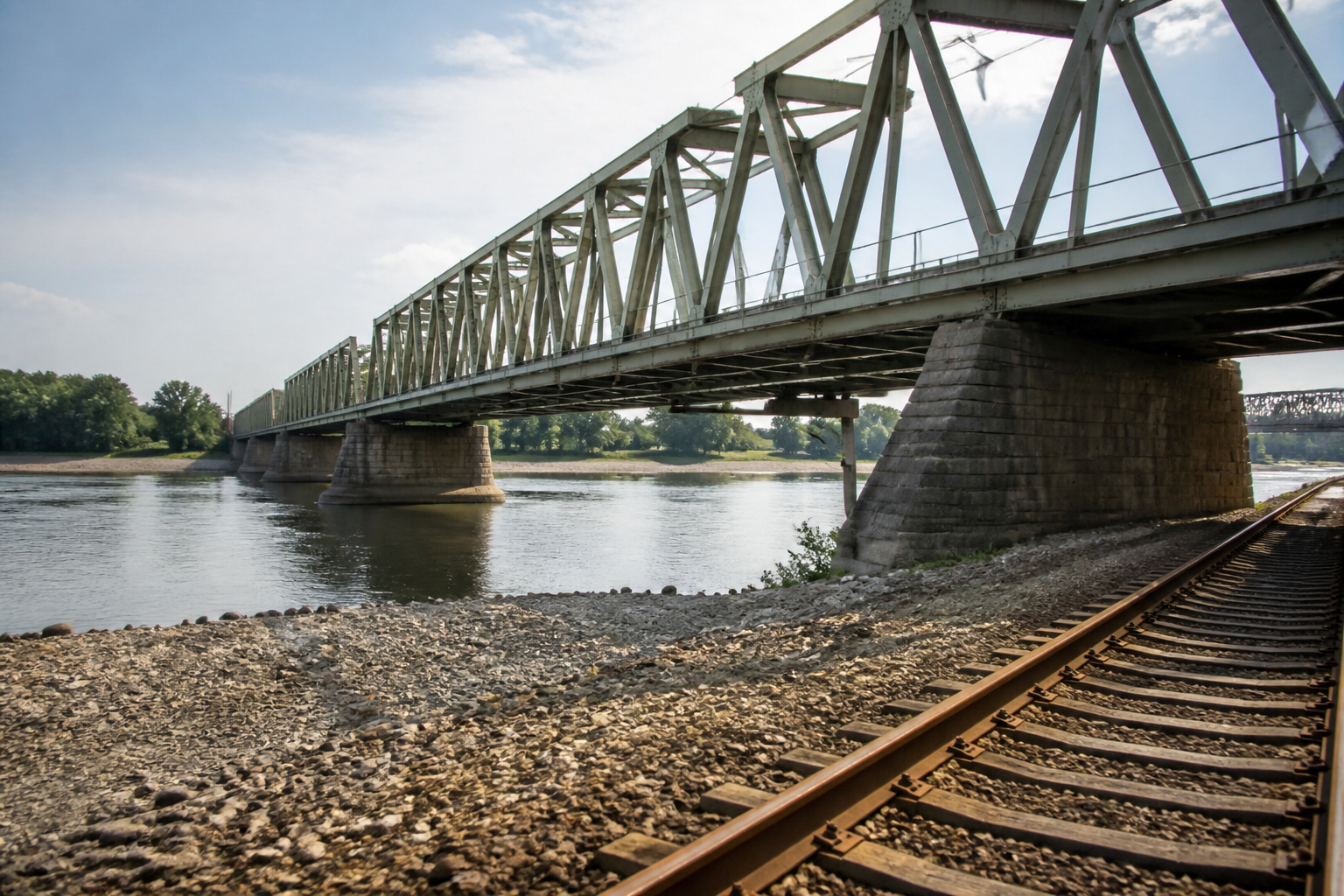
Since 2014, freight trains have crossed Budapest's Gubacsi railway bridge at 5 kilometres per hour. Walking pace. That bridge carries an estimated 10 to 15 per cent of Hungary's entire rail freight traffic and is the rail access to the Csepel Freeport and the container terminals behind it. When the state finally tendered its replacement, the cheapest bid landed almost HUF 10 billion under the client's own estimate. The client threw it out for being too cheap.
A HUF 16.62 billion bid against a HUF 26.54 billion estimate
A-Híd Építő Zrt., one of Hungary's largest civil engineering contractors and fully Hungarian-owned since 2008, bid in consortium with Swietelsky Vasúttechnika Kft. Their price was a net HUF 16.62 billion, roughly EUR 46 million. The then Ministry of Construction and Transport under János Lázár had estimated the works at a net HUF 26.54 billion. The consortium also came in more than HUF 4 billion below the next bidder, HE-DO Építő Zrt.
The ministry ran the price-justification procedure that EU procurement law requires before any abnormally low tender may be rejected, then declared the bid invalid: the justification did not credibly demonstrate the full technical scope could be delivered at that price. The Public Procurement Arbitration Board upheld the ministry. A-Híd took the decision to the Budapest Metropolitan Court and asked for the process to be suspended pending trial. The court refused interim relief. Contract signature was never blocked, and on 29 July 2026 the ministry told HVG that signature with HE-DO is still in progress.
The dispute is about quantities, not discounts
This is the part worth reading closely. The consortium did not claim a cheaper cost base or a bought-in supply chain. It argued that on several work phases its own engineering and technology calculations produced smaller real quantities than the sample bill of quantities issued with the tender, and that its price justification was professional substantiation of the bid rather than a modification of it.
That is a re-measurement argument, and it puts a hard question to every contractor bidding public work in Central Europe. Price your own take-off instead of the client's indicative quantities and you have converted a commercial risk into a validity risk. Being right about the quantities is worth nothing if the bid is excluded before anybody tests whether you were.
Seven bidders, and the cheapest one is in court
The bidder list is a map of the Hungarian market. Alongside A-Híd/Swietelsky and HE-DO sat Economy Home Kft., DSC2000 Kft. in consortium with China Railway Electrification Engineering Group (Hungary) Ltd., Generál Mélyépítő Kft., Züblin Zrt. of the STRABAG group, and Híd-Tám Kft. V-Híd Építő Zrt. challenged the tender conditions before bids were due, lost, and then did not bid at all. HE-DO qualified by relying on third-party capacity, naming Termini-Rail Építő és Szolgáltató Kft., Colas Közlekedésépítő Zrt. and M-Z Rock Kft. as its capacity providers.
Seven bids is a competitive field by Hungarian standards. The European Commission's Single Market and Competitiveness Scoreboard puts Hungary's single-bid rate at 34 per cent for 2024, against an EU average of 28 per cent. So a tender that drew seven bidders and ended with the cheapest one in administrative litigation is not a competition problem. It is an evaluation-rules problem, which is considerably harder to fix.
Twelve years at 5 km/h has a price too
Dávid Vitézy, transport and investment minister in the new government, announced the HUF 31 billion (about EUR 85 million) scheme on 22 July as part of the Baross Gábor Plan, the HUF 3,550 billion ten-year railway modernisation programme. The ministry has since clarified that the HUF 31 billion is a gross whole-project figure covering land acquisition, site preparation, permitting, audits and laboratory testing as well as construction. The new bridge goes up about 15 metres from the old one, with the associated track and signalling rebuilt. Works start at the end of 2026 and finish at the end of 2029.
Note what did not happen. The designs were complete and the building permit was valid; the previous government had simply stopped the project. The new ministry, whose own minister had campaigned partly on this bridge, reviewed the file and kept the exclusion in place. Meanwhile Budapest Közút awarded Híd-Tám Kft. a net HUF 94.7 million contract in late June to refurbish bearings and replace expansion joints on the parallel road bridge, where procurement documents record rusting cast-iron bearings on the Pesterzsébet side and shifted rollers on the Csepel side.
What it signals for the next packages
Hungary is about to spend EU money on rail at a scale it has never managed before, and Gubacsi is the first live test of how that money gets let. The signal to contractors is unambiguous: in this programme a deep discount against the client's estimate buys you a price-justification file, an arbitration hearing and an administrative lawsuit, and probably not the job. Expect bid prices to cluster nearer the engineer's estimate on the next Baross Gábor packages, expect more bidders to price the client's bill of quantities line for line, and expect the competitive lever to shift from price towards programme, capacity evidence and third-party capacity arrangements. For sponsors and lenders the lesson runs the other way. A client estimate sitting 60 per cent above the cheapest credible bid is not a safety margin. It is the number the market will eventually charge.
Share it with your peers
Help your network stay ahead of CEE capital projects.
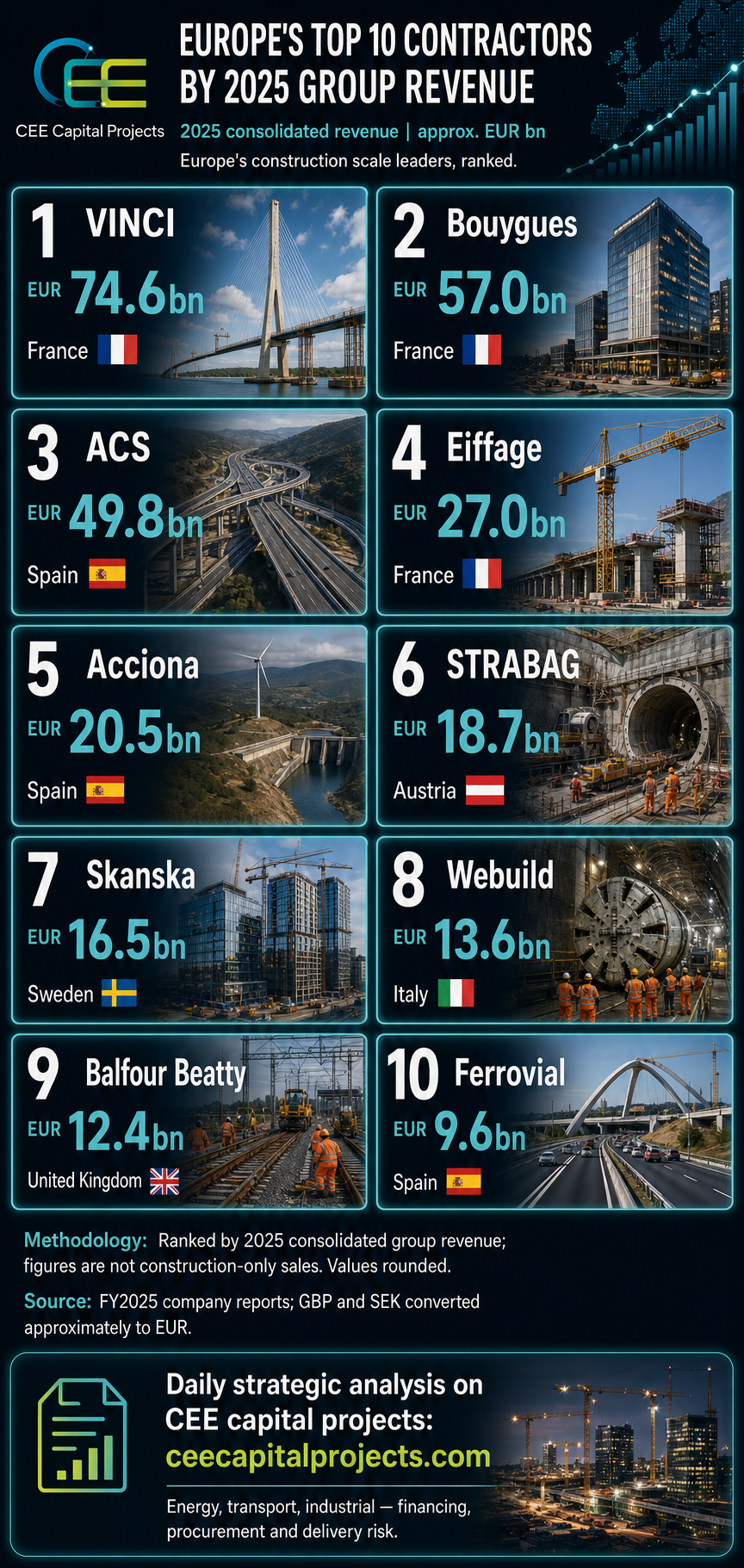
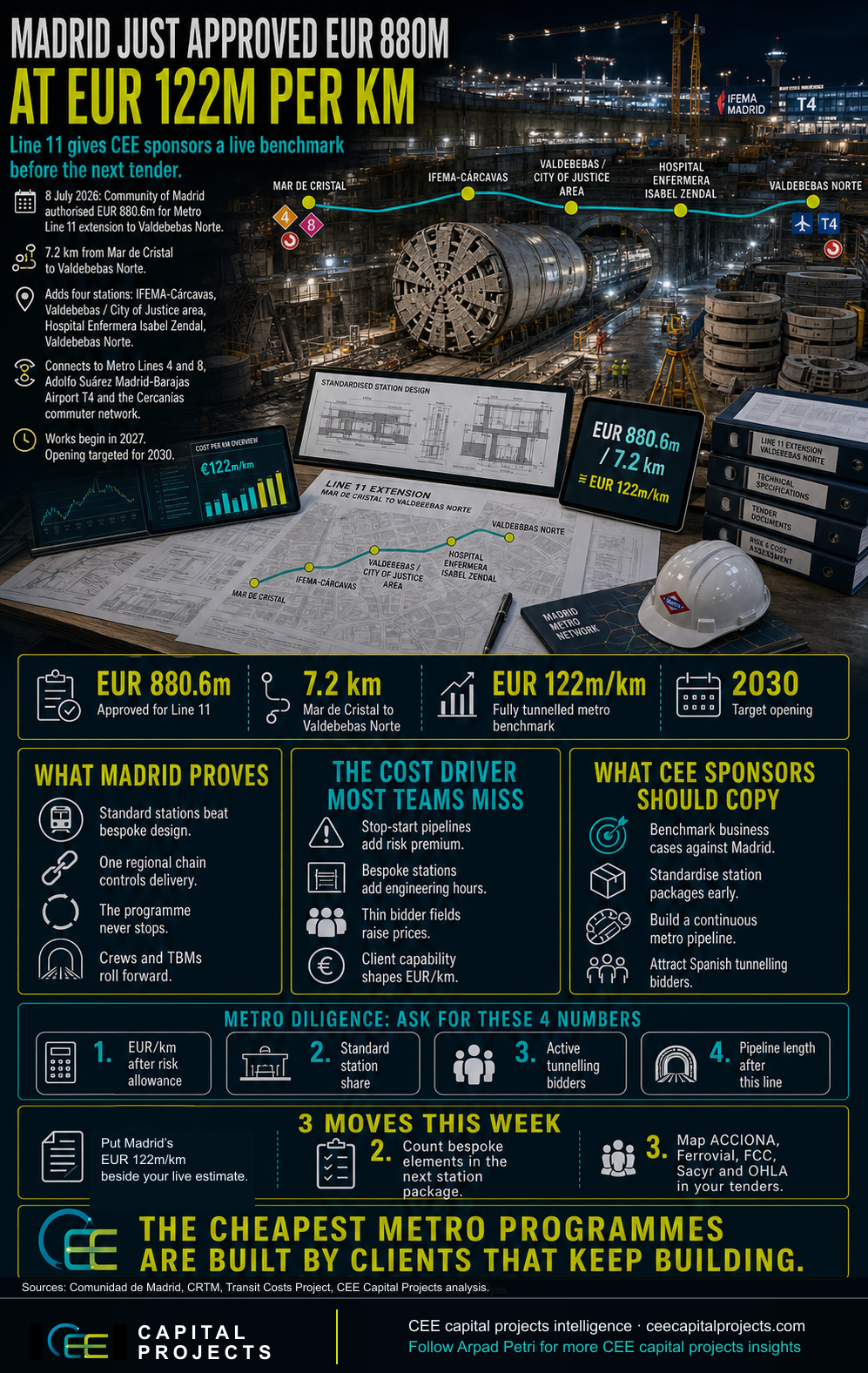
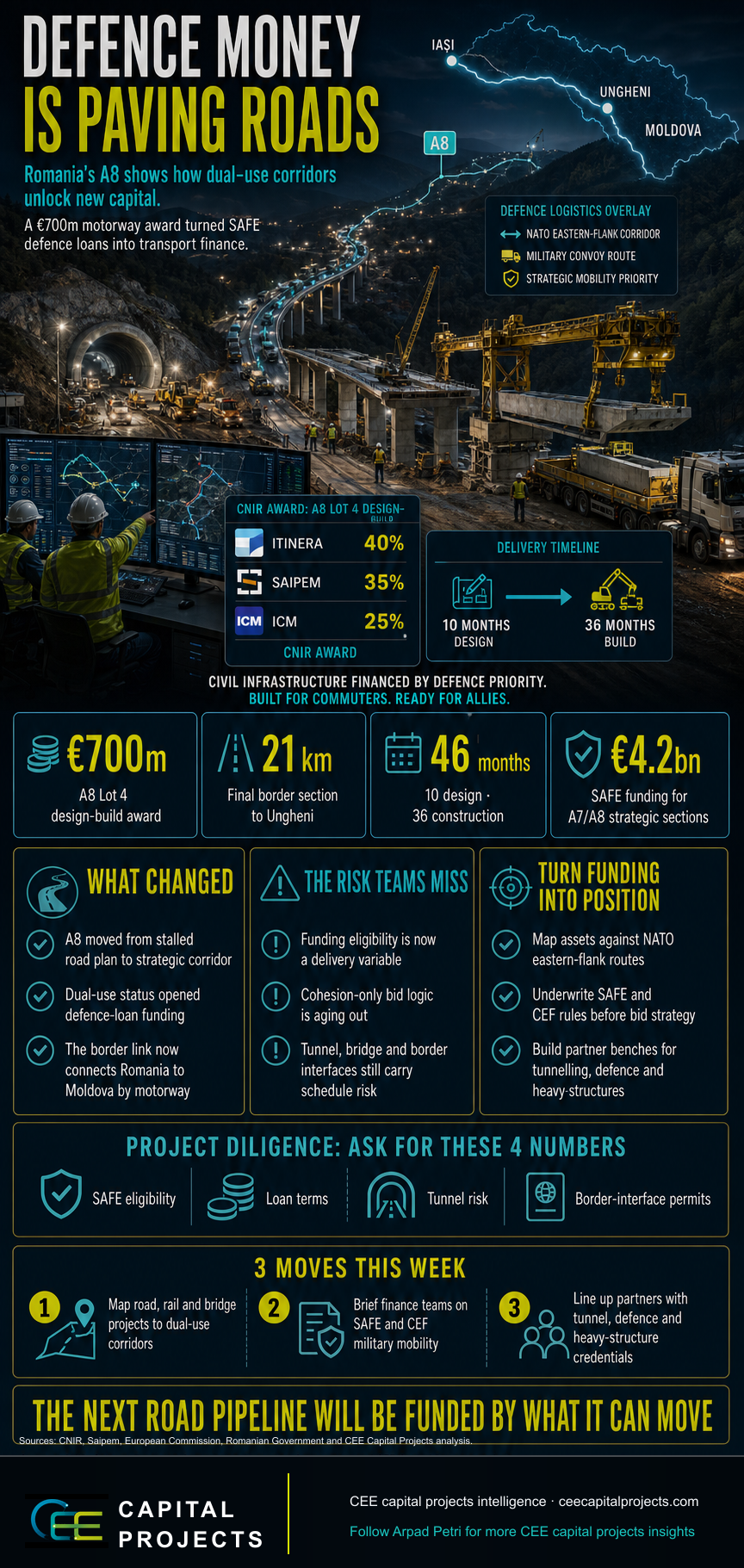
Explore our infograph library — strategic visuals for CEE capital projects leaders.
Project benchmarks, financing structures, tender dynamics and delivery risk — at a glance. Free access for investors, owners, contractors and strategy teams tracking CEE capital projects.
Browse the libraryStrategic Insights
📊 Analytics & Strategic Insight
The bid you are not allowed to submit
The decision most in this industry are avoiding:
👉 Pricing your own quantities turns an engineering judgement into a validity risk. Contractors treat the client's bill of quantities as an estimate to be improved on. Procurement law treats a large departure from it as evidence you have not priced the scope. Those two views collide exactly once, at evaluation, and the contractor is the one who loses.
👉 The engineer's estimate is the real price signal, and almost nobody audits it. A client estimate sitting 60 per cent above the cheapest credible bid is not conservatism, it is an anchor that eventually gets paid. Nobody in the delivery chain has an incentive to stress-test that number before the notice goes out.
👉 A win you have to litigate is worse than a loss you walk away from. V-Híd challenged the tender conditions, lost, and stopped, keeping its costs contained. A-Híd bid, priced sharply, and now carries tender costs, legal costs, an open administrative case and no contract.
Here's the full context:
→ 2014: A 5 km/h speed restriction is imposed on the Gubacsi railway bridge because of its structural condition. It stays in force for twelve years while the bridge continues to carry 10-15 per cent of Hungarian rail freight.
→ 2025: The Ministry of Construction and Transport launches the replacement tender after an earlier stop. V-Híd Építő Zrt. challenges the reference requirements and contract terms, including a 10 per cent profit-margin clause; the arbitration board rejects the challenge and V-Híd does not bid. Seven bids arrive by September.
→ May 2026: The ministry declares the A-Híd/Swietelsky Vasúttechnika bid of net HUF 16.62 billion invalid as abnormally low after a price-justification procedure. The Public Procurement Arbitration Board upholds the decision.
→ June-July 2026: A-Híd starts administrative litigation at the Budapest Metropolitan Court and asks for the award process to be suspended; the court refuses interim relief. Budapest Közút separately awards Híd-Tám Kft. a net HUF 94.7 million contract for bearings and expansion joints on the parallel road bridge.
→ Most recent: On 22 July 2026 the government approves the HUF 31 billion scheme under the Baross Gábor Plan, and on 29 July the transport ministry confirms to HVG that it is proceeding with HE-DO Építő Zrt., with contract signature still in progress.
What this means for infrastructure operators, contractors and investors:
✅ Deep discounting is now the highest-risk bid strategy in EU-funded CEE work. The abnormally low tender rules give a client a lawful route to remove the cheapest bidder without ever assessing whether the price was deliverable. Where EU money and audit exposure are in play, clients will take that route rather than defend a cheap award later.
✅ Third-party capacity is becoming the qualification lever, not the balance sheet. HE-DO qualified by relying on the capacity of Termini-Rail, Colas Közlekedésépítő and M-Z Rock. Who you can borrow capability from now decides eligibility as much as your own turnover or plant does, which changes who you should be signing capacity agreements with.
✅ Litigation no longer stops a signature. The Metropolitan Court refused interim suspension, so the contract proceeds while the case runs. Challenging an exclusion is now a damages play with a long tail, not a way to freeze an award, and bid strategy has to be priced on that basis.
3 moves you can make this week:
1️⃣ Build the price-justification file before you submit, not after. If your bid will land more than 20 per cent under the published estimate, assemble the method statement, quantity take-off, plant and labour build-up and supplier quotations as a submission-ready pack. The clock you get after the request is far too short to construct it from scratch.
2️⃣ Set an internal discount ceiling against the client's estimate. Agree a board-level rule on how far below the published estimate you will go, and require a written justification of the quantity variance to clear it. Treat the gap as a validity risk with its own sign-off, separate from margin.
3️⃣ Map and lock your third-party capacity providers. Identify the specialist firms whose references you would need for the next tranche of rail packages and put capacity agreements in place now. Qualification evidence is becoming the scarce input, and the good providers get committed early.
Related analyses
- Transport & Infrastructure
V-Híd Just Lost Hungary's HUF 338 Billion Déli Körvasút at 42 Per Cent Complete. The Grant Clock Is the Real Story
Hungary halted construction of the Budapest Southern Circle Railway on 9 October 2026 and barred V-Híd from every ongoing rail investment. The HUF 367 billion of EU money behind the job survives only if a lawful re-tender lands inside two years.
Read analysis → - Transport & Infrastructure
Afcons Wins Croatia's EUR 899m Dugo Selo-Novska Rail Contract: Four Bids, No European Prime
Croatia signed its largest ever railway contract on 1 October 2026, handing 83 km of double-tracking to India's Afcons Infrastructure at EUR 677.06m excluding VAT. Four bids were priced for the work and not one of them came from a European prime contractor.
Read analysis → - Transport & Infrastructure
STRABAG Closes BAWI Construction Buy in Romania as Rail Qualification Becomes the Scarce Asset
STRABAG has closed its purchase of BAWI Construction, a Bucharest rail specialist with 240 employees and about EUR 60 million of 2025 output. The number that matters is the qualification it buys, as Romania opens a EUR 5.99 billion rail programme with the EU recovery window shut.
Read analysis →
Facing a decision on a CEE capital project?
Describe the situation in a few sentences. Within 72 hours you get an experienced read: the risks we see, what we'd check, and whether we can help — no calls, no obligation.