We Help International Investors and Project Owners Deliver Major CEE Projects Without Expensive Surprises
Independent project intelligence and advisory across energy, transport, real estate and industrial construction.
Vinci, Bouygues and Eiffage Just Stopped Competing for France's €10 Billion Nuclear Job. On the 'Project of the Century,' EDF Decided Rivalry Was the Bigger Risk
EDF is set to hand roughly €10 billion of EPR2 nuclear civil works to an alliance of Vinci, Bouygues and Eiffage rather than run an open tender. On a €72.8 billion reactor fleet, France decided competition between its biggest builders was the bigger risk.
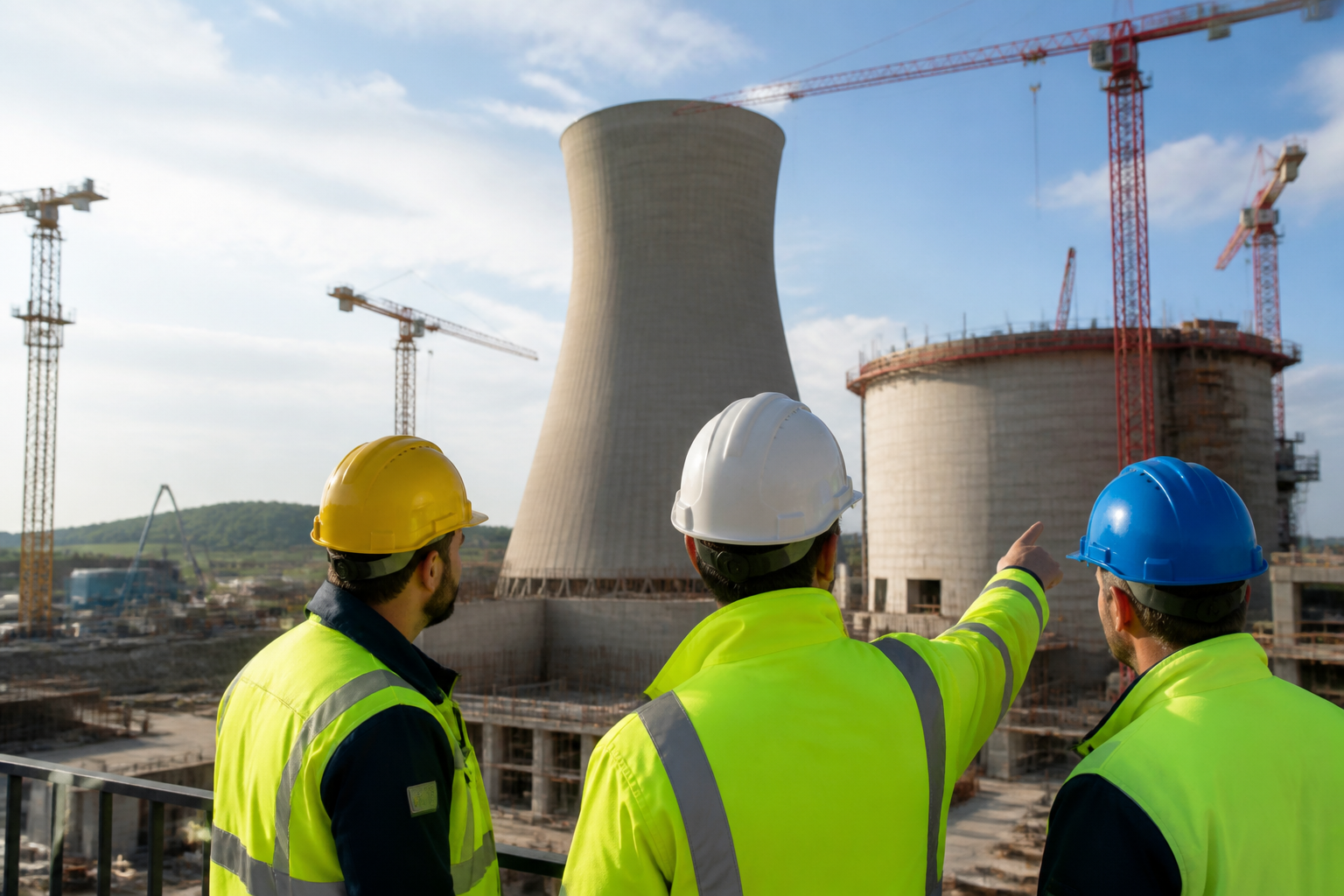
For a decade, Vinci, Bouygues and Eiffage have met on the same shortlists and undercut one another for France's biggest civil-engineering prizes. On the country's €72.8 billion nuclear new-build programme, they have agreed to stop. EDF is preparing to hand the civil works of its next EPR2 reactors to a single alliance of the five largest French builders, rather than run the open contest that has defined public procurement for a generation.
A €72.8 billion programme that cannot afford another Flamanville
EDF put the provisional cost of six EPR2 reactors at Penly, Gravelines and Bugey at €72.8 billion, an 8% rise on earlier projections, in a statement on 18 December 2025. The board earmarked €2.7 billion for the programme in 2026 and is aiming for a final investment decision by the end of the year. The European Commission opened a formal state-aid investigation in March 2026 into the French support package — a subsidised loan for at least half the build cost, a 40-year contract-for-difference and state–EDF risk-sharing — which lifts the headline figure toward €84 billion once financing is counted.
Behind the numbers sits one word EDF would rather not say out loud: Flamanville. The single EPR in Normandy ran years late and billions over budget. The EPR2 programme is built to avoid a repeat by delivering six near-identical reactors as a series, and the civil works are where series discipline is won or lost.
From competitive tender to an alliance of rivals
The break with tradition is stark. In 2023, EDF awarded the civil-engineering contract for the first two EPR2 units at Penly to Eiffage alone — a deal worth more than €4 billion covering 69 structures, including a 70-metre reactor-building dome, per Eiffage's own announcement. Bouygues and Vinci lost that contest.
For the four reactors that follow at Gravelines and Bugey, EDF is not running that contest again. According to Les Échos on 3 June 2026, the utility is set to entrust roughly €10 billion of civil works to an unprecedented consortium of Vinci, Bouygues and Eiffage, joined by NGE and Fayat, the fourth- and fifth-largest French builders. An expression of interest opened in March 2026; the partners are expected to divide the work between themselves by the end of the year.
Why EDF decided rivalry was the risk
The logic is cost-and-method mutualisation. Nuclear civil works demand a narrow pool of certified welders, formwork crews and quality engineers, and there are not five separate teams of them in France. Splitting the fleet across competing contractors would have each firm climbing the same learning curve alone, drawing on the same scarce labour at the same time. Pooling it lets one integrated organisation carry the lessons from Penly straight into Gravelines and Bugey — the "series effect" that makes fleet nuclear cheaper than one-off builds.
The trade-off is that EDF gives up the price tension of an open tender and takes on the harder problem of making rivals share one site, one schedule and one risk register. First concrete at Penly has already slipped from 2026 to 2028, so the alliance inherits a programme with no slack. Commissioning of the first reactor is targeted for 2038, with the rest following at 12-to-18-month intervals.
What it signals for Europe's nuclear builders
The read-across for Central and Eastern Europe is direct. Czechia's Dukovany build (KHNP, around CZK 407 billion) and Hungary's Paks II (Rosatom) are both single-supplier bets, and Poland's Westinghouse AP1000 programme is still assembling its contractor base. France has just signalled that for a multi-unit fleet, the procurement question is not "who is cheapest per reactor" but "who can carry the learning curve across the whole series." That favours alliances and framework structures over one-shot tenders — the same shift already visible in Europe's grid buildout.
For contractors, the message is that the next wave of European nuclear work will reward those who can partner, not only those who can underbid. For investors and public sponsors, the EPR2 model is a live test of whether an alliance of former rivals can deliver a €72.8 billion fleet on cost — and whether Brussels will bless the state aid that underwrites it. The final investment decision at the end of 2026 will show whether France's bet on cooperation over competition holds.
Share it with your peers
Help your network stay ahead of CEE capital projects.
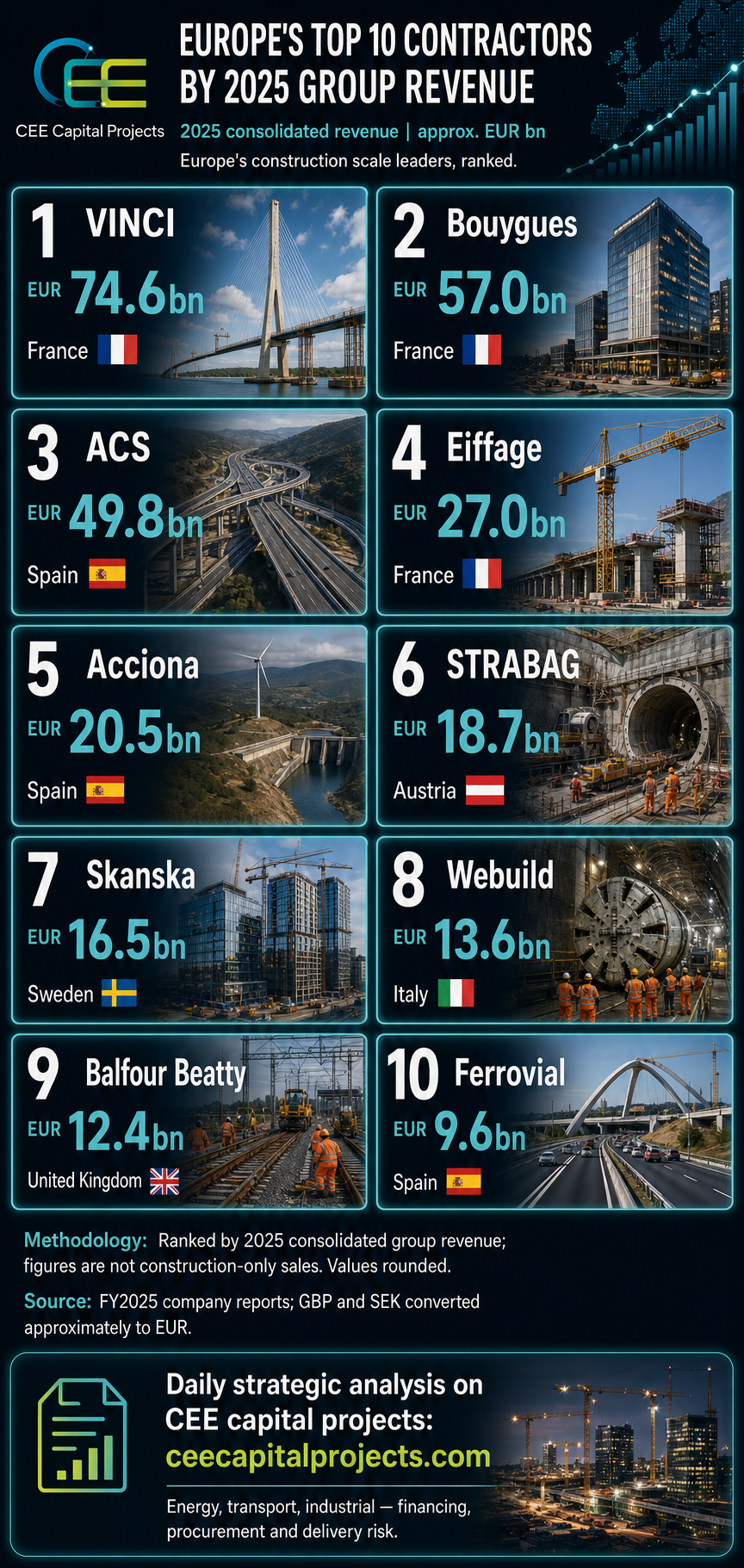
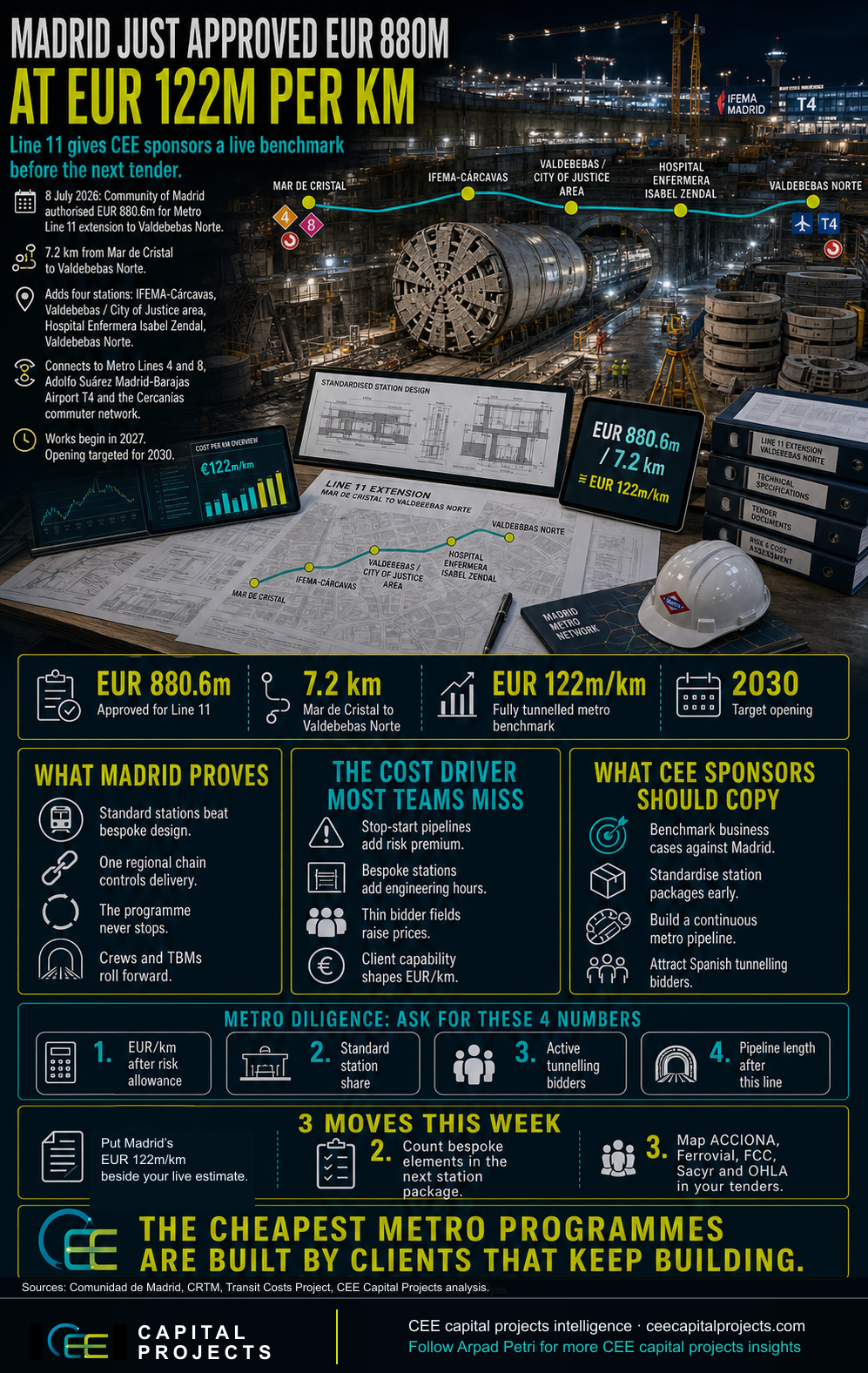
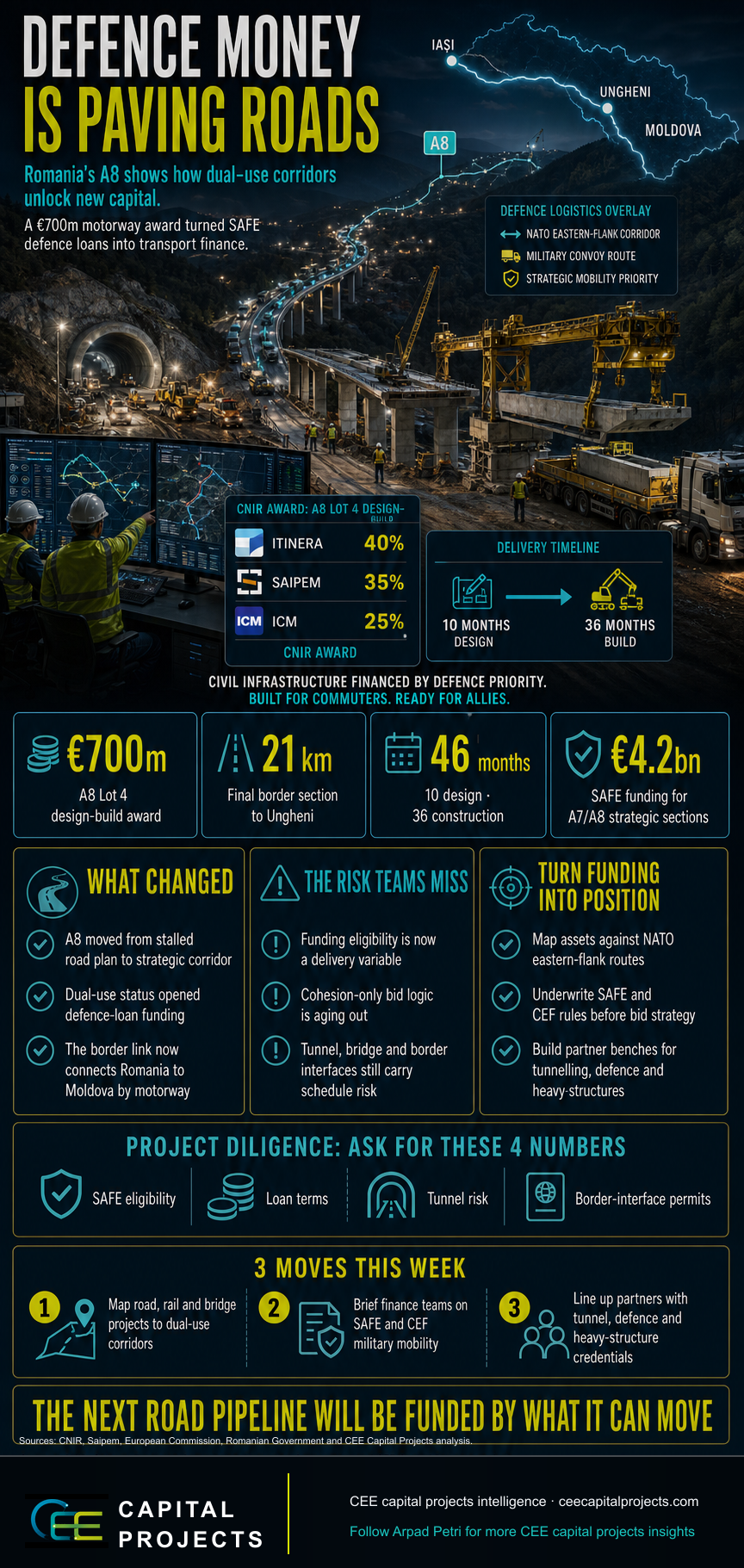
Explore our infograph library — strategic visuals for CEE capital projects leaders.
Project benchmarks, financing structures, tender dynamics and delivery risk — at a glance. Free access for investors, owners, contractors and strategy teams tracking CEE capital projects.
Browse the libraryStrategic Insights
📊 Analytics & Strategic Insight
When cooperation beats competition: the procurement lesson inside France's nuclear fleet
The decision most in this industry are avoiding:
👉 Open tenders are not always the cheapest route. For a repeatable fleet, competition per unit can raise total cost by scattering scarce skills and resetting the learning curve on every site.
👉 The real scarce resource is certified people, not balance-sheet capacity. Whoever controls the nuclear-grade welders and formwork crews controls the schedule; alliances form to pool that labour, not to pool money.
👉 Giving up price tension is a deliberate bet, not a giveaway. EDF is trading the discipline of an open bid for the discipline of a series, and accepting that policing five rivals on one site is now its core delivery risk.
Here's the full context:
→ 2023: EDF awards Penly's first two EPR2 civil works to Eiffage alone, worth more than €4bn, beating a Bouygues–Vinci pairing in a classic price contest (Eiffage).
→ Dec 2025: EDF puts the six-reactor EPR2 programme at €72.8bn, up 8%, and books €2.7bn for 2026 (EDF, 18 December 2025).
→ March 2026: The European Commission opens a formal state-aid probe into France's support package, which lifts the headline figure toward €84bn once financing is counted.
→ 3 June 2026: Les Échos reports EDF will hand roughly €10bn of Gravelines and Bugey civil works to an alliance of Vinci, Bouygues, Eiffage, NGE and Fayat, rather than a tender.
→ Most recent: First concrete at Penly slips from 2026 to 2028; the partners are to divide the work by end-2026, with a final investment decision targeted for the same date.
What this means for infrastructure operators, contractors and investors:
✅ Fleet programmes will increasingly be bought as alliances. Expect more "coopetition" structures where former rivals share one integrated delivery organisation for multi-unit builds.
✅ Skills certification is becoming the moat. Contractors with trained nuclear-civil crews and quality systems will be inside the tent; those without will be subcontractors or spectators.
✅ The state-aid decision is the swing factor. A programme this size lives or dies on Brussels' verdict, so investors should track the EC case as closely as the construction schedule.
3 moves you can make this week:
1️⃣ Map the certified-labour pool in your market. Know who holds the nuclear-grade welders, formwork crews and QA engineers before the next fleet tender, because that list decides the consortium.
2️⃣ Benchmark alliance versus open-tender delivery. Pull cost and schedule data from Flamanville, Hinkley and Olkiluoto against series builders, and use it to argue procurement method on your own multi-unit projects.
3️⃣ Position for CEE nuclear now. Dukovany, Paks II and Poland's AP1000 will each need a civil-works base; register on supplier lists and line up partners while the fleets are still on paper.
Related analyses
- Energy & Power
Constellation's $4.3bn Nuclear Uprate Deal With Google: 890 MW, No New Site, and a Finite Pool
Constellation will invest more than $4.3bn to lift 890 MW out of 11 existing reactors under a 20-year Google power purchase agreement, at roughly half the per-kilowatt cost of recent American new build. The point for Europe is that the national uprate pool runs to three to five gigawatts, ČEZ banked its Dukovany headroom by 2009, and the only route left to fresh capacity is a CZK 407bn new build.
Read analysis → - Energy & Power
NEK's EUR 350 Million Yadenitsa Dam Tender Turns Bulgaria's Chaira Storage Fix Into a Civils Job
Bulgaria's NEK has put EUR 350m on the market for the Yadenitsa dam and a six kilometre tunnel at the 864 MW Chaira pumped storage plant, with bids due 4 November 2026 and 60 months to build. The civil works are costed at more than three times the EUR 102m reconstruction of all four of the plant's machines.
Read analysis → - Energy & Power
EIB and BNP Paribas Guarantee EUR 700m of Grid Equipment Bonds: Europe's Network Bottleneck Moves to the Balance Sheet
The EIB and BNP Paribas signed a EUR 700m counter-guarantee portfolio on 29 September 2026, covering advance payment and performance bonds for European manufacturers of electricity grid components. The instrument is small, and it points at the constraint that now sets delivery dates on Europe's grid build: bonding capacity rather than factory floor.
Read analysis →
Facing a decision on a CEE capital project?
Describe the situation in a few sentences. Within 72 hours you get an experienced read: the risks we see, what we'd check, and whether we can help — no calls, no obligation.