We Help International Investors and Project Owners Deliver Major CEE Projects Without Expensive Surprises
Independent project intelligence and advisory across energy, transport, real estate and industrial construction.
NEK's EUR 350 Million Yadenitsa Dam Tender Turns Bulgaria's Chaira Storage Fix Into a Civils Job
Bulgaria's NEK has put EUR 350m on the market for the Yadenitsa dam and a six kilometre tunnel at the 864 MW Chaira pumped storage plant, with bids due 4 November 2026 and 60 months to build. The civil works are costed at more than three times the EUR 102m reconstruction of all four of the plant's machines.
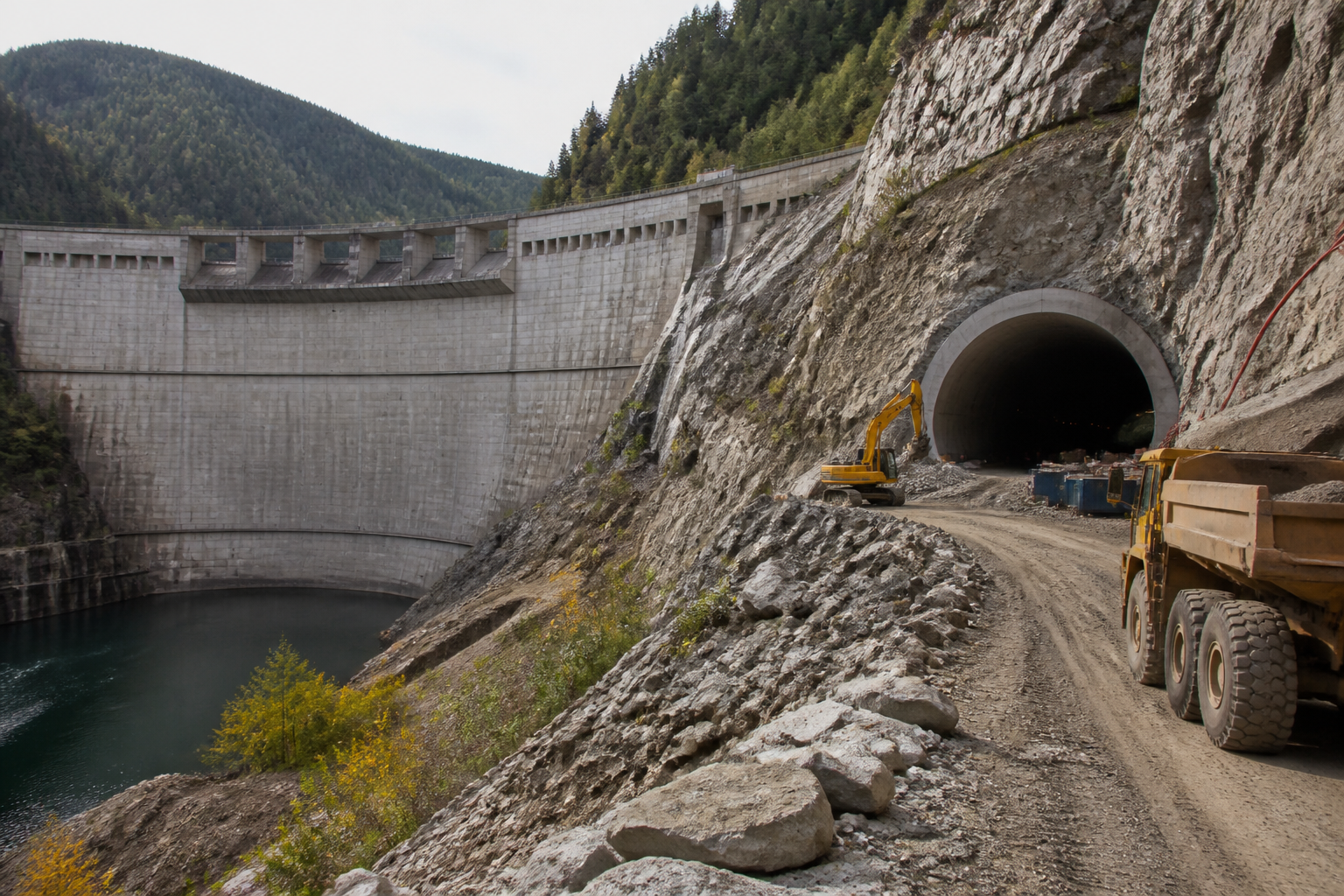
Most of the write-ups filed this one as a storage story. I filed it as a heavy civils story. Bulgaria's state electricity company has just put EUR 350m on the market for a dam and a tunnel. Reconstructing all four of the power plant's machines was costed at EUR 102m.
The tender was reported by Balkan Green Energy News on 5 October 2026. Natsionalna Elektricheska Kompania, the state-owned NEK, is seeking a contractor for the Yadenitsa dam and a connecting tunnel of more than six kilometres. The value is EUR 350m excluding VAT. Bids close on 4 November 2026 and the completion period is 60 months. The works raise the water volume available to the Chaira pumped storage plant from 4.2 million cubic metres to 13.4 million.
The capacity is already built and the hours behind it are not
Chaira is rated at 864 MW generating and 784 MW pumping, inside the Belmeken, Sestrimo and Chaira hydropower complex. Those are power ratings. A pumped storage plant carries a second rating that rarely makes the headline, which is how much energy it can actually deliver before the upper reservoir runs out. That number is set by water volume, head and efficiency.
At 4.2 million cubic metres of usable volume, Chaira is a powerful plant with a short run. Tripling the volume roughly triples the run time at full output, with head and efficiency held constant. So the EUR 350m buys almost no new megawatts. It buys hours. That distinction decides whether the asset arbitrages a midday solar trough or merely rides a morning ramp.
Why the dam costs more than the machines
Set the two numbers side by side. Full reconstruction of all four Chaira units was put at EUR 102m, with an emergency repair option for two aggregates at EUR 5.1m each, according to Balkan Green Energy News reporting first published in May 2023 and updated on 3 June 2026. The new reservoir and tunnel are tendered at EUR 350m. The civil works carry about three and a half times the cost of the entire rotating plant.
That ratio is normal in pumped storage and routinely underweighted in investment cases. Turbines, generators and control systems are an industrial product with a known supply chain. The reservoir is a geotechnical problem priced site by site. Yadenitsa has shown how that moves. The scheme was launched in 1994, suspended over financing and seismic concerns, redesigned in 2016 and 2017 and restarted in 2022. The estimate rose from EUR 250m to EUR 350m before a contractor was appointed.
A 60 month clock against a solar build already under way
The sequencing is the sharpest part of this story. Bids close on 4 November 2026. Award, mobilisation and a 60 month construction period put the useful water somewhere around 2032. Bulgaria's variable generation is not waiting. The country installed 1,416 MW of solar in 2025 to reach a cumulative 5,984 MW, its third consecutive year above 1 GW, with around 2.5 GW more under construction or at an advanced stage, according to pv magazine on 2 February 2026.
So the deep flexibility arrives roughly six years after the volume that creates the need for it. Battery storage will fill that gap because it can be built in eighteen to twenty four months, and Bulgaria already has a large battery pipeline moving through its grid connection process. The question for anyone underwriting those batteries is what their revenue stack looks like in the year a 864 MW plant with triple its present run time joins the same market.
What the contractor market should read into the scope
This is a dam plus more than six kilometres of tunnel in ground that stopped the scheme once on seismic grounds. The work is tunnelling, grouting, mass concrete and a seismic design case, with monitoring instrumentation on the dam for its whole life. Few regional contractors hold all of that in one organisation, which points to a joint venture between a tunnelling specialist and a dam builder.
The funding mix matters as much as the scope. The project is to be financed from the state budget and EU funds, and the European Union designated Yadenitsa a Project of Common Interest in 2026. That label brings procurement scrutiny, a documented audit trail and a reporting burden that sits on the contractor as well as the client. It does nothing at all to the geology.
What happens next
For NEK, the risk is that a 60 month civil works programme and four separate machine refurbishments run on different clocks and meet badly. Unit 2 returned to service in late 2024 after its 72 hour test. Toshiba is contracted on unit 1 and signed a memorandum with NEK on 27 April 2026. A Voith and ABB consortium is on unit 3 with the generator already dismantled, and unit 4 is slated for full replacement. A plant that is mechanically whole in 2028 and water constrained until 2032 earns less than either programme assumed.
Bid teams have four weeks and the pricing judgement is almost entirely geotechnical. For investors, the lesson travels beyond Bulgaria. Across Europe the procurement conversation is still conducted in megawatts while the scarcity has moved to megawatt hours, and the assets that supply hours are civil engineering projects with permitting, ground risk and decade long programmes. Anyone pricing flexibility revenue to 2035 should be reading dam tenders.
📊 Analytics & Strategic Insight
Europe keeps procuring power while the scarcity has moved to hours
The decision most in this industry are avoiding:
👉 Stop quoting storage assets in megawatts alone. Power tells you how hard an asset can push and energy tells you how long it lasts. Chaira has 864 MW and 4.2 million cubic metres of usable water. The second number is the one being bought for EUR 350m, and it is the one missing from most investment committee papers.
👉 The civil works are the schedule and the claims exposure. The rotating plant at Chaira was costed at EUR 102m and the reservoir at EUR 350m. Ground conditions, seismic design and tunnelling drive both the price and the programme, and they are the items that generate variations. Treat the machine order as the easy half.
👉 A Project of Common Interest label changes the paperwork and not the ground. EU designation in 2026 brings funding access, procurement scrutiny and an audit trail. It does not de-risk a six kilometre tunnel in seismically active rock that stopped this scheme once before. Price the geology independently of the funding status.
Here's the full context:
→ 1994: The Yadenitsa scheme is first launched, then suspended over financing and seismic concerns.
→ 2016 to 2017: The design is updated, and the project is revived again in 2022.
→ 2022: Chaira goes out of service in May following a turbine failure during testing in March. Full reconstruction of all four units is later costed at EUR 102m, with an emergency option for two aggregates at EUR 5.1m each.
→ 2024 to 2026: Unit 2 returns to service in late 2024 after a 72 hour test. Toshiba takes unit 1 and signs a memorandum with NEK on 27 April 2026, a Voith and ABB consortium takes unit 3 with the generator dismantled, and unit 4 is slated for full replacement.
→ Most recent: On 5 October 2026 NEK opens a EUR 350m tender for the Yadenitsa dam and a six kilometre connecting tunnel, bids due 4 November 2026, 60 months to complete, raising usable water from 4.2 to 13.4 million cubic metres.
What this means for infrastructure operators, contractors and investors:
✅ Bulgarian battery revenue cases need a 2032 line. A plant with 864 MW and roughly three times its present run time entering the same market changes capture spreads for every battery built before it. Model the year the water arrives rather than the year the tender closes.
✅ Dam and tunnel capability is the scarce qualification here. The scope needs tunnelling, mass concrete, grouting and seismic design in one team, with dam instrumentation for the asset's life. Contractors holding only one half of that should be forming a joint venture now rather than in late October.
✅ Flexibility scarcity is measured in hours across the whole continent. Capacity auctions, connection queues and network plans are still written in megawatts. The assets that actually supply duration are reservoirs, caverns and tunnels on ten year programmes, and that gap is where the mispricing sits.
3 moves you can make this week:
1️⃣ Pull the energy rating of every flexible asset you own or finance. List power in megawatts beside deliverable energy in megawatt hours at full output. Any asset where you cannot produce the second figure in an afternoon is an asset you are valuing on half the data.
2️⃣ Diarise 4 November and read the 60 month completion clause. If you are bidding, the geotechnical baseline and the seismic design case decide your price. If you are financing Bulgarian flexibility, that date tells you when the market's largest duration block starts its clock.
3️⃣ Re-run one revenue case with and without deep storage arriving in 2032. Take your most exposed Bulgarian or regional battery position and compare the two curves. If the difference is material, the hedging decision belongs in this quarter rather than in 2031.
Share it with your peers
Help your network stay ahead of CEE capital projects.




Explore our infograph library — strategic visuals for CEE capital projects leaders.
Project benchmarks, financing structures, tender dynamics and delivery risk — at a glance. Free access for investors, owners, contractors and strategy teams tracking CEE capital projects.
Browse the libraryRelated analyses
- Energy & Power
Constellation's $4.3bn Nuclear Uprate Deal With Google: 890 MW, No New Site, and a Finite Pool
Constellation will invest more than $4.3bn to lift 890 MW out of 11 existing reactors under a 20-year Google power purchase agreement, at roughly half the per-kilowatt cost of recent American new build. The point for Europe is that the national uprate pool runs to three to five gigawatts, ČEZ banked its Dukovany headroom by 2009, and the only route left to fresh capacity is a CZK 407bn new build.
Read analysis → - Energy & Power
EIB and BNP Paribas Guarantee EUR 700m of Grid Equipment Bonds: Europe's Network Bottleneck Moves to the Balance Sheet
The EIB and BNP Paribas signed a EUR 700m counter-guarantee portfolio on 29 September 2026, covering advance payment and performance bonds for European manufacturers of electricity grid components. The instrument is small, and it points at the constraint that now sets delivery dates on Europe's grid build: bonding capacity rather than factory floor.
Read analysis → - Energy & Power
MVM Starts Piling at the 1,000 MW Tisza CCGT in Tiszaújváros: the Turbine Date Now Sets Hungary's Civils Window
Piling has begun at MVM's 1,000 MW Tisza combined cycle plant in Tiszaújváros, seventeen months after the turnkey contract with Çalık Enerji Swiss and Ansaldo Energia was signed. The more useful reading is the sequence: EUR 1.2 billion of SACE-covered debt and the equipment order were both fixed long before the ground was touched.
Read analysis →
Is your project leaking money through its subcontractors?
Most owners lose 3–8% in vendor packages without noticing. Tell us about your project — we'll tell you where we'd look first.