We Help International Investors and Project Owners Deliver Major CEE Projects Without Expensive Surprises
Independent project intelligence and advisory across energy, transport, real estate and industrial construction.
VERBUND Is Missing a Third of Its Water and a Quarter of Its EBITDA. Europe's Cheapest Flexibility Just Became a Weather Bet
Austria's largest generator reported a 24.9% EBITDA fall for the first half of 2026 on a run-of-river hydro coefficient of 0.68, thirty-two points below its long-term average. Alpine hydrology has stopped behaving like the base case that underwrites Europe's balancing capacity.
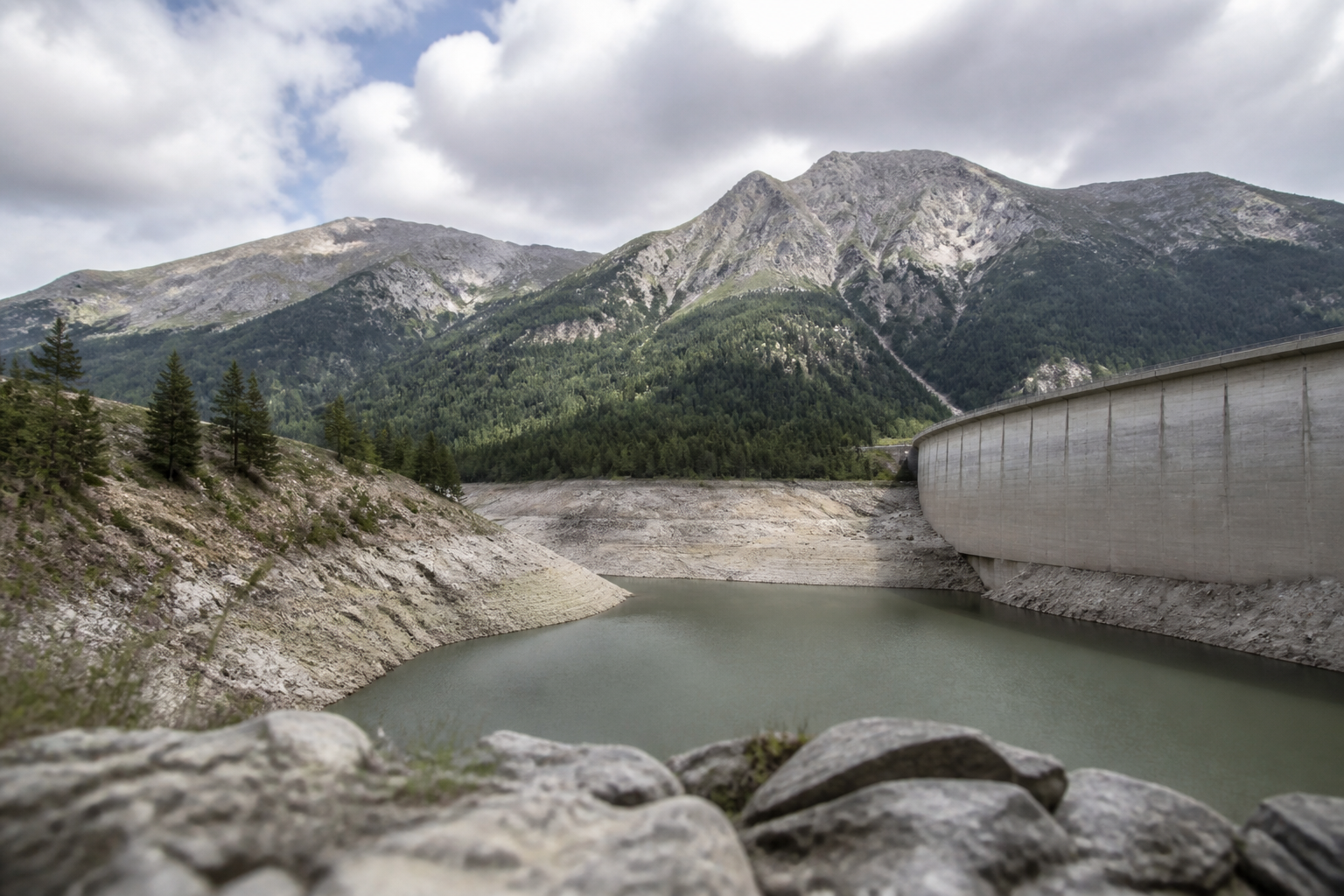
Austria's largest electricity producer has just told the market that its problem is not demand, not permitting and not the supply chain. It is rain. "We are simply missing one-third of the water volume that our hydropower plants would normally process," VERBUND chief executive Michael Strugl said in comments published by Euronews on 4 August 2026. The half-year results the company released five days earlier put a number on that missing third: EBITDA down 24.9% year on year to €1,061.5m, group result down 35.4% to €518.1m.
For an asset class European investors have treated for four decades as the most predictable thing in power — long life, low operating cost, dispatchable, no fuel bill — that deserves careful reading. Hydropower is not underperforming because of an operational failure, but because the hydrological base case it was financed against no longer describes the weather.
A 0.68 year against a 1.00 model
VERBUND reports its water supply as a coefficient, where 1.00 is the long-term average. In the first half of 2026 the coefficient for its run-of-river plants was 0.68: eight points below the same period in 2025 (0.76) and thirty-two points below the long-run mean. Output from the annual storage plants fell 5.9%. Total hydro generation dropped 1,210 GWh, or 9.8%, to 11,191 GWh.
Volume was only half the damage. The average price achieved on VERBUND's own hydro generation fell €31.0/MWh to €86.2/MWh, partly because the 2025 comparator was flattered by forward sales struck at the high wholesale prices of 2023. Less power, sold for less. Free cash flow before dividends fell 71.6% to €218.9m. Gearing moved from 23.2% to 36.2%. Full-year guidance is now EBITDA of €2,100m to €2,400m, and that range assumes normal water, wind and sun for the rest of the year.
This is a regional condition, not an Austrian one
Energy intelligence firm Montel reported that July inflows to reservoirs and run-of-river plants across Austria and Switzerland ran nearly 50% below average. Austrian hydro production came in at 51% of normal against a fifteen-year benchmark; Switzerland at 48%; Germany 63%; France 68%. Swiss reservoirs were 46% full on 17 July, 16.4 percentage points below the twenty-year average for the date, after what federal data records as one of the driest springs since Swiss measurements began in 1864.
Water scarcity is also reaching technologies that are not counted as hydro. On 31 July Hungary began powering down the Paks nuclear station, which supplies close to half the country's electricity, because the Danube fell too low to guarantee cooling flow. Same drought, different asset, same lesson: river water is an input to a great deal of European generation capacity that nobody classifies as water-dependent.
What runs when the water does not
Hydropower supplied 28% of EU electricity in the first quarter of 2026, ahead of solar at 17.3%. When a quarter of the generation mix under-delivers, something dispatchable covers it. Energy think-tank Ember attributes an 8% rise in EU gas-fired generation in 2025 largely to a 12% fall in annual hydro output. That substitution is arriving into a thinner gas buffer than usual: German storage sites were 44.7% full in mid-July against a ten-year average of 69.8% for that point in the season, according to Gas Infrastructure Europe.
The commercial consequence for a hydro-weighted balance sheet is visible in VERBUND's own segment split. Grid, sales and thermal generation all improved and partly offset the Hydro segment. The contribution from flexibility products still fell 16.7% to €136.4m. When the reservoir is low, the flexibility you sell is smaller even if the price of flexibility is rising.
Where the capital moves next
Two answers are already visible in VERBUND's asset base. The first is pumped storage. Limberg III at Kaprun, 480 MW built entirely underground using the existing Mooserboden and Wasserfallboden reservoirs, lifted the Kaprun group's turbine capacity 53% to 1,382 MW and its pump capacity 75% to 1,120 MW. A pumped plant does not depend on inflow. It depends on the spread between cheap hours and expensive hours, and that spread widens as solar deepens the midday trough.
The second is hybridisation. Ember's energy infrastructures lead Elisabeth Cremona notes that adding wind or solar at an existing hydropower connection point roughly doubles utilisation of that grid infrastructure while staying inside export limits. Across the EU's major hydro markets — Austria, Bulgaria, France, Italy, Portugal, Romania and Spain — Ember calculates hybridisation could absorb 18% of the new renewables expected by 2030 with no additional grid capacity. In a continent where interconnection queues are the binding constraint on new build, an existing hydro connection is an underused permit.
The number that needs replacing
The practical takeaway for sponsors, lenders and technical advisors is narrow and awkward. Almost every hydro business case, debt-service coverage test and concession valuation in Europe runs off a long-term average inflow series drawn from a thirty-year window. Austria has now delivered a 0.68 half-year, Switzerland its emptiest reservoirs in two decades, and Hungary a nuclear shutdown caused by river level. Whether or not the long-run mean is wrong, the variance around it has clearly widened, and variance is what debt structures absorb least well. Expect hydrology stress cases to migrate from the sensitivity annex into the base case, merchant hydro to be underwritten more like a weather-linked asset than a bond proxy, and capital that once chased new run-of-river to keep moving toward storage, hybridisation and the grid connections that make both work.
Share it with your peers
Help your network stay ahead of CEE capital projects.
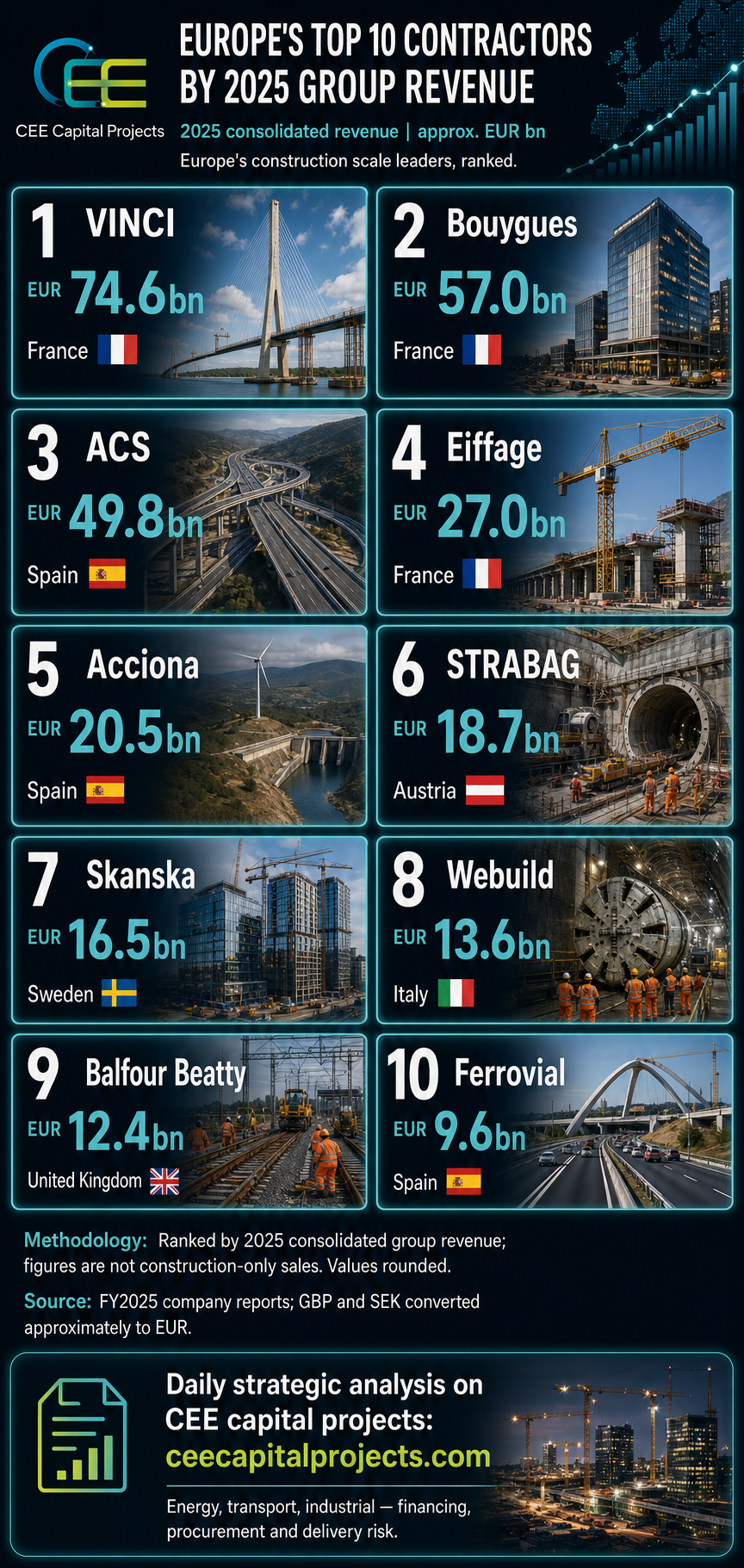
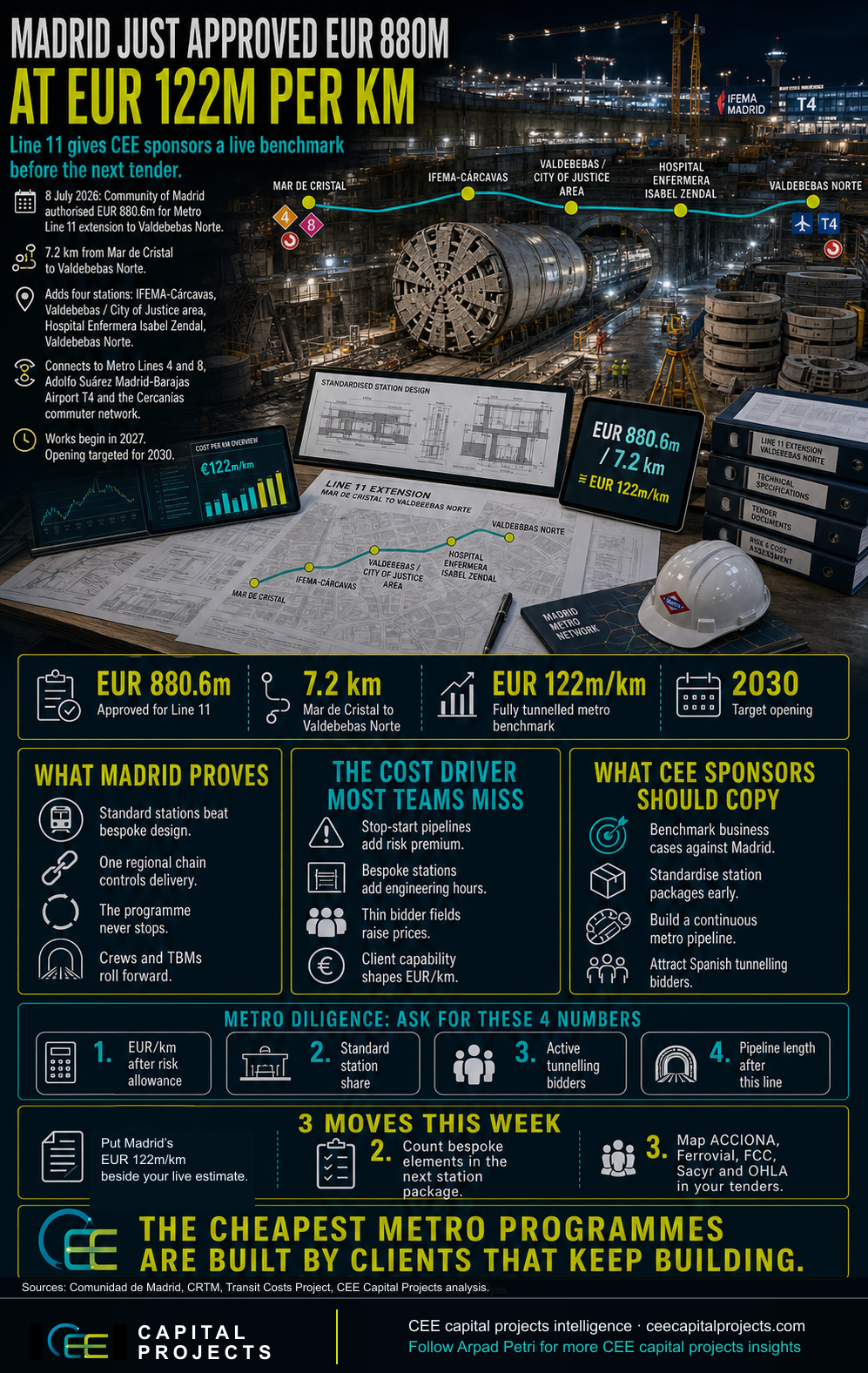
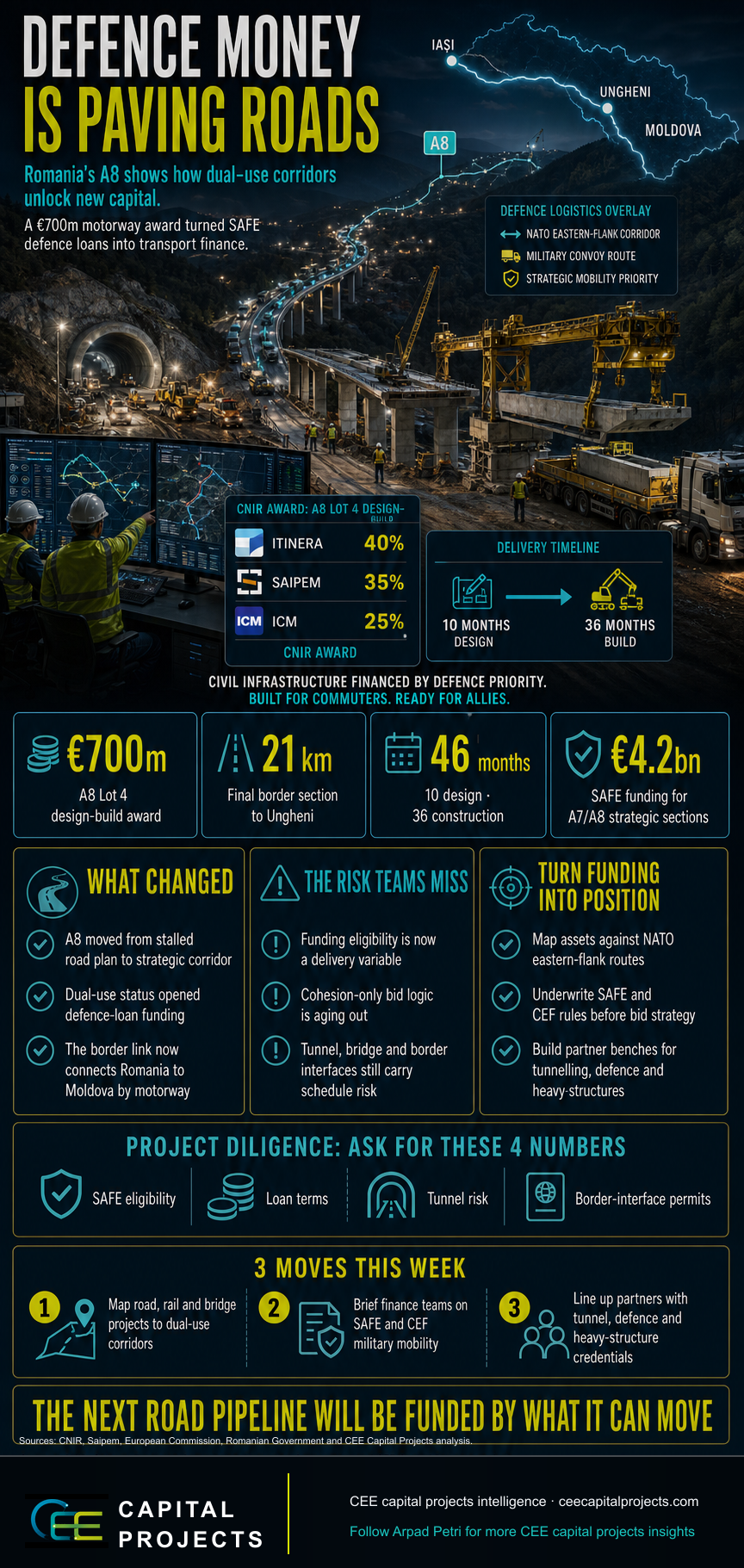
Explore our infograph library — strategic visuals for CEE capital projects leaders.
Project benchmarks, financing structures, tender dynamics and delivery risk — at a glance. Free access for investors, owners, contractors and strategy teams tracking CEE capital projects.
Browse the libraryStrategic Insights
📊 Analytics & Strategic Insight
Water has become a line item, and hardly anyone prices it
The decision most in this industry are avoiding:
👉 Stop calling hydro a safe asset. It pays when it rains. This year it did not rain enough. One company lost a quarter of its profit because of the weather. That is a market risk, not a bad quarter.
👉 The "long-term average" is the wrong number. Most plans use the water flows of the last thirty years. Water is now arriving below that. If your base case uses the old average, your base case is too high.
👉 A dry year hits you twice. You sell less power. You also sell it for less, because dry weather brings sun, and sun pushes prices down in the middle of the day. Most models only count the first hit.
Here's the full context:
→ 1864: Swiss weather records begin. Spring 2026 is one of the driest since then.
→ 2025: EU hydro output fell 12%. Gas-fired power rose 8% to fill the gap, according to think-tank Ember.
→ Early 2026: Hydro still made 28% of EU electricity in the first quarter. Solar made 17.3%.
→ 17 July 2026: Swiss reservoirs were 46% full, 16.4 points below the twenty-year average for the date.
→ Most recent: On 30 July VERBUND said EBITDA (profit before interest, tax and write-downs) fell 24.9% to €1,061.5m. On 31 July Hungary began shutting the Paks nuclear plant because the Danube ran too low to cool it.
What this means for infrastructure operators, contractors and investors:
✅ Banks will ask new questions. Loan cover tests on hydro assume a normal water year. Two poor years in a row make that assumption hard to defend. Expect tighter terms and bigger cash buffers on the next refinancing.
✅ Pumped storage beats new run-of-river. A pumped plant does not need rain. It needs a price gap between cheap hours and dear hours, and solar is widening that gap every year.
✅ Gas plants get a second life. When water fails, gas runs. That supports the value of existing plants and of the pipes and storage behind them, even in markets that had written them off.
3 moves you can make this week:
1️⃣ Rebuild your water case on the last ten years, not thirty. Run the same model twice and look at the gap. That gap is the money you have not budgeted for.
2️⃣ List everything you own that needs river water. Cooling water for thermal and nuclear plants counts. So does barge delivery of heavy plant and fuel. Hungary just proved the point the hard way.
3️⃣ Check the spare room on your grid connection. Ember found that adding solar or wind at an existing hydro connection roughly doubles how hard that connection works. Across seven EU countries it could take 18% of the new renewables due by 2030 with no new grid at all.
Related analyses
- Energy & Power
Constellation's $4.3bn Nuclear Uprate Deal With Google: 890 MW, No New Site, and a Finite Pool
Constellation will invest more than $4.3bn to lift 890 MW out of 11 existing reactors under a 20-year Google power purchase agreement, at roughly half the per-kilowatt cost of recent American new build. The point for Europe is that the national uprate pool runs to three to five gigawatts, ČEZ banked its Dukovany headroom by 2009, and the only route left to fresh capacity is a CZK 407bn new build.
Read analysis → - Energy & Power
NEK's EUR 350 Million Yadenitsa Dam Tender Turns Bulgaria's Chaira Storage Fix Into a Civils Job
Bulgaria's NEK has put EUR 350m on the market for the Yadenitsa dam and a six kilometre tunnel at the 864 MW Chaira pumped storage plant, with bids due 4 November 2026 and 60 months to build. The civil works are costed at more than three times the EUR 102m reconstruction of all four of the plant's machines.
Read analysis → - Energy & Power
EIB and BNP Paribas Guarantee EUR 700m of Grid Equipment Bonds: Europe's Network Bottleneck Moves to the Balance Sheet
The EIB and BNP Paribas signed a EUR 700m counter-guarantee portfolio on 29 September 2026, covering advance payment and performance bonds for European manufacturers of electricity grid components. The instrument is small, and it points at the constraint that now sets delivery dates on Europe's grid build: bonding capacity rather than factory floor.
Read analysis →
Facing a decision on a CEE capital project?
Describe the situation in a few sentences. Within 72 hours you get an experienced read: the risks we see, what we'd check, and whether we can help — no calls, no obligation.